Managed File Transfer Market Size, Share & Industry Analysis, By Solution (Application-centric, People-centric, and Ad-hoc), By Deployment (On-premises and Cloud), By Enterprise Type (Large Enterprises and SMEs), By Industry (BFSI, Healthcare, Manufacturing, IT & Telecom, Retail, and Others), and Regional Forecast, 2026–2034
 Download Free Sample
Managed File Transfer Market Size
 Listen to Audio Version
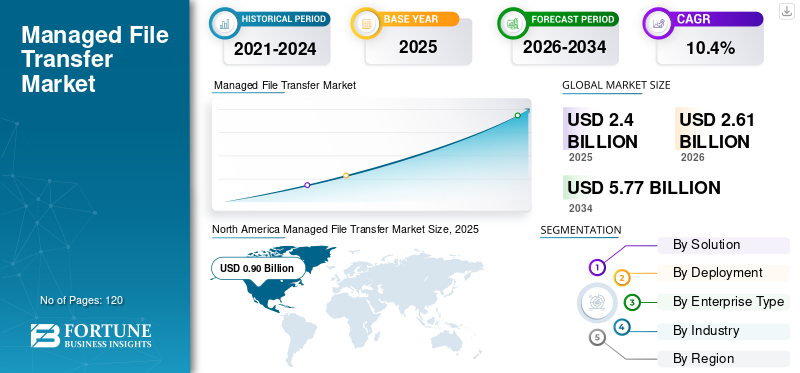
The global managed file transfer market size was valued at USD 2.40 billion in 2025. The market is projected to grow from USD 2.61 billion in 2026 to USD 5.77 billion by 2034, exhibiting a CAGR of 10.4% during the forecast period. North America dominated the managed file transfer market with a market share of 37.05% in 2025.
Managed file transfer (MFT) enables secure, compliant, and centrally governed movement of data between systems, applications, and external partners, replacing ad-hoc FTP/SFTP scripts and consumer file-sharing tools with enterprise-grade automation and visibility. The market is expanding steadily as organizations modernize integration workflows, strengthen cybersecurity postures, and adopt cloud-based MFT platforms to support hybrid infrastructures and rising regulatory demands. The growing need to protect sensitive data in transit and meet regulations (GDPR, HIPAA, PCI-DSS, local data-privacy laws) pushes firms away from unsecured FTP, email, and consumer file-sharing tools toward auditable MFT platforms.
The market is dominated by established key players, such as IBM Corporation, Progress Software, Fortra, Axway Inc., and Open Text Corporation. These players are continuously focusing on acquiring niche vendors, such as security specialists, MFT automation tools, to broaden functionality, customer base, and geography, while cross-selling into existing accounts.
Download Free sample to learn more about this report.
Managed File Transfer Market KEY TAKEAWAYS
 Market Size & Forecast
- 2025 Market Size: USD 2.40 Billion
- 2026 Market Size: USD 2.61 Billion
- 2034 Forecast Market Size: USD 5.77 Billion
- CAGR: 10.4% from 2026–2034
 Market Share
- North America dominated the managed file transfer market with a 37.05% share in 2025.
- The application-centric segment captured the largest market share in 2025.
- The cloud segment captured the largest market share in 2025.
 Key Regional Highlights
North America
North America generated USD 0.90 billion in 2025, driven by cloud adoption and mature IT infrastructure.
Europe
Europe is projected to reach USD 0.72 billion in 2026 and grow at a CAGR of 9.6% during the forecast period.
Asia Pacific
Asia Pacific is projected to reach USD 0.61 billion in 2026 and register the highest CAGR of 13.2% during the forecast period.
U.S.
The managed file transfer market is projected to reach USD 0.77 billion in 2026.
Japan
Rapid digitalization, cloud adoption, and demand for secure file transfer solutions are driving market growth in Japan.
Read More

IMPACT OF GENERATIVE AI
Growing Adoption of Generative AI in MFT Operations Boosts Market Growth
Generative AI is starting to augment managed file transfer rather than replace it, mainly by making file-transfer environments smarter and easier to operate. Vendors can use GenAI to analyze transfer logs and security events, spotting anomalous patterns, such as unusual file sizes, destinations, or times and explaining them in plain language to security and ops teams. Over time, GenAI will likely help auto-generate integration mappings, policies, and remediation playbooks, speeding up onboarding of new partners and workflows while still relying on MFT for the underlying secure, compliant transport. However, it also raises new governance and privacy concerns, so successful players will be those who combine GenAI-driven intelligence with strong controls around data access, auditability, and model usage. For instance,
- In October 2025, Progress Software launched Automate MFT, a next‑generation MFT solution designed with built‑in automation and AI‑powered workflows to modernize high-speed file transfer operations.
MARKET DYNAMICS
Market Drivers
Increase in Cyber Threats & Zero-Trust Initiatives Drives MFT Demand among Enterprises
The rise in cyber threats, such as ransomware, data breaches, and credential theft, has made encrypted file transfers a top priority for organizations. As businesses move toward zero-trust security models, where trust is never assumed, every file exchange must be continuously authenticated, monitored, and encrypted. Managed file transfer (MFT) platforms are increasingly crucial in this shift, as they offer centralized control, strong encryption, and real-time monitoring to mitigate these risks. Additionally, MFT systems now incorporate multi-factor authentication (MFA), anomaly detection, and automated response features to enhance file security. With growing regulatory demands around data protection, companies must adopt robust enterprise file transfer solutions to ensure compliance and reduce the risk of costly breaches. For instance,
- In June 2025, the Reserve Bank of India urged financial institutions to adopt a zero‑trust cybersecurity framework and AI‑aware defense strategies amid rising cyber‑fraud risks and vendor‑lock‑in dangers.
Market Restraints
Data Sovereignty and Cloud‑Residency Concerns May Hinder Market Growth
The requirement around data sovereignty and cloud‑residency acts as a significant restraint for the managed file transfer market growth, as many enterprises, especially in regulated sectors or across jurisdictions, must retain full control over where their files are stored and transferred, including country‑specific rules for data localization and audit trails. When MFT vendors promote global‑cloud or cross‑region solutions, which can conflict with strict regulatory demands, such as healthcare, government, and financial services, that require data to remain on‑premises or in a specific geography, due to these concerns, some organizations delay moving existing file‑transfer workloads to cloud‑native MFT or stay with legacy on‑premises solutions, thereby slowing broader adoption of newer MFT models. In sum, until cloud MFT platforms fully address data‑residency, performance, and sovereign‑audit concerns, uptake in certain sectors and regions remains constrained.
Market Opportunities
Growing Demand for Automation, Orchestration & Integration into Broader Workflows Creating Opportunities for Market Growth
The push toward automation, orchestration & integration into broader workflows represents a significant growth lever for MFT platforms. As enterprises increasingly view file transfer not as a standalone task but as part of end‑to‑end business processes, MFT vendors have the chance to embed themselves deeper into workflow pipelines. For example, initiating transfers when a billing run completes, triggering alerts when a partner exchange fails, or routing files into downstream analytic tools automatically. This evolution means MFT is no longer just “moving the file” but enabling smart data movement that is monitored, policy‑enforced, and embedded in business logic. Vendors who build pre‑built connectors, workflow templates, APIs, and visual orchestration interfaces to let non‑IT teams configure flows stand to capture more value and stickiness.
Managed File Transfer Market Trends
Rising Digital Transformation & Cloud Migration are Accelerating Market Growth
As organizations increasingly move away from legacy on‑premises file transfer scripts and servers, they are embracing cloud and hybrid infrastructures, driving demand for MFT platforms that can securely span on‑premises, private cloud, and public cloud endpoints. In this shift, MFT solutions become the “connective tissue” between disparate systems, enabling consistent, secure transfers across mobile apps, edge devices, SaaS apps, and legacy mainframes. As cloud migration often means increased volume, diversity, and dynamism of data flows, MFT vendors are adapting by offering scale‑on‑demand, API‑based integrations, and automation of workflows, reducing manual intervention and supporting agile business models. These factors elevate MFT’s role in enterprise architecture. For instance,
- March 2025, according to industry experts, 81% of organizations see cloud computing as central to their digital transformation programs in 2025, underscoring the shift toward cloud‑native file‑transfer and integration infrastructure.
Download Free sample to learn more about this report.
SEGMENTATION ANALYSIS
By Solution
Reliability and Automation Drive Application-Centric MFT to Market Leadership
Based on solution, the market is divided into application-centric, people-centric, and ad-hoc.
The application-centric segment captured the largest market share in 2025, estimated at USD 1.33 billion. As large enterprises rely on scheduled, high‑volume, backend file transfers (e.g., billing runs, batch data loads, clearing/settlement systems) where reliability, automation, and governance are paramount, MFT solutions are a natural fit. At the same time, many of these core processes are harder to replace with ad‑hoc tools, so budgets flow first into automating application‑centric file flows rather than ad‑hoc or user‑driven exchanges.
The people-centric segment is anticipated to grow at the highest CAGR of 11.6% during the forecast period, owing to rising remote work, business user self‑service needs, and large file transfer management between humans and external partners are driving demand for secure, intuitive, portal‑based MFT solutions beyond backend system transfers.
By Deployment
Growing Need for Remote Work and Scalability Fueled Cloud Segment Expansion
Based on deployment, the market is bifurcated into on-premises and cloud.
The cloud segment captured the largest market share in 2025, estimated at 0.79 billion. This is owing to organizations increasingly migrating to scalable, subscription‑based MFT platforms that reduce capital expenditure and simplify management of large data flows across distributed and hybrid environments. At the same time, remote work, rapid onboarding of external partners, and demand for agile file‑workflow automation strengthened the case for cloud MFT, accelerating its adoption over traditional on‑premises systems.
The cloud deployment is expected to grow at the highest CAGR of 11.7% during the forecast period. This is owing to more organizations, especially mid‑market and global enterprises are accelerating cloud migration and favoring scalable, subscription‑based MFT services that reduce upfront infrastructure costs and support hybrid/remote work models.
By Enterprise Type
Rising Regulatory and Workflow Demand Fueled MFT Adoption in Large Enterprises
Based on enterprise type, the market is classified into large enterprises and SMEs.
Large enterprises captured the largest market share in 2025, estimated at USD 1.69 billion. They manage complex, high‑volume file exchange ecosystems spanning global partners, heavy batch workflows, and strict regulatory requirements, where robust MFT platforms deliver mission‑critical reliability, governance, and auditability. Also, they have larger IT budgets and are under greater pressure to replace legacy scripting and fragmented file‑sharing tools with enterprise‑grade MFT, driving early adoption and scale.
SMEs are expected to grow at the highest CAGR of 13.1% during the forecast period. This is owing to cloud‑based MFT solutions allowing smaller organizations to replace unmanaged file‑transfer workflows with secure, subscription‑based platforms, lowering cost and complexity barriers to entry.
By Industry
To know how our report can help streamline your business, Speak to Analyst
Growing Demand for Secure File Transfers Boosted MFT Adoption in Banking Sector
Based on industry, the market is categorized into BFSI, healthcare, manufacturing, IT & telecom, retail, and others (government, energy & utility, etc.).
BFSI accounted for the largest market share, valued at USD 1,496.15 billion in 2025, owing to financial services organizations handling very large volumes of sensitive and secure file exchanges, such as payments, statements, inter‑bank transfers, and regulatory reports, that demand high reliability, encryption, and auditability. Furthermore, strict data transfer compliance requirements and partner networks driving B2B data flows, which fuel enterprise‑grade MFT solutions in BFSI.
Retail is projected to grow at the highest CAGR of 13.8% during the forecast period. The surge in omnichannel commerce, complex supply‑chain integrations, large volumes of partner/EDI file flows, and the need for real‑time automated data movement drive the adoption of secure, automated MFT solutions.
MANAGED FILE TRANSFER MARKET REGIONAL OUTLOOK
By geography, the market is categorized into North America, Europe, Asia Pacific, South America, and the Middle East & Africa.
North America
North America Managed File Transfer Market Size, 2025 (USD Billion) To get more information on the regional analysis of this market, Download Free sample
North America held the largest managed file transfer market share in 2024, valued at USD 0.84 billion, and also maintained the leading share in 2025, with USD 0.90 billion. The region has a high concentration of large enterprises with complex global file‑transfer demands, stringent regulatory requirements, and mature IT infrastructure that supports advanced secure file‑transfer platforms. Additionally, strong cloud adoption, well‑developed partner ecosystems, and early recognition of managed file transfer software as a strategic IT priority further boosted market penetration. For instance,
- In January 2025, according to an industry expert’s study, a 16% year‑on‑year increase in data breaches across U.S. enterprises in 2024, prompting elevated investment in secure file transfer platforms and boosting MFT uptake.
In 2026, the U.S. market is estimated to reach USD 0.77 billion. The market growth is being driven by stringent regulatory requirements in industries such as healthcare, finance, and government, which demand secure, auditable file‐transfer solutions to handle sensitive data and maintain compliance. Additionally, the acceleration of cloud migration, B2B partner networks, and high‑volume enterprise workflows is prompting organizations to adopt scalable, automated MFT platforms to replace legacy FTP/SFTP scripts and fragmented file‐sharing tools.
To know how our report can help streamline your business, Speak to Analyst
Europe
Europe is anticipated to witness a moderate growth in the coming years. During the forecast period, the European region is anticipated to record a growth rate of 9.6%, which is the fourth highest amongst all the regions, and reach the valuation of USD 0.72 billion in 2026. This is primarily due to increasing cloud adoption across industries, combined with regional initiatives for digital commerce and supply‑chain integration, which is driving enterprises to modernize legacy file‑transfer systems with next‑generation MFT platforms. Backed by these factors, countries including the U.K. are expected to record the valuation of USD 0.14 billion, Germany to record USD 0.13 billion, and France to record USD 0.11 billion in 2026.
Asia Pacific
The market in Asia Pacific is estimated to reach USD 0.61 billion in 2026, and it is expected to grow at the highest CAGR of 13.2% during the forecast period. In the region, rapid digitalization across enterprises, strong uptake of cloud platforms, and growing B2B data‑exchange activity between emerging economies are fueling demand for secure, scalable file‑transfer solutions. At the same time, rising cybersecurity awareness and government policies on data governance are prompting organizations to upgrade from basic file‑sharing tools to enterprise‑grade MFT platforms. In the region, India and China are both estimated to reach USD 0.08 billion and USD 0.13 billion, respectively, in 2026.
South America
South America is expected to witness significant growth in this market. The South American market in 2026 is set to record USD 0.14 billion. The market is growing in the region, as enterprises increasingly adopt cloud‑based and secure file‑exchange solutions to support digital trade, cross‑border supply chains, and regulatory compliance in countries undergoing rapid IT modernization.
Middle East & Africa
The Middle East & Africa is estimated to reach USD 0.16 billion in 2026 and is expected to grow at a prominent growth rate in the coming years, owing to the rising government digitalization initiatives and regulatory pushes for data protection, resulting in increased demand for secure, auditable transfer solutions in sectors such as public services, energy, and banking. Additionally, rising cloud infrastructure investments and international trade flows within the region are driving enterprises to upgrade legacy file‑exchange methods to modern MFT platforms capable of handling multi‑partner workflows and cross‑border data transfers. In the region, GCC is set to attain the value of USD 0.05 billion in 2026.
Competitive Landscape
KEY INDUSTRY PLAYERS
Key Market Players Are Focusing on Cloud-Based Solutions and Security Enhancements to Expand Their Customer Base
Leading companies in the managed file transfer (MFT) market are expanding their offerings by providing cloud-based solutions, industry-specific tools, and enhanced security measures to meet growing demands for secure, scalable, and compliant data transfers. These companies are focusing on automating file exchanges, ensuring seamless, high-volume file flows, and integrating AI-powered threat detection to enhance the security of data in transit. Furthermore, they are enhancing file transfer workflows with features such as automated scheduling, file encryption, and comprehensive audit trails to comply with evolving regulatory requirements.
In addition, many MFT providers are forming strategic partnerships and making acquisitions to strengthen their market presence across various industries, including finance, healthcare, and government, where the need for secure and reliable file transfer solutions is critical.
Long List of Managed File Transfer Companies Studied
- IBM Corporation (U.S.)
- Progress Software (U.S.)
- Fortra (U.S.)
- Axway Inc. (U.S.)
- Open Text Corporation (Canada)
- Wipro Limited (Canada)
- CA Technologies, Inc. (U.S.)
- Cleo (U.S.)
- SEEBURGER AG (Germany)
- CData Software (U.S.)
- Stonebranch (U.S.)
- SolarWinds (U.S.)
- com (U.S.)
- Thru, Inc. (U.S.)
- Couchdrop (New Zealand)
- Kiteworks (U.S.)
- Tidal Software (U.S.)
- Amazon Web Services (U.S.)
- Microsoft (U.S.)
- JSCAPE (U.S.)
….and more
KEY INDUSTRY DEVELOPMENTS
- October 2025: A critical zero‑day vulnerability in GoAnywhere MFT (CVE‑2025‑10035) was actively being exploited, highlighting the urgent need for secure file‑transfer platforms aligned with zero‑trust principles.
- August 2025: Axway introduced “Workbench” for MFT operations, offering enhanced visibility, automation, and centralized control for its SecureTransport and Transfer CFT portfolios.
- July 2025: Cleo strengthened its partnership with Effective Data to advance integration, including B2B/EDI and MFT, enhancing end‑to‑end secure data exchange capabilities.
- May 2025: Progress Software announced the release of MOVEit MFT 2025.0, which includes usability enhancements and fortified security features.
- February 2025: Wipro launched its cloud‑based Managed File Transfer as‑a‑Service (MFTaaS) offering, emphasizing reduced CAPEX, improved auditability, and secure file‑flows for enterprise clients.
REPORT COVERAGE
The global managed file transfer market report provides a detailed analysis of the market and focuses on key aspects such as leading companies, product types, and leading applications of the product. Besides, the report offers insights into the market trends and highlights key industry developments. In addition to the factors above, the report encompasses several factors that contributed to the market growth in recent years.
Request for Customization to gain extensive market insights.
REPORT SCOPE & SEGMENTATION
| ATTRIBUTE | DETAILS |
| Study Period | 2021-2034 |
| Base Year | 2025 |
| Estimated Year | 2026 |
| Forecast Period | 2026-2034 |
| Historical Period | 2021-2024 |
| Growth Rate | CAGR of 10.4% from 2026 to 2034 |
| Unit | Value (USD Billion) |
| Segmentation | By Solution
|
| Companies Profiled in the Report |
|
Frequently Asked Questions
The market is expected to reach USD 5.77 billion by 2034.
In 2025, the market was valued at USD 2.40 billion.
The market is expected to grow at a CAGR of 10.4% during the forecast period.
By industry, the BFSI sector led the market.
Increase in cyber threats & zero-trust initiatives drives MFT demand among enterprises.
IBM Corporation, Progress Software, Fortra, Axway Inc., Open Text Corporation, Wipro Limited, CA Technologies, Inc., Cleo, SEEBURGER AG, and CData Software are the top players in the market.
North America held the highest market share.
By industry, the retail sector is expected to grow with the highest CAGR during the forecast period.



- 2021-2034
- 2025
- 2021-2024
- 120
Get 30-60 hrs Free Customization
Expand Regional and Country Coverage, Segments Analysis, Company Profiles, Competitive Benchmarking, and End-user Insights.




















Related Reports
-
US +1 833 909 2966 ( Toll Free )
-
Get In Touch With Us