Renewable Natural Gas Market Size, Share & Industry Analysis, By Feedstock Source (Agricultural Waste, Municipal Solid Waste (MSW), Wastewater Treatment Sludge, Food Waste, and Others), By Product Form (Compressed Renewable Natural Gas (C-RNG), Liquefied Renewable Natural Gas (L-RNG), and Pipeline-Quality Renewable Natural Gas), By End-Use Industry (Transportation Fuel, Power Generation, Residential Use, Commercial Use, Industrial Use, and Chemical Feedstock and Others), and Regional Forecast, 2026-2034
 Download Free Sample
Renewable Natural Gas Market Size and Future Outlook
 Listen to Audio Version
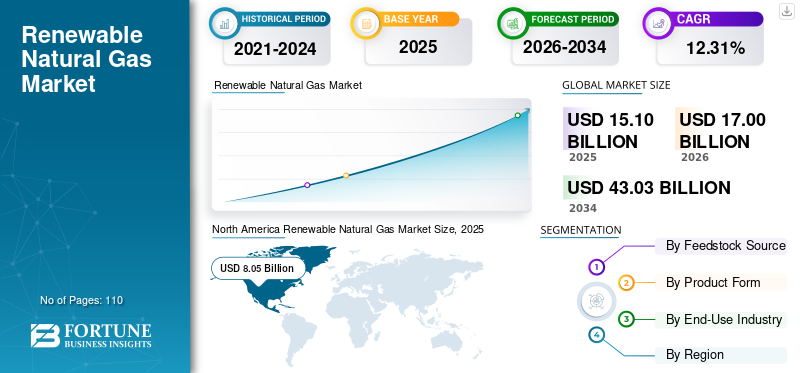
The global renewable natural gas market size was valued at USD 15.10 billion in 2025. The market is projected to grow from USD 17.00 billion in 2026 to USD 43.03 billion by 2034, exhibiting a CAGR of 12.31% over the forecast period. North America dominated the renewable natural gas market with a market share of 53.31% in 2025.
The shift toward sustainable energy systems, the reduction of methane emissions, and the decarbonization movement are all contributing to the growth of the market. Due to its ability to be generated from organic waste sources such as food waste, wastewater sludge, landfill waste, and agricultural residues, governments and industries are increasingly embracing RNG as a low-carbon alternative to traditional natural gas. By turning waste into usable energy, RNG contributes to circular economy programs while also lowering greenhouse gas emissions.
The market is expanding significantly due to stringent environmental regulations and supportive government policies. Investments in biomethane and RNG infrastructure are being promoted by initiatives such as the U.S. Renewable Fuel Standard (RFS), California's Low Carbon Fuel Standard (LCFS), and the REPowerEU strategy in Europe. By offering tax benefits, carbon credits, and subsidies for the manufacturing and distribution of renewable natural gas, these measures enhance the economics of projects and accelerate their adoption across transportation, power generation, and industry.
The market is being driven by major players such as Chevron Corporation, BP plc, and Kinder Morgan Inc. through targeted investments, infrastructure development, and programs promoting low-carbon energy. To enhance their renewable energy portfolios, these firms are concentrating on biomethane generation, landfill gas recovery, agricultural waste conversion, and pipeline integration projects. Through mergers and acquisitions aimed at boosting renewable fuel production for industrial and transportation uses, Chevron has strengthened its position in the RNG industry.
- In February 2022, a binding deal was made between Renewable Energy Group, Inc. ("REG") and Chevron Corporation, under which Chevron would acquire the remaining shares of REG in an all-cash transaction valued at USD 3.15 billion or USD 61.50 per share. The purchase brings together Chevron's strong manufacturing, distribution, and commercial marketing position with REG's expanding renewable fuel production and industry-leading feedstock capabilities.
Download Free sample to learn more about this report.
Renewable Natural Gas Market Key Takeaways
 Global Market Size & Forecast
- 2025 Market Size: USD 15.10 billion
- 2026 Market Size: USD 17.00 billion
- 2034 Forecast Market Size: USD 43.03 billion
- CAGR: 12.31% from 2026–2034
 Market Share
- North America dominated the renewable natural gas market with a 53.31% share in 2025.
- The agricultural waste segment dominated the market with a 37.23% share in 2025.
- The Compressed Renewable Natural Gas (C-RNG) segment led the market with a 67.88% share in 2025.
 Key Regional Highlights
North America
North America dominated the market with a valuation of USD 8.05 billion in 2025.
Europe
Europe reached USD 5.02 billion in 2025 and is expected to reach USD 5.69 billion in 2026.
Asia Pacific
Asia Pacific was valued at USD 1.28 billion in 2025 and is projected to reach USD 1.46 billion in 2026.
U.S.
The market stood at approximately USD 7.23 billion in 2025.
Japan
The market is supported by growing interest in renewable gas and sustainable energy solutions.
Read More

RENEWABLE NATURAL GAS MARKET TRENDS
Rising Demand for Sustainable Transportation Fuels to Drive the Market Growth
As governments, fleet managers, and logistics firms search for low-emission alternatives to conventional diesel and gasoline, the rising demand for sustainable transportation fuels is driving the significant expansion of the market. As it uses existing compressed natural gas (CNG) and liquefied natural gas (LNG) infrastructure while producing significantly less greenhouse gas emissions throughout its lifetime, RNG is becoming widely used in heavy-duty transportation applications, such as trucks, buses, garbage trucks, and city transit fleets. Several nations are enforcing strict rules regarding vehicle emissions, carbon reductions, and clean fuels, pushing transportation firms to move toward renewable fuels.
- In May 2026, at the Advanced Clean Transportation (ACT) Expo, Clean Energy Fuels Corp., the largest supplier of the cleanest fuel for the transportation industry, unveiled the addition of six new operating stations to its renewable natural gas (RNG) station network. The stations are purposely placed along the main freight transport corridors in the U.S.
MARKET DYNAMICS
MARKET DRIVERS
Download Free sample to learn more about this report.
Growth in Waste-to-Energy and Circular Economy Projects to Drive Market Expansion
A rise in waste-to-energy and circular economy projects is significantly driving the renewable natural gas market growth as governments and industries increasingly focus on converting organic waste into valuable low-carbon energy sources. Waste materials such as agricultural residues, municipal solid waste, landfill gas, food waste, and wastewater sludge are being utilized to produce biomethane through anaerobic digestion and gas upgrading technologies. This approach helps reduce landfill waste and methane emissions and also supports sustainable waste management and resource recovery initiatives. Many countries are promoting circular economy frameworks that encourage the reuse of waste streams for renewable energy generation, creating favorable conditions for RNG project development. In addition, increasing investments in waste-to-energy infrastructure by utilities, municipalities, and private energy companies are expanding global biomethane production capacity.
In June 2024, in partnership with Kinder Morgan and bp, Waste Connections and ESI are delighted to unveil yet another groundbreaking waste-to-energy and circular-economy initiative, including a cutting-edge RNG processing plant at the Loess Hills Regional Sanitary Landfill in Malvern, Iowa. Representing a major advancement in sustainable waste management and renewable energy generation, this facility, meticulously built over two years by ESI, features a sophisticated, multi-step processing plant that converts landfill gas into methane. The initiative emphasizes the growing use of circular-economy strategies that turn landfill waste into valuable, low-carbon fuel rather than releasing it into the atmosphere. The plant advances waste-to-energy development, greenhouse gas reduction initiatives, and the expansion of sustainable transportation fuel infrastructure throughout North America by converting waste-derived methane into pipeline-grade renewable natural gas.
MARKET RESTRAINTS
High Initial Capital and Infrastructure Costs to Restrain Market Growth
Due to the high initial capital and infrastructure expenditures required to build RNG production facilities, which necessitate significant investments in anaerobic digesters, gas upgrading systems, purification equipment, storage units, and pipeline interconnection infrastructure, the market is expected to expand slowly. The installation of biomethane upgrading facilities, agricultural waste processing plants, and landfill gas recovery systems requires sophisticated engineering and high operational costs, especially for small- and medium-sized producers. In addition, to meet pipeline quality requirements, integrating RNG into existing natural gas networks often requires additional investments in compression, transportation, and monitoring systems. For investors, financial risks can be exacerbated by lengthy project development timelines and reliance on carbon credit programs or government incentives. In underdeveloped areas where access to finance, cutting-edge technology, and supporting infrastructure are still comparatively lacking, these high initial expenditures may restrict market growth.
MARKET OPPORTUNITIES
Technological Advancements in Biogas Upgrading to Drive Market Growth
Technological advancements in biogas upgrading are significantly driving the growth of the market by improving methane recovery efficiency, gas purity, and overall production economics. Advanced upgrading technologies, such as membrane separation, pressure swing adsorption (PSA), water scrubbing, and cryogenic separation, are enabling producers to efficiently remove impurities, including carbon dioxide, hydrogen sulfide, moisture, and siloxanes, from raw biogas to produce pipeline-quality biomethane. These innovations are helping RNG facilities achieve higher operational performance, lower energy consumption, and reduced maintenance costs. In addition, modern automation, digital monitoring systems, and advanced gas processing equipment are enhancing plant reliability and scalability, supporting the large-scale commercial deployment of RNG projects. Continuous improvements in biogas upgrading technologies are also enabling the utilization of diverse feedstocks, such as landfill waste, agricultural residues, food waste, and wastewater sludge, further expanding global production capacity.
In April 2026, Hydron Energy unveiled its groundbreaking renewable natural gas (RNG) platform project at the Bailey Landfill in Chilliwack, British Columbia. The purpose of the project is to test the effectiveness of Hydron Energy's unique biogas improvement method for use in landfills. Hydron Energy's innovative metal organic framework (MOF) powers the platform. It is designed to simultaneously eliminate nitrogen (N₂) and carbon dioxide (CO₂) at ambient pressure, simplifying operations and resulting in a significant decrease in both capital and operating expenses compared to current technologies.
MARKET CHALLENGES
High Production and Project Development Costs to Hamper Market Growth
The development of the market is anticipated to be hampered by high production and project development costs, as RNG plant construction requires significant investments in anaerobic digestion systems, gas upgrading technology, purification equipment, storage infrastructure, and pipeline interconnection networks. The procedure for turning organic waste into biomethane requires sophisticated engineering, cutting-edge methane purification systems, and ongoing operational monitoring, all of which significantly increase the project's total cost. Additionally, project economics are affected by costs for feedstock collection, transportation, environmental compliance, and maintenance. Due to lengthy payback periods and reliance on government incentives or carbon credit programs, small- and medium-sized manufacturers frequently struggle to obtain long-term finance.
Segmentation Analysis
By Feedstock Source
Agricultural Waste Segment to Grow due to Abundant Availability of Livestock Manure and Crop Residues
Based on feedstock source, the market is classified into agricultural waste, municipal solid waste (MSW), wastewater treatment sludge, food waste, and others.
The agricultural waste segment dominated the renewable natural gas market share, accounting for 37.23%, in 2025. This is due to the abundant availability of organic feedstock from livestock farms, crop residues, manure, and agricultural processing activities. The agricultural sector generates significant volumes of biodegradable waste that can be efficiently converted into biogas and upgraded into renewable natural gas through anaerobic digestion technologies. Livestock manure, particularly from dairy and poultry farms, is considered as one of the most reliable feedstocks for continuous biomethane production due to its high methane generation potential.
In February 2026, Green Energy Parks announced plans to establish a USD 142 million agricultural waste-to-energy plant in Kentucky that will convert agricultural byproducts from nearby farms into sustainable natural gas. The project emphasizes the growing investments in on-farm RNG production and circular economy programs, which aim to reduce emissions while generating more income for the agricultural industry.
The wastewater treatment sludge segment is the fastest-growing segment, which is projected to grow at a CAGR of 13.31% during the forecast period. The segment is growing as municipalities and industrial sectors focus on sustainable waste management, methane emission reduction, and circular economy initiatives. Wastewater treatment plants generate large volumes of organic sludge that can be processed through anaerobic digestion to produce biogas, which is then upgraded into pipeline-quality renewable natural gas. This approach allows utilities and municipalities to convert waste byproducts into valuable low-carbon energy while reducing landfill disposal and environmental pollution.
By Product Form
Compressed Renewable Natural Gas (C-RNG) Segment Led the Market due to Widespread Use in Transportation Fleet
By product form, the market is categorized into Compressed Renewable Natural Gas (C-RNG), Liquefied Renewable Natural Gas (L-RNG), and pipeline-quality renewable natural gas.
The Compressed Renewable Natural Gas (C-RNG) segment dominated the market, accounting for 67.88%, in 2025. The widespread adoption of the product form in transportation applications, particularly in heavy-duty trucks, buses, municipal fleets, and refuse collection vehicles, drives segment growth. C-RNG offers significantly lower lifecycle greenhouse gas emissions than diesel and conventional compressed natural gas while leveraging existing CNG fueling infrastructure, making it a cost-effective and practical low-carbon fuel alternative. The growing implementation of clean transportation policies, low-carbon fuel standards, and emission reduction targets across North America and Europe is further accelerating the demand for compressed renewable natural gas. In addition, C-RNG provides easier storage, distribution, and direct compatibility with current natural gas vehicle technologies, supporting large-scale commercial adoption.
In May 2026, in Ghaziabad, India, VA Tech Wabag and Peak Sustainability Ventures launched a project to convert biogas produced from wastewater into renewable compressed natural gas (C-RNG) for use in industry and transportation. The project demonstrates the expanding use of C-RNG throughout developing economies, as evidenced by rising expenditures in waste-to-energy systems, sustainable compressed gas infrastructure, and low-carbon transportation fuel alternatives.
The Liquefied Renewable Natural Gas (L-RNG) segment is anticipated to grow at a CAGR of 13.06% over the forecast period. The segment is growing due to the increasing demand for low-carbon fuels in long-haul transportation, marine bunkering, and heavy industrial applications, where higher energy density and longer fuel storage are required. L-RNG offers similar operational advantages as liquefied natural gas (LNG) while significantly reducing lifecycle greenhouse gas emissions, making it an attractive sustainable fuel alternative for sectors that are difficult to electrify. The growing adoption of renewable fuels in heavy-duty trucking, shipping, and off-grid industrial operations is accelerating the global demand for liquefied RNG.
By End-Use Industry
To know how our report can help streamline your business, Speak to Analyst
Transportation Fuel Segment Led the Market due to Increasing Adoption of Low-Carbon Fuels in Heavy-Duty Vehicles
By end-use industry, the market is categorized into transportation fuel, power generation, residential use, commercial use, industrial use, and chemical feedstock and others.
The transportation fuel segment captured the largest market share, accounting for 35.85%, in 2025. The dominance is due to the rising adoption of low-carbon fuels in heavy-duty transportation, public transit buses, refuse trucks, and commercial fleet operations. Renewable natural gas is increasingly preferred as a sustainable alternative to diesel as it significantly reduces greenhouse gas emissions while utilizing existing compressed natural gas (CNG) and liquefied natural gas (LNG) fueling infrastructure. In addition, supportive government policies, such as the Renewable Fuel Standards (RFS), the Low Carbon Fuel Standards (LCFS), and fleet-emission-reduction mandates, are encouraging transportation companies to shift toward renewable fuels.
Over half of all compressed natural gas (CNG) stations in the U.S. will directly distribute renewable natural gas, with about 1,400 natural gas refueling stations anticipated to promote clean transportation expansion in 2026, according to The Transport Project. The group further stated that about 86% of all natural gas motor fuel consumed in the U.S. in 2025 was RNG, indicating that commercial fleets are increasingly using renewable transportation fuels.
The power generation segment is the second-largest segment and is anticipated to grow at a CAGR of 10.19% over the forecast period. The segment growth is driven by the increasing demand for reliable, low-carbon electricity from sustainable fuel sources. Renewable natural gas is widely used in power plants, combined heat and power (CHP) systems, and distributed energy facilities as it can be integrated into existing natural gas-based power infrastructure with minimal modifications. RNG-based power generation helps utilities and industries reduce greenhouse gas emissions, improve energy security, and support renewable energy targets.
RENEWABLE NATURAL GAS MARKET REGIONAL OUTLOOK
By geography, the market is categorized into Europe, North America, Asia Pacific, Latin America, and the Middle East & Africa.
North America
North America Renewable Natural Gas Market Size, 2025 (USD Billion)
To get more information on the regional analysis of this market, Download Free sample
North America is the dominating region in the market. The region was valued at roughly USD 6.85 billion in 2024 and is expected to touch USD 8.05 billion by 2025. The market in North America is expanding rapidly due to robust government support, rising demand for transportation fuels, and increasing investments in waste-to-energy infrastructure. The U.S. and Canada have implemented positive regulatory structures, such as the Renewable Fuel Standard (RFS), California's Low Carbon Fuel Standard (LCFS), and clean fuel initiatives, that offer tax breaks, renewable fuel credits, and carbon-reduction benefits for RNG producers and transportation fleet operators. These regulations have greatly enhanced the commercial viability of biomethane projects throughout the area.
U.S. Renewable Natural Gas Market
The U.S. market stood at around USD 7.23 billion in 2025. This market is expanding rapidly due to increasing investments in waste-to-energy infrastructure, growing demand for low-carbon transportation fuels, and significant policy support at the federal and state levels. The economic viability of RNG projects is greatly enhanced by renewable fuel credits and financial incentives offered by initiatives such as California's Low Carbon Fuel Standard (LCFS) and the Renewable Fuel Standard (RFS). These rules are promoting the use of RNG as a cleaner alternative to traditional fossil fuels by utilities, energy firms, and transportation fleets.
Asia Pacific
The Asia Pacific regional market size was valued at USD 1.28 billion in 2025 and is expected to reach USD 1.46 billion by 2026. The market is growing due to rapid urbanization, increasing waste generation, rising energy demand, and strong government initiatives promoting low-carbon energy and sustainable waste management. Countries such as China, India, Japan, South Korea, and Australia are increasingly investing in biogas, biomethane, and waste-to-energy projects to reduce dependence on imported fossil fuels and lower greenhouse gas emissions. In addition, expanding agricultural activities and large volumes of municipal solid waste and wastewater sludge are providing abundant feedstock availability for RNG production across the region.
China Renewable Natural Gas Market
In 2025, the China market reached USD 0.44 billion and is growing rapidly due to the country’s strong focus on utilizing agricultural waste, rural energy transformation, and achieving national carbon neutrality goals. Unlike North America, where RNG market growth is largely driven by transportation fuel credits and landfill gas projects, China’s market expansion is strongly linked to large-scale livestock farming, crop residue management, and government-led rural biogas development programs. China generates enormous volumes of agricultural waste, including livestock manure and straw residues, creating substantial feedstock availability for biomethane production. The government is increasingly promoting the conversion of agricultural and municipal waste into renewable gas to reduce coal dependency and improve rural environmental conditions.
In March 2026, BASF began full operations at its integrated manufacturing facility in Zhanjiang, southern China, representing its largest single investment worldwide. The project, with a total cost of EUR 8.7 billion (approximately USD 10 billion), is underway as China advances with its 15th Five-Year Plan, which prioritizes green development and industrial modernization. The site uses electric-driven compressors and is intended to operate on 100% renewable electricity.
India Renewable Natural Gas Market
The India market reached around USD 0.27 billion in 2025, accounting for roughly 21.20% of the global market. This country market is expanding rapidly as the government increases emphasis on waste-to-energy development, the clean energy transition, and lower reliance on fossil fuel imports. The nation produces massive amounts of agricultural waste, animal manure, household garbage, and sewage sludge, making it a rich source of raw materials for biomethane and bio-CNG production. The growth of RNG and compressed biogas (CBG) infrastructure nationwide is being greatly aided by government initiatives such as the Sustainable Alternative Towards Affordable Transportation (SATAT) plan. India intends to construct thousands of bio-CNG facilities as part of this effort to encourage the use of sustainable transportation fuels and improve circular economy practices.
Europe
The Europe market was valued at USD 5.02 billion in 2025 and is expected to reach USD 5.69 billion by 2026. The market in Europe is expanding rapidly due to stringent decarbonization regulations, rising concerns about energy security, and ambitious renewable energy transition goals across the continent. The EU's REPowerEU plan and Fit for 55 package are promoting the large-scale production of renewable gas and biomethane to reduce reliance on foreign fossil fuels and increase long-term energy resilience. To help achieve carbon-neutrality goals, governments in Italy, France, Germany, the Netherlands, and the Nordic nations are making significant investments in waste-to-energy initiatives, anaerobic digestion facilities, and biomethane infrastructure.
U.K. Renewable Natural Gas Market
The U.K. market stood at around USD 0.67 billion in 2025, representing roughly 13.30% of the global market. The U.K. market is growing due to the country’s strong net-zero targets, rising biomethane investments, and increased focus on sustainable waste management and energy security. The U.K. government is actively promoting renewable gas production through policies supporting anaerobic digestion, green gas injection, and low-carbon energy generation as part of its broader decarbonization strategy. Agricultural waste, food waste, landfill gas, and wastewater sludge are increasingly being converted into biomethane to reduce methane emissions and support circular economy initiatives.
Germany Renewable Natural Gas Market
The Germany market stood at around USD 1.31 billion in 2025, accounting for roughly 26.10% of the global market. Germany's robust energy transition strategy, ambitious carbon-neutrality targets, and growing emphasis on reducing reliance on imported fossil fuels are driving the expansion of this market. Backed by a sizable agricultural industry that produces substantial amounts of animal excrement, crop residues, and organic waste suitable for biomethane synthesis, Germany is one of the top biogas producers in Europe. To promote decarbonization across industry, transportation, and power generation, the nation is progressively converting biogas into pipeline-quality RNG.
Latin America & Middle East Africa
Latin America and the Middle East & Africa markets stood at USD 0.46 billion and USD 0.29 billion, respectively, in 2025. The rising government emphasis on a sustainable energy transition, vast agricultural feedstock availability, and growing investments in waste-to-energy projects are driving the industry expansion in Latin America. There is significant potential for the production of biomethane and RNG in nations such as Brazil, Mexico, Argentina, and Colombia, given the large amounts of agricultural residues, livestock manure, sugarcane waste, food waste, and landfill gas produced there. The development of farm-based biogas and biomethane projects aimed at lowering methane emissions and enhancing waste management practices is being supported by the region's major agricultural and livestock industries.
The growing government efforts to lower greenhouse gas emissions, increasing investments in sustainable waste management, and an increasing emphasis on energy diversification are contributing to the expansion of the market in the Middle East and Africa. Through waste-to-energy initiatives, nations across the region are increasingly using municipal solid waste, agricultural byproducts, wastewater sludge, and animal waste to generate RNG and biomethane. The generation of organic waste is rising rapidly due to urbanization and population growth, creating a large supply of feedstock for RNG production.
GCC Renewable Natural Gas Market
The GCC market stood at around USD 0.11 billion in 2025, representing roughly 39.00% of the global market. Increased investments in waste-to-energy infrastructure, greater emphasis on economic diversification, and robust government programs promoting sustainability and carbon-reduction targets are all contributing to the expansion of the GCC market. To convert municipal solid waste, wastewater sludge, and agricultural waste into renewable energy sources, GCC nations such as the UAE, Saudi Arabia, and Qatar are increasing efforts to promote circular-economy programs and sustainable waste-management methods. The region's rapid urbanization, industrialization, and population increase are producing large amounts of organic waste, which has a high potential for use as feedstock in the manufacturing of RNG and biomethane.
COMPETITIVE LANDSCAPE
Key Industry Players
Market Participants Focus on Expanding Biomethane Production and RNG Infrastructure to Strengthen Industry Foothold
Major players in the renewable natural gas (RNG) market are actively focusing on expanding biomethane production capacity, developing waste-to-energy projects, and investing in landfill gas and agricultural waste conversion facilities. They are also upgrading biogas purification technologies, expanding RNG fueling infrastructure, and forming strategic partnerships to strengthen low-carbon fuel supply and support global decarbonization initiatives.
In March 2024, Iberdrola announced plans to invest USD 15.5 billion in renewable energy by 2026, with USD 5 billion from partners in projects already identified. This was a component of a far larger revelation of a USD 41 billion investment to support electrification. More than half of the money would be allocated to offshore wind projects in the U.S., the U.K., France, and Germany. The entire investment would be allocated to initiatives that are already underway.
LIST OF KEY RENEWABLE NATURAL GAS COMPANIES PROFILED
- Clean Energy Fuels Corp. (U.S.)
- Archaea Energy (U.S)
- Kinder Morgan Inc. (U.S.)
- Montauk Renewables, Inc. (U.S.)
- Chevron Corporation (U.S.)
- BP plc (U.K.)
- TotalEnergies SE (France)
- Enbridge Inc. (Canada)
- Veolia Environment S.A. (France)
- OPAL Fuels Inc. (U.S.)
KEY INDUSTRY DEVELOPMENTS
- May 2026: Burckhardt Compression acquired Fornovo Gas, one of Europe's top suppliers of gas compression technology for biogas, renewable natural gas (RNG), and compressed natural gas (CNG) Based in Italy since 1969, Fornovo Gas has established a solid market position throughout Europe by specializing in medium-sized reciprocating compressors. With a workforce of about 120 and double-digit MCHF in sales, the company's profitability is comparable to that of Burckhardt Compression. By expanding its capabilities in biogas upgrading, biomethane compression, and sustainable gas infrastructure solutions for low-carbon energy and transportation applications, the acquisition increases Burckhardt Compression's presence in the growing market for renewable natural gas.
- May 2026: TotalEnergies and EGAS signed a Memorandum of Understanding (MoU) for exploration operations in a vast area in the north-western offshore zone of Egypt. The agreement establishes a cooperation framework for technical collaboration, including preliminary exploration activities and subsurface evaluations. The partnership also reflects TotalEnergies’ broader strategy of expanding low-carbon energy and renewable natural gas (RNG) opportunities alongside conventional energy development to support long-term sustainable energy transition and decarbonization initiatives in the region.
- April 2026: Through investments in low-carbon energy projects, biomethane integration, and natural gas infrastructure, Enbridge Inc. is aggressively growing its footprint in the renewable natural gas (RNG) industry. Enbridge recently received federal clearance for its Sunrise Expansion Program in British Columbia, a significant natural gas infrastructure project that will enhance transportation capacity across its West Coast pipeline network. According to the company, the expansion is in line with the rising demand for natural gas, renewable natural gas (RNG), and other low-carbon energy alternatives throughout North America.
- January 2026: Ameresco and Republic Services recently announced the successful operation of a 5.2 MWe renewable natural gas (RNG) facility at the Upper Rock Island County Landfill in Illinois. The project converts landfill gas into pipeline-quality renewable natural gas that can be used as a low-carbon transportation fuel and for other renewable energy applications. The facility is designed to process approximately 2,000 standard cubic feet per minute (scfm) of landfill gas and produce more than 500,000 Dekatherms of renewable natural gas annually, while reducing over 27,000 metric tons of CO₂ annually.
- May 2024: Given the current trend of developing local and low-carbon RNG energy sources, there has been an unprecedented alliance between three companies involved in RNG generation, namely, Veolia, which is a major player in the field of bioenergy and waste-to-energy technologies; Waga Energy, which specializes in RNG production from landfill waste worldwide; and ENGIE, which is one of the world’s leaders in providing low-carbon energy and services. In this partnership, Waga Energy has been supplying RNG generated at the Val Pôle landfill, operated by Veolia, to ENGIE under a 13-year Biomethane Purchase Agreement, without using any feed-in tariffs offered by the French government. This initiative clearly demonstrates the economic viability of RNG generation from landfills and aligns with France's decarbonization agenda.
REPORT COVERAGE
The global renewable natural gas market analysis provides an in-depth study of the market size and forecast across all market segments included in the report. It contains details on the market dynamics and trends expected to drive the market over the forecast period. It offers information on technological advancements, new product launches, key industry developments, and partnerships, mergers, and acquisitions. The market research report also includes a detailed competitive landscape, providing market share and profiles of key players.
Request for Customization to gain extensive market insights.
Report Scope & Segmentation
| ATTRIBUTE | DETAILS |
| Study Period | 2021-2034 |
| Base Year | 2025 |
| Estimated Year | 2026 |
| Forecast Period | 2026-2034 |
| Historical Period | 2021-2024 |
| Growth Rate | CAGR of 12.31% from 2026-2034 |
| Unit | Value (USD Billion) |
| Segmentation | By Feedstock Source, By Product Form, By End-Use Industry, and Region |
| By Feedstock Source |
|
| By Product Form |
|
| By End-Use Industry |
|
| By Region |
|
Frequently Asked Questions
Fortune Business Insights says that the global market value stood at USD 15.10 billion in 2025 and is projected to reach USD 43.03 billion by 2034.
The market is expected to exhibit a CAGR of 12.31% during the forecast period (2026-2034).
The transportation fuel segment led the market by end-use industry in 2025.
Growth in waste-to-energy and circular economy projects is a key factor driving market expansion.
Clean Energy Fuels Corp., Archaea Energy, and Kinder Morgan Inc. are the top players in the market.
North America dominates the market.
Technological advancements in biogas upgrading is a major factor driving product adoption.



- 2021-2034
- 2025
- 2021-2024
- 110
Get 30-60 hrs Free Customization
Expand Regional and Country Coverage, Segments Analysis, Company Profiles, Competitive Benchmarking, and End-user Insights.



















Related Reports
-
US +1 833 909 2966 ( Toll Free )
-
Get In Touch With Us