Zero-Sugar Beverages Market Size, Share & Industry Analysis, By Product Type (Alcoholic Beverages and Non-Alcoholic Beverages {Carbonated Drinks, Fruits & Vegetable Juices, RTD Tea and Coffee, Sports Drinks, and Others}), By Packaging (Bottles, Cans/Tins, and Others), By Distribution Channel (On-premises, Supermarkets/Hypermarkets, Convenience Store, Specialty Stores, Online Stores and Others), and Regional Forecast, 2026-2034
 Download Free Sample
(Offer valid till 31st Oct 2026)

Zero-Sugar Beverages Market Size & Overview
 Listen to Audio Version
The global zero-sugar beverages market size was valued at USD 71.94 billion in 2025. The market is projected to grow from USD 79.48 billion in 2026 to USD 199.68 billion by 2034, exhibiting a CAGR of 12.20% during the forecast period. Asia Pacific dominated the zero-sugar beverages market with a market share of 38.14% in 2025.
Zero-sugar beverages are drink products, including non-alcoholic beverages such as soft drinks, soda, lemonade, iced tea, energy drinks, sports beverages, and alcoholic beverages such as spirits, wines, and beer, that are either no sugar or contain less than 0.5 grams of sugars, both natural sweeteners and added refined sugar per serving.
Sugar-free beverages appeal to health-conscious consumers as they contain low sugar content and have high health benefits. Rising global health concerns primarily drive the growth of the zero-sugar beverage demand. Growing premiumization and new product development within the category to cater to consumers' demand are likely to drive the market growth. Companies' focus on reducing sugar content in their beverage products is likely to shape the industry landscape during the forecast period. Additionally, emerging natural, organic, and clean-label popularity in the sugar-free beverages industry is expected to grow in the upcoming years.
The Coca-Cola Company, PepsiCo Inc., Carlsberg Group, Nestlé S.A., and Molson Coors Beverage Company are the leading producers of zero-sugar beverages in the market.
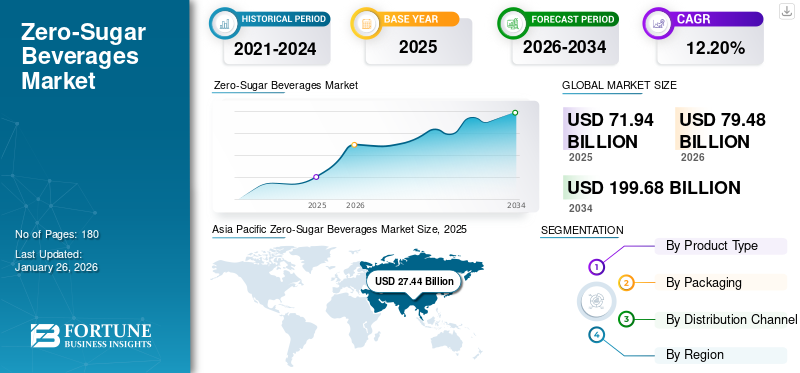
Download Free sample to learn more about this report.
Zero-Sugar Beverages Market Key Takeaways
 Global Market Size & Forecast
- 2025 Market Size: USD 71.94 billion
- 2026 Market Size: USD 79.48 billion
- 2034 Forecast Market Size: USD 199.68 billion
- CAGR: 12.20% from 2026–2034
 Market Share
- Asia Pacific dominated the market with a 38.14% share in 2025.
- Non-Alcoholic Beverages segment is projected to hold the largest market share with 69.15% in 2026.
- Bottles segment is projected to account for 59.62% of the global market share in 2026.
 Key Regional Highlights
North America
The market reached USD 15.87 billion in 2025, driven by rising health awareness and demand for healthier RTD beverages.
Asia Pacific
The market reached USD 27.44 billion in 2025, accounting for 38.14% of global revenue.
Europe
The market reached USD 20.80 billion in 2025, supported by strong product innovation and sustainable packaging trends.
U.S.
The market is projected to reach USD 14.04 billion by 2026.
Japan
The market is projected to reach USD 5.31 billion by 2026.
Read More

MARKET DYNAMICS
Market Drivers
Growing Premiumization and Diversification to Cater to Their Clientele Base to Drive Market Growth
Recently, millennials and Gen-Z consumers have actively shifted toward no-calorie and no-sugar options in beverage products due to health concerns. Thus, new and emerging brands such as Belvedere Vodka, Greenall's Gin, Smirnoff Zero Sugar Infusions, and 3Sisters Drinks are introducing new products with no added sugar, reduced sugar, and no-sugar options to cater to health-conscious consumers. Furthermore, non-alcoholic beverage companies such as Coca-Cola, PepsiCo, and Keurig Dr Pepper, Inc. are diversifying their existing brands and product ranges to retain their clientele. It will significantly contribute to the global zero-sugar beverages market growth in the coming years. For instance, in February 2025, Keurig Dr Pepper (KDP), one of the leading beverage manufacturing companies, launched a new product under the no-sugar category. The newly launched Dr Pepper blackberry-flavored carbonated beverages are available across the U.S.
Emerging Product Fortification to Propel Industry Growth
The rising health awareness among individuals is increasing globally. As a result, functional or fortified beverage demand is growing gradually. In addition to this trend, the popularity of beverage products containing botanical and clean-label ingredients such as fruits, herbs, and spice extracts is emerging in the market. Thus, the demand for RTD beverage products enriched with ingredients such as ginger, turmeric, lemon, and orange continues to exhibit significant growth globally. Consumers' inclination toward nutrition-enriched products, paired with the increasing popularity of fortified products and low-calorie beverages, encourages industry players to bring this trend within the ready-to-drink beverage category by launching new products. As a result, the global zero-sugar beverages market share is anticipated to emerge in the global beverages market in the coming years.
Market Restraints
High Interference of Regulatory Bodies to Impede Market Growth
The regulations, taxes, and government policies for sugar-free beverages, including both alcoholic and non-alcoholic beverages, vary nationwide. As compared to non-alcoholic RTD beverages, spirit-based alcoholic RTDs have more restrictions. FDA approved limited ingredients to produce sugar-free beverages; for instance, the FDA allows aspartame, sucralose, and saccharin, and a combination of both natural and refined sugar content must be below 0.5 grams per serving. Additionally, the FDA follows strict labeling and marketing regulations. This factor creates difficulty for manufacturers to penetrate the new market. Hence, product sales are anticipated to grow slowly in the global space.
Additionally, the increasing availability of counterfeit products by local players across countries limits the market growth. Local manufacturers usually produce counterfeit products with inferior or harmful materials, lacking quality assurance and safety standards, leading to various potential health risks. Consumers unknowingly purchase counterfeit products and experience adverse effects, which may negatively impact consumer trust. It will impact the market growth. For instance, in June 2025, the U.S. Food and Drug Administration (FDA) recalled 19,203 cases of zero-sugar beverages manufactured by Dr Pepper with mislabeling and filled with the sugar version.
Market Opportunities
Geographical Expansion to Reach a Larger Consumer Base to Unlock New Growth Opportunities
Over the past couple of years, sugar-free, low-calorie, and no-alcohol beverages have been emerging across the globe, including the U.S., U.K., China, and India. Many leading players, such as Coca-Cola and PepsiCo, have experienced lucrative double-digit year-on-year growth from this category across developed and developing nations. Thus, companies focus on expanding their geographical reach through online and offline channels. Emerging and key players' focus on geographical expansion will be a new opportunity for the industry's growth in the upcoming years. For instance, in September 2024, GURU Organic Energy Corp, one of the emerging organic energy drinks manufacturing companies, expanded its fastest-growing segment, the Zero Sugar energy drink category, to the U.S. market. The company launched its products on Amazon, LifeTime, and in selected retailers across the country.
Zero-Sugar Beverages Market Trends
Product Innovation with Unique Wellness Ingredients to Shape Industry
Consumers often prefer to experience new and unique products developed from unusual ingredients. Furthermore, in this post-pandemic era, users are emphasizing beverage products that are formulated using nutraceuticals and wellness-supporting natural ingredients such as herbs, botanicals, and plants. Thus, emerging beverage brands significantly invest in innovation activities to develop innovative product options. This emerging trend will shape the global market.
For instance, in September 2024, Zooz, one of the emerging non-alcoholic wellness drink brands, launched a unique and innovative mushroom-based beverage to the growing no-and-low alcohol market. The Zooz beverages are made from Cordyceps and Lion's Mane mushrooms with various flavor notes. These products are free from sugar, gluten, and artificial additives, packaged in environmentally friendly 250ml aluminum cans, and available across the U.K.
Impact of Tariffs
Recently proposed reciprocal tariffs on several countries, including Canada, Mexico, and China, have significantly impacted the price spikes of sugar-free beverages in the U.S. The U.S. is one of the key markets for sugar-free beverages, and a sudden price shift in the category may impact consumer buying behavior and reduce the product's volume of sales in the country. In early March 2025, U.S. President Donald Trump levied import tariffs of 25% on goods from Canada and Mexico. Mexico is a key tequila and mezcal exporter to the U.S.; nearly 99% of mezcal and tequila have been imported from Mexico. According to the Distilled Spirits Council, the U.S. imported approximately USD 93 million worth of mezcal from Mexico in 2024.
Furthermore, the Distilled Spirits Council, a 25% tariff on distilled spirits imported from these countries, may also impact the beverages industry by losing more than 31,000 jobs. Therefore, the tariff will have a significant impact on the product import and create disturbance across the supply chain. As a result, the no-sugar beverages industry is anticipated to grow at a lower percentage than usual.
SEGMENTATION ANALYSIS
By Product Type
High Product Availability of Non-Alcoholic Beverages Resulted in Its Highest Market Proportion
On the basis of product type, the market is segmented into alcoholic beverages and non-alcoholic beverages. The non-alcoholic beverages segment is further categorized into carbonated drinks, fruits & vegetable juices, RTD tea and coffee, sports drinks, and others.
The non-alcoholic beverages segment held the largest market share 69.15% in 2026. Non-alcoholic beverages such as carbonated beverages, smoothies, fruit juices, RTD coffee & tea, and sports drinks are widely available in no-sugar, no-added-sugar, and low-sugar categories across the retail shelves. Furthermore, consumers prefer to eat these category products in their daily lives to achieve their specific health goals. Accessibility, availability, and promotional activities to promote the product are likely to contribute to the product demand in the non-alcoholic beverages category.
The alcoholic beverages segment is anticipated to expand with a steady growth rate during the forecast period. Alcoholic beverage manufacturers such as Carlsberg Group and AB InBev are introducing new products in the low-calorie and sugar-free range to serve their clientele. Furthermore, with increasing RTD trends within the alcoholic beverage segment, including wine, spirits, and beer, the penetration rate of no-sugar claims is increasing globally. It is likely to push the segment's growth during the forecast period.
By Packaging
Bottles Segment Led Market Due to Convenience Benefits
On the basis of packaging, the market is segmented into bottles, cans/tins, and others.
The bottles segment held the highest share 59.62% of the market in 2026. Bottle packaging, including PET and glass bottles, is more prevalent in the beverage industry. The factors such as versatility, ability to protect beverages, and convenience of usage make the bottle format a more ideal option for beverage packaging. Additionally, emerging trends in sustainability and recycling packaging are likely to shape the segment's growth in the coming years.
The cans/tins segment is anticipated to grow at the fastest CAGR during the forecast period. Aluminum cans and tins are lightweight, strong, and have a more versatile nature than PET or glass packaging. Since cans/tin packaging options are durable, easy to transport, recyclable, and environmentally friendly, the adoption rate has been increasing globally. Additionally, companies are launching new products using such packaging options to attract their consumers. Therefore, the segment exhibits the highest growth rate over the forecast period.
By Distribution Channel
To know how our report can help streamline your business, Speak to Analyst
Supermarkets/Hypermarkets Hold Dominance Due to Convenience and Accessibility
Based on the distribution channel, the market is segmented into on-premises, supermarkets/hypermarkets, specialty stores, convenience stores, online stores, and others.
The supermarkets/hypermarkets segment holds the largest share 35.91% in 2026 of the global market. The supermarket and hypermarket stores offer various sugar-free beverage products at a competitive price range. The expanding network of supermarket outlets across the global market is another supportive factor in increasing the sales of beverage products globally.
Online retailing is emerging across the global market as it provides more flexibility in shopping. Attractive online advertisements and discounts on zero-sugar beverages appeal to consumers to buy the products through this sales channel. Furthermore, transparency, testimonials on the products, and door delivery factors influence the segment's sales growth. Launching new products in online retail formats and collaborating with online retailers to increase consumer reach will also drive the product's sales in the segment.
Zero-Sugar Beverages Market Regional Outlook
Regionally, the global market report covers analysis across North America, Europe, Asia Pacific, South America, and the Middle East & Africa.
Asia Pacific
Asia Pacific Zero-Sugar Beverages Market Size, 2025 (USD Billion)
To get more information on the regional analysis of this market, Download Free sample
Asia Pacific contributed 38.14% to the global market in 2025, with a valuation of USD 27.44 billion, and is projected to reach USD 30.46 billion in 2026. Asia Pacific is one of the emerging and developing markets that have significantly contributed to the volume and value growth of zero-sugar beverages. The prominent players in the region have been adopting investment strategies to establish facilities within the region to supply the rising demand for alcoholic and non-alcoholic no-sugar RTD beverages. The rising disposable income among the middle-class population and growing alcohol consumption across countries, coupled with the high presence of international & local beverage manufacturers offering a wide range of alcoholic and non-alcoholic beverages in the sugar-free category. It is driving the sugar-free beverages market growth. The Japan market is projected to reach USD 5.31 billion by 2026, the China market is projected to reach USD 12.5 billion by 2026, and the India market is projected to reach USD 4.42 billion by 2026.
China
China is the leading producer and consumer of no-sugar beverages in the region. As consumers opt for healthy beverages, no-sugar functional beverages such as energy, sports, and enhanced fruit drinks have been gaining immense popularity in the Asia Pacific market. Increasing new product development by regional players within the category further drives the product demand in the country.
Download Free sample to learn more about this report.
Europe
The Europe market generated USD 20.8 billion in 2025, representing 28.91% of the global market landscape, and is expected to reach USD 22.85 billion in 2026. Europe is one of the prominent markets for no-sugar beverages. No sugar beverage manufacturers are actively involved in innovation and R&D to develop novel product portfolios. Furthermore, several stakeholders in the supply chain are also developing novel ingredients to support sugar-free beverage producers in developing innovative product options. This factor will propel the market growth during the forecast period. Additionally, consumers are becoming more aware of environmental sustainability. As a result, ethical and eco-friendly packaging is becoming more mainstream in the market. The manufacturers in the industry utilize ozone-friendly packaging factors as a key positioning strategy for new product launches. Therefore, numerous manufacturers are using recyclable packaging materials to pack their products. It is further contributing to market growth. The UK market is projected to reach USD 5.68 billion by 2026, while the Germany market is projected to reach USD 4.82 billion by 2026.
North America
In 2025, North America represented USD 15.87 billion, accounting for 22.06% of the worldwide market, and is projected to grow to USD 17.55 billion in 2026. North America is expected to have potential growth in the sugar-free beverages segment due to rising health awareness and busy lifestyles. People in the region lead busy lives with increasing health problems due to work stress and pressure. Additionally, growing awareness about the adverse effects of sugar consumption significantly promotes the purchase of no-sugar beverages. Therefore, manufacturers of no-sugar beverages focus on introducing innovative, healthy beverages in RTD options for consumers to reduce stress and cater to evolving food habits. Increasing consumer demand for healthier drinks across the region, including the U.S., Canada, and Mexico, will likely drive the sugar-free beverages market. The U.S. market is projected to reach USD 14.04 billion by 2026.
South America and Middle East & Africa
The demand for no-sugar beverage products, including functional waters, fruit juices, sports drinks, and dairy beverages, is increasing for different needs, including meal replacement, vitamins & minerals needs, energy requirements, and taste. The shift toward healthy and clean label options among consumers will continue to influence the demand for functional and fortified beverage products in the South American market.
The Middle East & Africa market was valued at USD 2.17 billion in 2025, capturing 3.02% of global revenue, and is estimated to reach USD 2.37 billion in 2026. Over the past few years, the beverages industry has seen significant growth across Middle Eastern countries such as UAE, Saudi Arabia, and other Gulf countries. Consumers' hectic lifestyles and rising obesity and diabetes-related concerns among users are likely to drive the no-sugar beverages in Middle Eastern countries. The change in the demand for beverage products by consumers and tourists due to globalization and cultural diversification resulted in the beverage industry becoming more competitive and innovative in the region.
COMPETITIVE LANDSCAPE
Key Industry Players
Focus on Improved Product Functionality to Support Market Growth
The global zero-sugar beverages market share is fragmented, with several market players competing and developing new products. Companies are focusing on manufacturing innovative products using herbs and botanical ingredients to cater to the rising demand for wellness-supportive products. Additionally, alcoholic beverage manufacturers are developing zero-calorie and sugar-free beverages to attract their clientele.
Key Players in the Zero-Sugar Beverages Market
|
Rank |
Company Name |
|
1 |
The Coca-Cola Company |
|
2 |
PepsiCo Inc. |
|
3 |
Carlsberg Group |
|
4 |
Nestlé S.A. |
|
5 |
Molson Coors Beverage Company |
The Coca-Cola Company, PepsiCo Inc., Carlsberg Group, Nestlé S.A., and Molson Coors Beverage Company are some of the largest players in the market. The global market is fragmented, with the top 5 players accounting for a limited portion of the global market share.
List of Key Zero-Sugar Beverage Companies Profiled
- The Coca-Cola Company (U.S.)
- PepsiCo Inc (U.S.)
- Carlsberg Group (Denmark)
- Nestlé S.A. (Switzerland)
- Dr Pepper Snapple Group (U.S.)
- Mott's and Mott's (U.S.)
- MOGUMOGU (Thailand)
- Molson Coors Beverage Company (U.S.)
- Red Bull GmbH (Austria)
- GURU Organic Energy Corp (Canada)
KEY INDUSTRY DEVELOPMENTS
- February 2025: The Coca-Cola Company, one of the leading beverage manufacturing companies, launched three no-sugar products under the Fanta brand. The newly launched products are available in Fanta Zero Apple and Fanta Zero Raspberry, and a limited-edition Fanta Tutti Frutti Zero Sugar flavors.
- February 2025: Mogu Mogu, an emerging beverage brand, launched a sugar-free range in two varieties: Mogu Mogu Zero Sugar Summer Berries and Zero Sugar Tropical Delight.
- January 2025: Carlsberg Britvic, a U.K.-based beverages company, expanded its sugar-free beverages portfolio by launching two new Pepsi Zero Sugar flavors—Strawberries' N' Cream and Cream Soda. These new products are available in selected grocery stores across the U.K.
- November 2024: Red Bull, one of the leading energy drinks manufacturing companies, launched a no-sugar and zero-calorie version of its classic Red Bull Original energy drink across the world.
- September 2021: ONLY Beverages, a Hong Kong-based RTD alcoholic beverages brand, launched a zero sugar, zero carb, and naturally flavored RTD alcohol beverage - ONLY Vodka This product is available in two flavors: Tahitian Lime and Yuzu Ginger.
REPORT COVERAGE
The global zero-sugar beverages market industry report analyzes the market in-depth and highlights crucial aspects such as global market trends, market dynamics, prominent companies, and applications. Besides this, the market statistics report also provides insights into the market trends and highlights significant industry developments.
Request for Customization to gain extensive market insights.
Report Scope & Segmentation
|
ATTRIBUTE |
DETAILS |
|
Study Period |
2021-2034 |
|
Base Year |
2025 |
|
Estimated Year |
2026 |
|
Forecast Period |
2026-2034 |
|
Historical Period |
2021-2024 |
|
Growth Rate |
CAGR of 12.20% from 2026 to 2034 |
|
Unit |
Value (USD Billion) |
|
Segmentation |
By Product Type
|
|
By Packaging
|
|
|
By Distribution Channel
|
|
|
By Region
|
Frequently Asked Questions
The global zero-sugar beverages market size was valued at USD 71.94 billion in 2025. The market is projected to grow from USD 79.48 billion in 2026 to USD 199.68 billion by 2034, exhibiting a CAGR of 12.20% during the forecast period.
At a CAGR of 12.20%, the global market will exhibit steady growth over the forecast period (2026-2034).
By product type, the non-alcoholic beverages segment leads the market.
Asia Pacific held the largest market share in 2025.
Increasing premiumization and product diversification to drive market growth.
The Coca-Cola Company, PepsiCo Inc., Carlsberg Group, Nestlé S.A., and Molson Coors Beverage Company are the leading companies in the market.
Product innovation with unique wellness ingredients to shape the industry.



- 2021-2034
- 2025
- 2021-2024
- 180
-
(Offer valid till 31st Oct 2026)
Get 30-60 hrs Free Customization
Expand Regional and Country Coverage, Segments Analysis, Company Profiles, Competitive Benchmarking, and End-user Insights.




















Related Reports
-
US +1 833 909 2966 ( Toll Free )
-
Get In Touch With Us