Medical Imaging Informatics Market Size, Share & Industry Analysis, By Component (Software/Platforms and Services), By Deployment (Cloud-Based, On-Premise, and Hybrid), By Type (Picture Archiving & Communication System, Vendor Neutral Archive, Radiology Information System, Enterprise Imaging Platforms, Image Viewing & Universal Viewer Solutions) By Imaging Specialty (Radiology, Cardiology, Pathology / Digital Pathology, Ophthalmology, Orthopedics, and Others), By End User (Hospitals, Diagnostic Imaging Centers, Specialty Clinics, Academic & Research), and Regional Forecast, 2026-2034
 Download Free Sample
Medical Imaging Informatics Market Size and Future Outlook
 Listen to Audio Version
The global medical imaging informatics market size was valued at USD 5.02 billion in 2025 and is projected to grow from USD 5.49 billion in 2026 to USD 12.11 billion by 2034, exhibiting a CAGR of 10.39% during the forecast period. North America dominated the medical imaging informatics market with a market share of 41.83% in 2025.
Methods of medical imaging informatics are utilized to capture, store, manage, retrieve, exchange, and analyze medical imaging data, supporting clinical decision-making across multiple specialties. The market is expanding due to the increased number of diagnostic imaging procedures, higher adoption of cloud-based and enterprise imaging solutions, and a growing need for interoperable systems that enhance image workflow, reporting, and data exchange across various care environments. Demand in the market is increasing as final users enhance digital imaging systems using different solutions. These technologies enhance workflow efficiency, facilitate remote access to images, boost collaboration among clinicians, and reinforce long-term management of imaging data.
Key players operating in the global market include Koninklijke Philips N.V., General Electric Company, Siemens Healthcare Private Limited, and FUJIFILM Holdings Corporation. These firms are focusing on enterprise imaging platforms, PACS, VNA, radiology workflow and reporting software, universal viewer solutions, advanced visualization and analysis tools, cloud-based imaging informatics, and interoperability-driven image management applications that support multi-site care delivery, diagnostic productivity, and integrated clinical workflows.
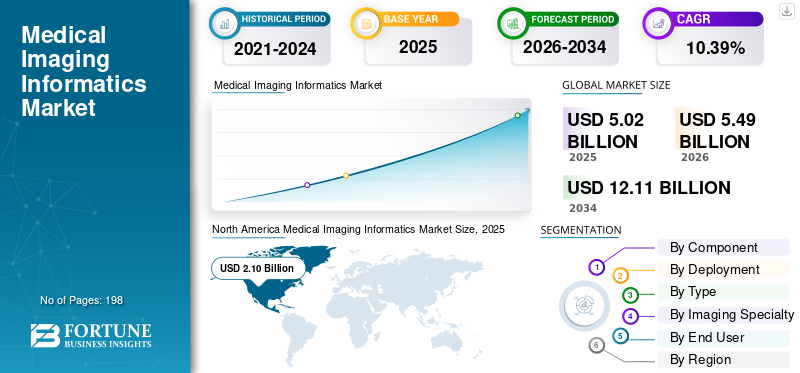
Download Free sample to learn more about this report.
Medical Imaging Informatics Market KEY TAKEAWAYS
 Global Market Size & Forecast
- 2025 Market Size: USD 5.02 billion
- 2026 Market Size: USD 5.49 billion
- 2034 Forecast Market Size: USD 12.11 billion
- CAGR: 10.39% from 2026–2034
 Market Share
- North America dominated the medical imaging informatics market with a 41.83% share in 2025.
- The on-premise segment accounted for the largest market share in 2025.
- The Picture Archiving & Communication System (PACS) segment accounted for the largest market share in 2025.
 Key Regional Highlights
Asia Pacific
Asia Pacific reached USD 1.25 billion in 2026, driven by hospital digitization and rising imaging procedures.
North America
North America reached USD 2.10 billion in 2025, supported by PACS adoption and enterprise imaging growth.
Europe
Europe is driven by healthcare IT modernization and increasing adoption of imaging platforms.
U.S.
U.S. reached USD 1.98 billion in 2026, fueled by advanced imaging infrastructure and digital healthcare adoption.
Japan
Japan reached USD 0.34 billion in 2026, driven by hospital digitization and growing imaging informatics adoption.
Read More

MEDICAL IMAGING INFORMATICS MARKET TRENDS
Growing Adoption of Cloud-based Imaging Informatics is a Significant Trend Observed in Global Market
The increasing uptake of cloud-based imaging informatics is becoming a significant market trend as hospitals and diagnostic imaging centers transition from on-premises PACS/RIS systems to cloud PACS, cloud VNA, SaaS reporting, and cloud-centric image exchange platforms. This change is influenced by increasing imaging volumes, a lack of radiologists, the necessity for remote interpretation, and the escalating demand to exchange images among various locations. Cloud-based systems lessen the responsibility of managing local servers, enable quicker software updates, assist in disaster recovery, and facilitate the scaling of storage for health systems as imaging data expands. Multi-site hospital networks and outpatient imaging chains are progressively embracing cloud-based platforms due to their requirements for centralized image access, standardized reporting, and quicker collaboration among radiologists and clinicians. This trend is additionally promoting recurring revenue models for vendors, as imaging informatics shifts from single license sales to SaaS and managed cloud subscriptions. In general, cloud adoption is enhancing the market by increasing the flexibility, scalability, and suitability of imaging workflows for remote and distributed care delivery. These factors are supporting the overall global medical imaging informatics market growth.
- For instance, in November 2025, GE HealthCare announced an agreement to acquire Intelerad Medical Systems for USD 2.3 billion to advance cloud-enabled enterprise imaging across care settings.
MARKET DYNAMICS
MARKET DRIVERS
Download Free sample to learn more about this report.
Rising Diagnostic Imaging Volume is Driving Market Growth
Increasing volumes of diagnostic imaging serve as a major catalyst for the market, as each CT, MRI, X-ray, ultrasound, mammography, nuclear imaging, cardiology imaging, and digital pathology exam produces extensive datasets that need to be stored, accessed, visualized, reported, and distributed. With the increase in imaging procedures at hospitals and diagnostic centers, there is a growing requirement for enhanced PACS, VNA, RIS, enterprise imaging, universal viewer, and reporting workflow systems to effectively handle data. The growing image load also heightens the demand for scalable storage, quicker image access, automated worklists, remote radiology assistance, and long-term archiving management. The driver plays a crucial role for major health systems and outpatient imaging networks, where centralized platforms and cloud-based access are needed for multi-site imaging workflows. With increasing imaging volumes, conventional departmental PACS becomes inadequate, leading to a need for enterprise imaging platforms that can handle images across various specialties such as radiology, cardiology, pathology, and ophthalmology. As a result, greater use of imaging directly raises expenditures on medical imaging informatics solutions. All these factors cumulatively drive the overall market growth.
- For instance, in May 2024, researchers participating in the ImageCLEFmedical 2024 Caption task developed transformer-based models for diagnostic captioning of radiology images, with the study highlighting the need to improve report quality and efficiency in medical imaging workflows.
MARKET RESTRAINTS
High Implementation and Ownership Cost to Limit Market Growth
High implementation and ownership cost acts as a restraint for the market since PACS, VNA, RIS, enterprise imaging platforms, advanced visualization, and reporting workflow systems require large upfront spending. Hospitals must invest not only in software licenses or subscriptions, but also in data migration, integration with EHR/HIS/RIS, cloud or server infrastructure, cybersecurity, user training, and long-term support. These costs become higher when providers move from legacy departmental PACS to enterprise-wide platforms covering radiology, cardiology, pathology, ophthalmology, and other specialties. Smaller hospitals, independent imaging centers, and providers in price-sensitive markets may delay upgrades since the return on investment is not immediate. Cloud and SaaS models reduce some capital burden, but they still require recurring subscription fees, storage costs, migration services, and implementation support. As a result, high total cost of ownership can slow adoption, especially in emerging markets and public healthcare systems with tight budgets.
- For instance, in June 2025, Sectra reported that its transition to service-based medical imaging IT deliveries requires costs to be incurred at the beginning of projects, while revenue comes later and major customer go-lives add pressure before revenue starts.
MARKET OPPORTUNITIES
Expansion of Digital Pathology and Specialty Imaging to Offer Market Growth Opportunities
The growth of digital pathology and specialty imaging is generating a significant market opportunity as medical imaging informatics expands from radiology to include pathology, ophthalmology, cardiology, orthopedics, dermatology, wound care, and various other clinical areas reliant on imaging. Hospitals are progressively seeking a unified enterprise imaging platform that can handle both DICOM and non-DICOM images across various departments, instead of relying on distinct systems for each specialty. Digital pathology is particularly appealing due to whole-slide images being large files that necessitate specialized storage, rapid viewing, image sharing, annotation, and workflow integration. This generates fresh demand for VNA, corporate viewers, digital pathology image management, cloud storage, and AI-compatible imaging repositories. Specialty imaging enhances the worth of enterprise imaging platforms as it allows providers to integrate radiology, pathology, ophthalmology, and cardiology images with the EHR and clinical processes. Consequently, vendors capable of providing multi-specialty imaging are expected to generate greater revenue per hospital and extend their reach beyond conventional PACS replacement chances. All these factors would drive the market growth in the coming years.
- For instance, in April 2025, researchers published “Iris: A Next Generation Digital Pathology Rendering Engine,” describing a high-performance digital pathology rendering system designed to improve whole-slide image viewing speed and usability. The development highlights the growing need for advanced digital pathology informatics infrastructure as hospitals and labs move from microscope-based workflows toward digital slide viewing, storage, and analysis.
MARKET CHALLENGES
Shortage of Skilled IT Imaging Professionals to Pose a Prominent Challenge to Market Growth
The lack of skilled imaging IT professionals poses a significant challenge in the market, as medical imaging informatics systems necessitate specialized teams for deployment, integration, security, and maintenance. Hospitals require PACS administrators, radiology IT experts, data migration professionals, cloud engineers, cybersecurity personnel, and workflow specialists to oversee PACS, VNA, RIS, enterprise imaging, digital pathology, and cloud imaging systems. When these abilities are restricted, implementation schedules extend, system migration turns more perilous, and providers might postpone updates from legacy PACS to enterprise imaging systems. The difficulty is greater in smaller hospitals and developing markets, where IT teams might lack sufficient expertise in DICOM, HL7/FHIR, cloud hosting, cybersecurity, and multi-specialty imaging processes. In established markets, staffing challenges in radiology departments may hinder the integration of new digital systems and the enhancement of workflow. Consequently, vendors might have to offer additional managed services, training, and implementation assistance, potentially raising project expenses and delaying adoption.
- For instance, May 2026, the Royal College of Radiologists reported that the NHS spent a record USD 317.52 million in 2025 outsourcing diagnostic scan analysis to private firms as staffing shortages left hospitals without enough capacity to read all scans.
Segmentation Analysis
By Component
Software / Platforms Segment Dominated Due to High Adoption of PACS, VNA, Enterprise Imaging, and Workflow Platforms
In terms of component, the market is divided into software/platforms and services.
The software/platforms segment led the global medical imaging informatics market share in 2025. The medical imaging informatics is primarily driven by core digital systems used to store, retrieve, view, analyze, report, and exchange imaging data. Additionally, software platforms generate higher recurring and license-based revenue as they form the central infrastructure for radiology, cardiology, digital pathology, ophthalmology, and orthopedic imaging. The segment is also supported by the shift from departmental PACS to cloud-enabled enterprise imaging platforms that combine viewing, archiving, workflow, reporting, and AI-readiness in one system.
- For instance, in November 2025, Visage Imaging announced that it would showcase Visage 7 CloudPACS, powered by the Visage 7 Enterprise Imaging Platform, at RSNA 2025. The company highlighted cloud-based PACS, AI-optimized workflow, vendor-neutral archive, digital pathology, image viewing, workflow, archiving, and AI capabilities, showing how integrated software platforms are becoming central to modern imaging informatics.
The services segment is anticipated to rise with a CAGR of 8.77% over the forecast period.
To know how our report can help streamline your business, Speak to Analyst
By Deployment
On-Premise Segment Dominated Due to Higher Control Over Imaging Data, Legacy PACS Infrastructure, and Hospital IT Security Needs
Based on deployment, the market is classified into on-premise, cloud-based, and hybrid.
The on-premise segment captured the leading position in the global market in 2025. This is due to the fact that many hospitals and health systems historically deployed PACS, RIS, VNA, reporting, and advanced visualization systems within their own IT infrastructure resulting in higher revenue share. Large hospitals and public healthcare systems also have long replacement cycles, meaning many legacy on-premise PACS and archive systems continued to generate maintenance, upgrade, and support revenue. Furthermore, the segment is set to hold 41.2% share in 2026.
- For instance, in June 5, 2025 year-end report, Sectra noted that many healthcare providers in Europe still showed hesitation toward public cloud solutions from U.S. vendors, and that the company has long offered private cloud solutions as an alternative in the European market.
The hybrid segment is anticipated to rise with a CAGR of 11.14% over the forecast period.
By Type
Picture Archiving & Communication System (PACS) Widely Preferred Due to Its Core Role in Digital Image Storage and Radiology Workflow
Based on type, the market is classified into Picture Archiving & Communication System (PACS), Vendor Neutral Archive (VNA), Radiology Information System (RIS), enterprise imaging platforms, image viewing & universal viewer solutions, advanced visualization & analysis software, radiology reporting & workflow software, and others.
The Picture Archiving & Communication System (PACS) segment dominated the market share in 2025. As it remains the foundational system used by hospitals and diagnostic imaging centers to store, retrieve, view, distribute, and archive medical images. The segment is also supported by ongoing PACS upgrades, cloud PACS adoption, integration with RIS/EHR systems, and demand for faster image access across multi-site care settings. Furthermore, the segment is set to hold 28.0% share in 2026.
- For instance, in August 2025, the Institute of Medical Sciences, BHU reported the successful use of an indigenously developed PACS integrated with HIMS at one of India’s largest level-one trauma centers. The system digitized medical imaging processes, enabled instant image access, supported free e-X-ray services, and introduced a mobile PACS interface for radiology reports.
The enterprise imaging platforms segment is anticipated to rise with a CAGR of 15.16% over the forecast period.
By Imaging Specialty
Radiology Segment Dominated Due to High Imaging Volumes and Core Dependence on PACS, RIS, VNA, and Reporting Workflows
On the basis of imaging specialty, the market is segmented into radiology, cardiology, pathology / digital pathology, ophthalmology, orthopedics, and others.
In 2025, the market share was primarily led by the radiology segment. This is owing to the large volume of medical image data generated across CT, MRI, X-ray, ultrasound, mammography, and nuclear imaging procedures. Moreover, radiology departments have more mature digital workflows and broader installed infrastructure across hospitals and diagnostic imaging centers. The segment is also supported by rising scan volumes, radiologist workload pressure, remote reading needs, and the replacement of legacy PACS with enterprise imaging platforms. Furthermore, the segment is set to hold 66.4% share in 2026.
- For instance, in November 2025, researchers published “Radiology Workflow-Guided Hierarchical Reinforcement Fine-Tuning for Medical Report Generation,” which highlighted that radiologists follow structured reporting workflows and that AI-supported reporting tools are being developed to improve diagnostic consistency and report quality. This supports the dominance of radiology, as the specialty continues to drive demand for imaging informatics tools focused on reporting, workflow efficiency, and image-based diagnosis.
The pathology / digital pathology segment is anticipated to rise with a CAGR of 19.99% over the forecast period.
By End User
Hospitals & Health Systems Led Demand Due to Higher Enterprise-Level Imaging Infrastructure Spending
Based on end user, the market is segmented into hospitals & health systems, diagnostic imaging centers, specialty clinics, academic & research institutes, and others.
The hospitals & health systems segment accounted for the dominant market share in 2025 as these facilities generate the largest volume of imaging data across radiology, cardiology, pathology, ophthalmology, orthopedics, and emergency care. Large hospitals require enterprise-level systems such as PACS, VNA, RIS, universal viewers, advanced visualization, reporting workflow software, and cloud or hybrid image archives to support multiple departments and care sites. Health systems also invest in enterprise imaging to standardize image access across multiple hospitals, outpatient sites, and physician networks. This makes hospitals the primary buyers of large imaging informatics contracts and the largest contributor to overall market revenue. Furthermore, the segment is set to hold 72.1% share in 2026.
- For instance, in October 2025, Aidoc announced an expanded partnership with SimonMed Imaging to deploy its aiOS platform across SimonMed’s national imaging network of more than 170 sites.
In addition, specialty clinics segment is projected to witness 15.94% growth rate during the forecast period.
Medical Imaging Informatics Market Regional Outlook
By geography, the market is divided into Latin America, Asia Pacific, Europe, North America, and the Middle East & Africa.
North America
North America Medical Imaging Informatics Market Size, 2025 (USD Billion)
To get more information on the regional analysis of this market, Download Free sample
The North America held the largest share of the global market size and attained USD 1.93 billion in 2024 and topped the global market. In 2025, the region maintained its dominance, with USD 2.10 billion. North America is expanding due to high adoption of PACS, VNA, enterprise imaging platforms, radiology workflow software, and cloud-based imaging infrastructure. In addition, growing use of digital pathology, cardiology imaging management, and multi-specialty enterprise imaging further supports market growth.
U.S. Medical Imaging Informatics Market
The U.S. market led the North American region and is projected to be approximately USD 1.98 billion in 2026, representing about 36.0% of the global market.
Europe
Europe’s market is growing at a CAGR of 9.02% during the forecast period. Europe’s growth is supported by hospital digitization, public healthcare IT modernization, and increasing adoption of enterprise imaging platforms across radiology, cardiology, and pathology.
U.K. Medical Imaging Informatics Market
The U.K. market is estimated at around USD 0.19 billion in 2026, representing roughly 3.5% of global revenues.
Germany Medical Imaging Informatics Market
Germany’s market size is projected to reach approximately USD 0.26 billion in 2026, equivalent to around 4.6% of global sales.
Asia Pacific
The Asia Pacific market size is expected to reach a valuation of USD 1.25 billion by 2026. Asia Pacific is also expected to be the fastest-growing region due to rapid hospital digitization, expansion of private diagnostic imaging chains, and rising imaging procedure volumes in China, India, Japan, South Korea, Australia, and Southeast Asia.
Japan Medical Imaging Informatics Market
The Japanese market is estimated at around USD 0.34 billion in 2026, accounting for roughly 6.2% of global revenues.
China Medical Imaging Informatics Market
China’s market is projected to reach revenues of around USD 0.38 billion in 2026, representing roughly 6.8% of global sales.
India Medical Imaging Informatics Market
The Indian market is estimated at around USD 0.14 billion in 2026, accounting for roughly 2.5% of global revenues.
Latin America and Middle East & Africa
The growth in the Latin America and Middle East & Africa regions is anticipated to be slower over the forecast period. The growth of the markets is driven by healthcare infrastructure expansion, hospital modernization, and rising investment in digital health, and gradual adoption of cloud-based PACS and RIS platforms. The Latin America market is estimated at around USD 0.27 billion in 2026.
GCC Medical Imaging Informatics Market
The GCC market is projected to reach approximately USD 0.09 billion by 2026, representing about 1.6% of global revenues.
COMPETITIVE LANDSCAPE
Key Industry Players
Major Players Focus on Technological Advancements and Strategic Initiatives to Strengthen Market Position
The global medical imaging informatics market is moderately consolidated, with key companies including Koninklijke Philips N.V., General Electric Company, Siemens Healthcare Private Limited, and FUJIFILM Holdings Corporation representing a significant portion of market revenue. These firms are aiming to strengthen market position through broad portfolios, loud-based image management, and wide geographic presence. These players are focusing on integrated platforms that connect radiology, cardiology, pathology, ophthalmology, and other imaging workflows across hospitals and diagnostic networks.
Other significant participants include Sectra AB, Agfa-Gevaert Group, and Canon Inc. among others. These firms are anticipated to focus on product improvement, automation of workflows, and expanded support to elevate their market position throughout the forecast period.
- For instance, in August 2025, AGFA HealthCare reported strong Healthcare IT performance, with Q2 2025 top line reaching USD 85 million, supported by Enterprise Imaging momentum and improved profitability, showing how established imaging IT vendors are strengthening their position through enterprise imaging software and recurring customer deployments.
LIST OF KEY MEDICAL IMAGING INFORMATICS COMPANIES PROFILED IN REPORT
- Koninklijke Philips N.V. (The Netherlands)
- General Electric Company (U.S.)
- Siemens Healthcare Private Limited (Germany)
- FUJIFILM Holdings Corporation (Japan)
- Sectra AB (Sweden)
- Agfa-Gevaert Group (Belgium)
- Canon Inc. (Japan)
- Intelerad (Canada)
- Mach7 Technologies (U.S.)
- Merative (U.S.)
KEY INDUSTRY DEVELOPMENTS
- April 2026: Aidoc raised USD 150 million in Series E funding, led by Goldman Sachs Alternatives, with participation from General Catalyst, SoftBank Investment Advisers, and NVentures. The company’s imaging AI platform is used to analyze CT scans and X-rays and support emergency department triage and radiology workflows.
- September 2025: Aidoc received FDA Breakthrough Device Designation for a multi-triage imaging AI solution spanning multiple acute CT findings, based on its CARE1 foundation model.
- January 2025: Quibim raised USD 50 million in Series A funding to accelerate development of advanced imaging biomarker technology and expand globally.
- October 2024: Aidoc and NVIDIA worked on BRIDGE — Blueprint for Resilient Integration and Deployment of Guided Excellence, a framework intended to support deployment and integration of AI tools in healthcare.
- July 2024: GE HealthCare acquired the clinical artificial intelligence business from Intelligent Ultrasound for USD 51 million.
REPORT COVERAGE
The global medical imaging informatics market analysis includes a thorough evaluation of the market size and forecasts for every segment highlighted in the report. It offers insights into the market dynamics and trends expected to drive the market throughout the forecast period. It provides understanding of essential factors, including technological progress, product innovations, the regulatory environment, and the launch of new products. Additionally, it details partnerships, mergers & acquisitions, as well as key developments in the industry within the market. The market report also provides an in-depth competitive landscape, including information on market share and profiles of key active players.
Request for Customization to gain extensive market insights.
Report Scope & Segmentation
| ATTRIBUTE | DETAILS | |
| Study Period | 2021-2034 | |
| Base Year | 2025 | |
| Estimated Year | 2026 | |
| Forecast Period | 2026-2034 | |
| Historical Period | 2021-2024 | |
| Growth Rate | CAGR of 10.39% from 2026-2034 | |
| Unit | Value (USD Billion) | |
| Segmentation | By Component, Deployment, Type, Imaging Specialty, End User, and Region | |
| By Component |
|
|
| By Deployment |
|
|
| By Type |
|
|
| By Imaging Specialty |
|
|
| By End User |
|
|
| By Region |
|
|
Frequently Asked Questions
According to Fortune Business Insights, the global market value stood at USD 5.02 billion in 2025 and is projected to reach USD 12.11 billion by 2034.
In 2025, the North America’s market value stood at USD 2.10 billion.
The market is expected to exhibit a CAGR of 10.39% during the forecast period of 2026-2034.
By component, the software/platforms segment is expected to lead the market.
Rising diagnostic imaging volume coupled with growth of outpatient imaging and diagnostic center networks are primarily driving market expansion.
Koninklijke Philips N.V., General Electric Company, Siemens Healthcare Private Limited, and FUJIFILM Holdings Corporation are the top players in the global market.
North America held the largest market share in 2025.



- 2021-2034
- 2025
- 2021-2024
- 198
Get 30-60 hrs Free Customization
Expand Regional and Country Coverage, Segments Analysis, Company Profiles, Competitive Benchmarking, and End-user Insights.













.webp)






Related Reports
-
US +1 833 909 2966 ( Toll Free )
-
Get In Touch With Us