Steel Ingots Market Size, Share & Industry Analysis, By Steel Category (Carbon Steel, Alloy Steel, Stainless Steel, and Tool & Die Steel Ingots), By Manufacturing Process (Continuous Casting, Conventional Ingot Casting, Vacuum Ingot Casting, and Electroslag Remelting), By Subsequent Processing (Rolling & Direct Mill Product Conversion, Forging, and Remelting & Recasting), By End-Use Industry (Construction & Infrastructure, Automotive & Transportation, Industrial Machinery & Heavy Equipment, Energy & Power, Oil & Gas, Shipbuilding, and Aerospace & Defense), and Regional Forecast, 2026-2034
 Download Free Sample
Steel Ingots Market Size and Future Outlook
 Listen to Audio Version
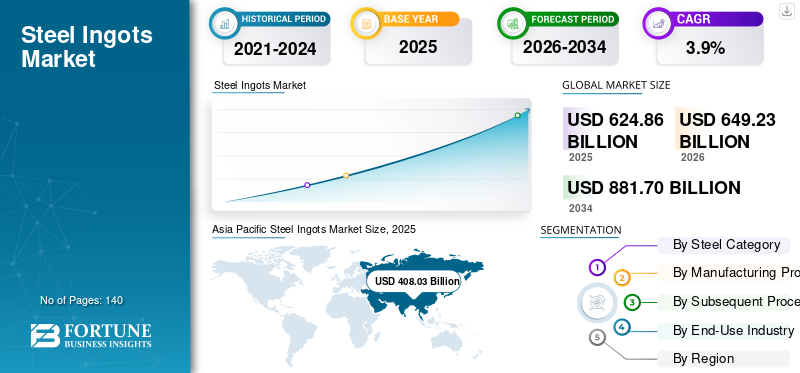
The global steel ingots market size was valued at USD 624.86 billion in 2025. The market is projected to grow from USD 649.23 billion in 2026 to USD 881.70 billion by 2034, exhibiting a CAGR of 3.9% during the forecast period. Asia Pacific dominated the steel ingots market with a market share of 65.29% in 2025.
Steel ingots comprise the production and commercial sale of carbon steel, alloy steel, stainless steel, tool steel, and specialty steel ingots supplied by integrated steel manufacturers, specialty steel producers, foundries, and remelting companies. These ingots are produced through conventional steel casting, vacuum casting, electroslag remelting, vacuum arc remelting, and other specialized processes for subsequent forging, rolling, remelting, and recasting. The market supports automotive manufacturers, construction companies, industrial machinery producers, power-generation equipment suppliers, oil and gas companies, shipbuilders, aerospace and defense manufacturers, and tooling companies requiring high-strength metal forging materials and metallurgically controlled steel feedstock.
Growing infrastructure development, steel manufacturing activity, industrial machinery production, defense investment, power-generation projects, shipbuilding, and demand for large forged components are supporting steel ingot consumption globally. Increasing adoption of vacuum melting, controlled solidification, automated pouring, and real-time process monitoring is enabling manufacturers to improve steel cleanliness, reduce segregation, minimize internal defects, and produce large and ultra-heavy ingots for critical applications. Steel ingots also support billet and bloom production, rolled steel products, construction steel materials, and other industrial steel processing activities. Steel prices, raw-material availability, energy costs, trade policies, decarbonization requirements, and changes across the global steel supply chain continue to shape production economics and market growth.
- For instance, in June 2025, Sheffield Forgemasters increased its recapitalization program from USD 1.21 billion to USD 1.75 billion to expand defense manufacturing capacity, improve production resilience, and reduce lead times for critical heavy-engineering components.
Union Electric Steel Corporation, ArcelorMittal S.A., Nippon Steel Corporation, POSCO Holdings Inc., and Sheffield Forgemasters International Limited are among the major companies operating in the market.
Download Free sample to learn more about this report.
Steel Ingots Market Key Takeaways
 Global Market Size & Forecast
- 2025 Market Size: USD 624.86 billion
- 2026 Market Size: USD 649.23 billion
- 2034 Forecast Market Size: USD 881.70 billion
- CAGR: 3.9% from 2026–2034
 Market Share
- Asia Pacific dominated the market with a 65.29% share in 2025.
- Other specialty steel ingots are expected to grow at the highest CAGR of 5.2% from 2026–2034.
- Vacuum arc remelting and other specialized processes are projected to grow at the highest CAGR of 5.7%.
 Key Regional Highlights
North America
North America generated over USD 56.86 billion in revenue in 2025, supported by demand from automotive, aerospace, defense, energy, and industrial applications.
Europe
Europe is expected to witness steady growth, driven by automotive manufacturing, industrial machinery, aerospace, defense, shipbuilding, energy, and specialty steel applications.
Asia Pacific
Asia Pacific dominated the market with USD 408.03 billion in 2025 and is expected to maintain its leading position during the forecast period.
U.S.
The U.S. market is expected to reach approximately USD 40.52 billion in 2026, supported by strong demand across high-performance industrial and defense applications.
Japan
The Japan market is estimated at around USD 26.93 billion in 2026, accounting for roughly 4.3% of global sales.
Read More

STEEL INGOTS MARKET TRENDS
Growing Adoption of Advanced Remelting and Large-Ingot Manufacturing Technologies is Accelerating Market Expansion
Demand for steel ingots is increasingly being influenced by the adoption of advanced remelting, controlled solidification, and ultra-large ingot manufacturing technologies across aerospace, defense, power generation, shipbuilding, oil and gas, and heavy engineering applications. As critical components become larger and require higher cleanliness, structural integrity, and uniform mechanical properties, manufacturers are investing in electroslag remelting, vacuum arc remelting, vacuum degassing, optimized mold designs, and automated ingot handling systems. These technologies help reduce non-metallic inclusions, internal porosity, segregation, and solidification-related defects while improving material consistency and downstream forging performance.
The market is also witnessing increasing deployment of digital process monitoring, thermal modeling, automated pouring, and predictive quality-control systems to improve production yields and reduce rejection rates. The transition toward premium-grade and ultra-heavy steel ingots is strengthening demand for modern melt shops, high-capacity forging presses, and specialized manipulators capable of processing large ingots for nuclear, defense, marine, and energy equipment applications.
- For instance, in September 2025, Sheffield Forgemasters appointed Presstrade to install its new forging press, which will be supported by a 450-ton rail-bound manipulator designed to handle large steel ingots, highlighting continued investment in advanced heavy-forging infrastructure.
MARKET DYNAMICS
MARKET DRIVERS
Download Free sample to learn more about this report.
Rising Demand for Ultra-Heavy Forgings from Nuclear, Defense, and Energy Applications is Driving Market Growth
The steel ingots market growth is increasingly being driven by renewed investment in nuclear power, defense programs, shipbuilding, and large energy infrastructure requiring ultra-heavy forged components with exceptional structural integrity. Steel ingots serve as critical starting materials for reactor pressure vessels, turbine shafts, generator rotors, marine propulsion systems, containment components, and other safety-critical parts. Manufacturers are developing larger, cleaner, and more compositionally uniform ingots that can be forged into single-piece components, reducing weld joints and improving fatigue resistance, reliability, and service life. Demand is particularly strong for high-purity alloy steel ingots with controlled segregation, low inclusion content, and consistent internal properties. The growing preference for monoblock forgings is supporting investments in ultra-large ingot casting, heavy forging presses, advanced heat treatment, and precision machining capabilities.
- For instance, in February 2026, Daido Steel reported that orders for open-die forgings used in aircraft, marine diesel engines, heavy electrical machinery, industrial machinery, and chemical plants remained strong, highlighting sustained demand for specialty steel ingots and large forged components across critical industrial applications.
|
Rank |
Market Drivers |
Overall Impact Rank |
CAGR Contribution (2026–2034) |
Impact 2026–2028 |
Impact 2029–2031 |
Impact 2032–2034 |
|
1 |
Expansion of construction, transportation, and infrastructure projects increasing demand for primary steel forms |
High |
+2.1% |
High |
High |
High |
|
2 |
Growth in automotive, industrial machinery, and heavy-equipment manufacturing |
High |
+1.6% |
High |
High |
Medium |
|
3 |
Rising demand for ultra-heavy forgings from energy, nuclear power, defense, and shipbuilding applications |
Medium-High |
+1.4% |
Medium |
High |
High |
|
4 |
Steelmaking capacity additions and accelerating industrialization across emerging economies |
Medium-High |
+1.2% |
Medium |
High |
High |
|
5 |
Increasing adoption of specialty steel, ESR, VAR, and high-cleanliness ingots for critical applications |
Medium |
+1.0% |
Medium |
Medium |
High |
|
6 |
Others (urbanization, replacement of aging infrastructure, reshoring, railway expansion, renewable-energy projects, and downstream rolling capacity growth) |
Low |
+0.8% |
Low |
Medium |
Medium |
|
|
Total Positive Growth Contribution |
|
+8.1% |
|
|
|
MARKET RESTRAINTS
Volatility in Iron Ore, Scrap, Ferroalloy, Electricity, and Fuel Prices Affecting Production Margins
The market is constrained by fluctuations in iron ore, steel scrap, ferroalloys, electricity, natural gas, and fuel prices, which directly influence steel ingot production costs and manufacturer profitability. Steel ingot manufacturing requires substantial raw-material and energy consumption across melting, refining, casting, remelting, reheating, and heat-treatment operations. Sudden increases in scrap, alloying-element, electrode, refractory, or electricity costs can compress margins, disrupt production planning, and increase selling prices for downstream forging and rolling companies. Producers dependent on imported raw materials remain particularly exposed to exchange-rate fluctuations, freight costs, geopolitical disruptions, and supply shortages. These pressures can reduce plant utilization, delay capacity expansion, and weaken demand from price-sensitive construction, automotive, machinery, and infrastructure customers.
|
Rank |
Market Restraints |
Overall Impact Rank |
Negative CAGR Contribution (2026–2034) |
Impact 2026–2028 |
Impact 2029–2031 |
Impact 2032–2034 |
|
1 |
Volatility in iron ore, scrap, ferroalloy, electricity, and fuel prices affecting production margins |
High |
-1.6% |
High |
High |
Medium |
|
2 |
High decarbonization investment and increasingly stringent carbon-emission and environmental regulations |
Medium-High |
-1.2% |
Medium |
High |
High |
|
3 |
Regional steel overcapacity, trade barriers, import competition, and cyclical end-use demand |
Medium |
-0.9% |
High |
Medium |
Medium |
|
4 |
Others (low metallurgical yield, internal-defect risk, extended qualification periods, skilled-labor shortages, and high plant-maintenance costs) |
Low |
-0.5% |
Low |
Low |
Medium |
|
|
Total Negative Growth Impact |
|
-4.2% |
|
|
|
MARKET OPPORTUNITIES
Growing Aerospace and Defense Demand for Premium Remelted Steel Ingots Creating Significant Market Opportunities
A major opportunity emerging within the market is the rising demand for premium-quality steel ingots used in aerospace, defense, space, marine propulsion, and high-performance industrial applications. These industries require specialty alloy, tool steel, stainless steel, ESR, and VAR ingots with superior cleanliness, fatigue resistance, heat resistance, and metallurgical consistency. Increasing aircraft production, engine replacement, defense modernization, and localization of critical material supply chains are creating opportunities for manufacturers capable of producing certified high-performance ingots for turbine shafts, landing gear, structural components, bearings, and propulsion systems. Growing customer preference for traceable materials, near-net-shape forgings, and long-term supply agreements is also encouraging investments in vacuum melting, remelting capacity, quality-control systems, and aerospace-grade certification.
- For instance, in April 2026, voestalpine secured aerospace orders worth approximately USD 1.18 billion, the largest aerospace order volume in its history, covering high-performance materials and forged components for aircraft structures, engines, and landing gear.
MARKET CHALLENGES
Trade Barriers, Cyclical End-Use Demand, and Capacity-Utilization Risk Affecting Market Growth
One of the major challenges affecting the market is the difficulty of maintaining stable production volumes and profitability amid fluctuating demand from automotive, construction, machinery, energy, and other steel-consuming industries. Steel ingot plants require high capital investment, continuous furnace utilization, skilled metallurgical labor, and substantial energy consumption, making low operating rates particularly costly. Producers also face trade tariffs, import restrictions, anti-dumping measures, regional overcapacity, and price competition from lower-cost suppliers, which can disrupt export strategies and compress margins. At the same time, sudden changes in alloy costs, customer inventory levels, project schedules, and industrial production can create order volatility and extend working-capital cycles. Manufacturers must therefore balance production capacity, inventory, customer contracts, raw-material procurement, and geographic exposure while continuing to invest in decarbonization, quality improvement, and advanced manufacturing technologies.
Segmentation Analysis
By Steel Category
Carbon Steel Ingots and Primary Cast Steel Segment Led Market Due to Its Large-Scale Use Across Construction, Machinery, and Transportation
By steel category, the market is segmented into carbon steel ingots and primary cast steel, alloy steel ingots, stainless steel ingots, tool and die steel ingots, and other specialty steel ingots.
Carbon steel ingots and primary cast steel held the largest steel ingots market share in 2025, driven by their extensive use across construction, infrastructure, automotive, railways, shipbuilding, industrial machinery, capital goods, and general engineering applications. Compared with higher-alloy and specialty grades, carbon steel offers broader availability, lower production costs, easier downstream processing, and suitability for high-volume rolling, forging, and fabrication. The segment also benefits from large integrated steelmaking capacity, strong demand for structural and engineering products, and continued industrialization across emerging economies. Its wide application base, established supply chains, and ability to meet diverse strength, weldability, and machinability requirements continue to support its market leadership.
- For instance, in May 2025, Tata Steel inaugurated the Phase II expansion of its Kalinganagar operations, increasing annual crude steel capacity from 3 million tons to 8 million tons to support demand from automotive, infrastructure, power, shipbuilding, defense, and engineering sectors.
Other specialty steel ingots are expected to witness the highest growth rate, with a CAGR of 5.2% over the forecast period, driven by rising demand for high-performance materials across aerospace, defense, energy, tooling, medical instruments, and precision engineering applications. Growing adoption of customized chemistries, advanced remelting, and high-cleanliness production is enabling manufacturers to develop ingots with superior hardness, corrosion resistance, fatigue strength, and thermal stability.
To know how our report can help streamline your business, Speak to Analyst
By Manufacturing Process
Continuous Casting of Primary Steel Forms Segment Led Market Owing to Its Higher Production Efficiency and Improved Metal Yield
By manufacturing process, the market is segmented into continuous casting of primary steel forms, conventional ingot casting, vacuum ingot casting, electroslag remelting, and vacuum arc remelting and other specialized processes.
Continuous casting of primary steel forms held the largest market share in 2025, driven by its widespread adoption across integrated steel plants producing slabs, blooms, billets, and other primary steel forms for construction, automotive, machinery, transportation, and infrastructure applications. Compared with conventional ingot casting, continuous casting offers higher production efficiency, improved metal yield, lower energy consumption, reduced handling requirements, and better dimensional consistency.
Vacuum arc remelting and other specialized processes are expected to witness the highest growth rate, with a CAGR of 5.7% over the forecast period, driven by rising demand for ultra-clean and compositionally uniform materials across aerospace, defense, semiconductor, medical, energy, and high-performance industrial applications.
By Subsequent Processing
Rolling and Direct Mill Conversion Segment Led Market Due to Its Increased Use in Flat and Long Steel Production
By subsequent processing, the market is segmented into rolling and direct mill conversion, forging, and remelting and recasting.
Rolling and direct mill conversion held the largest market share in 2025, driven by the substantial volume of primary steel forms converted into plates, sheets, coils, bars, rods, rails, structural sections, and other flat and long products. Compared with forging and remelting, rolling supports continuous high-volume production, improved dimensional consistency, higher throughput, and lower unit processing costs. The segment benefits from widespread integration between steelmaking, continuous casting, reheating, and rolling operations across major integrated and electric arc furnace-based steel plants. Strong demand from construction, automotive, machinery, transportation, energy, and infrastructure industries continues to support the large-scale conversion of primary steel forms through hot and cold rolling processes.
Forging is expected to witness the highest growth rate, with a CAGR of 4.7% over the forecast period, driven by rising demand for high-strength, fatigue-resistant, and safety-critical components across aerospace, defense, nuclear power, oil and gas, shipbuilding, heavy machinery, and transportation applications.
By End-Use Industry
Large Project Scales and Extensive Material Requirements Boosted Construction and Infrastructure Segment Growth
By end-use industry, the market is segmented into construction and infrastructure, automotive and transportation, industrial machinery and heavy equipment, energy and power, oil and gas, shipbuilding, aerospace and defense, tooling, dies, and molds, and others.
Construction and infrastructure held the largest market share in 2025, driven by the high consumption of carbon steel ingots and primary cast steel forms used in the production of structural sections, reinforcement products, plates, rails, pipes, bridges, commercial buildings, industrial facilities, and transportation infrastructure. Compared with other end-use industries, construction generates significantly higher steel volumes due to large project scales, extensive material requirements, and recurring investment in urban development, roads, railways, ports, utilities, and public infrastructure.
Aerospace and defense is expected to witness the highest growth rate, with a CAGR of 5.5% over the forecast period, driven by increasing demand for high-cleanliness alloys, stainless, ESR, VAR, and specialty steel ingots used in aircraft structures, landing gear, turbine components, defense platforms, propulsion systems, missiles, naval equipment, and other safety-critical applications.
Steel Ingots Market Regional Outlook
By geography, the market is categorized into Europe, North America, Asia Pacific, South America, and the Middle East & Africa.
Asia Pacific
Asia Pacific Steel Ingots Market Size, 2025 (USD Billion)
To get more information on the regional analysis of this market, Download Free sample
Asia Pacific dominated the market with USD 408.03 billion in 2025 and will continue to lead in the coming years, supported by the region’s dominant crude steel production, extensive continuous-casting capacity, large construction sector, automotive manufacturing, shipbuilding, industrial machinery, and infrastructure development. Within the region, China represents the largest market due to its massive integrated steelmaking base, broad downstream manufacturing ecosystem, and high consumption of primary steel forms across construction, transportation, machinery, energy, and engineering applications. Japan and South Korea remain important value-intensive markets for high-quality alloy, stainless, tool, ESR, VAR, and specialty steel ingots used in automotive, shipbuilding, aerospace, electronics, and heavy engineering.
China Steel Ingots Market
China’s market is projected to remain the dominant one in the Asia Pacific region, with 2026 revenues estimated at around USD 288.07 billion, representing roughly 46.1% of global sales.
Japan Steel Ingots Market
The Japan market in 2026 is estimated at around USD 26.93 billion, accounting for roughly 4.3% of global sales.
India Steel Ingots Market
The India market in 2026 is estimated at around USD 50.35 billion, accounting for roughly 7.8% of global sales.
North America
The North America market accounted for over USD 56.86 billion in revenue in 2025, supported by the region’s established automotive, aerospace, defense, oil and gas, industrial machinery, and heavy engineering sectors. Regional demand is strongly influenced by the U.S. manufacturing base, infrastructure modernization, reshoring initiatives, defense procurement, and investment in energy equipment. North America also benefits from substantial electric arc furnace capacity, high scrap availability, advanced specialty steel production, and established forging and rolling infrastructure.
U.S. Steel Ingots Market
The U.S. is expected to dominate the market with an estimated revenue of about USD 40.52 billion in 2026, driven by its large steelmaking base, extensive electric arc furnace capacity, growing defense expenditure, infrastructure investment, and demand from automotive, aerospace, energy, and industrial machinery manufacturers. Steel ingot demand remains particularly strong across forged shafts, gears, bearings, turbine components, pressure vessels, oilfield equipment, defense systems, and heavy machinery.
Europe
The European market is expected to witness steady growth during the forecast period, supported by demand from automotive manufacturing, industrial machinery, renewable and conventional energy, aerospace, defense, shipbuilding, and tooling applications. Regional demand is closely linked to Germany’s engineering and automotive industries, Italy’s forging and machinery base, France’s aerospace and nuclear sectors, the U.K.’s defense and heavy-forging capabilities, and Russia’s large steelmaking industry. Europe remains an important value-intensive market for alloy, stainless, tool, ESR, VAR, and other specialty steel ingots due to strict quality requirements and strong demand for high-performance components. Germany, Italy, France, the U.K., BENELUX, and the Nordics remain key contributors. At the same time, decarbonization policies, high energy costs, import competition, and carbon-border regulations continue to shape regional production strategies and investment decisions.
U.K. Steel Ingots Market
The U.K. market in 2026 is estimated at around USD 5.62 billion, representing roughly 0.9% of global sales.
Germany Steel Ingots Market
Germany’s market is projected to reach approximately USD 17.23 billion in 2026, equivalent to around 2.7% of global sales.
Middle East & Africa
The Middle East & Africa market is driven by expanding infrastructure development, energy projects, oil and gas investment, industrial diversification, construction activity, mining operations, and growing demand for heavy engineering products across GCC countries, Turkey, South Africa, North Africa, and other regional markets. Demand is closely linked to structural steel production, pipelines, pressure vessels, industrial machinery, forged components, transportation equipment, shipbuilding, and power-generation infrastructure. GCC countries remain important regional contributors due to large-scale construction programs, energy-sector investment, localization initiatives, and growing downstream steel-processing capacity.
GCC Steel Ingots Market
The GCC market is projected to reach around USD 8.35 billion in 2026, representing roughly 1.3% of global sales.
South America
The South America market is driven by expanding construction activity, mining investment, automotive production, energy development, industrial machinery demand, and infrastructure modernization across Brazil, Argentina, Chile, Colombia, Peru, and other regional economies. Demand is mainly associated with structural steel production, forged components, mining equipment, transportation systems, oil and gas infrastructure, power-generation equipment, and heavy engineering applications. Brazil leads the regional market due to its large steelmaking base, established automotive and machinery industries, substantial mining sector, and continued investment in infrastructure and energy projects.
Brazil Steel Ingots Market
The Brazil market is projected to reach around USD 19.86 billion in 2026, representing roughly 3.1% of global sales.
COMPETITIVE LANDSCAPE
Key Industry Players
Competitive Advantage Driven by Production Scale, Metallurgical Expertise, and Advanced Remelting Capabilities
The steel ingots market is moderately concentrated, with competitive positioning shaped by crude steel production capacity, product quality, melting and remelting capabilities, downstream integration, geographic presence, customer relationships, and exposure to high-value end-use industries. Leading companies, including Union Electric Steel Corporation, ArcelorMittal S.A., Nippon Steel Corporation, and POSCO Holdings Inc., maintain strong market positions through broad carbon, alloy, stainless, tool, forging-quality, ESR, VAR, and specialty steel portfolios.
Competitive differentiation is increasingly influenced by the ability to produce large, clean, compositionally uniform, and application-specific ingots while maintaining high yield, energy efficiency, traceability, and consistent mechanical properties. Companies are investing in vacuum melting, electroslag remelting, vacuum arc remelting, automated casting, process simulation, digital quality control, low-carbon steelmaking, and integrated forging capabilities to serve aerospace, defense, energy, automotive, machinery, shipbuilding, and tooling customers.
- For instance, in July 2025, Carpenter Technology reported record fiscal-year operating performance, with Specialty Alloys Operations generating USD 2.56 billion in net sales and aerospace and defense accounting for more than 60% of total revenue, highlighting strong demand for premium specialty alloy materials.
LIST OF KEY STEEL INGOT COMPANIES PROFILED
- Union Electric Steel Corporation (U.S.)
- ArcelorMittal S.A. (Luxembourg)
- Nippon Steel Corporation (Japan)
- POSCO Holdings Inc. (South Korea)
- JFE Steel Corporation (Japan)
- Tata Steel Limited (India)
- JSW Steel Limited (India)
- Steel Authority of India Limited (India)
- voestalpine AG (Austria)
- Carpenter Technology Corporation (U.S.)
KEY INDUSTRY DEVELOPMENTS
- January 2026: JSW Steel reported its highest-ever consolidated quarterly sales of 7.64 million tons, supported by healthy domestic demand and higher operating volumes across its steelmaking facilities.
- December 2025: JFE Steel and JSW Steel agreed to establish a 50:50 integrated steelmaking joint venture in India, with JFE committing approximately USD 1.67 billion to acquire and expand the Bhushan Power & Steel facility in Odisha.
- September 2025: JFE Steel published new steelmaking and casting technologies covering high-speed continuous casting, segregation control, billet-plant capacity expansion, inclusion control, and predictive monitoring of large-section slab production.
- August 2025: Steel Authority of India Limited supplied approximately 8,000 tons of critical-grade steel for the Indian Navy’s advanced frontline frigates INS Udaygiri and INS Himgiri, strengthening its position in defense-grade steel supply.
- June 2025: POSCO announced a strategic partnership connecting its advanced steel capabilities with South Korea’s defense sector, supporting the development and localization of high-performance steel materials for naval and defense applications.
REPORT COVERAGE
The global steel ingots market analysis includes a comprehensive assessment of market size and forecasts across all segments covered in the report. It provides detailed insights into market dynamics and trends expected to influence growth during the forecast period. The study examines crude steel production, continuous and conventional casting, specialty steel demand, ESR and VAR adoption, downstream forging and rolling activity, and demand across construction, automotive, machinery, energy, shipbuilding, aerospace, defense, and tooling industries. Additionally, it analyzes capacity expansions, technology investments, partnerships, joint ventures, mergers and acquisitions, decarbonization initiatives, and key industry developments. The report also provides an in-depth competitive landscape, including market shares and profiles of key operating players.
Request for Customization to gain extensive market insights.
Report Scope & Segmentation
| ATTRIBUTE | DETAILS |
| Study Period | 2021-2034 |
| Base Year | 2025 |
| Estimated Year | 2026 |
| Forecast Period | 2026-2034 |
| Historical Period | 2021-2024 |
| Growth Rate | CAGR of 3.9% from 2026 to 2034 |
| Unit | Value (USD Billion) |
| Segmentation | By Steel Category, Manufacturing Process, Subsequent Processing, End-Use Industry, and Region |
| By Steel Category |
|
| By Manufacturing Process |
|
| By Subsequent Processing |
|
| By End-Use Industry |
|
| By Region |
|
Frequently Asked Questions
According to Fortune Business Insights, the global market value stood at USD 624.86 billion in 2025 and is projected to reach USD 881.70 billion by 2034.
In 2025, the Asia Pacific’s market value stood at USD 408.03 billion.
The market is expected to exhibit a CAGR of 3.9% during the forecast period (2026-2034).
By end-use industry, the construction and infrastructure segment led the market.
Rising demand for ultra-heavy forgings from nuclear, defense, and energy applications is driving market growth.
China Baowu Steel Group Corporation Limited, ArcelorMittal S.A., Nippon Steel Corporation, POSCO Holdings Inc., and JFE Steel Corporation are among the top players in the market.
Asia Pacific held the largest market share in 2025.


- 2021-2034
- 2025
- 2021-2024
- 140
Get 30-60 hrs Free Customization
Expand Regional and Country Coverage, Segments Analysis, Company Profiles, Competitive Benchmarking, and End-user Insights.












Related Reports
-
US +1 833 909 2966 ( Toll Free )
-
Get In Touch With Us