Metal Cosmetic Packaging Market Size, Share & Industry Analysis, By Material (Aluminum, Steel, and Tinplate), By Product Type (Bottles, Jars & Containers, Caps & Closures, Tubes, Pumps & Dispensers, Aerosol Cans, Blisters, and Others), By Capacity (Less than 50 ml, 50-100 ml, 101-200 ml, 201-500 ml, and Above 500 ml), By Application (Skincare, Nailcare, Haircare, Makeup, and Others), and Regional Forecast, 2026-2034
 Download Free Sample
(Offer valid till 31st Oct 2026)

KEY MARKET INSIGHTS
 Listen to Audio Version
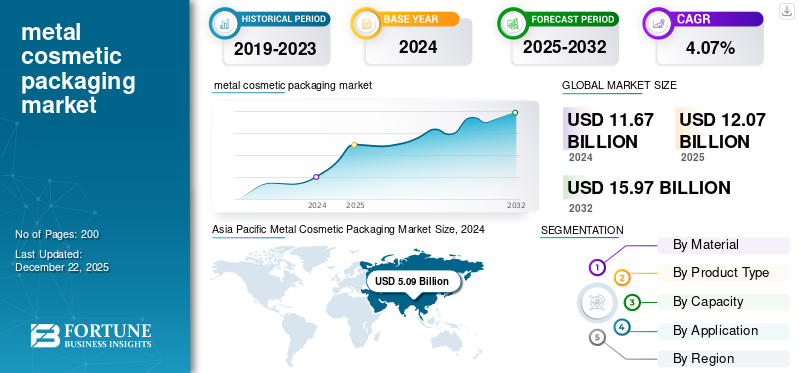
The global metal cosmetic packaging market size was valued at USD 12.07 billion in 2025 andis projected to be worth USD 12.51 billion in 2026 and reach USD 17.43 billion by 2034 , exhibiting a CAGR of 4.23% during the forecast period. Asia Pacific dominated the metal cosmetic packaging market with a market share of 43.97% in 2025.
Metal cosmetic packaging refers to containers and closures made of aluminum, tin, and steel, including bottles, jars, tubes, caps, pumps, and dispensers. These are used across a wide range of personal care applications, such as skincare, hair care, makeup, nail care, and fragrances. The metal cosmetic packaging market is a substantial and fast-growing segment within the global metal packaging industry, with robust expansion projected over the next several years. Growth is fueled by increased demand for premium and sustainable packaging among global cosmetic brands.
The global market is witnessing strong expansion, propelled by a higher demand for cosmetic products and an increasing emphasis on innovative and eco-friendly packaging options. This expansion is also supported by elements such as a rising youth demographic, evolving personal care routines, and the growth of online shopping.
AptarGroup, Inc. and Albea S.A. are the leading manufacturers, accounting for the largest global share in the metal cosmetic packaging market.
Download Free sample to learn more about this report.
METAL COSMETIC PACKAGING MARKET KEY TAKEAWAYS
 Global Market Size & Forecast
- 2025 Market Size: USD 12.07 billion
- 2026 Market Size: USD 12.51 billion
- 2034 Forecast Market Size: USD 17.43 billion
- CAGR: 4.23% from 2026-2034
 Market Share
- Asia Pacific dominated the metal cosmetic packaging market with a market share of 43.97% in 2025.
- The bottles segment by product type is expected to attain USD 3.79 billion, representing 30.28% of the total market share.
- The 50–100 ml segment by capacity is anticipated to reach USD 4.3 billion, capturing 34.36% of the market share.
 Key Regional Highlights
North America
North America recorded a market size of USD 2.24 billion in 2025, capturing 18.52% of the global market share, and is projected to reach USD 2.31 billion in 2026.
Europe
Europe represented USD 3.12 billion, accounting for 25.84% of the worldwide market, and is projected to grow to USD 3.22 billion in 2026.
Asia Pacific
The Asia Pacific market generated USD 5.31 billion in 2025, representing 43.97% of the global market landscape, and is expected to reach USD 5.54 billion in 2026.
U.S.
The U.S. market is projected to reach USD 1.82 billion by 2026.
Japan
The Japan market is projected to reach USD 1.02 billion by 2026.
Read More

MARKET DYNAMICS
MARKET DRIVERS
Rising Growth of E-commerce Sector Drives Market Growth
The e-commerce industry is witnessing substantial expansion, fueled by greater internet access, rising smartphone adoption, and the ease of shopping online. This expansion leads to various advantages for both consumers and businesses. Metal material is a favored option for e-commerce packaging due to its affordability, strength, and sustainability. It offers outstanding protection for products during transport, can be tailored for branding purposes, and meets the demands of environmentally conscious consumers. It ensures impressive product protection while enhancing branding and improving the unboxing experience, resulting in heightened customer satisfaction and loyalty. Henceforth, the growing e-commerce sector drives the global metal cosmetic packaging market growth.
Remarkable Benefits Including Durability and Recyclability Offered by Packaging to Drive Market Growth
Metal cosmetic packaging presents numerous benefits, such as improved durability, a high-end look, and excellent recyclability. This type of packaging is recognized for its capability to safeguard products against light, air, and moisture, thereby maintaining product quality and prolonging shelf life. The upscale touch and visual appeal of metal packaging can also enhance a product's perceived worth, making it an ideal choice for luxury cosmetics. Metal packaging conveys an elegant appearance that resonates with high-end cosmetic products. To differentiate themselves in a crowded market, brands incorporate embossing, metallic finishes, and refined design features, which makes metal containers a favored option for upscale collections.
MARKET RESTRAINTS
Rising Production and Material Costs Associated with Metal Material Obstruct Market Growth
The production of metal packaging involves energy-intensive methods. It heavily depends on raw materials such as aluminum and steel, both of which experience price fluctuations due to global supply chain issues, geopolitical conflicts, and variations in demand. These rising costs directly affect profit margins for producers and increase consumer prices, making metal packaging less appealing compared to alternative materials such as plastic or paper. Furthermore, the significant capital investment needed for state-of-the-art machinery and adherence to environmental regulations adds to the financial strain. Fluctuating prices for aluminum, tin, and steel can disrupt production costs and profit margins for manufacturers. Consequently, many companies—especially small and medium-sized enterprises—are reluctant to embrace metal packaging, restricting its broader application in the cosmetics sector, thus hampering the market growth.
MARKET OPPORTUNITIES
Technological Advancements Will Generate Potential Growth Opportunities for Industry
The incorporation of smart packaging technologies in corrugated packaging is enhancing the efficiency of supply chains and consumer engagement. QR codes, RFID tags, and NFC technology enable real-time tracking, authentication, and interactive user experiences. This advancement is particularly beneficial for inventory management and combating counterfeit products. Intelligent packaging merges technology with traditional packaging to enhance its usability, communication, and overall customer experience. This includes integrating sensors, RFID tags, QR codes, and wireless communication to track items, evaluate conditions, and provide current information to consumers and businesses. As a result, it creates profitable opportunities for growth.
MARKET CHALLENGES
Recycling Complexity with Mixed Materials Challenges Market Growth
While metal is recyclable, the energy-intensive production process and the challenge of recycling multi-material packaging remain concerns for sustainability efforts. The complexity of recycling mixed materials presents a major obstacle to the developing metal cosmetic packaging industry. Although metal can be recycled, packaging for cosmetics frequently combines various materials—including plastics, rubber, glass, adhesives, and coatings—alongside metals such as aluminum or tinplate. Such mixed-material designs are typical in compacts, lipsticks, pumps, and cream jars, where visual appeal and functional performance are primary considerations. However, these combinations complicate the recycling process. Most local recycling programs cannot effectively separate these materials, contaminating recycling streams and often leading to the total disposal of the packaging in landfills. This undermines sustainability initiatives and challenges companies striving to comply with environmental regulations and meet consumer preferences.
Download Free sample to learn more about this report.
METAL COSMETIC PACKAGING MARKET TRENDS
Augmenting Demand for Environmentally-Friendly Packaging Emerges as a Key Market Trend
The increasing awareness of environmental issues is encouraging the industry to adopt more sustainable practices. Companies increasingly implement recyclable materials, reduce waste, and develop biodegradable packaging solutions. For instance, innovations in aluminum tins, closures, tubes, and other packaging formats, as well as reusable designs, are gaining popularity in response to consumer demands for eco-friendly products. Shoppers are more inclined to support businesses that demonstrate a commitment to sustainability. As the significance of sustainability grows, companies that utilize environmentally friendly packaging are more likely to succeed in the long run. Moreover, design innovation is accelerating, with companies using techniques including 3D printing and special finishes to achieve unique aesthetics and a luxury look and feel. Therefore, the growing demand for sustainable and eco-friendly packaging products is a significant market trend.
SEGMENTATION ANALYSIS
By Material
Remarkable Advantages of Aluminum Material in Cosmetics Sector Thrives Segmental Growth
Based on the material, the market is segmented into aluminum, steel, and tinplate.
The aluminium segment by material is projected to reach USD 8.01 billion, accounting for 64.00% of the market share and has been analyzed to witness massive growth during the forecast period. Aluminum provides major advantages in the cosmetics sector due to its distinctive characteristics, such as durability, recyclability, and outstanding barrier protection. Its lightweight nature makes it perfect for packaging, and its capability to shield against light, air, and moisture from affecting product quality makes it a favored option for cosmetic and skincare items. Aluminum protects active ingredients in cosmetic formulations by limiting their exposure to air and light, which helps preserve their potency and effectiveness.
Tinplate is the second-dominating material segment and is expected to grow rapidly in the coming years. Tinplate is advantageous for cosmetic packaging owing to its strength, resistance to corrosion, and visual attractiveness. It serves numerous products such as lip balms, creams, powders, and aerosol cans, delivering a safe and appealing packaging option.
By Product Type
Durability and Extended Shelf Life Offered by Metal Cosmetic Bottles Boost Segmental Growth
Based on the product type, the market is segmented into bottles, jars & containers, caps & closures, tubes, pumps & dispensers, aerosol cans, blisters, and others.
The bottles segment by product type is expected to attain USD 3.79 billion, representing 30.28% of the total market share. The popularity of metal cosmetic bottles is on the rise due to their attractive design, durability, and ability to extend the shelf life of products. This trend is fueled by the expanding beauty industry, increasing consumer demand for high-end and eco-friendly packaging, and the superior protective features of metal. These bottles provide numerous advantages for both consumers and brands. They are aesthetically pleasing, imparting a sense of luxury and high quality, thus elevating the perceived value of the cosmetic item, thereby further driving growth in this segment.
Tubes are the second-dominating product type segment and are expected to grow rapidly in the coming years. The need for aluminum squeeze tubes is rapidly increasing; packaging is essential for brand representation and product effectiveness in the current competitive landscape. Aluminum tubes for hand creams are now favored among producers and consumers due to their strength, eco-friendliness, and high-end look, thus contributing to the segment’s expansion.
By Capacity
Growing Demand for Convenience and Necessity for Skincare Products Propels Segmental Growth
Based on capacity, the market is segmented into less than 50 ml, 50-100 ml, 101-200 ml, 201-500 ml, and above 500 ml.
The 50–100 ml segment by capacity is anticipated to reach USD 4.3 billion, capturing 34.36% of the market share, largely due to the younger generation's strong focus on skincare. The younger demographic increasingly perceives skincare as a necessity instead of a luxury. This trend is particularly pronounced among Gen Z and millennials, who are more knowledgeable about skincare ingredients and are actively pursuing long-term skin health. This change has spurred an increase in the creation of specialized products tailored to their unique needs and preferences, with sizes that are neither too large nor too small. Consequently, this promotes growth in this segment.
Less than 50 ml is the second most dominant capacity segment and will grow in the upcoming years. Metal cosmetic packages that hold less than 50 ml of cosmetic products are usually small-sized items. The demand for this category is rising, driven by affordability, convenience, and a desire to experiment with new products. This trend is particularly appealing to Gen Z and consumers looking for travel-friendly options.
By Application
To know how our report can help streamline your business, Speak to Analyst
Growing Emphasis on Social Media Platforms Cushions Skincare’s Segment Growth
Based on the application, the market is segmented into skincare, nailcare, haircare, makeup, and others.
The skincare segment by application is forecast to reach USD 5.4 billion, accounting for 43.15% of the market share. Social media platforms have significantly influenced young consumers' awareness and interest in skincare, as influencers and celebrities highlight routines and suggest products. The younger demographic emphasizes skincare routines that prioritize overall skin health and the prevention of future problems, rather than just focusing on immediate cosmetic issues. Beauty brands leverage social media to engage with consumers, advertise products, and foster brand loyalty through captivating content and influencer partnerships. This approach contributes to the growth of the segment.
Makeup is the second most dominant application segment and will experience significant growth. An increasing focus on personal appearance and grooming is fueling the demand for makeup items. The influence of beauty influencers and celebrity endorsements on social media greatly affects consumer decisions, thereby boosting the demand for makeup products.
METAL COSMETIC PACKAGING REGIONAL OUTLOOK
The market has been studied geographically across five main regions: North America, Europe, Asia Pacific, Latin America, and the Middle East & Africa.
ASIA PACIFIC
Asia Pacific Metal Cosmetic Packaging Market Size, 2025 (USD Billion)
To get more information on the regional analysis of this market, Download Free sample
Massive Growth in Cosmetic Sector Drives Market Growth in Asia Pacific
Asia Pacific is the dominating region of the global metal cosmetic packaging market. An increasing middle class, intensified urbanization, and a rising demand in premium beauty products drive the market forward. Countries such as China, India, and South Korea are fueling a rapid expansion in demand for personal care and cosmetic offerings. The cosmetics industry in this region has seen significant growth, particularly in the natural and organic product segments, creating a heightened need for high-quality cosmetic glass bottle solutions. China plays a vital role in this market growth, acting as a major importer and a key player in global cosmetics production and consumption, which further boosts the market expansion in the Asia Pacific region. The Japan market is projected to reach USD 1.02 billion by 2026, the China market is projected to reach USD 1.81 billion by 2026, and the India market is projected to reach USD 1.5 billion by 2026. The Asia Pacific market generated USD 5.31 billion in 2025, representing 43.97% of the global market landscape, and is expected to reach USD 5.54 billion in 2026.
- The Observatory of Economic Complexity states that in 2024, China brought in USD 13 billion worth of beauty products. The primary sources for China's beauty product imports in 2024 included France (USD 3.6 billion), Japan (USD 2.55 billion), South Korea (USD 1.94 billion), the U.S. (USD 1.51 billion), and the U.K. (USD 1.23 billion).
EUROPE
Single-use Plastic Ban Majorly Boosts Demand for Metal Cosmetic Packaging in Europe
Europe is the second-largest contributor to the market. European manufacturers are committed to sustainable packaging solutions. Germany is known for its strong commitment to environmental sustainability. The country has one of the most advanced recycling systems in the world, including the Green Dot system, which incentivizes manufacturers to use recyclable packaging materials and ensures proper collection and recycling. It is heavily focused on a circular economy, promoting the reuse, reduction, and recycling of materials. Many companies are increasingly adopting biodegradable and recyclable materials such as metal packaging, thus driving market growth. The UK market is projected to reach USD 0.62 billion by 2026, while the Germany market is projected to reach USD 0.71 billion by 2026. In 2025, Europe represented USD 3.12 billion, accounting for 25.84% of the worldwide market, and is projected to grow to USD 3.22 billion in 2026.
Europe enforces some of the strictest regulations globally regarding chemicals, emissions, and packaging waste (for instance, REACH, the Green Deal, and the Single-Use Plastics Directive), which in turn increases the usage of metal materials for packaging.
- The European Union states that single-use plastic products are more likely to end up in our seas than reusable options. The 10 most commonly found single-use plastic items on European beaches, alongside fishing gear, represent 70% of all marine litter in Europe.
NORTH AMERICA
Growing Import of Cosmetic Goods Drives North American Market Growth
North America ranks as the third-largest region in the metal cosmetic packaging market. Social media platforms such as Instagram and YouTube have made skincare information and trends readily available, influencing buying choices and shaping beauty ideals in the U.S. The existence of prominent cosmetic companies in the region further enhances market expansion. Additionally, the region serves as a significant importer of cosmetic goods, promoting market development. The U.S. market is projected to reach USD 1.82 billion by 2026. North America recorded a market size of USD 2.24 billion in 2025, capturing 18.52% of the global market share, and is projected to reach USD 2.31 billion in 2026.
- As per World Top Exports Data 2024, the total value of beauty cosmetics and skincare imports by the U.S. reached USD 7.8 billion. The suppliers of beauty and skincare products to the U.S. that experienced the highest growth since 2023 were South Korea (up by 55%), India (up by 51.1%), Japan (up by 24%), and Taiwan (up by 21.8%).
LATIN AMERICA
Growing Demand for Skincare Products Enhances Market Growth in Latin America
The Latin America region is anticipated to experience significant growth. Improved access to information and a wider variety of skincare products, including specialized items such as serums, toners, and sunscreens, has made it easier for young people to establish and maintain skincare routines. The increasing demand for serums, toners, and other skincare products among the youth in the region drives market expansion. In 2025, Latin America held 6.16% of the global market, reaching a valuation of USD 0.74 billion, and is projected to grow to USD 0.76 billion in 2026.
MIDDLE EAST & AFRICA
Increasing Demand from the Retail Sector Propels Market Growth in Middle East & Africa
The Middle East and African market is expected to grow significantly. The rise of online retail is increasing the availability of cosmetic products to a broader audience, driving market growth. Additionally, there is an increasing demand for products tailored to the unique hair and skin requirements of the diverse population, especially among individuals of African descent, thereby facilitating market expansion. Middle East & Africa accounted for USD 0.67 billion in 2025, representing 5.51% of the global market share, and is projected to reach USD 0.68 billion in 2026.
COMPETITIVE LANDSCAPE
KEY INDUSTRY PLAYERS
Key Market Participants to Witness Significant Growth Opportunities with New Product Launches
The global metal cosmetic packaging market is highly fragmented and competitive. A few significant players are dominating the market by offering innovative packaging solutions in the packaging industry. These major market players constantly focus on expanding their customer base across regions by innovating their existing range of products. The market report also highlights the key developments by the manufacturers.
Major players in the industry include AptarGroup, Inc., Albea S.A., HCP Packaging, APackaging Group, MJS Packaging, and Tecnocap S.p.A. Numerous other companies operating in the market are focused on market scenarios and delivering advanced metal packaging solutions.
List of Key Metal Cosmetic Packaging Companies Profiled
- AptarGroup, Inc. (U.S.)
- Albea S.A. (France)
- HCP Packaging (China)
- APackaging Group (U.S.)
- MJS Packaging (U.S.)
- Tecnocap S.p.A. (Italy)
- Quadpack (Spain)
- Linhardt GmbH & Co. KG (Germany)
- Silgan Holdings (U.S.)
- Everflare Packaging (China)
- Eurovetrocap S.r.l. (Italy)
- Libo Cosmetics Company Ltd (Taiwan)
- Crown Holdings Inc. (U.S.)
- ALLTUB Group (France)
- Zhejiang B.I. Industrial Co., Ltd. (China)
KEY INDUSTRY DEVELOPMENTS
- In May 2024, Neopac, an international supplier of premium packaging and dosing solutions for the pharmaceutical, beauty, and oral care industries, showcased several recent product launches and capability improvements at Luxe Pack New York on May 8-9. At their exhibit booth, Neopac unveiled a new line of tubes for cosmetics, in addition to several of their latest packaging innovations for tubes. The advanced tube production line is set to feature improved capacity and functionalities, allowing for the creation of an extra 70 million tubes annually, with sizes varying from 25-40mm in diameter and volumes between 15-150ml.
- In June 2022, Ball Corporation introduced an aerosol can with a low carbon footprint, constructed from aluminum. The new cans contain 50% recycled material and low-carbon aluminum produced using renewable energy sources. This initiative aims to cut the company's carbon emissions by 16% by the year 2030.
- In July 2021, Aptar entered into a strategic partnership with YAT, a Chinese online skincare firm, to create a variety of products and services tailored for the skincare industry. This collaboration combines YAT’s unique approach to consumer-focused product design and concept development with Aptar’s cutting-edge packaging and dispensing technologies.
- In June 2021, Tubex Aluminium Tubes unveiled a Monotube made entirely from recycled aluminum, featuring a snap-off closure that allows for resealing. For this release, Tubex collaborated with REN Clean Skincare, a brand dedicated to eco-friendly packaging.
- In October 2019, the German company Louvrette, which specializes in industrial cosmetics packaging, was purchased by Quadpack, an international manufacturer and supplier of beauty packaging. This acquisition significantly boosts Quadpack's injection-moulding capabilities, positioning it as one of the top jar manufacturers in Europe, while also improving its flexibility and dramatically speeding up its time to market.
INVESTMENT ANALYSIS AND OPPORTUNITIES
- In August 2025, A fund overseen by ACON Investments, L.L.C. ("ACON"), a private equity investment firm, announced its agreement to sell its majority stake in Amfora Packaging S.A.S. to Albéa Group. This deal comes after ACON's successful exit from Vitalis S.A.C.I., another investment in its portfolio located in Colombia, which was completed earlier this year. With 29 years of experience in Latin America, ACON has made investments in 44 companies across 10 different nations.
REPORT COVERAGE
The market research report provides a detailed market analysis. The metal cosmetic packaging market overview also focuses on key aspects, such as top key players, competitive landscape, product/service types, market segments, Porter's five forces analysis, and leading segments of the product. Besides, the report offers insights into the metal cosmetic packaging market trends and highlights key industry developments. In addition to the abovementioned factors, the report encompasses several factors that have contributed to the market intelligence & growth in recent years.
Request for Customization to gain extensive market insights.
Report Scope & Segmentation
|
ATTRIBUTE |
DETAILS |
|
Study Period |
2021–2034 |
|
Base Year |
2025 |
|
Estimated Year |
2026 |
|
Forecast Period |
2026-2034 |
|
Historical Period |
2021–2024 |
|
Growth Rate |
|
|
Unit |
Value (USD Billion) |
|
Segmentation |
By Material
|
|
By Product Type
|
|
|
By Capacity
|
|
|
By Application
|
|
|
By Region
|
Frequently Asked Questions
As per the Fortune Business Insights study, the market size was USD 12.07 billion in 2025.
The market will likely grow at a CAGR of 4.23% over the forecast period (2026-2034).
The skincare application segment will lead the market during the forecast period.
The Asia Pacific market size stood at USD 5.31 billion in 2025.
The key market drivers are the rising growth of the e-commerce sector and the remarkable benefits offered by metal cosmetic packages.
Some of the top players in the market are AptarGroup, Inc., Albea S.A., HCP Packaging, APackaging Group, MJS Packaging, Tecnocap S.p.A., and others.
The global market size is expected to reach USD 17.43 billion by 2034.



- 2021-2034
- 2025
- 2021-2024
- 200
-
(Offer valid till 31st Oct 2026)
Get 30-60 hrs Free Customization
Expand Regional and Country Coverage, Segments Analysis, Company Profiles, Competitive Benchmarking, and End-user Insights.






Related Reports
-
US +1 833 909 2966 ( Toll Free )
-
Get In Touch With Us