Microdermabrasion Devices Market Size, Share & Industry Analysis, By Device Type (Crystal, and Diamond), By Indication (Acne & Scars, Anti-Aging, and Others), By End-user (Specialty Clinics & Spas and Home Care & Others), and Regional Forecast, 2026-2034
 Download Free Sample
KEY MARKET INSIGHTS
 Listen to Audio Version
The global microdermabrasion devices market size was USD 688.54 million in 2025 and is projected to grow from USD 748.96 million in 2026 to USD 1516.25 million by 2034, exhibiting a CAGR of 7.98% during the forecast period. North America dominated the microdermabrasion devices market with a market share of 36.22% in 2025.
Microdermabrasion is a common, non-surgical, minimally-invasive epidermal resurfacing procedure that gently exfoliates the skin to improve its texture and tone. The device also enhances the penetration and absorption of topical products into the skin for better treatment outcomes. The rising prevalence of skin conditions among the young population and the increasing demand for minimally invasive cosmetic treatments magnifies the adoption of aesthetic devices, such as microdermabrasion systems, across healthcare settings.
- According to the global survey report by the International Society of Aesthetic Plastic Surgery in 2022, about 18.8 million non-surgical cosmetic procedures were performed across the world in 2022, with an annual increase of 7.2% compared to the previous year.
Moreover, increasing awareness among the global population toward user-friendly, low-maintenance, and less abrasive treatments for the rising incidence of skin disorders is accelerating the adoption of these devices across the globe. Furthermore, the rising focus of players on futuristic and innovative at-home microdermabrasion device launches is expected to propel the global market.
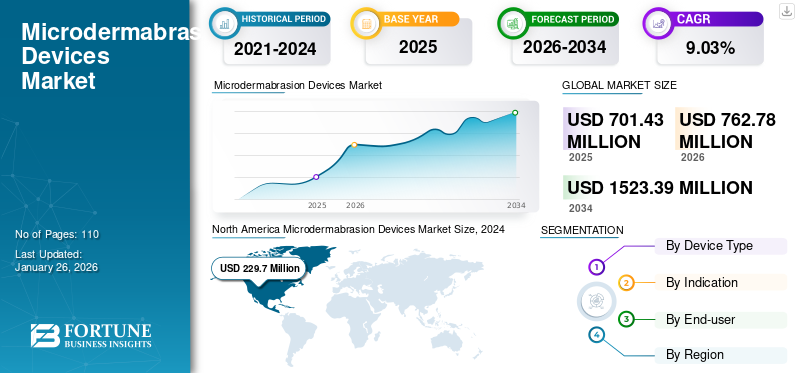
Download Free sample to learn more about this report.
Microdermabrasion Devices Market KEY TAKEAWAYS
 Global Market Size & Forecast
- 2025 Market Size: USD 688.54 million
- 2026 Market Size: USD 748.96 million
- 2034 Forecast Market Size: USD 1,516.25 million
- CAGR: 7.98% from 2026–2034
 Market Share
- North America dominated the microdermabrasion devices market with a 36.22% share in 2025.
- The diamond device type segment is projected to account for 75.30% of the market in 2026.
- The acne & scars indication segment is projected to hold 52.45% of the market in 2026.
 Key Regional Highlights
North America
North America generated USD 249.40 million in 2025, accounting for 36.22% of the global market.
Europe
Europe reached USD 177.09 million in 2025, representing 25.72% of the global market.
Asia Pacific
Asia Pacific recorded USD 158.58 million in 2025, capturing 23.03% of the global market share.
U.S.
The market is projected to reach USD 227.95 million by 2026.
Japan
The market is projected to reach USD 33.05 million by 2026.
Read More

COVID-19 IMPACT
Decline in Minimally Invasive Elective Procedures amid COVID-19 Hampered Market Growth
The COVID-19 pandemic outbreak led to a decline in market growth in 2020. Worldwide lockdowns and trade restrictions imposed by government authorities across the globe led to the cancellation of elective cosmetic procedures, including microdermabrasion treatments, in health settings. Moreover, a decline in the number of patient visits across hospitals and specialty clinics for aesthetic procedures further hampered the demand for these devices.
- According to the American Board of Plastic Surgery Report 2020, the number of microdermabrasion procedures declined by 23.0% in 2020 in the U.S., compared to 681,190 procedures in 2019.
However, after the COVID-19 pandemic, the volume of patients seeking cosmetic treatments increased across medical offices and spas due to the relaxation of the global restrictions in 2021. Moreover, the rising emphasis of industry players on launching devices for home care and the expanding the distribution channel contributed to the market's growth in 2021 and 2022.
- In October 2020, Trophy Skin was acquired by Pattern Inc., an e-commerce accelerating company, to expand its device business globally.
Microdermabrasion Devices Market Trends
Rising Demand for Home-use Microdermabrasion Devices
The demand for microdermabrasion treatment is increasing across medispas and dermatology clinics owing to the high incidence of skin diseases. However, the cost associated with cosmetic treatment across healthcare settings is high and needs multiple interventions.
- According to data from the American Society of Plastic Surgeons in 2022, the average cost of one session of microdermabrasion in the U.S. is USD 167.
Thus, the high cost of cosmetic procedures in health centers and the increasing introduction of cosmetic devices for home use are increasing the demand for microdermabrasion equipment across developed countries. Furthermore, the high focus of industry players on launching cost-effective products are catering to the global microdermabrasion devices market growth.
- In September 2020, Trophy Skin announced the introduction of the ‘Trophy Skin UltradermMD’. It is a 3-in-1 at-home microdermabrasion device that exfoliates, unclogs, and minimizes pores and tones, and tightens the skin with ten suction levels and five treatment modes.
Download Free sample to learn more about this report.
Microdermabrasion Devices Market Growth Factors
Rising Shift Toward Crystal-Free Microdermabrasion Devices to Propel Market Development
Microdermabrasion devices are used in the treatment of several skin conditions, such as acne, hyperpigmentation, melasma, and other signs of skin aging. The increasing awareness of minimally invasive skin rejuvenation among the population and the rising presence of advanced devices by industry players propel market growth.
The adoption of these devices with diamond tips is increasing owing to high potential advantages such as precise nature, less abrasive, accurate results, ease of handling, and safety compared to crystal-based devices. Moreover, the rising adoption of diamond-based devices across home settings among the general population will further accelerate market growth during the forecast period.
- According to data published by the School of Botanical & Medical Aesthetics in 2023, diamond-tipped devices are safer and more precise compared to crystal-tipped microdermabrasion devices.
Moreover, market players are now actively focusing on producing new and innovative crystal-free devices, further augmenting demand for these devices across the globe.
- The lancerskincare launched Pro Polish Microdermabrasion Device in July 2020. The device combines diamond-encrusted tips with gentle vacuum suctioning and is used to revitalize the skin texture, and target fine lines and wrinkles across the body.
Thus, elements such as the increasing adoption of crystal-free microdermabrasion, combined with innovative product offerings by market players, are expected to augment the growth of the market.
RESTRAINING FACTORS
Rising Preference toward Alternative Procedures to Hamper the Device Market
Microdermabrasion procedures minimize many skin care concerns, including uneven skin tone, clogged pores, blackheads, acne, fine lines, minor scars, and age spots. However, the increasing presence of effective facial rejuvenation treatments across similar applications, such as chemical peels, microneedling, hydradermabrasion, and dermabrasion, is limiting the adoption of these devices across medical clinics. Moreover, side effects associated with the use of these devices in home settings, such as improper use, bruising, and burning of skin, further limit its adoption among the population.
- According to data published by Vibrant Skin in August 2022, microneedling is a choice of treatment against microdermabrasion among pregnant women and patients with active skin conditions such as eczema, rosacea, and cold sores.
Furthermore, the increasing launch and adoption of advanced devices with effective results compared to microdermabrasion equipment is further hampering the growth of the market.
- In August 2023, the Beauty Health Company announced a new milestone with the placement of its 30,000th Hydrafacial delivery system, an adjunct to microdermabrasion device, marking a new landmark for the company’s expanding global omnichannel footprint.
Thus, the above factors, combined with the rising adoption of other advanced devices among healthcare professionals, limit the growth of the market.
Microdermabrasion Devices Market Segmentation Analysis
By Device Type Analysis
Diamond Segment’s Growth Driven by Rise in Presence of Advanced Devices
Based on device type, the global market is segmented into crystal and diamond.
The diamond segment is projected to dominate the market with a share of 75.30% in 2026. The dominance was attributed to the rise in the number of cosmetic non-surgical procedures and the increasing number of new players offering innovative devices, further bolstering the growth of the diamond segment.
- For instance, in March 2023, Bella Vacuum launched a new business, Bella Facial. The brand offers professional aesthetic products, including microdermabrasion machines for spas and salons.
The crystal segment is expected to grow at a substantial CAGR during the forecast period. The segment's growth is attributed to the high demand for these devices in the treatment of skin diseases across developing countries. Moreover, the increasing prevalence of skin conditions, such as acne scars and melasma, further propels the demand for crystal-tipped devices.
To know how our report can help streamline your business, Speak to Analyst
By Indication Analysis
Acne & Scars Segments Leads with Increase in Global Prevalence of Skin Disorders
Based on indication, the market for microdermabrasion devices is segmented into acne & scars, anti-aging, and others.
The acne & scars segment is projected to dominate the market with a share of 52.45% in 2026. The higher share was due to the rising prevalence of acne and the increased awareness of non-surgical cosmetic treatments such as acne scar removal among the young population.
- According to an article published by the Journal of Clinical Medicine in June 2023, the worldwide prevalence of acne among adolescents is about 80%. As per similar estimates, acne in the adult population is estimated to affect 40% of the global population.
The anti-aging segment is expected to grow at the highest CAGR from 2025 to 2032. The growing number of anti-aging and facial rejuvenation cosmetic procedures and increasing expenditure on cosmetics products and procedures among the adult population is expected to drive the segment growth during the forecast period.
- According to statistics revealed by the International Society of Aesthetic Plastic Surgery (ISAPS) report in 2022, the total volume of facial rejuvenation procedures increased by 10.0% globally compared to 2021.
By End-user Analysis
Specialty Clinics & Spas Segment Dominance Led by Rising Global Penetration of Med Spa Centers
Based on end-user, the market is segmented into specialty clinics & spas, and homecare & others.
The specialty clinics & spas segment is projected to dominate the market with a share of 74.11% in 2026. The growing number of specialty clinics and medispa centers offering a varied range of non-surgical treatments augmented the segment's growth. Moreover, the increasing expansion of medical tourism for cosmetic treatments across developing countries such as India, Brazil and Mexico further propels the segment growth.
- According to data published by the American Med Spa Association in 2022, the total number of medispa centers increased to 8,841 in 2022 from 7,430 in 2021 in the U.S.
On the other hand, the homecare & others segment is expected to grow at a significant CAGR from 2025 to 2032. Increasing adoption of at-home microdermabrasion devices paired with an increased number of advanced products launched by market players is propelling the segment during the forecast period.
- For instance, in February 2020, Michael Todd Beauty launched an at-home sonic microdermabrasion system. The device uses a diamond microdermabrasion system for exfoliation and offers micro mist and pore extraction options.
REGIONAL INSIGHTS
Geographically, the market is studied across North America, Europe, Asia Pacific, Latin America, and the Middle East & Africa.
North America Microdermabrasion Devices Market Size, 2024 (USD Million)
To get more information on the regional analysis of this market, Download Free sample
North America
North America recorded a market size of USD 249.4 million in 2025, capturing 36.22% of the global market share, and is projected to reach USD 270.93 million in 2026. The growth is attributed to the rising demand for non-surgical cosmetic procedures among the population and the increasing regional presence of aesthetic clinics providing several procedures, such as microdermabrasion and micro-needling, among others. Moreover, increasing adoption of at-home aesthetic devices among the population further caters to the region’s microdermabrasion devices market growth. The U.S. market is projected to reach USD 227.95 million by 2026.
- According to the 2022 survey by the International Society of Aesthetic Plastic Surgery, about 30.8% of total non-surgical cosmetic procedures, including microdermabrasion, were conducted in the U.S. in 2022.
Europe
In 2025, Europe represented USD 177.09 million, accounting for 25.72% of the worldwide market, and is projected to grow to USD 192.72 million in 2026. The growth is due to the increasing prevalence of acne among the European population and the rising availability of aesthetic devices for cosmetic treatments in professional and home settings. The UK market is projected to reach USD 26.61 million by 2026, while the Germany market is projected to reach USD 36.54 million by 2026.
- According to Acne Statistics U.K., in 2022, about 11.5% of the U.K. adult population suffered from acne vulgaris.
Asia Pacific
The Asia Pacific market generated USD 158.58 million in 2025, representing 23.03% of the global market landscape, and is expected to reach USD 173.26 million in 2026. The market in the Asia Pacific region is anticipated to witness robust growth during the forecast period. A surge in the rate of adoption of aesthetic devices in specialty clinics boosts the demand for microdermabrasion devices in the region. In addition, the increasing number of patients visiting clinics for non-surgical procedures is expected to propel market growth. The Japan market is projected to reach USD 33.05 million by 2026, the China market is projected to reach USD 27.01 million by 2026, and the India market is projected to reach USD 23.3 million by 2026.
- According to the International Society of Aesthetic Plastic Surgery (ISAPS) report in 2022, about 324,155 non-surgical cosmetic procedures were performed in India.
Latin America
In 2025, Latin America held 9.58% of the global market, reaching a valuation of USD 65.96 million, and is projected to grow to USD 71.49 million in 2026.
Middle East & Africa
Middle East & Africa accounted for USD 37.5 million in 2025, representing 5.45% of the global market share, and is projected to reach USD 40.56 million in 2026. On the other hand, Latin America and the Middle East & Africa region are expected to register a substantial CAGR during the forecast period due to rapidly developing infrastructure and increasing medical tourism across Brazil, Mexico, and Turkey.
Key Industry Players
Strong Focus by Key Players on Brand Foundation Across Developing Countries to Drive Their Market Share
The global market in 2024 is consolidated with major players operating in the market, such as Trophy Skin, Age Sciences Inc., ImageDerm Inc., and Koninklijke Philips N.V. The rising focus on expanding the product distribution channel by significant players and strategic initiatives to diversify their product offerings in developing countries propelled their global microdermabrasion devices market share in 2024.
- For instance, according to data published by Age Sciences Inc., in April 2023, the company announced building a brand foundation in Asia markets such as China, Korea, Japan, and Southeast Asia for its cosmetic devices.
Similarly, other players, such as SILHOUET-TONE USA, Conair LLC, and Beurer GmbH, are emerging companies in the global market. The increasing emphasis on inorganic growth strategies, such as collaborations and acquisitions with existing players, is expected to boost their segment share in the market.
List of Top Microdermabrasion Devices Companies:
- Trophy Skin (U.S.)
- Age Sciences Inc. (U.S.)
- Conair LLC (U.S.)
- Skin for Life (Lifeline Medical, Inc.) (U.S.)
- ImageDerm Inc. (U.S.)
- DiamondTome Pro (U.S.)
- Koninklijke Philips N.V. (Netherlands)
- SILHOUET-TONE USA (U.S.)
- Dermaglow (U.S.)
- Rio the Beauty Specialists (U.K.)
- Beurer GmbH (Germany)
KEY INDUSTRY DEVELOPMENTS
- October 2023: Trufacial received the U.S. patent for its three dual-function plate technology that combines microdermabrasion, massaging, and microneedling functions in a single at-home device for smoother, firmer, and more toned skin.
- August 2023: Beautybio announced the launch of an at-home facial device. The newly launched GloFacial combines vacuum technology with microdermabrasion and blue light therapy.
- July 2021: Age Sciences Inc., launched Personal Microderm, an at-home microdermabrasion tool that uses spinning disc technology embedded with aluminum oxide crystals.
- October 2019: The Rio Beauty Specialists launched the Rio Skin Renew Microdermabrasion System. The system uses vacuum technology to gently lift dead skin cells from the skin's surface.
- May 2019: Age Sciences Inc., launched its line of gadgets in the Middle East region, including personal at-home microdermabrasion devices.
REPORT COVERAGE
The microdermabrasion devices research report provides a detailed competitive landscape and market dynamics. It focuses on key aspects such as the prevalence of skin diseases, the number of non-surgical cosmetic procedures, and an overview of microdermabrasion devices in the market. Furthermore, the report provides information on key industry developments, and detailed market segmentation by device type, indication, and end-user. In addition, the report includes insights related to technological advancements in the devices and the impact of COVID-19 on the market.
Request for Customization to gain extensive market insights.
Report Scope & Segmentation
|
ATTRIBUTE |
DETAILS |
|
Study Period |
2021-2034 |
|
Base Year |
2025 |
|
Estimated Year |
2026 |
|
Forecast Period |
2026-2034 |
|
Growth Rate |
CAGR of 7.98% from 2026-2034 |
|
Historical Period |
2021-2024 |
|
Unit |
Value (USD million) |
|
Segmentation |
By Device Type
|
|
By Indication
|
|
|
By End-user
|
|
|
By Region
|
Frequently Asked Questions
According to Fortune Business Insights, the global market is projected to grow from USD 688.54 million in 2025 to USD 1516.25 million by 2034.
In 2025, the North American market size stood at USD 249.4 million.
The market will exhibit steady growth at a CAGR of 7.98% during the forecast period (2026-2034).
The increase in the number of non-surgical cosmetic procedures globally and the rising adoption of these devices across homecare settings are the key drivers of the market.
Age Sciences Inc., ImageDerm Inc., and Koninklijke Philips N.V., are the markets top players.



- 2021-2034
- 2025
- 2021-2024
- 110
Get 30-60 hrs Free Customization
Expand Regional and Country Coverage, Segments Analysis, Company Profiles, Competitive Benchmarking, and End-user Insights.













.webp)






Related Reports
-
US +1 833 909 2966 ( Toll Free )
-
Get In Touch With Us