Molecular Cytogenetics Market Size, Share & Industry Analysis, By Product & Service (Hardware [Instruments {Imaging Systems & Analyzers, Microarray Scanners and Others} and Reagents & Kits] and Software & Services), By Technique (Fluorescence In-Situ Hybridization (FISH), Comparative Genomic Hybridization (CGH), Karyotyping and Others), By Application (Genetic Disorders, Oncology and Others), By End User (Hospitals & Clinics, Clinical Laboratories, Pharmaceutical & Biotechnological Companies and Others), and Regional Forecast, 2026-2034
 Download Free Sample
KEY MARKET INSIGHTS
 Listen to Audio Version
The global molecular cytogenetics market size was valued at USD 1.63 billion in 2025 and is projected to grow from USD 1.78 billion in 2026 to USD 3.67 billion by 2034 exhibiting a CAGR of 9.5% during the forecast period. North America dominated the global molecular cytogenetics market with a market share of 39.88% in 2025.
Molecular cytogenetics refers to the analysis of chromosome structure to help distinguish normal and cancer-causing cells. The growing prevalence of cancer and genetic disorders is resulting in an increasing patient pool in clinical settings. This surging patient pool and technological advancements in products are thereby supporting the adoption rate of molecular cytogenetics devices and software in the market.
- For instance, according to the 2025 statistics published by the Centers for Disease Control and Prevention (CDC), approximately 1.9 million cancer cases were reported in the U.S.
Additionally, the increasing adoption of personalized and precision medicine and growing R&D investments are also vital factors contributing to the rising demand for these procedures in market. This, coupled with increasing focus toward R&D initiatives to develop and introduce novel products, is driving the focus of prominent players, including Abbott, Agilent Technologies, Inc., and others, and is expected to support market growth.
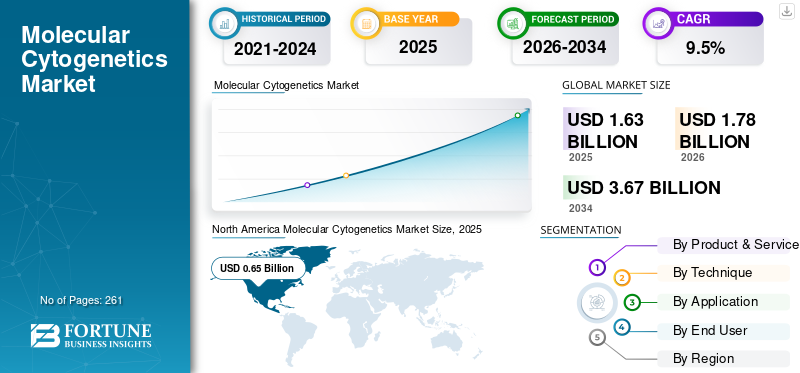
Download Free sample to learn more about this report.
MOLECULAR CYTOGENETICS MARKET KEY TAKEAWAYS
 Market Size & Forecast
- 2025 Market Size: USD 1.63 Billion
- 2026 Market Size: USD 1.78 Billion
- 2034 Forecast Market Size: USD 3.67 Billion
- CAGR: 9.5% from 2026–2034
 Market Share
- North America dominated the molecular cytogenetics market with a 39.88% share in 2025.
- The hardware segment held the largest market share in 2025.
- The oncology segment accounted for 61.0% of the market in 2025.
 Key Regional Highlights
North America
North America reached USD 0.65 billion in 2025, maintaining its leading market position.
Europe
Europe is projected to reach USD 0.53 billion in 2026, growing at a CAGR of 8.0%.
Asia Pacific
Asia Pacific is expected to reach USD 0.42 billion in 2026 as the third-largest regional market.
U.S.
The market is estimated to reach USD 0.64 billion in 2026.
Japan
Asia Pacific growth is supported by expanding genetic testing adoption across major countries, including Japan.
Read More

Market Dynamics
Market Drivers
Increasing Prevalence of Chronic Conditions to Drive Market Growth
The growing prevalence of genetic disorders and various types of cancer, such as lung cancer, breast cancer and others, is contributing to the increasing demand for advanced detection technology among patient population, consequently driving the adoption rate of these products in the market.
- For instance, according to statistics published by the World Cancer Research Fund (WCRF), approximately 1.5 million new cases of prostate cancer were reported globally in 2022.
Cytogenetics methods such as karyotyping, comparative genomic hybridization (CGH), and others play a significant role in the detection of microdeletions, aneuploidies, and other structural variations, which help in the diagnosis of certain genetic and oncologic conditions. Therefore, the factors above, coupled with increasing focus of prominent companies on the development and introduction of novel products, are anticipated to boost the adoption rate, thereby supporting the global molecular cytogenetics market size.
Other Prominent Drivers
- Increased research funding and investments in oncology, rare disease research, and translational genomics.
Market Restraints
High Cost Associated with Instruments & Assay Kits to Limit the Market Growth
There is a growing demand for technologically advanced molecular cytogenetic devices and kits for diagnostic and research workflows. However, the high cost associated with these advanced devices and kits is anticipated to limit the adoption rate for these systems, particularly in developing nations, including Brazil, Mexico, and others.
The technologically advanced imaging systems, such as automated FISH platforms, microarray scanners, and digital cytogenetics systems, require high capital investment, making it challenging for many small and mid-sized laboratories, especially in developing markets. Moreover, recurring costs of consumables such as FISH probes, slide preparation consumables, and others also add to the financial burden.
- For instance, according to 2025 data published by the LabX Media Group, it was reported that the cost of new microarray scanners ranges from USD 20,000 to USD 150,000.
Market Opportunities
Expansion of Genetic Testing in Developing Nations to Create Market Opportunity
There is an increasing demand for molecular cytogenetic techniques owing to their distinct benefits, including enhanced diagnostic accuracy and others, among the patient population. Healthcare facilities are emphasizing the scaling up of genetic testing procedures, including reproductive genetics, newborn screening, and others.
Furthermore, increasing healthcare expenditure, expansion of private clinical laboratories, and strategic initiatives among governmental organizations to promote early detection of disorders are expected to support the adoption rate of these products and services in the market.
- According to a 2025 article published by the National Cancer Institute, approximately 2.0 million women undergo non-invasive prenatal testing every year in the U.S.
Market Challenges
Limited Healthcare Access in Emerging Nations to Hamper Market Growth
There is an increasing focus on novel products and kits for detecting chronic conditions among the patient population. However, limited healthcare spending, limited penetration of technologically advanced devices and software, coupled with insufficient reimbursement policies, especially in emerging markets, are some of the factors resulting in limited access to clinical facilities among the patient population.
Additionally, shortage of skilled cytogenetic technologists and highly stringent regulatory frameworks for the approval, validation, and commercialization of diagnostic kits, instruments and others are some other factors resulting in the delayed detection of genetic conditions and various types of cancer, thus leading to postponement of diagnostic procedures among patients, particularly in developing nations, including China, Mexico, among others.
- For instance, according to 2025 data published by the World Bank Group (WBG), it was reported that about 4.5 billion people are not covered by essential health services globally.
Other Prominent Challenges
- Data interpretation challenges due to complex structural variants and uncertain variants, which require experienced clinical evaluation.
Molecular Cytogenetics Market Trends
Technological Advancements in these Devices to Create Market Opportunities
There is an increasing focus on integration of technological advancements in these products, such as automated and miniaturized imaging devices, which improve workflow efficiency and enhance diagnostic accuracy. Different companies are emphasizing research and development activities to introduce bench-top imaging systems with digital image capture and other innovative features.
The integration of advanced features allows for high-throughput evaluation of karyotyping and FISH results, further reducing the dependency on highly advanced cytogenetic technologists. Therefore, rising demand and growing technological advancements including integration of bioinformatics tools and cloud based analysis pipelines for automated interpretation and reporting by the manufacturers are expected to fuel the the market growth.
- In September 2025, Leica Biosystems Nussloch GmbH launched CytoVision DX, a next-generation image capture, analysis, and case management system purpose-built for clinical cytogenetics laboratories.
Other Prominent Trends
- Increasing use of fluorescence in situ hybridization and array based comparative genomic hybridization for oncology, hematology, and prenatal diagnostics.
- Adoption of newer technologies such as optical genome mapping and high resolution arrays to detect complex structural variants.
- Growing menu of laboratory developed tests in hospital and reference laboratories for disease specific panels.
- Consolidation of molecular cytogenetics into broader comprehensive genomic profiling services.
Download Free sample to learn more about this report.
SEGMENTATION ANALYSIS
By Product & Service
Growing Product Launches to Drive Hardware Segment Dominance
Based on product & service, the market is classified into hardware and software & services. Hardware is further bifurcated into instruments and reagents & kits. Additionally, instruments are further divided into imaging systems & analyzers, microarray scanners, and others.
To know how our report can help streamline your business, Speak to Analyst
The hardware segment held the largest market share in 2025. This growth is due to the increasing prevalence of genetic disorders and cancer among patients, resulting in a growing demand for advanced molecular cytogenetic instruments such as microarray scanners, and others, globally. This, coupled with increasing focus of prominent players on R&D activities to launch novel products, is further expected to support the segmental growth.
- In October 2025, Thermo Fisher Scientific, Inc., introduced the Applied Biosystems SwiftArrayStudio Microarray Analyzer, designed for fast and scalable sample analysis.
The software & services segment is expected to grow at a CAGR of 10.0% over the forecast period.
By Technique
High Sensitivity and Specificity of Fluorescence in Situ Hybridization (FISH) Segment Led to Dominance of the Segment
Based on technique, the market is bifurcated into fluorescence in situ hybridization (FISH), comparative genomic hybridization (CGH), karyotyping, and others.
The fluorescence in situ hybridization (FISH) segment dominated the market in 2025. In 2026, the segment is anticipated to dominate with a 42.3% share. This dominant share is due to its advantages, such as high sensitivity and specificity and others. This, coupled with increasing focus on acquisitions and partnerships among other players, is expected to support segmental growth in the market.
- In October 2023, Ikonisys SA, a player specializing in early and accurate detection of cancer with a unique, fully automated solution for medical diagnostic labs, partnered with Biocare Medical, a leader in immunohistochemistry (IHC) and FISH (Fluorescent in situ hybridization) tools and reagents.
The comparative genomic hybridization (CGH) segment is expected to grow at a CAGR of 10.2% in the market during the forecast period.
By Application
The Increasing Prevalence of Cancer Led to the Dominance of Ocology Segment
Based on application, the market is segmented into genetic disorders, oncology, and others.
The oncology segment dominated the global market in 2025. The segment held a share of 61.0% in 2025. This growth is primarily due to increasing prevalence of various types of cancer including breast cancer, and others, thus resulting in a growing demand for molecular cytogenetics devices among the patient population in the market.
- For instance, according to the 2022 data published by World Health Organization (WHO), it was reported that about 2.3 million women were diagnosed with breast cancer globally.
The segment of genetic disorders is set to flourish with a growth rate of 9.2% over the forecast period.
By End-user
Increasing Number of Clinical Laboratories Led to the Segment’s Dominance
Based on end user the market is segmented into hospitals & clinics, clinical laboratories, pharmaceutical and biotechnological companies, and others.
The clinical laboratories segment dominated the market in 2025. The increasing prevalence of genetic disorders and various types of cancer, as well as the growing number of healthcare facilities such as clinical laboratories, are some of the vital factors supporting the growth of the segment in the market. Furthermore, the segment is set to hold a 41.9% share in 2025.
- For instance, according to 2021 statistics published by the Laboratory of Florida, LLC., there are more than 200,000 clinical laboratories in the U.S.
In addition, pharmaceutical & biotechnological companies’ end users are projected to grow at a 10.3% CAGR during the forecast period.
Molecular Cytogenetics Market Regional Outlook
Based on region, the market has been studied across North America, Europe, Asia Pacific, Latin America, and the Middle East & Africa.
North America
North America Molecular Cytogenetics Market Size, 2025 (USD Billion)
To get more information on the regional analysis of this market, Download Free sample
The North America molecular cytogenetics market held the dominant share in 2024, valued at USD 0.59 billion, and also took the leading share in 2025 with USD 0.65 billion. The dominance of the region is due to certain factors, including high testing volumes, strong reimbursement in parts of the region, and the presence of leading manufacturers and reference laboratories. In 2026, the U.S. market is estimated to reach USD 0.64 billion. Increasing prevalence of cancer and genetic disorders and others, along with growing adoption of technologically advanced techniques including comparative genomic hybridization (CGH), and others is likely to support the growth of the market in the country.
- For instance, according to 2022 statistics published by the World Cancer Research Fund (WCRF), it was reported that about 230,125 people were suffering from prostate cancer in the U.S.
Europe and Asia Pacific
Other regions, such as Europe and the Asia Pacific, are expected to witness considerable growth in the forecast period. During the study period, the European region is projected to record a growth rate of 8.0% and reach the valuation of USD 0.53 billion in 2026. This is due to significant adoption of the product in oncology, prenatal testing, and rare disease diagnostics with strong public healthcare and research funding. Additionally, expanding healthcare infrastructure in China, India, Japan, and other countries, and rising investments in genetic testing also contributing factors to market growth. Backed by these factors, countries such as the U.K. are expected to record the valuation of USD 0.12 billion, Germany to record USD 0.11 billion, and France to record USD 0.09 billion in 2026. After Europe, the market in the Asia Pacific is estimated to reach USD 0.42 billion in 2026 and secure a position of third-largest region in the market. In the region, India is estimated to reach USD 0.07 billion while China is estimated to reach USD 0.14 billion in 2026.
Europe and Asia Pacific
Over the forecast period, the Latin America and Middle East & Africa regions are expected to witness moderate growth in this market. The Latin America market in 2026 is set to record USD 0.07 billion as its valuation. The emerging adoption with growth tied to improved access to specialized laboratories and international collaborations is expected to support the growth regional market. In the Middle East & Africa, GCC is set to attain the value of USD 0.02 billion in 2026.
Competitive Landscape
Key Industry Players
Increasing Expansion of Oncology Portfolio Among Prominent Companies Support Their Dominance
A robust and diversified product portfolio of advanced instruments, coupled with strong geographical presence, is a crucial factor contributing to the dominance of key players in the market. Abbott, Agilent Technologies, Inc., and Illumina, Inc., are few key contributors in the market. Moreover, the growing focus of prominent players on the expansion of their product portfolio is likely to support the global molecular cytogenetics market share.
- For instance, in May 2025, Illumina, Inc., expanded its clinical oncology portfolio with an aim to advance precision oncology and improve the standard of care.
Other key players, including MetaSystems, are also growing in the market, primarily due to their increasing focus on acquisitions and collaborations among other players to strengthen their presence.
List of Key Molecular Cytogenetics Companies Profiled
- Abbott (U.S.)
- MetaSystems (Germany)
- Agilent Technologies, Inc. (U.S.)
- Illumina, Inc. (U.S.)
- Leica Biosystems Nussloch GmbH (Germany)
- Hoffmann La-Roche. Ltd. (Switzerland)
- Danaher Corporation (U.S.)
- Predicta Biosciences (U.S.)
- Revvity (U.S.)
- Thermo Fisher Scientific, Inc. (U.S.)
KEY INDUSTRY DEVELOPMENTS
- May 2024 – Northwell Health Labs expanded the Multiple Myeloma (MM) fluorescence in situ hybridization (FISH) panel with two additional probes. This helped the company in strengthening its presence.
- May 2024 – Thermo Fisher Scientific Inc., updated the Applied Biosystems CytoScan Dx Assay and Applied Biosystems Chromosomal Analysis Suite (ChAS) Dx software to comply with in vitro diagnostic regulations (IVDR) 2017/746 in the European Union.
- April 2024 – Bionano, a player in the transformation of the cytogenetic workflow with optical genome mapping (OGM), partnered with Hangzhou Diagens Biotechnology Co., Ltd. (Diagens), the pioneering leader in artificial intelligence (AI) chromosome karyotype analysis technology, to commercialize the first-ever cytogenetic workflow.
- December 2023 – Cytelabs launched dual in-situ hybridization (DISH) testing for breast cancer, aiming to cater to the growing demand among patients.
- September 2020 – The National Institutes of Health has awarded Phase Genomics two grants totaling USD 3.9 million. The funds supported research on sequencing-based proximity ligation (Hi-C) assays that can be used in cytogenetics.
REPORT COVERAGE
The market report provides a detailed global molecular cytogenetics market analysis and focuses on key aspects such as leading companies, product & service, technique, application, and end user. Besides this, the global report offers insights into the market growth trends and highlights key industry developments. In addition to the aforementioned factors, the report encompasses several factors that have contributed to the growth and advancement of the market over recent years.
Request for Customization to gain extensive market insights.
Report Scope & Segmentation
|
ATTRIBUTE |
DETAILS |
|
Study Period |
2021-2034 |
|
Base Year |
2025 |
|
Estimated Year |
2026 |
|
Forecast Period |
2026-2034 |
|
Historical Period |
2021-2024 |
|
Growth Rate |
CAGR of 9.5% from 2026-2034 |
|
Unit |
Value (USD Billion) |
|
Segmentation |
By Product & Service, Technique, Application, End User, and Region |
|
By Product & Service |
· Hardware o Instruments § Imaging Systems & Analyzers § Microarray Scanners § Others o Reagents & Kits · Software & Services |
|
By Technique |
· Fluorescence In Situ Hybridization (FISH) · Comparative Genomic Hybridization (CGH) · Karyotyping · Others |
|
By Application |
· Genetic Disorders · Oncology · Others |
|
By End User |
· Hospitals & Clinics · Clinical Laboratories · Pharmaceutical & Biotechnology Companies · Others |
|
By Region |
· North America (By Product & Service, By Technique, By Application, By End User, and by Country) o U.S. (By Application) o Canada (By Application) · Europe (By Product & Service, By Technique, By Application, By End User, and by Country/Sub-region) o U.K. (By Application) o Germany (By Application) o France (By Application) o Italy (By Application) o Spain (By Application) o Scandinavia (By Application) o Rest of Europe (By Application) · Asia Pacific (By Product & Service, By Technique, By Application, By End User, and by Country/Sub-region) o China (By Application) o Japan (By Application) o India (By Application) o Australia (By Application) o Southeast Asia (By Application) o Rest of Asia Pacific (By Application) · Latin America (By Product & Service, By Technique, By Application, By End User, and by Country/Sub-region) o Brazil (By Application) o Mexico (By Application) o Rest of Latin America (By Application) · Middle East & Africa (By Product & Service, By Technique, By Application, By End User, and by Country/Sub-region) o GCC (By Application) o South Africa (By Application) o Rest of the Middle East & Africa (By Application) |
Frequently Asked Questions
Fortune Business Insights says that the global market size was USD 1.63 billion in 2025 and is projected to reach USD 3.67 billion by 2032.
In 2025, the North America regional market value stood at USD 0.65 billion.
Growing at a CAGR of 9.5%, the market will exhibit steady growth over the forecast period (2026-2034).
By product type, the hardware segment is the leading segment in this market.
The introduction of novel molecular cytogenetics products is one of the major factors driving the markets growth.
Abbott and Agilent Technologies, Inc., are the major players in the global market.
North America dominated the market share in 2025.
The growing prevalence of chronic conditions, the increasing number of product launches, among others, are some of the vital factors expected to boost the adoption of these products worldwide.



- 2021-2034
- 2025
- 2021-2024
- 261
Get 30-60 hrs Free Customization
Expand Regional and Country Coverage, Segments Analysis, Company Profiles, Competitive Benchmarking, and End-user Insights.













.webp)






Related Reports
-
US +1 833 909 2966 ( Toll Free )
-
Get In Touch With Us