Motorcycle Navigation System Market Size, Share & Industry Analysis, By Product Type (Standalone Motorcycle GPS Devices, Integrated/In-Dashboard Navigation Systems, Smartphone-Based Navigation Interfaces, & Helmet/Head-Up Display Navigation Systems), By Sales Channel (OEM & Aftermarket), By Motorcycle Type (Cruiser & Touring Motorcycles, Adventure/Sports Motorcycles, & Commuter Motorcycles), By Connectivity Type (Non-Connected/Offline GPS Navigation, Bluetooth-Enabled Navigation, Wi-Fi/Smartphone-Connected Navigation, & Cellular/Cloud-Connected Navigation), and Regional Forecast, 2026–2034
 Download Free Sample
(Offer valid till 31st Oct 2026)

Motorcycle Navigation System Market Size and Future Outlook
 Listen to Audio Version
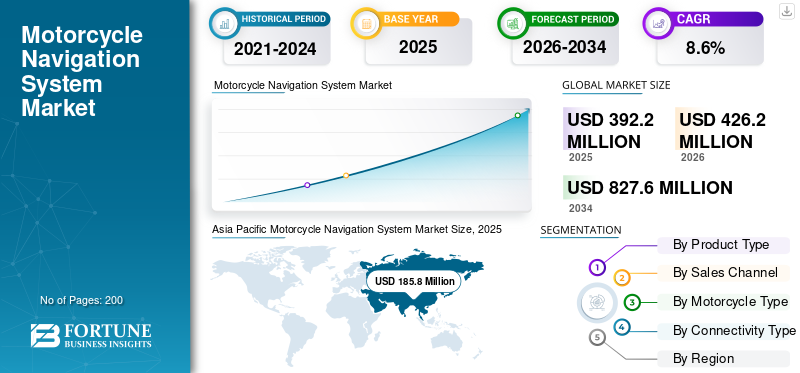
The motorcycle navigation system market size was valued at USD 392.2 million in 2025. The market is projected to grow from USD 426.2 million in 2026 to USD 827.6 million by 2034, exhibiting a CAGR of 8.6% during the forecast period. Asia Pacific dominated the motorcycle navigation system market with a market share of 47.37% in 2025.
Motorcycle navigation systems are GPS-enabled devices or integrated digital platforms that provide riders with route planning, turn-by-turn navigation, tracking, and mapping support. Market growth is driven by connected motorcycles, touring demand, GPS advancements, smartphone integration, rider safety needs, and real-time route guidance adoption.
Major players in the market include Garmin Ltd., TomTom International B.V., BMW Motorrad, Harley-Davidson, Inc., Robert Bosch GmbH, and Yamaha Motor Co., Ltd., competing through GPS navigation devices, connected motorcycle solutions, smartphone integration, motorcycle telematics, real-time route guidance, and safety-focused rider navigation technology.
Download Free sample to learn more about this report.
Motorcycle Navigation System Market Key Takeaways
 Global Market Size & Forecast
- 2025 Market Size: USD 392.2 million
- 2026 Market Size: USD 426.2 million
- 2034 Forecast Market Size: USD 827.6 million
- CAGR: 8.6% from 2026–2034
 Market Share
- Asia Pacific dominated the motorcycle navigation system market with a 47.37% share in 2025.
- The OEM segment is projected to grow at a 9.8% CAGR during the forecast period.
- Standalone motorcycle GPS devices are projected to grow at a 5.4% CAGR during the forecast period.
 Key Regional Highlights
Asia Pacific
Asia Pacific led the market in 2025, supported by high two-wheeler usage and rising digital adoption.
Europe
Europe was the second-largest market and is projected to grow at a 7.4% CAGR.
North America
North America held the third-largest market share in 2025, driven by demand for touring and premium motorcycle navigation systems.
U.S.
The market is estimated at USD 47.9 million in 2026, accounting for roughly 11.2% of global revenues.
Japan
The market is estimated at USD 17.2 million in 2026, representing roughly 4.0% of global revenues.
Read More

MOTORCYCLE NAVIGATION SYSTEM MARKET TRENDS
Smartphone-Based Navigation Platforms is an Emerging Market Trend
Smartphone-based navigation solutions are emerging as a major market trends due to affordability, ease of use, and regular software updates. Riders increasingly prefer app-based navigation and mapping software that connects with handlebar displays, helmet communication systems, and motorcycle infotainment systems. These platforms support traffic alerts, voice guidance, saved routes, and ride analytics without requiring expensive standalone devices. Their popularity is especially strong among urban riders, younger consumers, and cost-sensitive markets in the Asia Pacific and South America.
- In July 2023, Suzuki updated the Gixxer SF in India with Suzuki Ride Connect, a Bluetooth-enabled console offering smartphone-based navigation, call alerts, message alerts, speed warnings, ETA updates, and phone battery status, strengthening connected rider navigation features in entry-level sport motorcycles.
AI-Powered and Cloud-Connected Navigation is Another Prominent Market Trend
AI-powered navigation and cloud-connected mobility platforms are becoming important trends in the market. These systems analyze traffic, rider behavior, weather, road conditions, and route history to recommend safer and faster journeys. Advanced navigation platforms also support predictive routing, automatic map updates, hazard alerts, and personalized ride planning. This trend is encouraging manufacturers to combine intelligent transportation solutions with rider navigation technology, creating more adaptive, interactive, and safety-oriented motorcycle navigation experiences.
- In March 2026, Harman introduced its Ready Ride platform for motorcycles at Mobile World Congress 2026 in Barcelona, combining telematics, cloud connectivity, OTA updates, diagnostics, tracking, theft alerts, 4G/5G, GNSS, Wi-Fi, Bluetooth, and app-based digital rider services.
MARKET DYNAMICS
MARKET DRIVERS
Download Free sample to learn more about this report.
Rising Touring and Adventure Motorcycle Adoption Drives Market Growth
Growing preference for touring, adventure, and premium motorcycles is driving motorcycle navigation system market growth. Riders covering long-distance routes require reliable GPS navigation devices, turn-by-turn navigation, route planning, weather alerts, and real-time route guidance. Adventure riders also need off-road mapping, terrain-aware navigation, and rugged displays that remain visible in harsh conditions. This is increasing OEM and aftermarket adoption of rider navigation technology, especially across Europe, North America, and emerging Asia Pacific riding communities.
- In June 2026, Bajaj Auto announced the development of a new adventure motorcycle for Indian and global markets, targeting lightweight touring demand with long-travel suspension, upright ergonomics, multiple engine options, and affordability-focused positioning for domestic and Latin American riders.
Connected Motorcycle Ecosystems Drive Smart Navigation Integration
The shift toward connected motorcycle solutions is strongly supporting market growth. Motorcycle OEMs are integrating navigation platforms with digital clusters, smartphone apps, Bluetooth systems, emergency alerts, and motorcycle telematics. These systems improve rider safety, enable vehicle tracking technology, and provide location-based services such as theft tracking, route sharing, nearby fuel stations, and maintenance alerts. As motorcycles become more software-enabled, navigation systems are evolving from basic route tools into connected smart riding systems.
- In December 2025, Pioneer announced Pioneer Ride Connect, a two-wheeler UX solution to debut at CES 2026, integrating HERE SDK for cloud-based navigation, real-time traffic, motorcycle-optimized routing, BLE projection, voice HMI, AI hazard sharing, offline support, and global connected services.
MARKET RESTRAINTS
High System Cost Limits Adoption in Price-Sensitive Markets
High product and installation costs remain a major restraint for the market. Integrated motorcycle navigation systems, premium motorcycle infotainment systems, rugged GPS displays, and connected telematics platforms increase overall vehicle cost, making them less attractive for entry-level and commuter motorcycle buyers. In developing markets, many riders rely on smartphones instead of dedicated GPS navigation devices. This cost gap slows adoption among mass-market two-wheeler users, especially where affordability remains the primary purchase factor.
MARKET OPPORTUNITIES
Fleet and Commercial Two-Wheeler Expansion Creates Lucrative Market Opportunities
The rising use of motorcycles for delivery, logistics, ride-hailing, and field services creates strong opportunities for motorcycle GPS trackers and navigation-enabled telematics systems. Fleet operators require vehicle tracking technology, route optimization, driver behavior monitoring, theft prevention, and real-time route guidance to improve efficiency. As last-mile delivery networks expand, demand for connected motorcycle solutions is expected to increase. This creates opportunities for navigation providers, telematics firms, and OEMs targeting commercial two-wheeler applications.
- In August 2025, Rapido launched Bike Direct in Karnataka, India after Uber and Ola halted bike taxi services, offering captains technology access for direct customer connections, highlighting continued dependence on app-based routing, location services, and two-wheeler mobility platforms in urban transport.
Helmet and Head-Up Display Navigation Opens New Avenues for Market Growth
Helmet-based navigation and head-up display systems offer a promising opportunity for the premium and adventure riding segments. These solutions allow riders to receive turn-by-turn navigation, hazard alerts, speed information, and communication prompts without looking away from the road. Integration with smart riding systems, Bluetooth headsets, and connected motorcycle platforms can improve safety and convenience. As rider safety awareness increases, helmet navigation and augmented display technologies may become attractive add-ons for premium motorcycles and professional riders.
- In November 2025, TVS Motor Company partnered with Swiss startup Aegis Rider to showcase an augmented reality heads-up display helmet at EICMA 2025, featuring spatially anchored navigation, hazard alerts, call notifications, smartphone connectivity, infotainment integration, and future V2X-enabled ride assistance.
MARKET CHALLENGES
Connectivity Gaps and Platform Compatibility Affect User Experience
Connectivity limitations in remote riding areas and compatibility issues across motorcycle platforms remain key challenges. Navigation systems depend on stable GPS signals, mobile data, cloud updates, and smartphone pairing to deliver accurate real-time route guidance. Poor network coverage, outdated maps, app-device mismatch, and limited integration with older motorcycles can affect performance. Manufacturers must ensure reliable offline navigation, cybersecurity protection, and seamless compatibility across devices, operating systems, and motorcycle brands to maintain rider trust.
Segmentation Analysis
By Sales Channel
Broad Replacement Base and Retrofit Demand Sustain Aftermarket Segment Growth
Based on sales channel, the market is segmented into OEM and aftermarket.
The aftermarket segment holds the largest market share in 2025. The growth of the segment is due to strong replacement demand, wider use of motorcycle GPS trackers, and rising retrofit installation of GPS navigation devices across existing motorcycles. Riders prefer aftermarket systems for affordability, app compatibility, vehicle tracking technology, and flexible upgrades. Growing touring, delivery, and adventure riding electronics demand further support for aftermarket adoption across both developed and emerging motorcycle sectors.
The OEM segment is the fastest-growing and is projected to grow at a CAGR of 9.8% during the forecast period. Growth is driven by increasing factory integration of connected motorcycle solutions, motorcycle infotainment systems, smart riding systems, and real-time route guidance in premium motorcycles.
- In January 2026, P3 digital services and Magic Lane launched a motorcycle-specific navigation solution integrated into Sparq OS, featuring predictive environmental alerts, AI-based natural language routing, scenic motorcycle-optimized routes, Android Automotive OS integration, and faster deployment support for motorcycle OEMs.
By Product Type
Smartphone Connectivity and App-Based Navigation Boost Demand for Smartphone-Based Navigation Interfaces
Based on product type, the market is segmented into standalone motorcycle GPS devices, integrated/in-dashboard navigation systems, smartphone-based navigation interfaces, and helmet/head-up display navigation systems.
The smartphone-based navigation interfaces segment is dominating and also projected to develop at the fastest-growing CAGR over the forecast period. Affordability, easy app access, frequent map updates, and strong rider preference for mobile-based turn-by-turn navigation drive the segment growth. Integration with Bluetooth headsets, handlebar mounts, motorcycle infotainment systems, and connected motorcycle solutions further supports adoption among urban commuters, touring riders, and cost-sensitive motorcycle users.
- In November 2024, HERE Kawasaki Motors selected technologies to upgrade RIDEOLOGY THE APP MOTORCYCLE with HERE SDK Navigate Edition, enabling two-wheeler turn-by-turn navigation, meter-cluster display guidance, Bluetooth smartphone connectivity, and voice instructions through connected rider headsets.
Standalone motorcycle GPS devices represent the second-largest segment and are projected to grow at a CAGR of 5.4% during the forecast period. Demand is supported by touring and adventure riders requiring rugged hardware, offline maps, weather resistance, long battery life, and dependable real-time route guidance.
By Connectivity Type
Smartphone Pairing and App Ecosystem Propels Wi-Fi/Smartphone-Connected Navigation Segment Dominance
Based on connectivity type, the market is segmented into non-connected/offline GPS navigation, bluetooth-enabled navigation, Wi-Fi/smartphone-connected navigation, and cellular/cloud-connected navigation.
The Wi-Fi/smartphone-connected navigation segment held the largest motorcycle navigation system market share in 2025. The segment growth is supported by strong rider preference for app-based navigation, live traffic alerts, navigation and mapping software updates, and seamless smartphone pairing. Riders increasingly use connected motorcycle solutions for turn-by-turn navigation, real-time route guidance, ride sharing, and location-based services, making smartphone-connected systems highly attractive across commuting, touring, and adventure motorcycle applications.
The cellular/cloud-connected navigation segment is the fastest-growing segment and is projected to grow at a CAGR of 10.6% during the forecast period. Cloud map updates, motorcycle telematics, predictive routing, theft alerts, remote diagnostics, and intelligent transportation solutions in premium and fleet motorcycles drive growth.
- In March 2026, HARMAN announced Ready Ride at MWC Barcelona 2026, a rugged two-wheeler connectivity platform supporting navigation through Apple CarPlay and Android Auto, OTA updates, telematics, diagnostics, theft alerts, tracking, eCall readiness, and scalable OEM deployment.
By Motorcycle Type
To know how our report can help streamline your business, Speak to Analyst
Daily Mobility Needs and High Two-Wheeler Usage Boosts Commuter Motorcycles Segment Growth
Based on motorcycle type, the market is segmented into cruiser & touring motorcycles, adventure motorcycles, sports motorcycles, and commuter motorcycles.
The commuter motorcycle segment held the largest market share in 2025. The segment growth is driven by the large installed base of daily-use motorcycles, especially across the Asia Pacific, South America, and price-sensitive urban sectors. Riders increasingly use smartphone-based navigation interfaces, Bluetooth-enabled navigation, and motorcycle GPS trackers for route planning, traffic avoidance, theft monitoring, and real-time route guidance, supporting strong demand for affordable and easy-to-use rider navigation technology.
The adventure motorcycles segment is the fastest-growing segment and is projected to grow at a CAGR of 9.5% during the forecast period. Rising long-distance touring, off-road riding, rugged GPS navigation devices, offline maps, terrain guidance, and adventure riding electronics also supports market growth.
- In June 2026, Bajaj Auto was reported to be developing next-generation Pulsar Classic motorcycles, with expected upgrades including a new platform, digital instrument cluster, Bluetooth connectivity, smartphone integration, and possible turn-by-turn navigation to improve commuter motorcycle technology offerings.
Motorcycle Navigation System Market Regional Outlook
By geography, the market is categorized into Asia Pacific, North America, Europe, South America, and the Middle East & Africa.
Asia Pacific
Asia Pacific Motorcycle Navigation System Market Size, 2025 (USD Million)
To get more information on the regional analysis of this market, Download Free sample
Asia Pacific held the largest market share in 2025, supported by the world’s highest two-wheeler usage, dense urban commuting, and rising digital adoption among riders. Strong motorcycle ownership in India, China, Southeast Asia, Japan, and South Korea supports demand for smartphone-based navigation, Bluetooth systems, motorcycle GPS trackers, and affordable connected riding features. Growing delivery fleets, traffic congestion, and increasing use of app-based route planning further strengthen regional adoption of motorcycle navigation systems across commuter and commercial motorcycle applications.
- In June 2026, TVS-owned Norton began Atlas production in India ahead of its global debut, featuring an 8-inch touchscreen TFT with Bluetooth, Wi-Fi, turn-by-turn navigation, ride telemetry, GoPro control, OTA updates, and Norton Rider app pairing.
China Motorcycle Navigation System Market
The Chinese market in 2026 is estimated at around USD 58.0 million, accounting for roughly 13.6% of global revenues. Growth is driven by commuter motorcycles, delivery fleets, smartphone navigation, and GPS tracking adoption.
Japan Motorcycle Navigation System Market
The Japan market in 2026 is estimated at around USD 17.2 million, accounting for roughly 4.0% of global motorcycle navigation system revenues as premium motorcycles, touring riders, compact navigation displays, and advanced rider assistance integration support growth.
India Motorcycle Navigation System Market
The Indian market in 2026 is estimated at around USD 57.6 million, accounting for roughly 13.5% of global revenues. Growth is driven by high two-wheeler ownership, delivery services, affordable smartphone-connected navigation, and theft-tracking demand.
North America
North America held the third-largest market share in 2025, driven by strong adoption of cruiser, touring, adventure, and premium motorcycles. Riders in the U.S. and Canada prefer GPS navigation devices, rugged displays, offline maps, and route planning tools for long-distance travel and recreational riding. Demand is also supported by motorcycle telematics, theft tracking, and smartphone-connected navigation interfaces. However, the region grows steadily rather than rapidly due to its mature motorcycle base and relatively higher product penetration.
- In January 2026, Harley-Davidson revealed its 2026 Touring and CVO motorcycles, adding Skyline OS infotainment with a 12.3-inch touchscreen, integrated navigation, premium audio, improved touring comfort, and advanced technology across Street Glide and Road Glide Limited models.
U.S. Motorcycle Navigation System Market
The U.S. market in 2026 is estimated at around USD 47.9 million, accounting for roughly 11.2% of global revenues. Growth is supported by cruiser, touring, and adventure motorcycles using GPS devices, real-time guidance, and connected infotainment.
Europe
Europe is the second-largest market and is projected to grow at a CAGR of 7.4% during the forecast period. This growth is supported by strong touring motorcycle culture, premium motorcycle adoption, strict rider safety awareness, and high penetration of integrated navigation systems. Riders in Germany, France, Italy, Spain, and the U.K. increasingly prefer real-time route guidance, adventure riding electronics, and motorcycle infotainment systems. OEM integration and demand for connected motorcycle solutions continue to support steady regional market expansion.
- In May 2026, Hero MotoCorp launched the XPulse 200 4V and XPulse 200 Pro in the U.K., offering Bluetooth-enabled LCD instrument clusters with turn-by-turn navigation, three ABS modes, LED lighting, adventure-focused hardware, and accessible pricing for lightweight adventure riders.
Germany Motorcycle Navigation System Market
The German market in 2026 is estimated at around USD 23.8 million, accounting for roughly 5.6% of global revenues. Growth is supported by touring culture, premium motorcycles, OEM navigation integration, and advanced connected motorcycle solutions.
U.K. Motorcycle Navigation System Market
The U.K. market in 2026 is estimated at around USD 11.8 million, accounting for roughly 2.8% of global revenues. Growth is driven by adventure riding, urban commuting, smartphone-based route guidance, and motorcycle telematics adoption.
South America
South America held the least market share in 2025 but is the fastest-growing region, projected to grow at a CAGR of 11.0% during the forecast period. Growth is driven by expanding motorcycle use for commuting, delivery services, and urban mobility across Brazil, Argentina, Chile, and Colombia. Rising demand for affordable smartphone-based navigation, motorcycle GPS trackers, and real-time route guidance supports adoption. Delivery fleet expansion and increasing theft-prevention needs further strengthen demand for navigation and tracking solutions.
Brazil Motorcycle Navigation System Market
The Brazil market in 2026 is estimated at around USD 12.0 million, accounting for roughly 2.8% of global revenues. Motorcycle commuting, delivery fleets, vehicle tracking technology, and affordable smartphone navigation drive growth.
- In August 2024, Auper Motorcycles launched the C600 electric motorcycle in Brazil, featuring ABS, traction control, keyless ignition, built-in alarm, GPS tracking, app-based technical support, 150 km range, and urban mobility positioning for riders and delivery users.
Middle East & Africa
The Middle East & Africa region held the fourth-largest market share in 2025, supported by the gradual adoption of motorcycle navigation systems across urban delivery fleets, premium motorcycles, and tourism-led riding activities. The UAE, Saudi Arabia, and South Africa show stronger demand for connected motorcycle solutions, location-based services, and vehicle tracking technology. However, adoption remains comparatively moderate due to affordability concerns, uneven connectivity infrastructure, and lower premium motorcycle penetration across several African markets, limiting faster mass-market deployment.
- In April 2026, Moto Morini prepared for its South African launch with an expanded multi-segment motorcycle line-up, including X-Cape adventure models featuring TFT displays, connectivity features, and navigation integration, strengthening connected touring and adventure riding technology in Africa.
South Africa Motorcycle Navigation System Market
The South Africa market in 2026 is estimated at around USD 6.1 million, accounting for roughly 1.4% of global revenues. Urban delivery services, premium riders, GPS tracking, and location-based services support growth.
COMPETITIVE LANDSCAPE
Key Industry Players
Connected Navigation, Telematics, and OEM Partnerships Define Competitive Landscape
The market is moderately fragmented, with global navigation specialists, motorcycle OEMs, telematics providers, and electronics companies competing across integrated and aftermarket solutions. Key players such as Garmin Ltd., TomTom International B.V., BMW Motorrad, Harley-Davidson, Robert Bosch GmbH, and Yamaha Motor Co., Ltd. compete through GPS navigation devices, rider navigation technology, motorcycle telematics, smartphone connectivity, and real-time route guidance. To gain an edge, companies are developing cloud-connected platforms, AI-powered routing, motorcycle infotainment systems, and OEM partnerships, while expanding premium, touring, adventure, and fleet-focused navigation ecosystems.
LIST OF KEY MOTORCYCLE NAVIGATION SYSTEM COMPANIES PROFILED
- Garmin Ltd. (Switzerland)
- TomTom International B.V. (Netherlands)
- BMW Motorrad (Germany)
- Robert Bosch GmbH (Germany)
- Harley-Davidson, Inc. (U.S.)
- Honda Motor Co., Ltd. (Japan)
- Yamaha Motor Co., Ltd. (Japan)
- KTM AG (Austria)
- Sygic a.s. (Slovakia)
- CE Info Systems Ltd. / MapmyIndia Mappls (India)
- Cardo Systems Ltd. (U.S.)
- calimoto GmbH (Germany)
- REVER / Rever, LLC (U.S.)
- Beeline (U.K.)
- Trail Tech, Inc. (U.S.)
KEY INDUSTRY DEVELOPMENTS
- May 2026: Honda established Honda Digital Innovation India Private Ltd. to provide digital services, expand customer touchpoints, and build a mobility ecosystem integrating motorcycles, automobiles, and digital platforms, supporting future connected services, data-driven customer experiences, and new mobility applications in India.
- March 2026: Beeline announced the limited Moto II Anniversary Edition and permanent Moto II Classic Edition, celebrating 10 years of motorcycle navigation with advanced turn-by-turn navigation, Beeline Plus traffic and speed camera alerts, live ride stats, waterproof and shockproof construction, and 14-hour battery life.
- February 2026: Garmin announced the zumo XT3, its advanced motorcycle-focused GPS navigator, featuring 4.7-inch and 6-inch glove-friendly displays, rugged weather-resistant construction, live lean angle gauge, expanded street and topographic maps, Adventurous Routing, group tracking, route planning, Tread app integration, and optional performance package support.
- January 2026: Harley-Davidson launched 13 new 2026 models, including Street Glide Limited, Road Glide Limited, CVO models, trikes, and Pan America 1250 Limited, featuring Skyline OS touchscreen infotainment, integrated navigation, Bluetooth connectivity, audio systems, TFT displays, and touring-focused rider technology upgrades.
- October 2025: Kawasaki launched the MY26 Z900 in India with Rideology The App smartphone connectivity, a new 5-inch full-color TFT display, and turn-by-turn navigation shown directly on the instrument panel. The update strengthened Kawasaki’s premium naked motorcycle offering with connected navigation and rider information features.
- August 2025: Yamaha launched the 2025 MT-15 Version 2.0 in India, adding a color TFT screen with turn-by-turn navigation and Bluetooth connectivity through the Y-Connect app, offering maintenance recommendations, parking location, fuel consumption, malfunction alerts, revs dashboard, and rider ranking features.
REPORT COVERAGE
The global motorcycle navigation system market analysis provides an in-depth study of the market size & forecast by all the market segments included in the market report. It includes details on the market dynamics and trends expected to drive the market over the forecast period. It offers information on technological advancements, new product launches, key automotive industry developments, and details on partnerships, mergers, and acquisitions. The market report scope also encompasses a detailed competitive landscape with information on the market share and profiles of key operating players.
Request for Customization to gain extensive market insights.
Report Scope & Segmentation
| ATTRIBUTE | DETAILS |
| Study Period | 2021-2034 |
| Base Year | 2025 |
| Estimated Year | 2026 |
| Forecast Period | 2026-2034 |
| Historical Period | 2021-2024 |
| Growth Rate | CAGR of 8.6% from 2026 to 2034 |
| Unit | Value (USD Million) |
| Segmentation | By Product Type, By Sales Channel, By Motorcycle Type, By Connectivity Type, and By Region |
| By Product Type |
|
| By Sales Channel |
|
| By Motorcycle Type |
|
| By Connectivity Type |
|
| By Region |
|
Frequently Asked Questions
Fortune Business Insights says that the global market value stood at USD 392.2 million in 2025 and is projected to reach USD 827.6 million by 2034.
In 2025, the Asia Pacific market value stood at USD 185.8 million.
The market is expected to exhibit a CAGR of 8.6% during the forecast period of 2026-2034.
The aftermarket segment led the market by sales channel.
Connected motorcycles, touring demand, GPS advancements, smartphone integration, rider safety needs, and real-time route guidance adoption drives the market.
Major players in the market are Garmin Ltd., TomTom International B.V., BMW Motorrad, Harley-Davidson, Inc., and Robert Bosch GmbH.
Asia Pacific holds the largest share of the market.



- 2021-2034
- 2025
- 2021-2024
- 200
-
(Offer valid till 31st Oct 2026)
Get 30-60 hrs Free Customization
Expand Regional and Country Coverage, Segments Analysis, Company Profiles, Competitive Benchmarking, and End-user Insights.




















Related Reports
-
US +1 833 909 2966 ( Toll Free )
-
Get In Touch With Us