Motorcycle Swing Arm Market Size, Share & Industry Analysis, By Motorcycle (Standard, Sports, Cruiser, Touring, and Others), By Propulsion (ICE (Up to 200cc, 200cc to 400cc, 400cc to 800cc, and More than 800cc) and Electric), By Design (Double-Sided Swing Arm, Single-Sided Swing Arm, and Others), By Material (Steel, Aluminum Alloy, and Others), and Regional Forecast, 2026-2034
 Download Free Sample
(Offer valid till 15th Oct 2026)

Motorcycle Swing Arm Market Size
 Listen to Audio Version
The global motorcycle swing arm market size was valued at USD 926.69 million in 2025 and is projected to grow from USD 972.84 million in 2026 to USD 1,551.17 million by 2034, exhibiting a CAGR of 6.01% during the forecast period. Asia Pacific dominated the motorcycle swing arm market with a market share of 62.87% in 2025.
A motorcycle swing arm is a key component of a two-wheeler’s rear suspension system that connects the rear wheel to the motorcycle’s frame and allows controlled vertical movement. It acts as a pivoting link that supports the rear axle and ensures stability, balance, and smooth handling while riding. Working together with the shock absorber, the swing arm forms the foundation of the motorcycle suspension system, enabling efficient absorption of road impacts. Swing arms are typically made from materials such as steel, aluminum, or advanced composites to provide the right balance of strength, rigidity, and lightweight performance. Depending on the motorcycle type, they can be designed as single-sided or double-sided units to accommodate varying performance and aesthetic requirements.
The importance of the swing arm lies in its direct influence on ride quality, handling, and overall safety. It absorbs shocks and vibrations from uneven road surfaces through the shock absorber and suspension linkage, ensuring consistent tire contact and stability. A well-engineered swing arm enhances cornering precision, improves traction during acceleration, and reduces rider fatigue over long distances. Its design also affects the motorcycle’s geometry and weight distribution, making it essential for achieving the ideal combination of agility and control. In performance and racing motorcycles, swing arms are optimized for maximum stiffness and minimal weight, contributing to better responsiveness and speed.
The global motorcycle swing arm market is growing due to the rising demand for motorcycles across both developed and emerging economies. Increasing urbanization, higher disposable incomes, and the growing popularity of premium and performance motorcycles are driving the need for advanced motorcycle suspension systems. Additionally, the shift toward electric motorcycles has opened new opportunities for swing arm manufacturers, as these vehicles require redesigned suspension setups to accommodate battery weight and different powertrain layouts. The expanding aftermarket for custom and replacement parts further supports market growth, with riders seeking lightweight, durable, and visually appealing swing arm upgrades.
Leading market players are focusing on innovation through material advancements, design optimization, and integration with modern suspension and shock absorber technologies. Top motorcycle swing arm manufacturers are adopting aluminum alloys and carbon-fiber composites to reduce weight while maintaining structural integrity. Companies such as Honda, Yamaha, and KTM are incorporating precision-engineered swing arms in their latest models to enhance handling and performance. Meanwhile, component suppliers are investing in computer-aided engineering and finite element analysis (FEA) to develop designs that offer superior rigidity and vibration resistance. These efforts reflect a broader industry trend toward lightweighting, performance enhancement, and customization, positioning the motorcycle swing arm as a critical focus area in the evolving two-wheeler market.
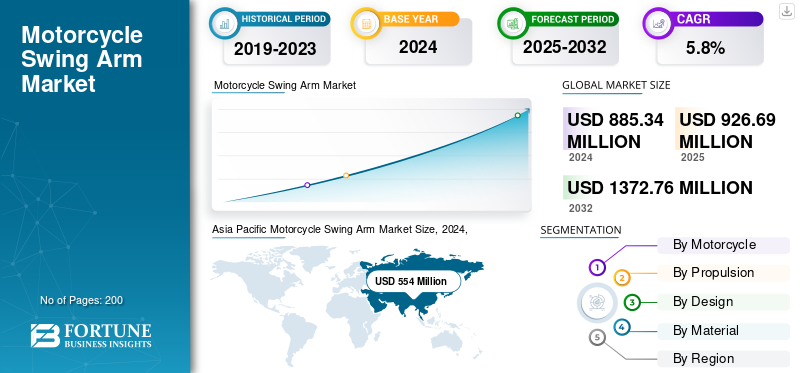
Download Free sample to learn more about this report.
Motorcycle Swing Arm Market KEY TAKEAWAYS
 Global Market Size & Forecast
- 2025 Market Size: USD 926.69 million
- 2026 Market Size: USD 972.84 million
- 2034 Forecast Market Size: USD 1,551.17 million
- CAGR: 6.01% from 2026–2034
 Market Share
- Asia Pacific dominated the motorcycle swing arm market with a 62.87% share in 2025.
- The standard motorcycle segment is projected to account for the largest market share with 35.01% in 2026.
- The ICE propulsion segment is projected to hold a 96.06% share in 2026.
 Key Regional Highlights
Asia Pacific
Asia Pacific reached USD 582.61 million in 2025, driven by strong two-wheeler demand, expanding manufacturing, and rising middle-class incomes.
North America
North America accounted for USD 84.14 million in 2025, supported by growing demand for recreational motorcycles and increasing EV adoption.
Europe
Europe reached USD 124.83 million in 2025, driven by premium motorcycle demand and stricter emission regulations.
U.S.
The U.S. market is supported by strong demand for cruiser and touring motorcycles, along with rising adoption of electric motorcycles.
Japan
The Japan market is projected to reach USD 6.94 million by 2026, driven by advanced motorcycle manufacturing and continued product innovation.
Read More

MARKET DYNAMICS
Market Drivers
Rising Adoption of Electric and Performance Motorcycles Accelerates Market Growth
As the two-wheeler market shifts toward electric models and higher-capacity performance machines, components such as swing arms are increasingly required to meet tougher structural, handling, and material demands. A growing number of riders expect improved stability, durability, and ride quality, especially in premium segments, which drives component innovation and demand. This is expected to boost the motorcycle swing arm market growth in the coming years.
- For instance, in August 2025, global electric two-wheeler sales (including motorcycles) reached around 4.4 million units in the first half of the year, up 7.2 % year-on-year.
Market Restraints
Integrated Chassis Designs May Limit Aftermarket Growth
Modern motorcycles are increasingly adopting integrated chassis architectures that combine the frame, engine mountings, and swing arm pivot into a tightly packaged structure. While this improves rigidity and weight balance, it limits modularity and reduces the ease of swapping swing arms, which in turn constrains aftermarket demand and narrows opportunities for third-party upgrades.
- For instance, in October 2025, reports on Ducati’s 2025 Panigale V4 highlighted a major chassis revision, including a move away from the traditional single-sided swing arm—illustrating how OEM-specific architectures can reduce replaceability and curtail aftermarket options.
Market Opportunities
Lightweight Materials and Design Innovation to Create Lucrative Growth Opportunities
OEMs and performance programs are accelerating the shift to aluminum and carbon-composite swing arms to improve strength-to-weight ratios, stability, and ride quality. This momentum opens collaboration prospects for specialized suppliers capable of advanced materials processing and precision engineering, particularly as electric motorcycles place greater structural demands on rear assemblies.
- For instance, in June 2025, MotoGP’s official test coverage noted Honda evaluating a carbon-fiber swing arm at the Aragón test, underscoring the near-term pipeline for lightweight, high-rigidity designs that can filter into production programs and supplier opportunities.
Motorcycle Swing Arm Market Trends
Wider Adoption of Simulation-Led Engineering is One of the Significant Market Trends
Manufacturers and engineering partners are embedding virtual validation, finite-element analysis, fatigue simulation, and topology optimization early in swing arm development to cut prototyping cycles and target optimal stiffness with lower mass. This digital workflow is becoming a standard step in motorcycle chassis design, supporting faster iteration and better field reliability.
- For instance, in April 2024, SAE International published a technical paper detailing fatigue analysis of a motorcycle rear swing arm across different road surfaces, highlighting how CAE is used to identify stress hotspots and validate durability before production.
Market Challenges
Balancing Rigidity, Durability, and Weight, especially for Electric Platforms, is Challenging for Market
Swing arm designers must deliver precise handling and long-term durability while reducing mass, even as electric motorcycles add batteryf weight and alter load paths. Achieving the right trade-off demands advanced materials, exacting manufacturing, and continuous chassis refinement, which increases development complexity and cost.
- For instance, in April 2025, Ducati announced the updated V21L MotoE prototype with a lighter chassis and revised electronics, reflecting the ongoing engineering push to manage stiffness and weight for high-performance electric motorcycles.
Download Free sample to learn more about this report.
Segmentation Analysis
By Motorcycle
Standard Bikes Led Due to Broad Utility and Strong Entry-Level Demand
On the basis of motorcycle, the market is segmented into standard, sports, cruiser, touring, and others (such as adventure, off road, scramblers and cafe racers, etc.).
The Standard Motorcycle segment will account for 35.01% market share in 2026, owing to its versatility for commuting, affordability, and suitability across both urban and semi-urban environments.
- For instance, in March 2025, TVS-Motorcycle’s Apache line reached a milestone of over 6 million units sold globally, reinforcing the strong demand for bikes with the practicality and appeal of the standard segment.
By Propulsion
ICE Dominates Due to Established Infrastructure and Cost Advantage
On the basis of propulsion, the motorcycle market is divided into ICE (up to 200cc, 200cc to 400cc, 400cc to 800cc, and more than 800cc) and electric.
The ICE Propulsion segment will account for 96.06% market share in 2026. The ICE segment leads the market as petrol-powered bikes benefit from well-established manufacturing ecosystems, abundant fuel infrastructure, lower initial costs, and rider familiarity.
- For instance, in February 2025, the article Capacity and market potential for local production and distribution of electric two-wheelers in Southeast Asia, focused on Thailand, Indonesia, and Vietnam, highlighted that these countries produced nearly 12 million ICE motorcycles in 2023, underscoring the entrenched dominance of ICE models in key growth regions.
By Design
Double-Sided Swing Arm Dominates Owing to Its Cost-Effectiveness and Structural Simplicity
The Double-Sided Swing Arm Design segment will account for 82.71% market share in 2026, single-sided swing arm, and others. The double-sided swing arm segment is dominant as it provides a simpler architecture, offers reliable structural support, is easier to manufacture and maintain, and suits a broad range of motorcycles from entry-level to mid-premium.
- For instance, in April 2024, the article 2025 Panigale V4S gets double-sided swing arm reported that Ducati switched from its signature single-sided swing arm to a double-sided design on its new Panigale V4S to improve rigidity and reduce tire wear, illustrating the engineering and cost logic behind the double-sided design’s dominance.
To know how our report can help streamline your business, Speak to Analyst
By Material
Steel Dominates Due to Its Proven Durability and Low Cost
The Steel Material segment will account for 70.08% market share in 2026. On the basis of the material used for swing arms, the market is divided into steel, aluminum alloy, and others. Steel remains dominant as it offers proven strength, ease of manufacturing, lower production cost, good serviceability in global markets, and widespread supply chain availability.
- For instance, in September 2025, the blog article Types of Steel used in Motorcycles emphasized that although new materials are making inroads, steel remains the gold standard for motorcycle chassis and suspension components due to its durability and cost advantages.
Motorcycle Swing Arm Market Regional Outlook
By geography, the market is categorized into North America, Europe, Asia Pacific, and the Rest of the World.
Asia Pacific
In 2025, Asia Pacific held 62.87% of the global market, reaching a valuation of USD 582.61 Million, and is projected to grow to USD 614.54 Million in 2026, supported by a vast population base, growing middle-class income levels, and a deeply rooted two-wheeler culture. Countries such as India, China, Indonesia, Vietnam, and Thailand serve as major production and consumption hubs, with extensive manufacturing capabilities and competitive export potential. The region’s dominance is further reinforced by government initiatives promoting domestic production, the rapid expansion of electric two-wheelers, and the affordability of ICE motorcycles that meet the daily commuting needs of millions. Additionally, established OEMs such as Honda, Yamaha, and Hero MotoCorp continue to strengthen their presence through product launches and localized manufacturing, keeping Asia Pacific at the forefront of the global motorcycle industry.
The Japan market is projected to reach USD 6.94 million by 2026, the China market is projected to reach USD 221.16 million by 2026, and the India market is projected to reach USD 248.33 million by 2026.
Asia Pacific Motorcycle Swing Arm Market Size, 2025,(USD Million)
To get more information on the regional analysis of this market, Download Free sample
Europe
The Europe market was valued at USD 124.83 Million in 2025, capturing 13.47% of global revenue, and is estimated to reach USD 129.97 Million in 2026. Europe ranks just behind these regions in terms of growth momentum, driven by evolving emission regulations, strong demand for premium motorcycles, and a rapid shift toward electrified two-wheelers. The region’s mature consumer base favors technologically advanced, high-performance motorcycles, while environmental policies such as the Euro 5+ standards are accelerating innovation in cleaner propulsion technologies. Countries such as Germany, France, Italy, and the UK remain central to production and consumption, with brands such as BMW Motorrad, Ducati, and Triumph expanding their portfolios with hybrid and electric variants to meet changing consumer preferences.
The UK market is projected to reach USD 10.83 million by 2026, and the Germany market is projected to reach USD 21.64 million by 2026.
North America
North America accounted for USD 84.14 Million in 2025, representing 9.08% of the global market share, and is projected to reach USD 87.17 Million in 2026. North America remains an emerging region within the global motorcycle market, characterized by its strong recreational and performance-bike culture. The countries within collectively contribute to steady growth, driven by rising enthusiasm for sports and cruiser motorcycles and growing interest in electric models. In the U.S. specifically, demand continues to be led by heavyweight cruisers, touring motorcycles, and premium performance models, with Harley-Davidson maintaining strong brand dominance.
The country is also witnessing the accelerating adoption of electric motorcycles, supported by federal incentives and expanding charging infrastructure. Additionally, the aging rider demographic and rising interest in leisure riding further shape motorcycle replacement cycles and part demand, including swing arms across the U.S. market. Increasing investment in electric mobility infrastructure and new model introductions from established brands such as Harley-Davidson and Zero Motorcycles are expected to enhance the region’s long-term potential.
The Japan market is projected to reach USD 6.94 million by 2026, the China market is projected to reach USD 221.16 million by 2026, and the India market is projected to reach USD 248.33 million by 2026.
Rest of the World
Rest of the World maintained a strong presence in the global market, reaching USD 135.11 Million in 2025, accounting for 14.58% share, and is expected to reach USD 141.16 Million in 2026. This growth is primarily attributed to increasing urbanization, rising disposable incomes, and growing demand for affordable and efficient mobility solutions in densely populated regions. Countries such as Brazil, Mexico, South Africa, and Egypt are witnessing steady adoption of motorcycles for both personal and commercial purposes, supported by expanding dealer networks and financing options. Additionally, improving road infrastructure and the entry of international brands are helping these markets transition from low-cost commuter models to mid-range and premium offerings, contributing to sustained market expansion.
COMPETITIVE LANDSCAPE
Key Industry Players
Established OEMs and Performance Innovators Advancing Lightweight Engineering in Market
The global motorcycle swing arm market is defined by the presence of long-established motorcycle manufacturers alongside emerging innovators focused on performance enhancement and electrified mobility. Leading OEMs such as Honda, Yamaha, and KTM continue to dominate through in-house manufacturing capabilities, extensive model portfolios, and global distribution networks. Motorcycle swing arm companies leverage decades of chassis engineering expertise, combining advanced design simulation, precision casting, and high-performance materials to optimize swing arm stiffness, weight balance, and durability.
Competition in the market is increasingly centered on lightweight construction, structural optimization, and material innovation. Manufacturers are progressively integrating aluminum alloys, carbon composites, and hybrid structures into their swing arm designs to improve rigidity without adding mass. As motorcycle electrification accelerates, swing arm design has gained further importance due to the structural loads imposed by battery systems and changing weight distribution, pushing both traditional and new players toward modular and adaptable chassis solutions.
- For instance, in October 2024, BMW Motorrad introduced upgrades to its 2025 M-series superbikes, emphasizing lighter chassis components and improved swing arm geometry for enhanced control.
LIST OF KEY MOTORCYCLE SWING ARM COMPANIES PROFILED
- Honda Motor Co. Ltd. (Japan)
- KTM AG (Austria)
- Yamaha Motor Co. Ltd. (Japan)
- Ducati Motor Holding S.p.A (Italy)
- BMW Motorrad (Germany)
- TVS Motor Company (India)
- Hero MotoCorp. Ltd. (India)
- Active Co. Ltd. (Japan)
- Trac Dynamics Inc. (U.S.)
- Tyga Performance Co. Ltd. (Thailand)
KEY INDUSTRY DEVELOPMENTS
- September 2025: Suter Racing Products expanded its range of superbike-level swing arms, listing its units as the choice of World SBK teams and making them available to high performance street machines, highlighting the trickle-down of racing-grade swing arm technology into consumer markets.
- February 2025: Technical coverage of swing arm types in motorcycles noted a broader trend toward advanced materials such as aluminum, carbon fiber, and extended swing arm geometries in customization and high-performance segments, reflecting how aftermarket and premium OEMs are rethinking the swing arm as a performance lever.
- January 2025: Honda Motor Co., Ltd. held a press briefing outlining its motorcycle business strategy, emphasizing electrification and structural optimization of chassis components, including rear suspension links and swing arms as part of its monozukuri manufacturing tradition.
- December 2024: Trac Chassis Sports introduced a new billet-series swing arm for Harley-Davidson motorcycles, marking a significant upgrade in aftermarket swing-arm engineering by offering enhanced length, stiffness, and aesthetic finishing.
- August 2024: KTM tested new swing-arm mounted aerodynamic wings on its RC16 MotoGP bike at the Austrian Grand Prix, illustrating how swing arm architecture is being used to enhance rear-wheel downforce and tire grip directly through unsprung component aerodynamics.
REPORT COVERAGE
The global motorcycle swing arm market analysis provides an in-depth study of market size & forecast by all the market segments included in the report. It includes details on the market dynamics and market trends expected to drive the market in the forecast period. It offers information on the technological advancements, new product launches, key industry developments, and details on partnerships, mergers & acquisitions. The motorcycle swing arm market research report also encompasses detailed competitive landscape with information on the market share and profiles of key operating players.
Request for Customization to gain extensive market insights.
Report Scope & Segmentation
| Attribute | Details |
| Study Period | 2021-2034 |
| Base Year | 2025 |
| Forecast Period | 2026-2034 |
| Historical Period | 2021-2024 |
| Growth Rate | CAGR of 6.01% from 2026-2034 |
| Unit | Value (USD Million) |
| Segmentation |
By Motorcycle
By Propulsion
By Design
By Material
By Region
|
Frequently Asked Questions
Fortune Business Insights says that the global market value stood at USD 926.69 million in 2025 and is projected to reach USD 1,551.17 million by 2034.
In 2025, the market value stood at USD 84.14 million.
The market is expected to exhibit a CAGR of 6.01% during the forecast period of 2026-2034.
The double-sided swing arm segment led the market by design.
Rising adoption of electric and performance motorcycles accelerates the market growth.
Honda Motor, KTM, and Yamaha are some of the major players in the market.
Asia Pacific dominated the market in 2025.



- 2021-2034
- 2025
- 2021-2024
- 200
-
(Offer valid till 15th Oct 2026)
Get 30-60 hrs Free Customization
Expand Regional and Country Coverage, Segments Analysis, Company Profiles, Competitive Benchmarking, and End-user Insights.




















Related Reports
-
US +1 833 909 2966 ( Toll Free )
-
Get In Touch With Us