Mountain Bike Market Size, Share & Industry Analysis, By Product Type (Hardtail and Full-Suspension), By Frame Material (Aluminum, Carbon Fiber, Steel, and Titanium), By Price Range (Entry-Level, Mid-Range, and Premium/High-End), By Distribution Channel (Specialty Bicycle Retail Stores, Online/Direct-To-Consumer (DTC), Sporting Goods Retail Chains), and Regional Forecast, 2026-2034
 Download Free Sample
(Offer valid till 30th Sep 2026)

KEY MARKET INSIGHTS
 Listen to Audio Version
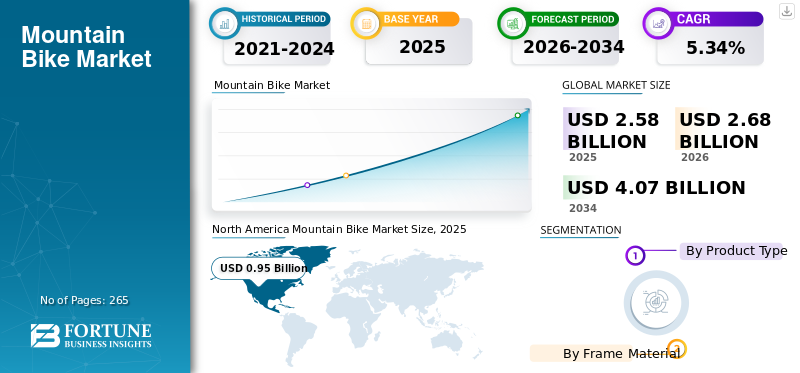
The global mountain bike market size reached USD 2.58 billion in 2025. It is projected to grow from USD 2.68 billion in 2026 to USD 4.07 billion by 2034, exhibiting a CAGR of 5.34% over the forecast period. North America dominated the global mountain bike market with a market share of 36.82% in 2025.
The mountain bike represents a steadily expanding and significant segment of the broader bicycle industry, with market growth primarily driven by the growing trends of competitive sports, recreational riding, adventure tourism, and fitness-oriented off-road cycling applications. Furthermore, market growth is supported by the increasing participation of individuals in endurance and outdoor activities, growing consumer preference for performance-oriented bicycles, and the expansion of purpose-built trail networks. For instance, Le Monde, a French newspaper (citing Decathlon and industry estimates), reported that Decathlon sold 4 million bicycles out of the global market of 120 million units. Moreover, premiumization trends, including the higher adoption of carbon frames and full-suspension designs, are triggering professionals to invest in premium mountain bicycles, leading to global market growth.
Key players in the market include Trek Bicycle Corporation, Santa Cruz Bicycles, Specialized Bicycle Components, Giant Manufacturing, and Canyon Bicycles. These manufacturers collectively boast strong brand recognition and a global distribution network. These key players consistently invest in the premiumization of full-suspension and carbon-frame bikes, ongoing product innovation, and the expansion of direct-to-consumer and specialty retail channels.
Download Free sample to learn more about this report.
MOUNTAIN BIKE MARKET KEY TAKEAWAYS
 Market Size & Forecast
- 2025 Market Size: USD 2.58 billion
- 2026 Market Size: USD 2.68 billion
- 2034 Forecast Market Size: USD 4.07 billion
- CAGR: 5.34% from 2026–2034
 Market Share
- North America dominated the mountain bike market with a 36.82% share in 2025.
- The full-suspension segment led the market in 2024, driven by strong demand for high-performance trail and enduro bikes.
- The aluminum segment dominated the market in 2024 due to its balance of durability, performance, and affordability.
 Key Regional Highlights
North America
North America was valued at USD 0.95 billion in 2025 and is projected to reach USD 0.98 billion in 2026, supported by a strong outdoor recreation culture, extensive trail networks, and rising demand for premium mountain bikes.
Europe
Europe is projected to reach USD 0.86 billion in 2026, driven by established cycling infrastructure, government support for outdoor activities, and steady demand for mid-range and premium mountain bikes.
Asia Pacific
Asia Pacific is expected to reach USD 0.64 billion in 2026, fueled by rising disposable incomes, urbanization, growing fitness awareness, and expanding cycling infrastructure across key markets.
U.S.
The market continues to benefit from premiumization trends, strong adoption of full-suspension bikes, and ongoing investments in trail infrastructure and bike parks nationwide.
Japan
The market is supported by growing participation in recreational cycling, increasing interest in outdoor sports, and demand for technologically advanced and lightweight mountain bikes.
Read More

MARKET DYNAMICS
Market Drivers
Growing Interest in Adventure Cycling and Outdoor Recreation to Drive Market Growth
A steady rise in the individual participation rate in adventure-based cycling and outdoor recreation activities is a key market driver in the global landscape. Mountain biking is predominantly adopted for competitive sports, fitness, and recreational riding, particularly in regions with well-developed trail networks, such as Europe and North America. For instance, according to the U.S. Bureau of Economic Analysis (Outdoor Recreation Satellite Account), outdoor recreation involves more than 50 million cyclists every year in the U.S., contributing significantly to the economic activity. As mountain biking is a crucial category within adventure and recreational cycling, the growing buzz and increasing participation rate directly translate into new purchases, upgrades, and replacement demand for mountain bikes. Furthermore, ongoing investments in trail infrastructure and bike parks by domestic governments and recreation authorities continue to reinforce long-term market dynamics for mountain bicycles globally.
Premiumization and Technological Advancements in Mountain Bikes to Fuel Market Expansion
One of the other major factors driving the global market's expansion is the ongoing premiumization of products and the continuous technological advancements that support it. More and more manufacturers are equipping mountain bikes with advanced suspension systems, lightweight carbon and high-grade aluminum frames, longer-lasting drivetrain components, and optimized geometry, which in turn significantly improve riding performance and comfort. This change is prompting buyers to shift from purchasing basic models to higher-value mid-range and premium mountain bikes, resulting in an increase in total market value, even in mature cycling regions.
The industry has set the pace for this trend by exhibiting an increased percentage of full-suspension and carbon-frame mountain bike sales in specialty retail stores, which is more evident in North America and Europe. Data from trade associations and manufacturer disclosures indicate that premium mountain bikes have significantly higher average selling prices than hardtail and steel frame models; thus, they are the main contributors to revenue growth, even with only a moderate increase in the number of units. As innovation continues to make products more durable, efficient, and improve ride quality, premiumization remains the primary structural factor driving the global market's long-term growth.
Market Restraints
High Purchase Cost and Maintenance Requirements to Hamper Market Growth
One of the main factors restricting the global mountain bike market growth is the expensive initial purchase and costly maintenance, especially for mid-range and premium models. In general, the addition of advanced features such as full suspension systems, carbon frames, hydraulic disc brakes, and high-performance drivetrains can double the product price, thus making mountain bikes less attractive to consumers sensitive to price and buyers who have never purchased a mountain bike before. Consequently, affordability remains an issue in developing regions and among casual riders, which limits the possibility of wider market penetration.
Besides the initial costs, mountain bikes require regular maintenance and some specialized servicing if they are used on off-road trails, where the components are subjected to higher wear and tear. Some of the maintenance work, such as suspension tuning, drivetrain replacements, and brake servicing, adds more to the total cost of ownership and requires professional expertise that is usually only available through specialty retailers. These factors thus serve as a deterrent to frequent upgrading and replacement, slowing down the process and hence limiting overall market growth, notwithstanding the growing interest in outdoor and adventure cycling.
Market Opportunities
Expansion of Mountain Biking Infrastructure and Emerging Market Adoption to Offer Lucrative Growth Opportunities
The global mountain bike market can significantly benefit from the prolonged expansion of mountain biking infrastructure that goes hand in hand with increased adoption in emerging markets. To promote outdoor recreation and eco-tourism, governments, local municipalities, and tourism authorities are investing more in purpose-built trail networks, bike parks, and off-road cycling facilities. Such infrastructure development leads to increased participation, repeat usage, and frequent bike upgrades, which, in turn, directly drive the demand for mountain bikes in the recreational and enthusiast segments.
Meanwhile, the emerging economies of Asia Pacific, Latin America, and some areas of the Middle East & Africa, due to their growing urban populations, rising disposable incomes, and increasing awareness of health and fitness activities, have strong untapped potential. As access to organized trails becomes more accessible and global bicycle brands expand their distribution and local assembly operations in these regions, mountain biking is poised to transition from a niche sport of the past to a mainstream outdoor recreational activity. The combination of infrastructure development and consumer base expansion is anticipated to create sustained long-term growth opportunities for the global market. In addition, electric mountain bikes create further growth opportunities for environmentally conscious consumers.
Market Challenges
Supply Chain Volatility and Component Availability to Pose a Challenge
The volatility of the supply chain, particularly regarding the availability and pricing of essential components such as drivetrains, suspension systems, brakes, and frames, poses a significant challenge to the global mountain biking industry. The production of mountain bicycles relies on a global supplier network, with a significant reliance on component manufacturers located in specific regions. This concentration makes the industry susceptible to disruptions caused by logistics bottlenecks, geopolitical conflicts, and variations in raw material costs.
These challenges on the supply side can result in prolonged lead times, erratic inventory availability, and rising costs, impacting both manufacturers and retailers. Smaller brands and independent bike dealers are particularly affected, as they possess limited negotiating power and have fewer options for finding alternative sources. Consequently, the uncertainty in the supply chain continues to exert pressure on profit margins, postpone product launches, and complicate long-term strategic planning throughout the global mountain bicycle industry.
MOUNTAIN BIKE MARKET TRENDS
Rising Adoption of Direct-to-Consumer (DTC) and Digital Sales Models
A major factor affecting the mountain bike market globally is the gradual decline of intermediaries and the increasing use of online selling channels by top manufacturers. Mountain bike brands are leveraging e-commerce platforms to offer a wider product selection, lower prices, and personalized customer service, in addition to attracting customers through digital tools such as virtual bike configurators and online fit guidance. This tendency enables producers to increase their margins, accelerate product launches, and obtain direct consumer data, ultimately leading to higher market efficiency.
Meanwhile, the DTC model is being supplemented by hybrid retail strategies where local service partners or authorized dealers support online purchases for assembly and maintenance. This combination approach tackles the issues of bike fitting and after-sales support, thus allowing customers to buy online, even if it is a mountain bike from the mid-range or premium sector. As consumers become more confident in online purchasing and brands continue to enhance their digital ecosystems, DTC and online channels will likely remain at the forefront of influencing global market evolution.
Download Free sample to learn more about this report.
SEGMENTATION ANALYSIS
By Product Type
Wide Ranging Suitability for Different Riding Conditions Supported Growth of Full-Suspension Segment
Based on product type, the market is segmented into Hardtail and full-suspension.
The full-suspension segment led the market in 2024, largely attributed to the adoption of these bikes by riders of trail, enduro, and those seeking performance. In fact, these cycles offer virtually perfect shock absorption, handling, and release on difficult terrain, and the soft-tail version is more adaptable than the others to the various riding conditions of the terrain. In addition, full-suspension bikes are often associated with higher average selling prices, and the rise in consumer willingness to pay for premium, high-performance gear has been the biggest factor behind their value-driven growth.
On the other hand, the hardtail segment is expected to grow at the fastest CAGR in the coming years. The growth will be primarily attributed to the needs of beginner riders, fitness enthusiasts, and individuals seeking a good value for their money. These bikes prove to be a suitable option for newbies and recreational cyclists, particularly in less developed regions. Their price, lighter weight, and simpler maintenance are the factors that make them attractive. Moreover, the increasing popularity of cross-country bike riding, as well as the use of hardtail bikes for on-road and light off-road activities, has been a major contributor to this trend. Hence, consistent growth is still possible, despite their value growth being behind that of full-suspension models.
To know how our report can help streamline your business, Speak to Analyst
By Frame Material
Excellent Characteristics and Widespread Adoption Among All Price Categories Boosted Aluminum Segment Growth
Based on frame material, the market is segmented into aluminum, carbon fiber, steel, and titanium.
The aluminum segment led the market in 2024, owing to its extensive use in both entry-level and mid-range price segments. Aluminum offers an ideal combination of durability, weight, performance, and affordability, making it the favored option for a wide range of consumers, from casual riders to serious enthusiasts. Its adaptability in both hardtail and full-suspension bikes, coupled with ongoing advancements in alloy technology and frame design, has allowed aluminum frames to sustain the largest portion of global demand.
Carbon fiber is projected to grow at the highest CAGR over the forecast period. A rise in premiumization and performance-oriented consumer preferences fuels the segment's growth. Cyclists are increasingly opting for carbon bikes due to their lightweight design, rigidity, and improved ride experience, particularly in cross-country, trail, and enduro applications.
By Price Range
Ideal Mix of Performance, Durability, and Affordability Bolstered Mid-Range Segment Growth
Based on price range, the market is segmented into entry-level, mid-range, and premium/high-end.
The mid-range segment accounted for the major global mountain bike market share. An excellent combination of performance, durability, and cost-effectiveness drives the segment’s dominance. This category strongly attracts both enthusiasts and recreational cyclists looking for advanced features, such as enhanced suspension systems and superior components, without the steep prices of high-end models. Regular upgrades from entry-level bikes, combined with widespread availability through specialized retailers and online platforms, have solidified the mid-range category's dominant status.
The premium/high-end segment is expected to witness the highest CAGR growth during the forecast period. Growing consumer willingness to spend on performance-oriented products is likely to supplement segment’s growth. In addition, increasing usage of carbon frames, full-suspension designs, and sophisticated components is propelling value growth in this segment, even though unit volumes remain relatively low.
By Distribution Channel
Professional Service, Technical Guidance, and After-Sales Support Fueled Specialty Bicycle Retail Stores Segment Growth
Based on distribution channel, the market is segmented into specialty bicycle retail stores, online/direct-to-consumer (DTC), and sporting goods retail chains.
The specialty bicycle retail stores segment accounted for the largest market share in 2024. The largest share of the segment is primarily attributed to their significant role in selling mid-range and premium elevation bikes that necessitate professional fitting, technical advice, and after-sales support. Consumers highly regard these shops for intricate purchases such as full-suspension and high-performance bikes, and they enjoy robust partnerships with top manufacturers. Their capacity to offer maintenance, customization, and community involvement has contributed to steady value growth, even in the face of rising competition from online platforms.
The online/direct-to-consumer (DTC) channel segment is anticipated to expand at the highest CAGR over the assessment period. The growing consumer focus on convenience and comfort provided by online shopping, along with detailed reviews and competitive pricing, reinforces the segment’s growth. In addition, hybrid sales models and brand-owned e-commerce platforms that combine online purchasing with local service support are accelerating adoption, particularly among digitally engaged and price-conscious consumers.
Mountain Bike Market Regional Outlook
Regionally, the market is divided into North America, South America, Europe, Asia Pacific, and the Middle East & Africa.
North America
North America Mountain Bike Market Size, 2025 (USD Billion)
To get more information on the regional analysis of this market, Download Free sample
North America held the dominant share in 2025, valued at USD 0.95 billion, and is expected to reach USD 0.98 billion in 2026. The growth of the region is attributed to a robust culture of outdoor activities, a well-established network of trails and bike parks, along with significant consumer investment in high-performance sports gear. The region demonstrates a strong preference for mid-range and premium sports gears, especially those with full suspension and carbon frames, which aids in the growth of market value. Furthermore, the existence of top mountain bicycle brands, scheduled racing competitions, and engaged cycling communities further bolsters ongoing demand and replacement trends. In addition, in countries such as the U.S., premiumization, with strong uptake of full-suspension bicycles, along with continued investments in trail infrastructure and bicycle parks across states, strengthens market growth.
Europe
Other regions, such as Europe and the Asia Pacific market, are anticipated to witness steady growth in the coming years. During the forecast period, the European region is projected to record a growth rate of 4.65% and reach a valuation of USD 0.86 billion by 2026. The region has a deeply ingrained cycling culture, comprehensive trail systems, and robust governmental and municipal backing for outdoor activities. The growth is fueled by consistent demand for mid-range and high-end elevation bikes, especially in nations with advanced cycling infrastructure, coupled with a rise in engagement in recreational and adventure cycling pursuits.
Asia Pacific
The market in Asia Pacific is estimated to reach USD 0.64 billion in 2026 and secure the position of the third-largest region in the market. In the region, China and India were valued at USD 0.21 billion and USD 0.20 billion, respectively, in 2025. Market growth is attributed to an increase in disposable incomes, swift urbanization, and heightened awareness of fitness and outdoor sports, which are significant trends. The growth of middle-class populations, improved access to cycling infrastructure, and the increasing presence of international mountain bicycle brands are key factors driving market expansion throughout the region.
South America and Middle East & Africa
Over the forecast period, South America and the Middle East & Africa regions are projected to witness significant growth. The market in South America in 2025 was valued at USD 0.11 billion. Rising participation in recreational and adventure cycling, improving access to affordable mountain bikes, and the gradual development of trail infrastructure and outdoor sports tourism are likely to drive South America market growth. In the Middle East & Africa, the UAE was valued at USD 0.02 billion in 2025.
Competitive Landscape
Key Industry Players
Focus on Product Innovation and Premiumization Offering Cutting-Edge to Players to Stay Competitive in Industry Landscape
The market demonstrates a moderately consolidated structure that is still highly competitive, comprising a few giant global brands and many regional and niche manufacturers that compete in terms of performance, price, and innovation. Leaders in the industry are enhancing their products with features such as advanced suspension systems, lightweight frame materials, and discipline-specific designs to differentiate their products. They are also going beyond traditional retail by opening direct-to-consumer and omnichannel distribution channels to achieve better margins and broader customer reach. Moreover, brands are enhancing their competitive strength through branding activities such as sponsoring professional racing, advocating for trails, and engaging with the community, which are some of the ways that help them not only maintain steady demand but also foster customer loyalty in the global market.
LIST OF KEY MOUNTAIN BIKE COMPANIES PROFILED
- Trek Bicycle Corporation (U.S.)
- Giant Manufacturing Co., Ltd. (Taiwan)
- Specialized Bicycle Components, Inc. (U.S.)
- Canyon Bicycles GmbH (Germany)
- Santa Cruz Bicycles (U.S.)
- Merida Industry Co., Ltd. (Taiwan)
- Scott Sports SA (Switzerland)
- BMC Switzerland AG (Switzerland)
- Orbea S. Coop. (Spain)
- Polygon Bikes (Insera Sena Group) (Indonesia)
Key Industry Developments
- January 2025: Trek Bicycle Corporation released its Sustainability Report 2024, which featured a major low-impact aluminum program as the key factor in reducing carbon emissions in the production of mountain bikes. This move aligns with Trek's strategic commitment to sustain the environment and maintain social responsibility in the long term. It sounds as though the program is a pioneering supplier deal that moves away from traditional aluminum to cleaner, less carbon-intensive production methods, thus drastically reducing the release of greenhouse gases associated with the production of frame materials, one of the major components of mountain bike manufacturing. Trek has signed up for ambitious emission reduction targets for 2030 and 2032, and this continuation of low-impact aluminum is a great step forward toward those goals while also making Trek a leader in the green bike industry.
- October 2024: Specialized Bicycle Components launched its “Reduce, Reuse, ReSpecialized” initiative to get 1 million bikes back on the road by the end of 2025. This strategic initiative focuses on sustainability and extending the lifecycle of bicycles, including mountain bikes. It encourages riders to repair and reuse existing bikes rather than purchase new ones, supporting environmental goals and community engagement. The program enhances brand visibility among environmentally conscious consumers and strengthens Specialized’s position as a socially responsible player in the bike market, tapping into the growing interest in sustainability-driven purchasing decisions.
- September 2024: Santa Cruz Bicycles expanded its 2025 mountain bike range with the release of the 2025 Hightower, redesigned from the ground up to enhance performance across mixed terrain. The 2025 Santa Cruz Hightower features updated frame geometry and suspension design, offering improved climbing efficiency and responsive handling, appealing to riders seeking do-it-all trail capability. This product launch exemplifies Santa Cruz’s strategy of incremental innovation in its premium MTB portfolio, elevating performance through engineering refinements while maintaining its reputation for high-quality carbon full-suspension bikes.
- August 2024: Canyon Bicycles announced the expansion of its direct-to-consumer e-commerce platform into additional key markets, including Japan, South Korea, and select South American countries. This strategic expansion represents a significant step in internationalizing Canyon’s DTC business model beyond its traditional European base. By enabling direct online sales and localized delivery infrastructure in these new regions, Canyon aims to reduce lead times, improve customer service experiences, and capture market share in areas with growing interest in mountain biking. The initiative also includes partnerships with local service centers for assembly and maintenance support, addressing a common barrier to online bike purchases and blending the advantages of digital sales with on-ground support.
REPORT COVERAGE
The mountain bike market report provides a detailed analysis of the market and focuses on key aspects such as the competitive landscape, services, and leading product types. It also offers global market industry trends and insights and highlights key industry developments. In addition to the aforementioned factors, the report on the global market outlook includes several factors that have contributed to the market's growth in recent years. The reports’s free sample pages gives the brief regarding the report coverage.
Request for Customization to gain extensive market insights.
Report Scope & Segmentation
|
ATTRIBUTE |
DETAILS |
|
Study Period |
2021-2034 |
|
Base Year |
2025 |
|
Estimated Year |
2026 |
|
Forecast Period |
2026-2034 |
|
Historical Period |
2021-2024 |
|
Growth Rate |
CAGR of 5.34% from 2026 to 2034 |
|
Unit |
Value (USD Billion) |
|
Segmentation |
By Product Type · Hardtail · Full-Suspension |
|
By Frame Material · Aluminum · Carbon Fiber · Steel · Titanium |
|
|
By Price Range · Entry-Level · Mid-Range · Premium/High-End |
|
|
By Distribution Channel · Specialty Bicycle Retail Stores · Online/Direct-to-Consumer (DTC) · Sporting Goods Retail Chains |
|
|
By Region
|
Frequently Asked Questions
According to Fortune Business Insights, the worldwide market size was USD 2.68 billion in 2026 and is anticipated to reach USD 4.07 billion by 2034
In 2025, the global market stood at USD 2.58 billion.
The market will be growing at a CAGR of 5.34% and exhibit a significant growth rate during the forecast period.
By product type, the full-suspension segment dominated the market.
The increasing participation of individuals in endurance and outdoor activities, along with the expansion of purpose-built trail networks, drives global market growth.
Trek Bicycle Corporation, Santa Cruz Bicycles, Specialized Bicycle Components, Giant Manufacturing, and Canyon Bicycles are key players in the global market.
North America held the highest market share in 2025.
The prolonged expansion of mountain biking infrastructure, accompanied by increased participation in adventure sports & activities, and frequent bike upgrades, is likely to drive product adoption among individuals.



- 2021-2034
- 2025
- 2021-2024
- 265
-
(Offer valid till 30th Sep 2026)
Get 30-60 hrs Free Customization
Expand Regional and Country Coverage, Segments Analysis, Company Profiles, Competitive Benchmarking, and End-user Insights.



















Related Reports
-
US +1 833 909 2966 ( Toll Free )
-
Get In Touch With Us