Mung Bean Protein Market Size, Share & Industry Analysis, By Type (Mung Bean Protein Isolate, Mung Bean Protein Concentrate, and Mung Bean Protein Flour), By Form (Dry and Liquid), By Application (Food & Beverages [Meat Alternatives, Dairy Alternatives, Bakery & Confectionery, Beverages, and Others], Dietary Supplements, Sports Nutrition, Animal Feed, and Others), By Nature (Organic and Conventional), and Regional Forecast, 2026-2034
 Download Free Sample
(Offer valid till 15th Oct 2026)

Mung Bean Protein Market Size and Future Outlook
 Listen to Audio Version
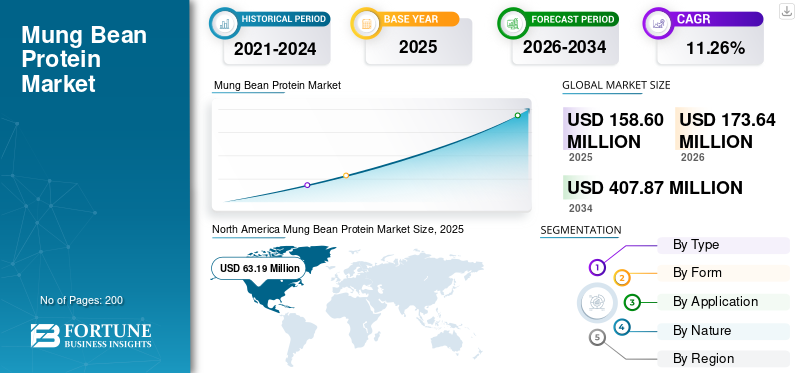
The global mung bean protein market size was valued at USD 158.60 million in 2025 and is projected to grow from USD 173.64 million in 2026 to USD 407.87 million by 2034, exhibiting a CAGR of 11.26% during the forecast period. North America dominated the mung bean protein market with a market share of 39.84% in 2025.
Mung bean protein products refer to the protein-rich ingredient obtained from mung beans, also known as green gram or Vigna radiata, through milling, dry fractionation, wet extraction, filtration, concentration, and isolation processes. It is commercially available as protein isolate, protein concentrate, and protein-rich flour in dry or liquid forms.
The market is moving beyond its traditional association with Asian foods and is developing into a specialized plant-protein ingredient category. Its growth is supported by demand for soy-free, dairy-free, gluten-free, non-GMO, and clean-label protein ingredients. Mung-bean protein is particularly attractive for egg-replacement formulations as its proteins can support coagulation, gel formation, foaming, binding, and emulsification. These properties are also being utilized in protein beverages, nutrition bars, dairy-free products, bakery mixes, and meat-alternative formulations.
Global supply and commercial development are being supported by ingredient manufacturers and distributors such as Proeon Foods, RELSUS, OMN9, Green Boy Group, and Royal Ingredients Group. Their commercial offerings include isolates with approximately 80% protein, concentrates with protein levels in the mid-50% range, organic powders, and application-specific proteins developed for beverages, vegan eggs, bakery products, meat alternatives, and dairy-free foods.
Download Free sample to learn more about this report.
Mung Bean Protein Market Key Takeaways
 Global Market Size & Forecast
- 2025 Market Size: USD 158.60 million
- 2026 Market Size: USD 173.64 million
- 2034 Forecast Market Size: USD 407.87 million
- CAGR: 11.26% (2026–2034)
 Market Share
- North America dominated the market with a 39.84% share in 2025.
- The Mung Bean Protein Concentrate segment is projected to grow at the fastest 13.96% CAGR.
- The Liquid segment is projected to grow at the fastest 14.84% CAGR.
 Key Regional Highlights
Asia Pacific
Asia Pacific was valued at USD 53.81 million in 2025 and is projected to reach USD 158.03 million by 2034, growing at the fastest 12.91% CAGR.
North America
North America dominated the market with a value of USD 63.19 million in 2025 and is projected to reach USD 139.80 million by 2034.
Europe
Europe was valued at USD 32.81 million in 2025 and is projected to reach USD 89.10 million by 2034.
U.S.
U.S. market was valued at approximately USD 56.65 million in 2025, dominating the North American market.
Japan
Japan is expected to witness steady growth in the mung bean protein market during the forecast period.
Read More

Mung Bean Protein Market Trends
Rising Development of Vegan Egg Formulations to Drive Product Demand and Shape Industry Trends
The growing development of plant-based scrambled eggs, liquid egg substitutes, egg patties, bakery egg replacers, and ready-to-eat breakfast products is creating an important application opportunity for mung bean protein. Unlike plant proteins used mainly for nutritional fortification, mung bean protein can provide functional properties required in egg alternatives, including heat-induced gelling, emulsification, water retention, binding, and texture formation. When heated, formulated mung bean protein can develop a cohesive and tender structure resembling cooked egg. Its relatively mild flavor also allows manufacturers to incorporate seasonings, colors, oils, and micronutrients without an excessively strong beany aftertaste.
- The Plant Based Foods Association reported that average U.S. egg prices increased from USD 1.47 in January 2021 to USD 4.95 in early 2025, representing an increase of approximately 237%, amid avian-influenza-related supply disruption. Such price and availability fluctuations encourage food manufacturers, restaurants, bakeries, and institutional buyers to evaluate shelf-stable and more predictable plant-based egg ingredients.
MARKET DYNAMICS
Market Drivers
Download Free sample to learn more about this report.
Increasing Demand for High-Protein and Allergen-friendly Sources to Increase Adoption of Mung Bean Proteins in Different Applications
Food manufacturers are increasingly seeking protein ingredients that can be used in products formulated without milk, egg, soy, wheat, peanuts, tree nuts, or sesame. This requirement is particularly important in plant-based beverages, nutritional products, bakery formulations, meat and dairy alternatives, vegan egg products, and foods supplied to schools or institutional catering facilities. Mung bean protein offers a commercially relevant alternative as mung bean is not included among the nine major food allergens identified under U.S. food-labelling regulations. These allergens, such as milk, egg, fish, crustacean shellfish, tree nuts, peanuts, wheat, soybeans, and sesame, are responsible for approximately 90% of food-allergic reactions in the U.S. This positioning allows mung bean-based protein to replace commonly used proteins such as soy, wheat gluten, dairy proteins, and egg ingredients in selected formulations.
- The Good Food Institute reported that global retail sales of plant-based meat, seafood, milk, yogurt, ice cream, and cheese reached USD 28.6 billion in 2024, representing growth of approximately 5%. The U.S. plant-based food retail market alone was valued at USD 8.1 billion.
|
Rank |
Market Drivers |
Overall Impact Rank |
CAGR Contribution (2026-2034) |
Impact 2026-2028 |
Impact 2029-2031 |
Impact 2032-2034 |
|
1 |
Rising demand for plant-based and alternative protein foods |
High |
+5.10% |
High |
High |
High |
|
2 |
Growing adoption of mung bean protein in plant-based egg and animal-protein replacement applications |
High |
+3.60% |
High |
High |
High |
|
3 |
Expansion of high-protein, vegan and diversified plant-protein product formulations |
Medium-High |
+2.85% |
Medium |
High |
High |
|
4 |
Advancements in extraction, modification and protein functionality technologies |
Medium |
+2.35% |
Medium |
High |
High |
|
5 |
Broader regulatory acceptance and commercialization across major food markets |
Medium |
+1.75% |
Medium |
Medium |
High |
|
6 |
Others: growing use in sports/performance nutrition, sustainability positioning of pulse proteins, expansion of mung bean cultivation and ingredient supply, rising preference for clean-label/non-soy proteins, and entry of new regional ingredient suppliers |
Low |
+0.95% |
Low |
Low |
Low |
|
Total Positive Growth Contribution |
+16.60% |
Market Restraints
Strong Competition from Established Plant-based Protein Sources, along with High Processing Costs, Limits Wider Commercial Penetration
Mung bean protein competes with established alternatives such as soy, pea, fava bean, and dairy proteins, which benefit from mature supply chains, large-scale processing, standardized grades, extensive regulatory documentation, and greater familiarity among formulators. As soy and pea proteins are generally easier to source in commercial volumes, mung bean protein is often selected only when its allergen-friendly profile, egg-replacement functionality, neutral positioning, or label differentiation offers a clear advantage.
Producing high-purity mung bean protein requires wet extraction, filtration, drying, deodorization, and careful pH and heat control, increasing costs compared with flours or less-refined pulse ingredients. Inadequate processing may also cause sedimentation, beany flavor, poor solubility, color variation, or inconsistent gelling, limiting repeat demand from beverage, sports-nutrition, and premium food manufacturers. Raw-material availability can further fluctuate geographically.
- USDA’s 2025 China Pulses Report estimated Chinese mung bean production at 150,000 tons in 2024-25, down from 160,000 tons in 2023-24, while imports were forecast at 590,000 tons. China was also identified as the world’s second-largest mung bean importer in 2023-24. Such dependence on imported beans exposes processors to crop conditions, freight rates, currency movements, and changes in food-grade bean prices.
|
Rank |
Market Restraint |
Overall Impact Rank |
CAGR Contribution (2026-2034) |
Impact 2026-2028 |
Impact 2029-2031 |
Impact 2032-2034 |
|
1 |
Higher ingredient cost and limited processing/supply scale compared with established soy and pea proteins |
High |
−2.25% |
High |
High |
Medium |
|
2 |
Formulation, sensory, and techno-functional limitations relative to established proteins |
Medium-High |
−1.55% |
High |
Medium |
Medium |
|
3 |
Allergenicity concerns and regulatory complexity in novel-food applications |
Medium |
−1.05% |
Medium |
Medium |
Medium |
|
4 |
Others: raw-material price volatility, seasonal variability in mung bean production, competition from pea/soy/chickpea/fava bean proteins, limited consumer awareness in some markets, and supply-chain or sourcing disruptions |
Low |
−0.49% |
Low |
Low |
Low |
|
Total Market Reduction |
−5.34% |
Market Opportunities
Expansion in Protein-enriched and Gluten-free Bakery Products to Create New Growth Potential
Bakery products represent an emerging opportunity for mung bean protein in breads, cakes, muffins, cookies, fillings, and baking mixes. The ingredients can enhance protein content, water retention, emulsification, binding, and batter structure. It is particularly relevant in gluten-free formulations, where additional protein is needed to compensate for the absence of wheat gluten, while also supporting vegan, soy-free, and pulse-based product positioning.
A study indexed in FAO’s AGRIS database assessed raw and sprouted mung bean flour as a partial rice flour replacement in gluten-free bread. Although the research used flour rather than isolate, it demonstrated the potential of mung bean-derived ingredients to improve the nutritional and physicochemical properties of gluten-free bakery products.
- In May 2025, Eat Just launched Just One, a single-ingredient, non-GMO mung bean protein powder, across Whole Foods Market stores in the U.S. The product was positioned not only for shakes but also as a functional ingredient for protein-enriched baked goods such as muffins, cookies, pancakes, and breads. Its protein-separation technology enables the ingredient to bind, emulsify, leaven, gel, and retain structure during cooking.
SEGMENTATION ANALYSIS
By Type
Mung Bean Protein Isolate Segment Dominated the Market Due to Its Higher Protein Purity and Strong Functional Performance
Based on type, the market is segmented into mung bean protein isolate, mung bean protein concentrate, and mung bean protein flour.
The mung bean protein isolate segment dominated the global market share and was valued at USD 91.88 million in 2025. Isolates are preferred in plant-based eggs, high-protein beverages, sports nutrition, meat alternatives, and dairy substitutes as they normally contain substantially more protein than flour and provide better control over taste, color, texture, and formulation consistency. Their gelling, foaming, emulsification, and water-binding properties make them suitable for products where protein performs a structural role.
The mung bean protein concentrate segment is projected to grow at the fastest CAGR of 13.96% from 2026 to 2034, supported by its balance between protein content, functionality, yield, and cost.
To know how our report can help streamline your business, Speak to Analyst
By Form
Dry Segment Held the Largest Share Due to Easier Storage, Transportation, and Formulation Flexibility
Based on form, the market is bifurcated into dry and liquid.
The dry segment dominated the global mung bean protein market share and was valued at USD 145.39 million in 2025. Dry isolates, concentrates, and flours are easier to store and transport and can be supplied in bags, drums, and bulk industrial packaging without requiring refrigerated distribution. Their longer shelf life makes them suitable for international trade and use in protein powders, bakery premixes, nutritional products, bars, dry beverage mixes, snacks, and meat-alternative formulations.
The liquid segment is projected to grow at the fastest CAGR of 14.84% from 2026 to 2034.
By Application
Food & Beverages Segment Dominated Due to Extensive Use in Meat Alternatives, Dairy Substitutes, Bakery Products, and Beverages
Based on application, the market is segmented into food & beverages, dietary supplements, sports nutrition, animal feed, and others. The food & beverages segment is further classified into meat alternatives, dairy alternatives, bakery & confectionery, beverages, and others.
The food & beverages segment dominated the global market and was valued at USD 116.60 million in 2025. The segment is also expected to grow at the fastest CAGR of 11.71% from 2026 to 2034. Its leadership is supported by the ability of mung bean protein to contribute nutrition, structure, binding, emulsification, gel formation, and moisture retention across several food categories. Within food & beverages, meat alternatives represented the largest application at USD 47.49 million, followed by dairy substitutes, bakery & confectionery, beverages, and other processed foods.
The sports nutrition segment is projected to grow at a moderate CAGR of 10.69% from 2026 to 2034.
By Nature
Conventional Segment Dominated Due to Wider Raw-material Availability and Lower Production Costs
Based on nature, the market is segmented into organic and conventional.
The conventional segment dominated the global market and was valued at USD 129.90 million in 2025. Conventional mung beans are more widely available through established agricultural supply chains and are generally more economical for large-volume protein extraction. This gives conventional ingredients a strong position in meat and dairy alternatives, bakery products, beverages, sports nutrition, and industrial food manufacturing.
The organic segment is projected to grow at the fastest CAGR of 14.24% over the global mung bean protein market forecast period.
Mung Bean Protein Market Regional Outlook
Regionally, the market is studied across North America, Europe, Asia Pacific, South America, and the Middle East & Africa.
North America
North America Mung Bean Protein Market Size, 2025 (USD Million)
To get more information on the regional analysis of this market, Download Free sample
North America dominated the global market and was valued at USD 63.19 million in 2025. Further, the region is projected to reach USD 139.80 million by 2034, growing at a CAGR of 9.40% during the forecast period. Such growth is supported by established demand for plant-based foods, high-protein products, sports nutrition, allergen-friendly ingredients, and egg substitutes.
U.S. Mung Bean Protein Market
The U.S. dominates the North American market and was valued at approximately USD 56.65 million in 2025. The growth is supported by demand from plant-based egg companies, alternative-meat manufacturers, beverage formulators, dietary-supplement companies, and sports-nutrition brands.
Europe
Europe was valued at USD 32.81 million in 2025 and is projected to reach USD 89.10 million by 2034, growing at a CAGR of 11.94% during the forecast period. This growth is driven by rising demand for clean-label proteins, egg-free bakery ingredients, meat alternatives, dairy-free products, organic foods, and sustainable ingredient sourcing.
Germany Mung Bean Protein Market
Germany was valued at approximately USD 7.44 million in 2025. Demand is supported by its large vegan and vegetarian product base, strong bakery and processed-food sectors, active ingredient-distribution network, and growing use of plant proteins across meat substitutes, protein snacks, dairy alternatives, and organic food products.
U.K. Mung Bean Protein Market
The U.K. market was valued at approximately USD 7.02 million in 2025. Growth is driven by demand for egg-free bakery products, plant-based diets, nutritional supplements, dairy-free foods, and innovative protein ingredients.
Asia Pacific
Asia Pacific was valued at USD 53.81 million in 2025 and is projected to reach USD 158.03 million by 2034, growing at the fastest CAGR of 12.91% during the forecast period. The region benefits from established mung bean cultivation, traditional familiarity with mung-based foods, expanding ingredient-processing capacity, and rising demand for plant proteins in China, India, Japan, Australia, South Korea, and Southeast Asia.
China Mung Bean Protein Market
China was valued at approximately USD 22.62 million in 2025. The country has a strong base of mung bean consumption and ingredient processing but increasingly depends on imports for raw beans.
India Mung Bean Protein Market
India was valued at approximately USD 9.49 million in 2025. Growth is supported by its large pulse-production base, widespread consumption of moong, expanding plant-protein processing, and rising demand from nutritional products, fortified foods, vegan eggs, sports nutrition, and export-oriented ingredient companies.
South America and Middle East & Africa
South America was valued at USD 4.88 million in 2025 and is projected to reach USD 11.44 million by 2034, growing at a CAGR of 10.12% during the forecast period. Growth is supported by the expansion of plant-based food companies, sports-nutrition products, protein-fortified foods, bakery applications, and imported specialty ingredients.
The Middle East & Africa market was valued at USD 3.90 million in 2025 and is projected to reach USD 9.49 million by 2034, growing at a CAGR of 10.56% during the forecast period. Growth is likely to be supported by imported protein ingredients, premium health products, halal-certified foods, fortified nutrition, bakery products, and demand for dairy-free and allergen-friendly formulations.
Brazil Mung Bean Protein Market
Brazil dominates the South American market and was valued at approximately USD 3.54 million in 2025. Its position is supported by a large packaged-food sector, established sports-nutrition consumption, expanding plant-based product ranges, and the presence of ingredient importers serving bakery, beverage, supplement, and meat-alternative manufacturers.
COMPETITIVE LANDSCAPE
Key Industry Players
Key Players Focus on Protein Purity, Functional Performance, and Application Support to Strengthen Market Position
The global mung bean protein market growth is relatively specialized and includes vertically integrated processors, plant-protein technology companies, ingredient distributors, organic ingredient suppliers, and application-focused manufacturers. Competition is based on protein concentration, solubility, sensory profile, gelling, foaming, emulsification, heat stability, digestibility, certification, batch consistency, traceability, and price.
Companies, including Proeon Foods, RELSUS, OMN9, Green Boy Group, and Royal Ingredients Group, are supplying alternative protein isolate generally to target premium applications such as vegan eggs, beverages, dairy alternatives, sports nutrition, and high-protein foods. Concentrate and flour suppliers compete more heavily in bakery, snacks, meat alternatives, nutritional mixes, and cost-sensitive formulations. Manufacturers with direct access to mung bean-producing regions can benefit from better raw-material traceability and opportunities to commercialize starch and fiber co-products.
List of Key Mung Bean Protein Companies Profiled
- Proeon Foods B.V. (India)
- RELSUS Pte. Ltd. (Singapore)
- OMN9 (India)
- Green Boy Group B.V. (Netherlands)
- Royal Ingredients Group B.V. (Netherlands)
- Van Wankum Ingredients B.V. (Netherlands)
- Top Health Ingredients Inc. (Canada)
- ORGANICWAY Food Ingredients Inc. (China)
- Devigere BioSolutions Pvt. Ltd. (India)
- Yantai T.Full Biotech Co., Ltd. (China)
KEY INDUSTRY DEVELOPMENTS
- April 2025: RELSUS inaugurated a commercial manufacturing facility in Ujjain, India, for functional plant proteins and starches produced through its Ultra-Precise Filtration technology. Aminola made a growth investment in RELSUS and became the company’s exclusive representative in Europe and the U.K. The agreement covers mung bean protein isolate and mung bean functional starch, alongside chickpea, pea, and rapeseed ingredients.
- July 2022: Researchers at Iowa State University received a USDA grant to breed high-yield, high-protein mung bean varieties. This project aims to introduce the drought-tolerant, nitrogen-fixing legume as a new crop in the U.S. Midwest, diversifying farm income and supplying the growing plant-based food market.
- April 2022: Eat Just received European Commission market approval for its mung bean protein, paving the way for a planned commercial rollout of JUST Egg across the European Union before the end of 2022.
- September 2021: Proeon raised USD 2.4 million in seed funding in a round led by entrepreneur Shaival Desai, with participation from Flowstate Ventures, Peak Sustainability Venture Fund I, Waoo Partners, and other investors. The company stated that the funding would be used to scale production, strengthen intellectual property, expand its team, and establish a research laboratory in the Netherlands. Proeon’s ingredient portfolio includes mung bean protein for plant-based egg, dairy, and meat-alternative formulations.
- January 2021: Eat Just and Cuisine Solutions announced the retail launch of JUST Egg Sous Vide bites in four flavors. The product was developed under an exclusive agreement through which Cuisine Solutions would manufacture Eat Just’s sous vide egg products globally. The company confirmed that mung bean protein was the principal protein ingredient, demonstrating its suitability for frozen, prepared, and convenience-food applications beyond liquid egg substitutes.
REPORT COVERAGE
The global industry report analyses the market in depth and highlights crucial aspects such as global market trends, market dynamics, supply chains, prominent companies, investment in research and development, and end-use. Besides this, the report also provides insights into the global mung bean protein market analysis and highlights significant industry developments.
Request for Customization to gain extensive market insights.
Report Scope & Segmentation
| ATTRIBUTE | DETAILS |
| Study Period | 2021-2034 |
| Base Year | 2025 |
| Estimated Year | 2026 |
| Forecast Period | 2026-2034 |
| Historical Period | 2021-2024 |
| Growth Rate | CAGR of 11.26% from 2026 to 2034 |
| Unit | Value (USD Million) |
|
Segmentation |
By Type
|
|
By Form
|
|
|
By Application
|
|
|
By Nature
|
|
|
By Region
|
Frequently Asked Questions
Fortune Business Insights says that the global market was valued at USD 158.60 million in 2025 and is anticipated to reach USD 407.87 million by 2034.
At a CAGR of 11.26%, the global market is projected to exhibit a steady growth over the forecast period.
By type, the mung bean protein isolate segment led the market.
North America held the largest market share in 2025.
The growing demand for allergen-friendly protein sources is the crucial factor driving market adoption.
Proeon Foods, RELSUS, OMN9, Green Boy Group, and Royal Ingredients Group are the leading players in the market.
The rising development of vegan egg formulations to strengthen product demand is shaping industry trends.



- 2021-2034
- 2025
- 2021-2024
- 200
-
(Offer valid till 15th Oct 2026)
Get 30-60 hrs Free Customization
Expand Regional and Country Coverage, Segments Analysis, Company Profiles, Competitive Benchmarking, and End-user Insights.



















Related Reports
-
US +1 833 909 2966 ( Toll Free )
-
Get In Touch With Us