Neuromorphic Computing Market Size, Share & Industry Analysis, By Application (Signal Processing, Image Recognition, Data Mining, and Others), By Industry (Automotive, Healthcare, Consumer Electronics, Manufacturing & Industrial, Aerospace & Defense, and Others), and Regional Forecast, 2026-2034
 Download Free Sample
Neuromorphic Computing Market Size and Industy Overview
 Listen to Audio Version
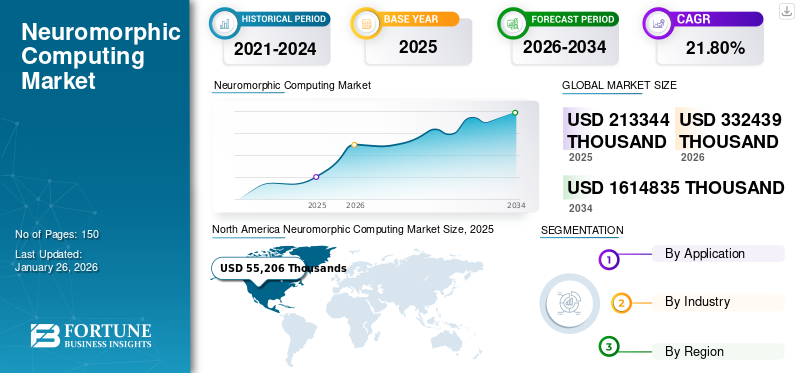
The global neuromorphic computing market size was valued at USD 2,13,344 thousands in 2025 and is projected to grow from USD 3,32,439 thousands in 2026 to USD 16,14,835 thousands by 2034, exhibiting a CAGR of 21.80% during the forecast period. North America dominated the global neuromorphic computing market with a share of 25.80% in 2025.
Neuromorphic computing is a method of computer engineering inspired by the human brain structure and function. It creates networks of electronic neurons and uses hardware based on the capacities of neurons and synapses in biological brains. Spiking Neural Networks (SNNs), the most common form of neuromorphic hardware, simulate natural learning by dynamically re-mapping neural networks.
In the report, we have considered key players offering solutions, including IBM Corporation, Intel Corporation, BrainChip Holdings Ltd., Qualcomm, and others. Such neuromorphic technology powers autonomous Artificial Intelligence (AI) solutions that require energy efficiency and continuous deep learning. It opens new possibilities in computing and is used in robotics, healthcare, sensing, and large-scale AI applications. The COVID-19 pandemic positively affected the healthcare industry, with neuromorphic chips being used in hospitals and clinics globally. However, the pandemic negatively affected the automotive, consumer electronics, manufacturing, and other industries. The trade restrictions, supply chain & production disruptions reduced demand and spending across many sectors.
Moreover, the rise in demand for Machine Learning (ML) and artificial intelligence and better-performing Integrated Circuits (ICs) drive the neuromorphic computing market growth. For instance, the NeuRRAM neuromorphic chip, built by an international team of researchers, caters to a wide range of AI applications while consuming a small amount of energy.
Download Free sample to learn more about this report.
Neuromorphic Computing Market Key Takeaways
 Market Size & Forecast
- 2025 Market Size: USD 2,13,344 thousands
- 2026 Market Size: USD 3,32,439 thousands
- 2034 Forecast Market Size: USD 16,14,835 thousands
- CAGR: 21.80% from 2026–2034
 Market Share
- North America dominated the neuromorphic computing market with a 25.80% share in 2025.
- The image recognition segment is projected to account for a 51.15% market share in 2026.
- The consumer electronics segment held the largest share of the market by end-use.
 Key Regional Highlights
Asia Pacific
Asia Pacific accounted for USD 58634 thousand in 2025 and is projected to reach USD 103953 thousend in 2026, driven by IC miniaturization and demand for autonomous vehicles.
North America
North America represented 25.80% of the global market in 2025 and is expected to reach USD 75555 thousend 2026, supported by semiconductor investments and government initiatives.
Europe
Europe contributed 25.40% of the global market in 2025 and is projected to reach USD 86180 thousend in 2026, driven by growing adoption of smart sensors and neuromorphic research programs.
U.S.
The neuromorphic computing market is projected to reach USD 30425 thousend by 2026, supported by semiconductor manufacturing investments and AI innovation.
Japan
The neuromorphic computing market is projected to reach USD 32836 thousend by 2026, driven by demand for advanced electronics, smart devices, and automotive technologies.
Read More

Neuromorphic Computing Market Trends
Increasing Adoption of Neuromorphic Computing to Revolutionize the Internet of Things (IoT) Bolsters Market Growth
Neuromorphic computing enhances and revolutionizes the way devices communicate with each other. It uses artificial neural networks to process information, adding to quick decision-making without human intervention. It can quickly process large amounts of data from numerous Internet of Things (IoT) devices, making it ideal for home automation, self-driving cars, and medical diagnostics applications.
Furthermore, by using AI algorithms, such computing enables efficient network architectures and faster data processing. A self-driving car learning from other cars in its vicinity to make quicker decisions or an automated home learning from its occupants to adjust the temperature and lighting are some examples of efficient neuromorphic technology. Moreover, adopting such computing also increases IoT security, wherein the devices can detect suspicious activity using AI algorithms. For instance, in January 2024, Innatera unveiled a neuromorphic microcontroller at the CES 2024 show, the Spiking Neural Processor T1. The launch implies key advancements in energy-competent AI for sensor-edge use cases, including smart home devices, wearables, and IoT applications.
Neuromorphic Computing Market Growth Factors
Rise in Demand for Artificial Intelligence and Machine Learning Technology to Drive the Neuromorphic Computing Market Growth
Neuromorphic computing enhances AI and ML applications, such as autonomous systems, computer vision, and natural language processing. It is well-suited for cutting-edge applications requiring real-time processing and low power consumption. Such applications include IoT devices, robotics, and autonomous vehicles. Many industries are automating their business operations to improve the efficiency and quality of their end products. The neuromorphic computing market is gaining attention and will have opportunities in industries, such as the military and cybersecurity, where such computing can aid in anomaly detection and image/object recognition by analyzing network traffic patterns. For instance, in September 2023, BrainChip Holdings Ltd, a neuromorphic AI IP producer, partnered with VVDN Technologies to deliver an Edge box based on neuromorphic technology. The device runs on various Edge AI applications utilizing BrainChip's Akida neuromorphic processors.
Moreover, the increasing number of research initiatives, collaborations between academia and industry, and government support contribute to the advancements of this field and the growth of this neuromorphic computing market
Download Free sample to learn more about this report.
RESTRAINING FACTORS
Complexity of Integrating Neuromorphic Technologies in Existing Systems to Impede Market
Neuromorphic computing is still in its nascent stages with a limited scale and scope of applications. Developing such software and hardware requires extensive research and development, thus making it challenging for businesses to adopt and integrate into their existing systems. Also, the lack of standardized frameworks and programming languages makes it harder for developers to create algorithms. Moreover, research and development costs related to such computing are relatively high, making it difficult for SMEs and startups to adopt this technology.
Neuromorphic Computing Market Segmentation Analysis
By Application Analysis
Image Recognition Segment’s Growth Boosted by Robust Pattern Recognition and Real-time Analysis of Images
Based on application, the neuromorphic computing market is segmented into signal processing, image recognition, data mining, and others.The image recognition segment will account for the largest neuromorphic computing market share due to advancements in image sensors and other processing technologies, accounting for a 51.15% market share in 2026. Neuromorphic chips can process information in real time, which is vital for applications, such as autonomous vehicles, robotics, and medical imaging, where quick decisions based on visual data are essential.
The signal processing segment is forecasted to grow with the highest CAGR due to its growing popularity among applications, such as speech and audio processing, music analysis, medical diagnostics, and others.
By Industry Analysis
To know how our report can help streamline your business, Speak to Analyst
Consumer Electronics Segment’s Growth Driven by Rising Number of Smartphones and Wearable Devices
Based on industry, the neuromorphic computing market is studied across automotive, healthcare, consumer electronics, manufacturing & industrial, aerospace & defense, and others.
The consumer electronics segment holds the largest share of the market owing to the increasing use of laptops, PCs, smartphones, tablets, and other wearable smart devices. According to Cisco Systems, the number of connected wearable devices globally in 2022 reached 1,110 million. Also, in October 2023, Prophesee, a developer of cutting-edge neuromorphic vision systems, unveiled the GenX320 Event-based Metavision sensor. Customized for ultra-low-power Edge AI vision devices, this latest sensor iteration expands Prophesee’s technology reach into Edge markets, such as AR/VR headsets, security systems, touchless displays, and others. The growing need to reduce the size of integrated circuits in smartphones and other sensory devices leads to greater demands for neuromorphic chips, thus driving the neuromorphic computing market.
The automotive industry is expected to grow at the highest CAGR during the forecast period, accounting for a 34.18% market share. Neuromorphic technology greatly enhances the performance of artificial intelligence and machine learning systems and enables tasks, such as autonomous driving, natural language processing, and image recognition.
REGIONAL INSIGHTS
We have studied the neuromorphic computing market across North America, Europe, Asia Pacific, and the rest of the world.
North America
North America Neuromorphic Computing Market Size, 2025
To get more information on the regional analysis of this market, Download Free sample
The North America market generated USD 55206 thousand in 2025, representing 25.80% of the global market landscape, and is expected to reach USD 75555 thousand in 2026. The region is gaining opportunities in semiconductor applications. For instance, the 2022 Chips and Science Act funded the U.S. Semiconductor industry with USD 39.0 billion to produce high-volume leading-edge memory chips. Moreover, the presence of key players delivers ample growth opportunities for neuromorphic computing market growth. The U.S. market is projected to reach USD 30,425 thousand by 2026.
Asia Pacific
Asia Pacific accounted for USD 58634 thousand in 2025, representing 27.50% of the global market share, and is projected to reach USD 103953 thousand in 2026. The industry is experiencing demand for miniaturization of Integrated Circuits (ICs). Also, the automotive sector is estimated to grow significantly with the growing demands for autonomous cars and smart vehicles. The Japan market is projected to reach USD 32,836 thousand by 2026, the China market is projected to reach USD 27,353 thousand by 2026, and the India market is projected to reach USD 20,466 thousand by 2026.
For instance, in September 2023, Intelligent Hardware Korea (IHWK) teamed up with Microchip Technology to develop a neuromorphic computing platform for field programmable neuromorphic devices and neurotechnology devices. The partnership aimed at creating ultra-low-power analog processing unit for applications such as autonomous cars, generative AI models, voice processing, medical diagnosis, security/surveillance and commercial drones.
Europe
Europe contributed 25.40% to the global market in 2025, with a valuation of USD 54107 thousand, and is projected to reach USD 86180 thousand in 2026. Europe is expected to grow rapidly during the projected period due to an increasing need for neuromorphic chips. The adoption and excessive use of smart sensors in many end-user industries, such as electronics, medical, and automotive, drives the need for such computing in the region. In addition, the region focuses on investing in neuromorphic research programs, initiatives, and vendors to accelerate the adoption of this technology. The UK market is projected to reach USD 33,169 thousand by 2026, while the Germany market is projected to reach USD 27,319 thousand by 2026.
For instance, as per EE Times Europe, in April 2023, the EU’s Horizon Europe research and innovation program funded a research project, NimbleAI, to help design a 3D neuromorphic chip.
Rest of World
In 2025, the Rest of the World market stood at USD 45,397 thousand, representing 21.30% of global demand, and is projected to grow to USD 66751 thousand in 2026.
Key Industry Players
Collaborations and Partnerships among Providers to Propel Market Growth
Key market participants are integrating and collaborating with similar companies to bring significant financial gains to both parties. Collaborations and partnerships assist businesses to cut costs by combining or sharing resources and increase sales.
For instance, in May 2023: Quantum Ventura Inc. and BrainChip Holdings Ltd. joined hands to develop cyber threat detection tools. The partnership aided Quantum in using BrainChip’s Akida technology to create cybersecurity applications for the U.S. Department of Energy.
List of Key Companies Profiled:
- Intel Corporation (U.S.)
- IBM Corporation (U.S.)
- BrainChip Holdings Ltd. (Australia)
- Qualcomm (U.S.)
- General Vision Inc. (U.S.)
- GrAI Matter Labs (France)
- Innatera Nanosystems (Netherlands)
- SynSense AG (Switzerland)
- Samsung Electronics Co. Ltd (South Korea)
- SK Hynix Inc. (South Korea)
KEY INDUSTRY DEVELOPMENTS:
- February 2024: SynSense partnered with iniVation to address the increasing demand for high-performance intelligent vision in consumer and industrial markets. The partnership aids in creating neuromorphic technology for stand-alone processors, vision sensors, and integrated compute-in-sensor devices across robotics, automotive, consumer electronics, and aerospace.
- October 2023: SiLC Technologies launched the Eyeonic Vision System, a FMCW LiDAR machine vision solution. This technology facilitates rapid and accurate object detection, polarization intensity, and 3D depth, delivering millimeter-level precision beyond 1,000 meters.
- September 2023: Eindhoven University of Technology researchers developed a method for training neuromorphic chips through a biosensor to identify cystic fibrosis. This "smart biosensor" emulates human brain communication, holding potential for point-of-care healthcare applications and allowing chips to adjust to their environments autonomously.
- June 2023: BrainChip Holdings Ltd. collaborated with Lorser Industries Inc. to develop neuromorphic systems. The partnership enabled Brainchip’s Akida technology to provide neuromorphic computing solutions for software-defined radio (SDR) devices.
- May 2023: BrainChip Holdings Ltd. partnered with CVEDIA to make advancements in Edge AI and neuromorphic technology. The partnership enabled the integration of the CVEDIA-RT platform and BrainChip’s Akida neuromorphic IP.
REPORT COVERAGE
The market research report provides a detailed analysis of the market and focuses on key aspects such as leading companies, product/service types, and leading applications of the product. Besides, the report offers insights into the market trends and highlights key industry developments. In addition to the factors above, the report encompasses several factors that contributed to the growth of the market in recent years.
Request for Customization to gain extensive market insights.
Report Scope & Segmentation
|
ATTRIBUTE |
DETAILS |
|
Study Period |
2021-2034 |
|
Base Year |
2025 |
|
Forecast Period |
2026-2034 |
|
Historical Period |
2021-2024 |
|
Growth Rate |
CAGR of 21.80% from 2026 to 2034 |
|
Unit |
Value (USD Thousands) |
|
Segmentation |
By Application
By Industry
By Region
|
Frequently Asked Questions
The market is projected to reach USD 16,14,835 thousands by 2034.
In 2025, the market was valued at USD 2,13,344 thousands.
The market is projected to grow at a CAGR of 21.80% during the forecast period.
Automotive is the leading industry in the market.
Rise in demand for artificial intelligence and machine learning technology to drive market growth.
Intel Corporation, IBM Corporation, BrainChip Holdings Ltd., Qualcomm, General Vision Inc., GrAI Matter Labs, Innatera Nanosystems, SynSense AG, Samsung Electronics Co. Ltd., and SK Hynix Inc. are the top players in the market.
North America dominated the global neuromorphic computing market with a share of 25.80% in 2025.
Signal processing is expected to grow with a remarkable CAGR during the forecast period.



- 2021-2034
- 2025
- 2021-2024
- 150
Get 30-60 hrs Free Customization
Expand Regional and Country Coverage, Segments Analysis, Company Profiles, Competitive Benchmarking, and End-user Insights.




















Related Reports
-
US +1 833 909 2966 ( Toll Free )
-
Get In Touch With Us