NFC-Enabled Packaging Market Size, Share & Industry Analysis, By Component (Tags, Labels & Stickers, Inlays & Chips, and Others), By Function (Product Authentication & Anti-Counterfeiting, Consumer Engagement & Loyalty Activation, Supply Chain Tracking & Visibility, Temperature Monitoring, and Others), By End Use (Food & Beverages, Healthcare, Consumer Electronics, Personal Care & Cosmetics, E-commerce & Retail, and Others), and Regional Forecast, 2026-2034
 Download Free Sample
(Offer valid till 30th Sep 2026)

NFC-Enabled Packaging Market Size and Future Outlook
 Listen to Audio Version
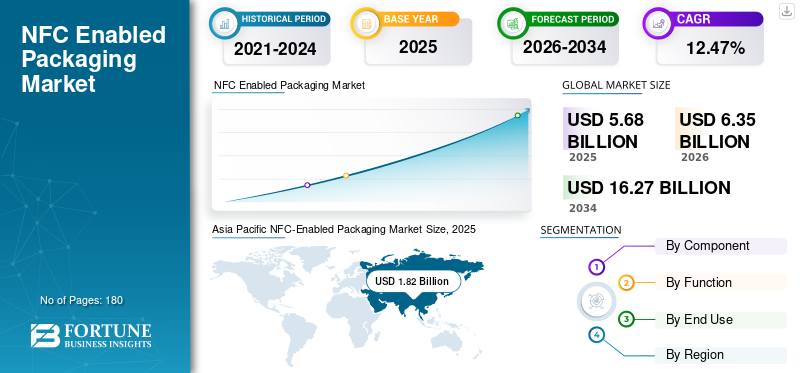
The global NFC-enabled packaging market size was valued at USD 5.68 billion in 2025. The market is projected to grow from USD 6.35 billion in 2026 to USD 16.27 billion by 2034, exhibiting a CAGR of 12.47% during the forecast period. Asia Pacific dominated the global NFC-enabled packaging market with a market share of 32.04% in 2025.
The global NFC-enabled packaging market refers to the sector dedicated to incorporating Near Field Communication (NFC) technology into various packaging formats such as labels, bottles, boxes, cartons, and flexible packs to facilitate digital interaction, authentication, and real-time data exchange between the product and the user's smartphone. This market includes the development, production, and application of NFC tags, inlays, smart labels, software platforms, and cloud-based systems that enable connected packaging capabilities.
Furthermore, the market is dominated by several major players, including Avery Dennison Corporation, Graphic Packaging International, and CCL Industries Inc., at the forefront. A broad portfolio, innovative product launches, and strong geographic presence expansion have supported the dominance of these companies in the global market.
Download Free sample to learn more about this report.
NFC-Enabled Packaging Market KEY TAKEAWAYS
 Global Market Size & Forecast
- 2025 Market Size: USD 5.68 billion
- 2026 Market Size: USD 6.35 billion
- 2034 Forecast Market Size: USD 16.27 billion
- CAGR: 12.47% from 2026–2034
 Market Share
- Asia Pacific dominated the NFC-enabled packaging market with a 32.04% share in 2025.
- The tags segment accounted for the largest market share of 40.80% in 2025.
- The product authentication & anti-counterfeiting segment accounted for the largest market share of 38.03% in 2025.
 Key Regional Highlights
Asia Pacific
Asia Pacific reached USD 1.82 billion in 2025, driven by rising smartphone adoption and demand for anti-counterfeiting solutions.
North America
North America accounted for USD 1.52 billion in 2025, supported by growing demand for smart packaging and brand protection.
Europe
Europe reached USD 1.10 billion in 2025, driven by strict product traceability regulations and sustainability initiatives.
U.S.
The market reached USD 1.20 billion in 2025, fueled by increasing adoption of NFC packaging in food, pharmaceuticals, and retail.
Japan
The market is witnessing steady growth, supported by increasing demand for smart packaging and product authentication solutions.
Read More

MARKET DYNAMICS
MARKET DRIVERS:
Rising Demand for Smart & Connected Packaging to Bolster Market Growth
The global transition toward more intelligent, digitally interactive packaging is accelerating the adoption of NFC-enabled solutions at a significant rate. Modern consumers anticipate that packaging should serve a purpose beyond merely safeguarding and containing products. They seek immediate access to information, effortless digital interaction, and tailored brand experiences. NFC technology meets these demands by facilitating one-tap interactions through any NFC-enabled smartphone, eliminating the need for app downloads. This functionality converts conventional packaging into a digital communication medium, enabling brands to provide product tutorials, authenticity verification, ingredient information, promotional offers, warranty registration, and loyalty rewards directly to customers.
MARKET RESTRAINTS:
High Integration Cost of NFC Tags in Packaging to Hinder Market Growth
The implementation of NFC-enabled packaging faces considerable limitations due to the relatively high expenses associated with integrating NFC tags compared to conventional identifiers, such as barcodes or QR codes. Although the prices of NFC chips have declined over time, the overall integration process remains costly, encompassing various components. These include chip manufacturing, antenna design, inlay production, encoding, lamination, and embedding into the packaging structure. These expenses escalate further when tags need to be tailored for specific packaging formats, such as curved bottles, metal containers, or flexible films, which necessitate additional engineering efforts to guarantee dependable tag performance. These factors are likely to hamper the NFC-enabled packaging market growth.
MARKET OPPORTUNITIES:
Expansion in Luxury Goods, Alcohol, and High-Value Retail Creates New Growth Opportunities
The sectors of luxury goods, premium alcohol, and high-value retail are generating substantial opportunities for NFC-enabled packaging as brands progressively pursue technologies that improve product authenticity, customer engagement, and premiumization. These industries encounter significant levels of counterfeiting, particularly in areas such as luxury fashion, perfumes, designer accessories, fine wines, and spirits. Within the alcohol sector, the use of NFC labels on wine and spirits bottles is becoming increasingly prevalent, enabling producers to share provenance information, cellar histories, and quality validation data, all of which help foster trust and enhance the customer experience.
NFC-ENABLED PACKAGING MARKET TRENDS:
Shift toward App-Less NFC Experiences Arises as a Market Trend
A significant accelerating trend in the NFC-enabled packaging sector is the widespread transition toward app-less NFC interactions, which has substantially enhanced consumer engagement and user-friendliness. Traditionally, numerous NFC-enabled solutions required users to install a specific mobile application to reach digital content. This process introduced friction, lowered interaction rates, and deterred consumers from utilizing smart packaging functionalities. As consumers place a higher premium on convenience and immediate access to information, app-less NFC is emerging as the prevailing model, facilitating greater scalability of NFC-enabled packaging in both premium and mass-market segments.
MARKET CHALLENGES:
Data Security and Privacy Concerns Pose Key Challenges to the Market
Concerns regarding data security and privacy pose a significant obstacle to the widespread implementation of NFC-enabled packaging. This is particularly true as brands increasingly utilize NFC tags to collect insights on consumer behavior and provide tailored digital content. With stringent data protection laws, such as the GDPR in Europe, the CCPA in California, and the LGPD in Brazil, as well as other developing global privacy regulations, brands are required to maintain complete transparency and adhere to compliance in their data management practices. Consumers may be reluctant to engage with NFC tags if they suspect that their personal information is being monitored without their explicit consent, which can result in diminished engagement and trust issues. In summary, safeguarding data privacy, fostering consumer trust, and implementing robust cybersecurity measures are essential for companies that utilize NFC-enabled packaging. This creates a considerable challenge for achieving large-scale market adoption.
Download Free sample to learn more about this report.
Segmentation Analysis
By Component
Numerous Benefits Offered by Tags Drive the Segment’s Leadership
In terms of components, the market is categorized into tags, labels & stickers, inlays & chips, and others.
The tags segment captured the largest share of the market in 2025. The segment dominated with a 40.80% share. The segment of tags is predominant as NFC tags are the essential technology that facilitates all smart packaging features, from authentication and tracking to consumer interaction and supply chain visibility. Tags act as the main physical link between the product and the consumer's smartphone, rendering them essential across various industries and applications. Their adaptability allows for incorporation into numerous packaging types, including labels, caps, bottles, boxes, cartons, and flexible packaging, which significantly enhances their acceptance compared to software platforms or readers.
The inlays and chip components segment is expected to grow at a CAGR of 12.41% over the forecast period.
By Function
Growing Counterfeiting Risks in Various Industries to Drive Product Authentication and Anti-Counterfeiting Segment Leadership
In terms of function, the market is categorized into product authentication & anti-counterfeiting, consumer engagement & loyalty activation, supply chain tracking & visibility, temperature monitoring, and others.
The product authentication and anti-counterfeiting segment captured the largest share of the market in 2025. The segment dominated with a 38.03% share. This segment is at the forefront of the market, as NFC tags offer secure and tamper-proof verification. This capability empowers brands to address the swiftly escalating global issue of counterfeiting, particularly in sectors such as pharmaceuticals, cosmetics, luxury goods, electronics, and premium beverages. Brands favor NFC technology due to its provision for real-time authentication, unique item-level identification, and consumer-side verification through smartphones, eliminating the need for extra devices.
The supply chain tracking & visibility function segment is expected to grow at a CAGR of 12.49% over the forecast period.
By End Use
High Traceability Needs and Consumer Engagement Demand Drives Food & Beverages Segmental Growth
Based on end use, the market is segmented into food & beverages, healthcare, consumer electronics, personal care & cosmetics, e-commerce & retail, and others.
To know how our report can help streamline your business, Speak to Analyst
In 2025, the global market was dominated by food & beverages in terms of end-use industry. Furthermore, the segment held a 35.91% share in 2025. This segment leads the market due to its significant requirements for product traceability, safety assurance, and consumer engagement domains, where NFC technology offers remarkable benefits. Food & beverage brands depend extensively on NFC tags to deliver real-time data regarding product packaging freshness, supply chain history, and origin verification, thereby aiding in compliance with stringent food safety regulations. As concerns about counterfeiting, spoilage, and the necessity for transparent product information increase, F&B companies are embracing NFC technology more rapidly than other sectors, positioning this segment as the foremost contributor to market expansion.
Additionally, the healthcare segment is projected to grow at a CAGR of 12.63% during the forecast period.
NFC-Enabled Packaging Market Regional Outlook
By geography, the market is categorized into Europe, North America, Asia Pacific, Latin America, and the Middle East & Africa.
Asia Pacific NFC-Enabled Packaging Market Size, 2025 (USD Billion)
To get more information on the regional analysis of this market, Download Free sample
Asia Pacific
The Asia Pacific held the dominant NFC-enabled packaging market share in 2024, valued at USD 1.61 billion, and maintained its leading position in 2025, with a value of USD 1.82 billion. The Asia Pacific market is propelled by swift urbanization, the growth of middle-class consumption, and the extensive adoption of smartphones. The elevated levels of counterfeiting in China, India, and Southeast Asia are compelling brands to implement NFC technology for product authentication, particularly in the FMCG, pharmaceutical, and electronics sectors.
In the region, China and India reached USD 0.61 billion and USD 0.45 billion, respectively, in 2025.
North America and Europe
Regions such as North America and Europe are anticipated to experience notable growth in the coming years. The North American region recorded a growth rate of 12.00%, the second highest among all regions, and reached a valuation of USD 1.52 billion in 2025. The adoption of NFC-enabled packaging in North America is propelled by a significant demand for consumer transparency, digital interaction, and brand security, particularly within the premium cosmetics, pharmaceuticals, and beverage industries. This region boasts a high penetration of smartphones and a technologically adept consumer demographic, which facilitates more intuitive and widely embraced NFC experiences.
In 2025, the U.S. market reached USD 1.20 billion. The trends in the U.S. market are experiencing significant growth, propelled by the need for anti-counterfeiting measures, enhanced supply chain transparency, and engaging consumer interactions, particularly in the food, pharmaceutical, and retail sectors. Notable companies such as Walmart and Avery Dennison are incorporating smart labels to facilitate real-time tracking.
After North America, the market in Europe reached a valuation of USD 1.10 billion in 2025 and secured the position of the third-largest region in the market. The market in Europe is expanding due to robust regulatory initiatives aimed at ensuring product traceability, such as the Falsified Medicines Directive. Additionally, the drive toward sustainability through digitalization and the significant demand for anti-counterfeit measures in sectors such as luxury goods, wines, spirits, and pharmaceuticals are contributing factors.
Backed by these factors, Germany recorded a valuation of USD 0.24 billion, the U.K. USD 0.19 billion, and France USD 0.17 billion in 2025.
Latin America and the Middle East & Africa
Over the forecast period, the Latin America and the Middle East & Africa regions are expected to witness moderate growth in this market space. The Latin America market, in 2025, reached a valuation of USD 0.68 billion. The increasing awareness of the risks associated with counterfeiting, particularly in the sectors of pharmaceuticals, luxury items, tobacco, and alcohol, is fostering early adoption. Multinational Fast-Moving Consumer Goods (FMCG) and beverage corporations are implementing NFC-enabled packaging to enhance brand protection and engage consumers.
In the Middle East & Africa, South Africa recorded a valuation of USD 0.15 billion in 2025. The Gulf Cooperation Council (GCC) nations represent a significant opportunity area, characterized by substantial purchasing power, an increasing demand for premium alcoholic beverages (where allowed), authentication of luxury products, and innovative healthcare initiatives. Pharmaceutical firms are progressively investigating NFC-enabled packaging solutions for monitoring adherence and implementing anti-counterfeit strategies.
COMPETITIVE LANDSCAPE
Key Industry Players:
Broad Product Portfolio and Robust Distribution Network Together Strengthen Key Players’ Leading Position
The market exhibits a semi-concentrated structure, with numerous small to mid-size companies actively operating worldwide. These players are actively involved in product innovation, strategic partnerships, and geographic expansion.
Avery Dennison Corporation, Graphic Packaging International, and CCL Industries Inc. are among the leading players in the market. A comprehensive range of products, a global presence through a strong distribution network, and collaborations with research and academic institutions are a few characteristics of these players that support their dominance.
Apart from this, other prominent players in the market include MM Group, Identiv Inc., Zebra Technologies Corporation, and others. These companies are undertaking various strategic initiatives, including investments in R&D and partnerships with pharmaceutical companies, to enhance their market presence.
LIST OF KEY NFC-ENABLED PACKAGING COMPANIES PROFILED:
- Avery Dennison Corporation (U.S.)
- Graphic Packaging International (U.S.)
- CCL Industries Inc. (Canada)
- MM Group (Austria)
- Identiv Inc. (U.S.)
- Zebra Technologies Corporation (U.S.)
- Checkpoint Systems (U.S.)
- American Label Technologies Inc. (U.S.)
- Stora Enso (Finland)
- Impinj (U.S.)
- Brady Corporation (U.S.)
- SATO Holdings Corporation (Japan)
- NXP Semiconductors N.V. (Netherlands)
- Toppan Printing Co.Ltd (Japan)
- Inovar (U.S.)
KEY INDUSTRY DEVELOPMENTS:
- November 2025: Tageos introduced Innovative NFC and Dual-Frequency RFID Inlays to improve consumer engagement and anti-tamper solutions. The organization’s latest offerings, the EOS-920 and the EOS-620 Seal, are designed to address the evolving needs of various sectors, where product authentication, supply chain transparency, and consumer engagement are crucial.
- January 2023: Toppan developed an environmentally friendly NFC tag label that deploys paper as the substrate for the antenna, replacing the traditional Polyethylene Terephthalate (PET) film. This transition to paper eliminates plastic usage entirely and also incorporates a novel circuit fabrication technology that guarantees adequate communication performance as an NFC device.
- July 2022: Identiv, Inc., a global leader in digital security and identification within the Internet of Things (IoT), announced its successful pilot launch for Identiv’s NFC-enabled smart packaging designed for OTACA Tequila. During this pilot launch, more than 5,000 bottles of tequila were successfully digitized, prompting OTACA to enhance its manufacturing plans with Identiv for the inclusion of an additional 50,000 Reposado tequila bottles in the first quarter of 2023.
- February 2022: Avery Dennison revealed the launch of ultra-compact versions of two of its well-known NFC products, the AD Circus Mini NTAG213 and the AD Microblock ICODE SLIX. This initiative is designed to meet the growing demand for increasingly smaller tagging solutions across the retail, packaging, pharmaceutical, and beauty industries.
- September 2020: Jones Healthcare Group introduced Near Field Communications (NFC) connected packaging solutions aimed at enhancing consumer wellness, providing brand insights, and ensuring supply chain protection. While CpaX NFC packaging is capable of connecting to any digital experience selected by a brand, Jones presents an "out-of-the-box" digital solution for brands in collaboration with TPG Rewards Inc.
REPORT COVERAGE
The market analysis provides an in-depth study of the market size and forecast for all the market segments included in the report. It includes details on market dynamics and trends expected to drive the market during the forecast period. It offers information on the technological advancements, new product launches, key industry developments, and details on partnerships, mergers, and acquisitions. The market research report also encompasses a detailed competitive landscape, including market share and profiles of key operating players.
Request for Customization to gain extensive market insights.
Report Scope & Segmentation
| ATTRIBUTE | DETAILES |
| Study Period | 2021-2034 |
| Base Year | 2025 |
| Forecast Period | 2026-2034 |
| Historical Period | 2021-2024 |
| Growth Rate | CAGR of 12.47% from 2026-2034 |
| Unit | Value (USD Billion) |
| Segmentation | By Component, Function, End Use, and Region |
| By Component |
|
| By Function |
|
| By End Use |
|
| By Geography |
|
Frequently Asked Questions
Fortune Business Insights says that the global market value stood at USD 5.68 billion in 2025 and is projected to reach USD 16.27 billion by 2034.
In 2025, the Asia Pacific market value stood at USD 1.82 billion.
The market is expected to exhibit a CAGR of 12.47% during the forecast period of 2026-2034.
The product authentication & anti-counterfeiting segment led the market by function in 2025.
The key factors driving the market growth are the rising demand for smart & connected packaging.
Avery Dennison Corporation, Graphic Packaging International, CCL Industries Inc., MM Group, Identiv Inc., and Zebra Technologies Corporation are some of the prominent players in the market.
Asia Pacific dominated the market in 2025 with the largest share.
The increase in demand for several NFC-enabled components in the food & beverages sector is one of the factors expected to favor product adoption.


- 2021-2034
- 2025
- 2021-2024
- 180
-
(Offer valid till 30th Sep 2026)
Get 30-60 hrs Free Customization
Expand Regional and Country Coverage, Segments Analysis, Company Profiles, Competitive Benchmarking, and End-user Insights.





Related Reports
-
US +1 833 909 2966 ( Toll Free )
-
Get In Touch With Us