Non-Volatile Memory Market Size, Share & Industry Analysis, By Memory Type (Flash Memory, EEPROM, MRAM, ReRAM, and Others), By Storage Density (Low Density, Medium Density, and High Density), By End-use Industry (Consumer Electronics, Automotive, IT & Telecom, Manufacturing, and Others), and Regional Forecast, 2026 – 2034
 Download Free Sample
Non-Volatile Memory Market Overview
 Listen to Audio Version
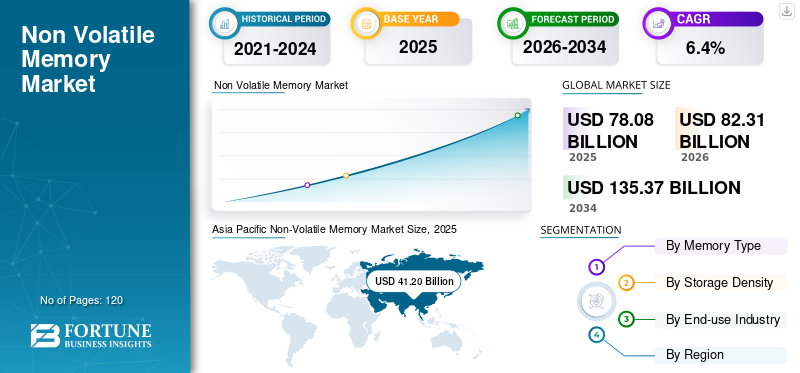
The global non-volatile memory market size was valued at USD 78.08 billion in 2025. The market is projected to grow from USD 82.31 billion in 2026 to USD 135.37 billion by 2034, exhibiting a CAGR of 6.4% during the forecast period. Asia Pacific dominated the non-volatile memory market with a market share of 52.76% in 2025.
The market refers memory technology that retains its data when it is turned off, including both flash memory and other types such as EEPROM, MRAM, ReRAM, and other future-generation types of memory. Non-volatile memory technologies are commonly used in smartphones, solid state drives (SSDs), automotive electronics, industrial products, telecom infrastructure, and data centers. The market is growing due to rising demand for high-density storage, AI-driven data center expansion, connected consumer devices, EVs, ADAS, and industrial automation, which require fast, durable, and power-efficient memory solutions.
Furthermore, many key market players, such as Samsung Electronics Co., Ltd., SK Hynix Inc., KIOXIA Corporation, SanDisk Corporation, and Micron Technology, Inc., operating in the market, are focusing on AI-focused enterprise SSD product launches, which offer high-capacity and low-latency NAND Flash storage solutions to capture rising demand from AI servers, cloud data centers, and generative AI workloads.
Download Free sample to learn more about this report.
NON-VOLATILE MEMORY MARKET KEY TAKEAWAYS
 Global Market Size & Forecast
- 2025 Market Size: USD 78.08 Billion
- 2026 Market Size: USD 82.31 Billion
- 2034 Forecast Market Size: USD 135.37 Billion
- CAGR: 6.4% from 2026–2034
 Market Share
- Asia Pacific dominated the non-volatile memory market with a market share of 52.76% in 2025.
- ReRAM segment is anticipated to grow at the highest CAGR of 17.5% over the forecast period.
- Medium density segment is anticipated to grow at a moderate CAGR of 5.2% over the forecast period.
 Key Regional Highlights
North America
North America is estimated to reach USD 18.75 billion in 2026 and secure the position of the second-largest region in the market.
Europe
Europe is projected to register the highest regional CAGR of 4.8% during the forecast period, fueled by automotive electronics and industrial automation.
Asia Pacific
Asia Pacific led the global market in 2025, reaching USD 41.20 billion, driven by its strong semiconductor manufacturing ecosystem and high electronics production.
U.S.
The U.S. market is estimated to reach USD 13.87 billion in 2026, accounting for approximately 16.9% of global revenues.
Japan
Japan’s market is estimated at USD 8.29 billion in 2026, representing roughly 10.1% of global revenues.
Read More

IMPACT OF GENERATIVE AI
Expansion of Generative AI Infrastructure Accelerating Demand for NAND Flash-Based Enterprise SSDs
Generative AI's increased infrastructure demand has resulted in a growing need for enterprise SSDs built on NAND flash with high-capacity, low-latency non-volatile memory that can be used within AI servers, training clusters, inference systems, vector databases, and AI Data Lakes. AI workloads require extensive movement of very large data sets, model checkpoints, embeddings, and unstructured data to/from storage and require speedy performance; therefore, hyperscalers and enterprises are seeking higher density SSDs over traditional storage solutions. For instance,
- In August 2024, TrendForce estimated that AI-related SSD procurement capacity would exceed 45 EB in 2024, while AI SSD demand could rise from 5% of total NAND Flash consumption in 2024 to 9% in 2025, showing a direct linkage between AI infrastructure growth and NAND Flash demand.
- In December 2024, McKinsey noted that enterprise adoption of generative AI is driving increased demand for server and data storage SSD's used in enterprise applications.
NON-VOLATILE MEMORY MARKET TRENDS
Growing Adoption of Embedded NVM in Automotive Electronics Accelerates Market Growth
As the market continues to grow, more and more automobile manufacturers are using embedded non-volatile memory (NVM) for their electrical systems. Due to the rapid growth of this technology, automobile manufacturers are increasingly using software defined architectures as well as the use of electrification, Advanced Driver Assistance Systems (ADAS), infotainment, and connected features in automobiles. All of these electronic systems require reliable memory that is capable of storing firmware, calibration data, security keys, event logs, and system configuration data, even when the power has been turned off.
Demand for automotive grade embedded NVM solutions is growing including EEPROM, NOR Flash, MRAM, ReRAM, and other types of non-volatile memory due to their ability to support high endurance, long data retention, functional safety, and their ability to operate in extreme temperature conditions. The increase in demand for embedded NVM is particularly crucial for EV powertrains, battery management systems (BMS), domain controllers (DC), and safety programs related to the automotive industry. For instance,
- In May 2025, Infineon announced that its SEMPER NOR Flash memory family received ASIL-D functional safety certification, the highest certification level under automotive functional safety requirements, strengthening its suitability for safety-critical vehicle applications such as ADAS and battery management systems.
MARKET DYNAMICS
MARKET DRIVERS
Download Free sample to learn more about this report.
Rising Need for Power-Efficient and High-Endurance Memory Drives Market Growth
Increasing demand for low-power and high-endurance NVM is fueling the non-volatile memory market growth, driven by memory needs from automotive industries, industrial applications, medical devices, wearable devices, IoT devices, and Edge Computing devices seeking non-volatile storage with low power usage and high durability (due to high-frequency write operations). Traditional forms of non-volatile memory often cannot meet the requirements for continuous data logging, immediate data retention, a long service life, and reliable (non-volatile) performance in harsh conditions. This has led to the ever-increasing adoption of advanced types of NVM (MRAM, ReRAM, and F-RAM), along with automotive-grade EEPROMs and NOR Flash memories that must provide exceptional durability, ultra-long write times, and very low standby power consumption. This factor is especially acute for battery operated devices, industrial sensors, automotive electronics, and every-day applications requiring critical configuration data storage, event log storage, firmware storage, and secure information storage without the risk of losing power.
MARKET RESTRAINTS
High Manufacturing Complexity and Capital-Intensive Fabrication May Hinder Market Growth
The complex and capital-intensive nature of non-volatile memory (NVM) manufacturing may hinder the growth of the market, since advanced memory manufacturing needs costly wafer fabs, precision machinery, and stringent process controls to manufacture high technology memory products. Emerging NVM technologies such as 3D NAND, MRAM, RERAM, FeRAM, and PCM rely on advanced materials engineering, multi-layer structures, lithographic processes, and durability testing, all of which make producing these products more costly. Small companies may have trouble scaling to the larger volumes needed for NVM products as NVM manufacturing requires ongoing investments in R&D, yield improvements, and capacity expansions; this may slow the commercialization of new NVM technologies to market or limit their use in applications with strict cost constraints. Therefore, only large companies that possess adequate capital resources, mature production operations, and a long-term customer base will be able to compete in the NVM market.
MARKET OPPORTUNITIES
Growing Demand from Telecom and 5G Infrastructure Creating New Opportunities for Market Growth
The emerging demand in telecommunications networks and infrastructure for 5G is becoming an opportunity for market. Within the network infrastructure for 5G, there are high-density, high-reliability, and high-speed memory requirements; and NVM fits all of these required memory characteristics. The increase in the amount of data being transmitted via the 5G network requires the processing of more data near the end-user, creating an increased demand for NAND Flash-based SSDs and embedded NVM in edge data centers and telecommunications equipment. Within the 5G network infrastructure, NVM is used to store firmware, boot code, network configuration, logs, cached data, and local storage. For enterprise and edge-based SSDs, NAND Flash-based SSDs represent the greatest opportunity for growth, whereas EEPROMs, NOR Flash, MRAM, and ReRAMs benefit from embedded storage requirements regarding reliability and equipment controls. For instance,
- In June 2024, KIOXIA highlighted its flash memory and SSD solutions for storage needs “from the edge to the cloud to AI,” stating that its BiCS FLASH 3D flash technology supports high-density applications including SSDs, automotive, and data centers, which aligns with growing storage requirements in telecom edge and cloud infrastructure.
Segmentation Analysis
By Memory Type
Rising Demand for Scalable and Cost-Efficient Storage Fuelled Flash Memory Segment Adoption
Based on memory type, the market is divided into flash memory, EEPROM, MRAM, ReRAM, and others.
Flash memory segment captured the largest market share in 2025. This is owing to flash memory being the most widely used device type for storing data across a variety of products including smartphones, SSDs, laptops, tablets, gaming consoles, memory cards, enterprise storage, and data center infrastructure. Additionally, NAND Flash is also widely used in AI servers, cloud storage, and high-density consumer electronics for fast data access and scalable, lower-cost capabilities. Therefore, these factors have allowed flash memory to maintain its current dominance throughout the market.
ReRAM segment is anticipated to grow at the highest CAGR of 17.5% over the forecast period. This is owing to its strong potential in low-power embedded memory, edge AI, automotive electronics, neuromorphic computing, and compute-in-memory applications, where high endurance, faster switching, scalability, and lower energy consumption are critical.
By Storage Density
Rising Demand for High-Capacity Storage is Driving High Density Segment Dominance
Based on storage density, the market is categorized into low density, medium density, and high density.
High density segment accounted for the largest market share in 2025 and is expected to continue its dominance by growing at the highest CAGR during the forecast period. This is owing to the widespread adoption of NAND Flash in SSDs, smartphones, laptops, enterprise storage, gaming devices, and cloud data centers, where large storage capacity and faster data access are essential. Its dominance is further supported by rising AI workloads and data-intensive applications, which are increasing demand for high-capacity enterprise SSDs and advanced 3D NAND solutions.
Medium density segment is anticipated to grow at a moderate CAGR of 5.2% over the forecast period. As it remains widely used in embedded systems, automotive control units, industrial equipment, and telecom devices, but its growth is slower than high-density memory due to stronger demand for NAND Flash-based SSDs and large-capacity storage applications.
By End-use Industry
To know how our report can help streamline your business, Speak to Analyst
Rising Demand for Smart Devices Strengthening Consumer Electronics Leadership
Based on end-use industry, the market is classified into consumer electronics, automotive, IT & telecom, manufacturing, and others.
The consumer electronics segment witnessed a dominating market share in 2025. This is owing to the high-volume use of non-volatile memory in smartphones, laptops, tablets, wearables, gaming devices, cameras, and smart home products. Additionally, the segment's size is supported by increasing demand for NAND flash memory type as well as low-power memory options which provide quicker operation times plus greater capacity/less chance of losing data when an energy supply is lost to connective consumer goods.
The automotive segment is anticipated to grow at the highest CAGR of 8.6% during the forecast period. This is owing to the rising adoption of EVs, ADAS, infotainment, battery management systems, and software-defined vehicle architectures, which require reliable EEPROM, NOR Flash, MRAM, ReRAM, and embedded NVM solutions for data retention, firmware storage, safety functions, and real-time system control.
Non-Volatile Memory Market Regional Outlook
By geography, the market is categorized into North America, South America, Europe, the Middle East & Africa, and Asia Pacific.
Asia Pacific
Asia Pacific Non-Volatile Memory Market Size, 2025 (USD Billion)
To get more information on the regional analysis of this market, Download Free sample
Asia Pacific accounted for the largest non-volatile memory market share in 2024, valuing at USD 38.97 billion, and also maintained the leading share in 2025, with USD 41.20 billion. The market in the Asia Pacific is expected to increase, owing to an established ecosystem for manufacturing memory, producing large quantities of electronic devices and having many suppliers providing NAND Flash across South Korea, Japan, China, and Taiwan. These suppliers have a long history of meeting the demand for non-volatile memory solutions, allowing manufacturers to produce large amounts of data. Furthermore, high demand for smartphones and consumer electronics, data centers, automotive electronics, and semiconductor assembly hubs will promote large-scale use of non-volatile memory solutions. For instance,
- In September 2024, Samsung Electronics started mass production of its QLC 9th-generation V-NAND for high-capacity AI-era SSD applications, supporting APAC’s leadership in advanced NAND Flash production.
China Non-Volatile Memory Market
China’s market is projected to be one of the largest globally, with 2026 revenues estimated at around USD 10.19 billion, representing roughly 12.4% of global sales. This is owing to strong domestic electronics manufacturing, rising data center and AI infrastructure investment, rapid EV and ADAS adoption, and government support for semiconductor localization, which together increase demand for NAND Flash, EEPROM, NOR Flash, and emerging embedded NVM solutions.
To know how our report can help streamline your business, Speak to Analyst
Japan Non-Volatile Memory Market
The Japanese market is estimated at around USD 8.29 billion in 2026, accounting for roughly 10.1% of global revenues.
India Non-Volatile Memory Market
The Indian market is estimated at around USD 5.95 billion in 2026, accounting for roughly 7.2% of global revenues.
North America
North America is estimated to reach USD 18.75 billion in 2026 and secure the position of the second-largest region in the market. This is owing to significant demands for enterprise solid state drives (SSDs) and AI data center/cloud storage facilities, telecommunications systems infrastructure, and high-performance computing across the U.S. and Canada. Additionally, several of the world's leading memory and storage manufacturers are located in North America, along with extensive R&D activity in the semiconductor sector, increasing demand from the auto electronics sector and continuing uptake of NAND Flash-based storage within hyperscale infrastructure. For instance,
- In July 2025: U.S.-based Micron launched a new portfolio of G9 NAND-based data center SSDs, including the 9650 PCIe Gen6 SSD, 6600 ION 122TB SSD, and 7600 PCIe Gen5 SSD, designed to support AI training, inference, and data center workloads.
U.S. Non-Volatile Memory Market
Based on North America’s significant contribution and the U.S. dominance within the region, the U.S. market can be analytically approximated at around USD 13.87 billion in 2026, accounting for roughly 16.9% of global sales.
Europe
Europe is projected to grow at a CAGR of 4.8% in the coming years, which is the highest among all regions, and reach a valuation of USD 12.43 billion by 2026. This is owing to the increased demand for automotive electronics, industrial automation, telecom infrastructure, and data center storage in Germany, France, U.K., Italy, and the Nordic countries. Key semiconductor firms and automotive technology suppliers based in Europe are enabling higher adoption rates of reliable non-volatile memory products such as EEPROMs, NOR Flash, F-RAM, and embedded NVM solutions for electric vehicles (EVs), advanced driver assistance systems (ADAS), battery management systems (BMS), and software-defined vehicles (SDVs). For instance,
- In May 2025, Germany-based Infineon announced that its SEMPER NOR Flash memory family received ASIL-D functional safety certification, strengthening its use in safety-critical automotive applications such as ADAS and battery management systems.
U.K Non-Volatile Memory Market
The U.K. market is estimated at around USD 2.16 billion in 2026, representing roughly 2.6% of global revenues.
Germany Non-Volatile Memory Market
Germany’s market is projected to reach approximately USD 2.77 billion in 2026, equivalent to around 3.4% of global sales.
South America
South America is expected to witness moderate growth in this market during the forecast period. The South America market is set to reach a valuation of USD 3.01 billion in 2026. The market growth in South America is driven by rising demand for smartphones, consumer electronics, cloud services, telecom modernization, and enterprise storage, with Brazil leading regional adoption through data center expansion, digitalization, and increasing use of NAND flash-based SSDs.
Brazil Non-Volatile Memory Market
Brazil's market projected to reach approximately USD 1.42 billion, representing around 1.7% of global revenues.
Middle East & Africa
The Middle East & Africa is estimated to reach USD 4.32 billion in 2026 and is expected to grow at a prominent rate in the coming years. The market growth is driven by increased investment in data centers, cloud services, AI infrastructure, telecom modernization, and 5G network deployment across GCC countries, South Africa, and other emerging digital hubs. There are further indications of future growth within enterprise storage / edge infrastructures based on expanding demand for NAND flash-based SSDs, combined with the embedded application market for NVM in telecommunications infrastructure, industrial control systems, smart city initiatives, and connected devices. For instance,
- In May 2025, KIOXIA announced the LC9 Series enterprise NVMe SSD, built with BiCS FLASH 3D flash memory and designed for high-density data center, AI, and generative AI storage applications, supporting rising SSD demand across MEA’s cloud and data center infrastructure.
GCC Non-Volatile Memory Market
The GCC market is set to reach a value of USD 1.45 billion in 2026.
COMPETITIVE LANDSCAPE
Key Industry Players
Focus on Expanding Advanced Node Logic Capabilities by Key Players to Propel Market Growth
The global non-volatile memory market holds a semi-consolidated structure, with prominent players such as Samsung Electronics Co., Ltd., SK Hynix Inc., KIOXIA Corporation, SanDisk Corporation, and Micron Technology, Inc., holding significant positions. These companies are investing in advanced NAND Flash, 3D NAND, QLC NAND, enterprise SSDs, embedded storage, and high-capacity memory solutions to meet rising demand from AI data centers, smartphones, laptops, cloud storage, automotive electronics, and telecom infrastructure. Their focus on higher storage density, lower cost per bit, faster read/write performance, and improved power efficiency is supporting adoption across consumer electronics, IT & telecom, automotive, manufacturing, and industrial applications.
Other notable players in the global market include Qualcomm Incorporated, Broadcom Inc., Apple Inc., MediaTek, Inc., and Marvell Technology, Inc. These companies are focusing on continuous product innovation, automotive-grade memory development, strategic customer partnerships, and investment in emerging memory technologies, which are expected to strengthen their market positioning over the forecast period.
LIST OF KEY NON-VOLATILE MEMORY COMPANIES PROFILED IN REPORT
- Samsung Electronics Co., Ltd. (South Korea)
- SK Hynix Inc. (South Korea)
- Micron Technology, Inc. (U.S.)
- KIOXIA Corporation (Japan)
- SanDisk Corporation (U.S.)
- Winbond Electronics Corporation (Taiwan)
- Macronix International Co., Ltd. (Taiwan)
- STMicroelectronics N.V. (Switzerland)
- Microchip Technology Inc. (U.S.)
- Infineon Technologies AG (Germany)
KEY INDUSTRY DEVELOPMENTS
- October 2025: SK Hynix presented its next-generation NAND storage strategy at OCP Global Summit 2025, including its AI-NAND lineup optimized for AI-era performance, bandwidth, and density requirements.
- August 2025: SanDisk signed an MoU with SK Hynix to standardize High Bandwidth Flash memory technology, designed to deliver higher memory capacity and performance for next-generation AI inference workloads.
- July 2025: KIOXIA introduced the LC9 Series 245.76TB NVMe SSD, built for high-capacity enterprise, data center, and generative AI storage environments.
- July 2025: Micron Technology launched its G9 NAND-based data center SSD portfolio, including the 9650 PCIe Gen6 SSD, 6600 ION 122TB SSD, and 7600 PCIe Gen5 SSD, to support AI training, inference, and data center workloads.
- March 2025: Microchip Technology highlighted its new CS family EEPROMs with Error Correction Status, designed to improve reliability, wear-leveling, and memory lifespan for industrial, automotive, medical, and safety-critical applications.
- November 2024: Macronix showcased and launched its 3D NOR Flash product at electronica 2024, targeting rising non-volatile memory demand across automotive, industrial, medical, autonomous driving, and smart technology applications.
- September 2024: Samsung Electronics started mass production of its one-terabit QLC 9th-generation V-NAND, aimed at high-capacity and high-performance SSDs for AI-era storage applications.
REPORT COVERAGE
The global non-volatile memory market analysis includes a comprehensive study of the market size & forecast by all the market segments included in the report. It includes details on the market dynamics and market trends expected to drive the market over the forecast period. It provides information on key aspects, including an overview of technological advancements, pipeline candidates, the regulatory environment, and product launches. Additionally, it details partnerships, mergers & acquisitions, as well as key industry developments. The global market research report also provides a detailed competitive landscape with information on the market share and profiles of key operating players.
Request for Customization to gain extensive market insights.
Report Scope & Segmentation
| ATTRIBUTE | DETAILS |
| Study Period | 2021-2034 |
| Base Year | 2025 |
| Estimated Year | 2026 |
| Forecast Period | 2026-2034 |
| Historical Period | 2021-2024 |
| Growth Rate | CAGR of 6.4% from 2026-2034 |
| Unit | Value (USD Billion) |
| Segmentation | By Memory Type, Storage Density, End-use Industry, and Region |
| By Memory Type |
|
| By Storage Density |
|
| By End-use Industry |
|
| By Region |
|
Frequently Asked Questions
According to Fortune Business Insights, the global market value stood at USD 78.08 billion in 2025 and is projected to reach USD 135.37 billion by 2034.
In 2025, Asia Pacific’s market value stood at USD 41.20 billion.
The market is growing at a CAGR of 6.4% during the forecast period.
By end-use industry, consumer electronics segment led the market.
Rising need for power-efficient and high-endurance memory drives market growth.
Samsung Electronics Co., Ltd., SK Hynix Inc., KIOXIA Corporation, SanDisk Corporation, and Micron Technology, Inc. are the top players in the global market.
Asia Pacific held the largest market share in 2025.


- 2021-2034
- 2025
- 2021-2024
- 120
Get 30-60 hrs Free Customization
Expand Regional and Country Coverage, Segments Analysis, Company Profiles, Competitive Benchmarking, and End-user Insights.




















-
US +1 833 909 2966 ( Toll Free )
-
Get In Touch With Us