In Memory Computing Market Size, Share & Industry Analysis, By Component (Hardware and Software), By Deployment (On-premises and Cloud), By Application (Risk Management, Real-Time Analytics, Data Processing and Management, and Others), By Industry (BFSI, Healthcare, Manufacturing, IT & Telecom, Retail, and Others), and Regional Forecast, 2026–2034
 Download Free Sample
In Memory Computing Market Size and Future Outlook
 Listen to Audio Version
The global In Memory Computing market size was valued at USD 15.16 billion in 2025 and is projected to grow from USD 16.72 billion in 2026 to USD 40.80 billion by 2034, exhibiting a CAGR of 11.8% during the forecast period. North America dominated the global market with a market share of 37.99% in 2025.
In memory computing refers to the use of in-memory computing technology, which allows users to store and handle their data through the computer's main processing unit (RAM) instead of traditional standard disk-based storage solutions. This approach enables much faster data access, significantly improving performance for real-time analytics, data processing, and decision-making. The market growth is driven by the increasing demand for real-time data processing, the rise of big data and IoT, and the adoption of cloud computing for scalable and efficient solutions.
Furthermore, many key industry players, such as SAP SE, Oracle Corporation, Microsoft, IBM Corporation, and GridGain, operating in the market, are investing in regional data hubs, AI factories, and industrial edge labs to deliver low-latency, high-performance in-memory computing solutions.
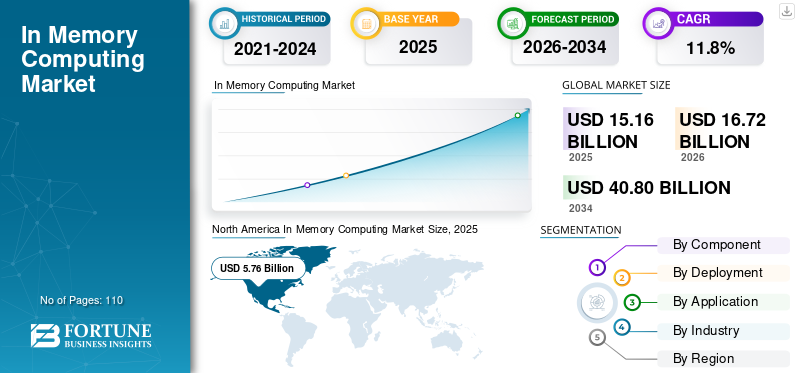
Download Free sample to learn more about this report.
In Memory Computing Market Key Takeaways
 Market Size & Forecast
- 2025 Market Size: USD 15.16 Billion
- 2026 Market Size: USD 16.72 Billion
- 2034 Forecast Market Size: USD 40.80 Billion
- CAGR: 11.8% from 2026–2034
 Market Share
- North America dominated the in memory computing market with a 37.99% share in 2025.
- The software segment held the largest market share and is projected to grow at a CAGR of 12.5%.
- The cloud deployment segment dominated the market and is expected to grow at a CAGR of 13.0%.
 Key Regional Highlights
North America
North America led the market with a value of USD 3.96 billion in 2025, driven by strong adoption of real-time analytics and cloud technologies.
Europe
Europe is projected to reach USD 3.93 billion in 2026, supported by digital transformation initiatives and increasing cloud adoption.
Asia Pacific
Asia Pacific is expected to attain USD 4.63 billion in 2026, fueled by rapid digitalization and expansion of cloud infrastructure.
U.S.
The market is estimated to reach USD 4.93 billion in 2026, accounting for approximately 29.5% of global revenue.
Japan
The market is projected to reach USD 0.88 billion in 2026, representing around 5.3% of global revenue.
Read More

IMPACT OF GENERATIVE AI
Rising Need for Real-Time Data Processing Fuels the Adoption of Generative AI in Memory Solutions
Generative AI is increasing the demand for high‑performance memory and processing capabilities, which directly supports the market growth, as AI workloads require very fast data access and low latency. For example, generative AI models push memory system architectures toward higher performance and efficiency to keep up with heavy data throughput needs, driving innovation in memory technologies that are core to in‑memory computing systems.
According to an industry expert survey reported that, in 2025, approximately 88 % of organizations regularly use AI in at least one business function, indicating broad AI adoption that increases pressure on real‑time processing systems.
The survey also indicated that the use of AI tools is rising rapidly across multiple industries. This will place further demands on memory-based infrastructure to support the real-time analysis and inference workload generated by AI implementations.
IN MEMORY COMPUTING MARKET TRENDS
Rapid Expansion of IoT Devices and Big Data Strengthens Market Momentum
The rapid expansion of IoT devices and big data generation has created massive volumes of data. All this data needs to be captured, saved, and analyzed in real time by companies. Thus, the need for in-memory computing solutions is increasing for the quick processing of collected data. For instance,
- By 2025, the global IoT device count is anticipated to surpass 20 billion, and the IoT market is valued at hundreds of billions of dollars, demonstrating that connected sensors and devices are infiltrating every industry across the globe.
As organizations increasingly combine streaming data from IoT systems with big data analytics for insights such as predictive maintenance, real‑time customer personalization, and automated decisions, in‑memory computing becomes critical because it drastically reduces latency compared to traditional storage and processing methods.
Download Free sample to learn more about this report.
MARKET DYNAMICS
MARKET DRIVERS
Growing Adoption of Hybrid and Multi‑cloud Environments Drives Market Growth
The rising use of hybrid and multi‑cloud environments is driving demand for in‑memory computing, as enterprises are increasingly distributing their workloads across a mix of private and public clouds and on-premises systems to achieve a better balance for performance, cost, and control, which requires high‑speed data access and processing. For instance,
- According to an industry expert survey, by 2025, approximately 89% of organizations worldwide are planning to operate with hybrid or multi‑cloud strategies to optimize workload.
In‑memory computing supports this factor by reducing latency and enabling real‑time analytics across hybrid data stores. This allows organizations to maintain consistent performance levels, regardless of where the data moves from on-premise to cloud systems or vice versa. Thus, the growing adoption of hybrid and multi‑cloud environments is expected to propel the market growth over the forecast period.
MARKET RESTRAINTS
High Initial Costs Requirement May Hinder Market Growth
High implementation costs are one of the major barriers to market growth, as the system, which uses in‑memory computing, often requires large amounts of high‑performance RAM and associated infrastructure, which is more expensive than traditional disk‑based solutions. Smaller and mid-sized businesses typically will not have the finances available to purchase large-scale memory modules and the hardware that supports the memory-centric architecture. The upfront cost associated with developing a memory-centric infrastructure and integrating it also creates a barrier to adoption due to the need for an initial investment that slows down adoption rates and limits the extent of the advantages associated with utilizing memory-centric solutions.
MARKET OPPORTUNITIES
Advancements in AI and Machine Learning to Create Lucrative Opportunities for Market Growth
Advancements in artificial intelligence (AI) and machine learning (ML) are providing a significant opportunity for the market to deliver advanced solutions for the high data rates and very low latency of AI/ML workloads through the implementation of in‑memory architectures, rather than traditional storage-based systems. Future memory technologies, including compute‑in‑memory and advanced DRAM types, are being adapted specifically to support AI acceleration, enabling real-time insights and high‑efficiency processing for deep learning applications. This integration of in‑memory computing with AI/ML allows organizations to perform predictive analytics much more quickly, enhance automation, and facilitate better decision-making in real time across all industries. As a result, the increasing utilization of AI in business analytics and automation is leading to a significant increase in the investment in in‑memory computing infrastructures.
Segmentation Analysis
By Component
Real-time Processing Across Various Enterprise Applications Lead to Software Segment
Based on the component, the market is divided into hardware and software.
Software is anticipated to account for the largest in memory computing market share, and it is expected to grow at the highest CAGR of 12.5% over the forecast period. This is due to, in-memory computing value is primarily delivered through in-memory databases, data grids, and analytics platforms that enable real-time processing and insights across enterprise applications. In addition, the rapid adoption of cloud-based and AI-driven analytics software has accelerated demand for scalable in-memory software solutions.
Hardware is anticipated to grow at a moderate compound annual growth rate over the forecast period. This is owing to the demand for high-performance memory, and servers continue and enterprises increasingly rely on cloud providers rather than making large upfront hardware investments.
By Deployment
Cloud Deployment Driving Segmental Growth Owing to Flexibility and Low-Cost in Solutions
Based on deployment, the market is bifurcated into on-premises and cloud.
In 2025, the cloud deployment dominated the global market, and it is expected to continue its dominance by growth at the highest CAGR of 13.0% during the forecast period. This is owing to the flexibility, low cost, and ease of cloud-based in-memory computing solutions. With the rise of AI, real-time analytics, and hybrid cloud strategies, there has been an increasing demand for cloud-based in-memory platforms that are flexible and have a faster deployment rate.
On-premises deployment is projected to grow at a moderate CAGR over the forecast period, as organizations face higher infrastructure and maintenance costs and are gradually shifting workloads toward more flexible and scalable cloud environments.
By Application
Rising Demand for Instant Insights Driving Dominance of Real-Time Analytics Segment
Based on the application, the market is categorized into risk management, real-time analytics, data processing and management, and others (image processing, etc.).
Real-time analytics is anticipated to witness a dominating market share in 2025, and it is expected to grow at the highest CAGR of 12.7% over the forecast period. This is owing to the increasing need of organizations for immediate access to large volumes of data generated to enable quicker and better-informed decisions. Additionally, the increase in the use of artificial intelligence (AI), the Internet of Things (IoT), and digital platforms across many industries has fueled the requirement for low-latency, in-memory data processing to enable companies to analyze data at the time that it is generated.
Data processing and management is projected to grow at a moderate CAGR over the forecast period, as it is a more mature application area with optimization-focused use cases, while enterprises increasingly prioritize real-time analytics for immediate insights and competitive advantage.
By Industry
To know how our report can help streamline your business, Speak to Analyst
High Dependence on Real-Time Data Driving BFSI Segment in the Market
Based on the industry, the market is classified into BFSI, healthcare, manufacturing, IT & telecom, retail, and others (government, education, etc.).
The BFSI sector is anticipated to witness a dominating market share over the forecast period as it relies heavily on in-memory computing for real-time transaction processing, fraud detection, and risk management. In addition, the sector’s strong focus on regulatory compliance and data-driven decision-making drives continuous investment in high-performance, low-latency computing solutions.
The retail sector is anticipated to grow at the highest CAGR of 14.3% during the forecast period. This is owing to the rapid expansion of e-commerce, omnichannel strategies, and real-time customer personalization, which is accelerating demand for in-memory analytics across pricing, inventory, and consumer behavior use cases.
In Memory Computing Market Regional Outlook
By region, the market is categorized into North America, South America, Europe, the Middle East & Africa, and Asia Pacific.
North America
North America In Memory Computing Market Size, 2025 (USD Billion)
To get more information on the regional analysis of this market, Download Free sample
North America held the largest in memory computing market share in 2024, valued at USD 3.45 billion, and also maintained the leading share in 2025, with USD 3.96 billion. The market in North America is expected to increase owing to the early adoption of advanced data processing technologies and the strong presence of major in-memory computing and cloud service providers. Additionally, the region continues to see high levels of demand for real-time analytics across the banking, finance, and insurance (BFSI), IT, and healthcare sectors, which have led to a continued increase in the number of in-memory computing solutions being implemented within each of these sectors. For instance,
- In November 2024, Microsoft announced Azure Managed Redis at Microsoft Ignite, positioning it as a first-party in-memory database service for developers building next-generation GenAI apps.
These factors play a significant role in fueling the market growth.
U.S In Memory Computing Market
Based on North America’s strong contribution and the U.S. dominance within the region, the U.S. market can be analytically approximated at around USD 4.93 billion in 2026, accounting for roughly 29.5% of global in memory computing sales.
Europe
Europe is projected to record a growth rate of 10.9% in the coming years, which is the second highest among all regions, and reach a valuation of USD 3.93 billion by 2026. In the region, the market growth is driven by strong adoption of in-memory computing across manufacturing, automotive, and BFSI sectors, where real-time analytics and process optimization are critical. Additionally, increasing digital transformation initiatives, data sovereignty requirements, and rising cloud adoption across EU-based companies are fueling demand for high-performance in-memory platforms.
U.K In Memory Computing Market
The U.K. in memory computing market in 2026 is estimated at around USD 0.77 billion, representing roughly 4.4% of global in memory computing revenues.
Germany In Memory Computing Market
Germany’s in memory computing market is projected to reach approximately USD 0.68 billion in 2026, equivalent to around 4.6% of global in memory computing sales.
Asia Pacific
Asia Pacific is estimated to reach USD 4.63 billion in 2026 and secure the position of the third-largest region in the market. This is owing to rapid digitalization, expansion of cloud infrastructure, and increasing adoption of real-time analytics across industries such as manufacturing, retail, and telecommunications. In the region, India and China are both estimated to reach USD 0.62 billion and USD 0.99 billion, respectively, in 2026. For instance,
- In March 2025, Microsoft and Oracle expanded Oracle Database@Azure availability in Singapore. Through this, the company aims to strengthen multi-cloud database and analytics deployment options for organizations in the Asia Pacific region.
Japan In Memory Computing Market
The Japan in memory computing market in 2026 is estimated at around USD 0.88 billion, accounting for roughly 5.3% of global in memory computing revenues. The increasing modernization of legacy enterprise systems and the rising demand for high-performance data processing to support mission-critical applications in smart factories, robotics, and industrial automation.
China In memory computing Market
China’s in memory computing market is projected to be one
of the largest worldwide, with 2026 revenues estimated at around USD 0.99 billion, representing roughly 5.9% of global in memory computing sales.
India In memory computing Market
The India in memory computing market in 2026 is estimated at around USD 0.62 billion, accounting for roughly 3.7% of global in memory computing revenues.
South America
South America is expected to witness moderate growth in this market space during the forecast period. The South America market is set to reach a valuation of USD 0.86 billion in 2026. The rising investments in data centers and the modernization of enterprise IT systems are supporting the gradual adoption of in-memory computing solutions across the region.
Middle East & Africa
The Middle East & Africa are estimated to reach USD 1.02 billion in 2026 and are expected to grow at a prominent growth rate in the coming years. Increasing investments in digital infrastructure and cloud adoption across sectors such as telecom, banking, and government services are driving in memory computing market growth across the Middle East & Africa. Additionally, increasing initiatives focused on data centers, smart cities, and digital transformation are accelerating demand for real-time data processing and in-memory computing solutions. In the Middle East & Africa, the GCC is set to reach a value of USD 0.32 billion in 2026.
COMPETITIVE LANDSCAPE
Key Industry Players
Focus on Expanding Product Portfolio by Key Players to Propel Market Progress
The global in memory computing market holds a semi-consolidated market structure, constituting prominent players such as SAP SE, Oracle Corporation, Microsoft, IBM Corporation, and GridGain. The significant market share of these companies is due to numerous strategic activities, including collaboration with cloud providers and telecom operators to deliver in-memory computing platforms. For instance,
- In September 2023, IBM and NTT DATA entered into a partnership to jointly provide hybrid cloud and AI platforms across the Asia Pacific. The initiative supports enterprise customers deploying real-time analytics and in-memory data processing across distributed and edge environments.
Other notable players in the global market include Google LLC, Exasol, TIBCO Software, Redis Labs, and Micro Focus. These companies are expected to prioritize new product launches and collaborations to increase their global market share during the forecast period.
LIST OF KEY IN MEMORY COMPUTING COMPANIES PROFILED
- SAP SE (Germany)
- Oracle Corporation (U.S.)
- Microsoft (U.S.)
- IBM Corporation (U.S.)
- Google LLC (U.S.)
- Exasol (Germany)
- GridGain(U.S.)
- Redis Labs (U.S.)
- TIBCO Software (U.S.)
- Micro Focus(U.K.)
KEY INDUSTRY DEVELOPMENTS
- October 2025: Exasol entered into a partnership with MariaDB to deliver a unified high-performance analytics offering called MariaDB Exa. The partnership strengthens Exasol’s go-to-market reach by pairing an analytics engine with a cloud database platform positioned for GenAI workloads.
- September 2025: Redis announced it would acquire Decodable, a real-time data platform, and also introduced updates to Redis for AI (including managed semantic caching services) to strengthen “context and memory” for AI agents. The acquisition and product updates reinforce Redis’s positioning as a real-time data and in-memory layer for AI-driven applications.
- May 2025: GridGain announced the general availability of GridGain Platform 9.1, highlighting enhanced support for real-time hybrid analytical and transactional processing to better serve AI and analytics workloads. This supports in-memory computing adoption by improving performance for low-latency, real-time data processing use cases.
- March 2025: Microsoft partnered with Singtel to integrate Azure services with Singtel’s 5G and edge infrastructure across Singapore and broader the Asia Pacific markets. This collaboration enables ultra-low-latency data processing and supports in-memory analytics use cases for enterprises in manufacturing, logistics, and smart cities.
- December 2024: SAP released major updates to SAP HANA Cloud, enhancing in-memory analytics, data federation, and AI-driven processing capabilities for global enterprises. The launch reinforces SAP’s focus on cloud-native, real-time data processing at scale.
REPORT COVERAGE
Request for Customization to gain extensive market insights.
Report Scope & Segmenation
|
ATTRIBUTE |
DETAILS |
|
Study Period |
2021-2034 |
|
Base Year |
2025 |
|
Estimated Year |
2026 |
|
Forecast Period |
2026-2034 |
|
Historical Period |
2021-2024 |
|
Growth Rate |
CAGR of 11.8% from 2026-2034 |
|
Unit |
Value (USD Billion) |
|
Segmentation |
By Component, Deployment, Application, Industry, and Region |
|
By Component |
· Hardware · Software |
|
By Deployment |
· On-premises · Cloud |
|
By Application |
· Risk Management · Real-Time Analytics · Data Processing and Management · Others (Image Processing, etc.) |
|
By Industry |
· BFSI · Healthcare · Manufacturing · IT & Telecom · Retail · Others (Government, Education, etc.) |
|
By Region |
· North America (By Component, Deployment, Application, Industry, and Country) o U.S. (By Industry) o Canada (By Industry) o Mexico (By Industry) · South America (By Component, Deployment, Application, Industry, and Country) o Brazil (By Industry) o Argentina (By Industry) o Rest of South America · Europe (By Component, Deployment, Application, Industry, and Country) o U.K. (By Industry) o Germany (By Industry) o France (By Industry) o Italy (By Industry) o Spain (By Industry) o Russia (By Industry) o Benelux (By Industry) o Nordics (By Industry) o Rest of Europe · Middle East & Africa (By Component, Deployment, Application, Industry, and Country) o Turkey (By Industry) o Israel (By Industry) o GCC (By Industry) o North Africa (By Industry) o South Africa (By Industry) o Rest of Middle East & Africa · Asia Pacific (By Component, Deployment, Application, Industry, and Country) o China (By Industry) o India (By Industry) o Japan (By Industry) o South Korea (By Industry) o ASEAN (By Industry) o Oceania (By Industry) o Rest of Asia Pacific |
Frequently Asked Questions
According to Fortune Business Insights, the global market value stood at USD 15.16 billion in 2025 and is projected to reach USD 40.80 billion by 2034.
In 2025, the market value for North America stood at USD 5.76 billion.
The market is expected to exhibit a CAGR of 11.8% during the forecast period of 2026-2034.
By industry, the BFSI segment is expected to lead the market.
Growing adoption of hybrid and multi‑cloud environments drives market growth.
SAP SE, Oracle Corporation, Microsoft, IBM Corporation, and GridGain are the major players in the global market.
North America dominated the market in 2025.



- 2021-2034
- 2025
- 2021-2024
- 110
Get 30-60 hrs Free Customization
Expand Regional and Country Coverage, Segments Analysis, Company Profiles, Competitive Benchmarking, and End-user Insights.




















Related Reports
-
US +1 833 909 2966 ( Toll Free )
-
Get In Touch With Us