Shooting Ranges Market Size, Share & Industry Analysis, By Ranges (Indoor Ranges, Outdoor Ranges, and Specialty Ranges), By Targets (Moving Targets, Turning Targets, Pop-Up Targets, and Smart Targets), By Weapon Class (Small Arms, Long-Range, Crew-Served Weapons, Non-Lethal & Training Rounds, and Legacy & Miscellaneous), By Capability (Basic Static Shooting Ranges, Advanced Tactical Ranges, Judgment / Decision-Making Training, Marksmanship Qualification Ranges, & Long-Range Engagement Ranges), By End User (Defense / Military, Law Enforcement, & Others), and Regional Forecast, 2026-2034
 Download Free Sample
Shooting Ranges Market Size and Future Outlook
 Listen to Audio Version
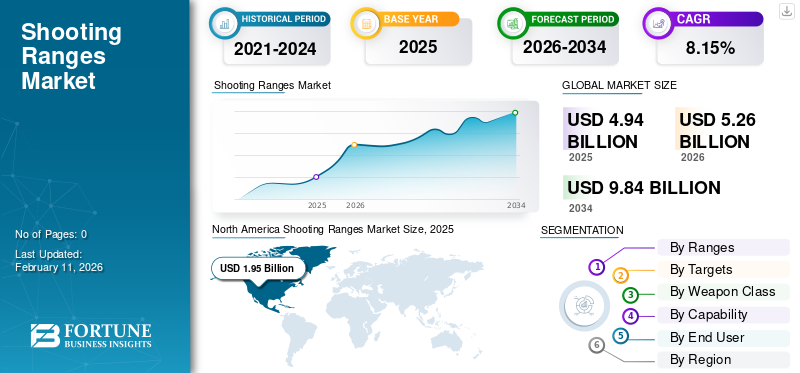
The global shooting ranges market size was valued at USD 4.94 billion in 2025 and is projected to grow from USD 5.26 billion in 2026 to USD 9.84 billion by 2034, exhibiting a CAGR of 8.15% during the forecast period. North America dominated the global shooting ranges market, with a 39.47% market share in 2025.
The shooting ranges market consists of purpose-built, controlled facilities such as indoor shooting ranges, outdoor, modular, and virtual, designed for safe firearms and archery training, testing, and recreation. These include firing points, target systems, ballistic backstops, ventilation, acoustic treatment, and digital control systems for managing safety and performance. These are used by military and law enforcement agencies in marksmanship, tactical drills, and scenario-based training; by private security providers for qualification; and by civilians for sport, practice related to hunting, and self-defense training. Increasingly, shooting ranges combine simulators with VR/AR environments and laser-based systems in order to offer realistic training conditions with lower risk.
The shooting ranges market size expansion is supported by sustained defense and internal security spending, rising training frequency requirements, and the modernization of legacy facilities. Military and law enforcement agencies are upgrading ranges to support realistic training scenarios, advanced target systems, and data-driven performance evaluation. Civilian participation also contributes to demand, particularly in regions with a strong shooting sports culture and regulated recreational access.
Shooting ranges market trends highlight growing adoption of smart targets, digital scoring, and scenario-based training systems. Indoor ranges gain prominence due to urbanization and environmental constraints, while specialty ranges address advanced tactical and long-range requirements. Sustainability and noise mitigation considerations influence facility upgrades and site selection.
The shooting ranges market growth is expected to remain stable through the forecast period. Expansion is underpinned by institutional training mandates, modernization funding, and continued emphasis on controlled, standardized firearms training environments. Regional growth patterns vary, but the market outlook reflects steady demand aligned with security, safety, and professional training priorities across defense, law enforcement, and regulated civilian segments globally.
The shooting ranges market share remains fragmented, reflecting diverse ownership models, including government-operated facilities, private commercial operators, and public-private partnerships. Technology providers supplying target systems, range management software, and safety infrastructure play an increasingly influential role in value creation. Integration capability and compliance expertise are becoming key differentiators.
The market is fragmented, with no single global leader, but a cluster of strong technology and range-systems players, including Action Target, Range Systems, Cubic Corp, and Saab AB, combined with thousands of independent operators. Competition is based on the sophistication of the technology, safety, and environmental performance, and the ability to provide military, law-enforcement, and commercial clients with turnkey, customized solutions.
Download Free sample to learn more about this report.
SHOOTING RANGES MARKET KEY TAKEAWAYS
 Market Size & Forecast
- 2025 Market Size: USD 4.94 billion
- 2026 Market Size: 5.26 billion
- 2034 Forecast Market Size: USD 9.84 billion
- CAGR: 8.15% from 2026–2034
 Market Share
- North America dominated the market with a 39.47% share in 2025.
- Specialty shooting ranges are the fastest-growing segment, with a 9.01% CAGR.
- Smart targets are the fastest-growing equipment segment, with a 9.73% CAGR.
 Key Regional Highlights
North America
North America held a 39.47% share and reached USD 1.95 billion in 2025.
Europe
Europe is projected to grow at a 9.34% CAGR and reach USD 2.80 billion by 2034.
Asia Pacific
Asia Pacific is the second-fastest-growing region due to defense modernization and shooting sports growth.
U.S.
The market is driven by military infrastructure, law enforcement training, and civilian shooting activities.
Japan
Growth is supported by advanced indoor ranges and safety-focused training systems.
Read More

Shooting Ranges Market Trends
Virtual Reality and Immersive Simulation Technology Advancement Anticipates Market Growth
The virtual reality and augmented reality simulation technologies are irreversibly changing the face of training methodologies in the ecosystem of shooting ranges by introducing realistic scenario immersions while reducing ammunition consumption, range wear, and environmental contamination associated with traditional live-fire training. Advanced VR systems now include ballistic physics engines that consider wind velocity, distance compensation, ammunition velocity characteristics, projectile trajectory modeling, and weapon-specific ballistic profiles for training fidelity near live-fire conditions within controlled laboratory environments.
- In January 2025, Action Target Inc. announced a showcase of next-generation shooting range technologies at SHOT Show 2025, emphasizing practical innovations such as smart target retrievers and integrated control systems designed to enhance safety and user experience across commercial, law enforcement, educational, and military applications.
Technology integration defines the current shooting ranges market trends. Facilities increasingly deploy smart target systems, digital scoring, and data analytics to enhance training effectiveness. These tools provide objective performance metrics and support continuous improvement. Indoor range adoption continues to expand. Controlled environments address land constraints, noise regulations, and weather dependency. Advanced ventilation and acoustic systems improve safety and user experience, supporting higher utilization.
Scenario-based and judgment training is gaining prominence. Law enforcement and military users prioritize decision-making under stress rather than static firing drills. Ranges incorporate moving, turning, and interactive targets to replicate operational conditions. Automation improves operational efficiency. Range management software streamlines scheduling, access control, and compliance reporting. These systems reduce administrative burden and improve oversight.
Sustainability considerations influence design choices. Operators adopt lead management systems, energy-efficient ventilation, and recyclable materials to meet environmental standards. These investments align with regulatory expectations and long-term cost control. Private-public collaboration is also increasing. Governments partner with commercial operators to expand training capacity without full ownership. These trends collectively reflect a shift toward technologically advanced, multi-use shooting ranges aligned with professional training requirements and long-term operational resilience.
Download Free sample to learn more about this report.
Market Dynamics
Market Drivers:
Market Expansion through Recreational and Competitive Demand Drives Market Growth
The key driver of the global market is the increasing participation in target sports and leisure shooting activities. Due to increasing competition in disciplines including IPSC, clay target shooting, and precision rifle target shooting, there has been high demand for purpose-built, well-equipped facilities to accommodate different shooting methods and levels of experience. This momentum is particularly pronounced in North America, where established firearm ownership culture and robust sporting traditions create recurring demand for accessible ranges offering competitive infrastructure, training programs, and social engagement opportunities.
- In January 2024, InVeris announced the rebrand of its FATS product line to FATS VR, marking 40 years of innovation in the virtual training industry with a new, 360-degree virtual reality solution for de-escalation and weapons training.
Defense and internal security training requirements represent the primary driver of the shooting ranges market. Armed forces and law enforcement agencies require regular, standardized firearms training to maintain readiness, accuracy, and safety compliance. Increasing operational complexity elevates demand for structured and repeatable training environments.
Modernization of training doctrine further supports market expansion. Agencies increasingly emphasize scenario-based and decision-making training rather than static marksmanship alone. Shooting ranges equipped with advanced target systems and digital monitoring enable realistic exercises and objective performance assessment. Urbanization contributes to demand growth for indoor and controlled-environment ranges. As outdoor training space becomes limited, indoor facilities offer consistent availability, environmental control, and noise mitigation. This supports year-round training and higher utilization rates.
Civilian shooting sports and professional training programs provide additional demand. Regulated recreational shooting, competition training, and private instruction sustain commercial range activity in select regions. This demand supports private investment and facility upgrades. Technological advancement reinforces adoption. Smart targets, automated scoring, and range management software improve training efficiency and safety oversight. These capabilities align with institutional accountability requirements.
Market Restraints:
Stringent Regulatory Compliance and Environmental Liability Management Hamper Market Growth
The industry is subject to an increasingly challenging regulatory environment, which involves several significant operational and economic burdens on facilities and market entrants. The OSHA Lead Standard, 29 CFR 1910.1025, requires that employers monitor for airborne lead exposure when employees are exposed to lead above the action level, and, considering that lead-based ammunition generates harmful, respirable particulate during firearms firing, lead continues to be the most significant occupational health risk at indoor and outdoor shooting ranges.
Regulatory complexity presents a significant restraint for the shooting ranges market. Zoning laws, environmental regulations, and noise control requirements complicate facility development and expansion. Compliance costs increase project timelines and capital requirements.
High initial investment also limits market entry. Modern shooting ranges require advanced ventilation, ballistic containment, and safety systems. These infrastructure demands elevate construction and maintenance costs, particularly for indoor facilities. Community opposition can constrain development. Public concerns regarding noise, safety, and environmental impact influence permitting outcomes. Operators must invest in mitigation measures and stakeholder engagement to secure approvals.
Operational risk management represents another constraint. Shooting ranges must maintain strict safety protocols, staff training, and insurance coverage. Any incident can result in reputational damage and regulatory scrutiny, affecting utilization and revenue stability. Economic sensitivity affects discretionary segments. Civilian and recreational usage fluctuates with economic conditions, influencing commercial range performance. This volatility can deter private investment in some markets.
Market Opportunities:
Digital Integration and Artificial Intelligence-Driven Training Optimization Propel Market Growth
The integration of artificial intelligence, machine learning, and advanced analytics into shooting range operations and training platforms makes for a potentially transformative opportunity vis-à-vis differentiation, operational efficiency, and market expansion into hitherto underserved customer segments. AI-powered training systems, capable of real-time performance analysis, biometric monitoring, and personalized coaching algorithms, enable customized skill development pathways. These pathways dynamically adapt to individual shooter performance profiles and create engagement mechanisms that drive facility utilization and customer retention.
- In November 2024, ESA South and MILO LIVE documented comprehensive case studies demonstrating modular range deployment to U.S. Air Force and Immigration & Customs Enforcement facilities, with additional government locations adopting modular infrastructure as operational templates for future acquisitions.
Modernization of legacy facilities presents a major opportunity within the shooting ranges market. Many existing ranges require upgrades to meet current safety, technology, and environmental standards. Retrofit projects generate sustained demand for equipment and services. Advanced tactical and specialty ranges offer growth potential. Military and law enforcement agencies increasingly seek facilities supporting long-range engagement, urban combat simulation, and integrated training exercises. These requirements support premium investment.
Emerging markets represent an additional opportunity. Expanding defense and internal security budgets in developing regions drive demand for standardized training infrastructure. Local partnerships facilitate market entry and compliance. Technology providers can expand value through integration. Combining target systems, analytics, and training software enhances differentiation and recurring revenue potential. Subscription-based models support predictable cash flows.
Market Challenges
Regulatory Fragmentation and Compliance Complexity across Jurisdictions Hamper Market Growth
The industry faces fragmented regulatory regimes in which the standards, enforcement mechanisms, and compliance thresholds differ significantly between federal, state, and local jurisdictions, raising operational difficulties and financial uncertainties for multi-site operators and growing enterprises alike. Federal OSHA standards set the minimum lead exposure and occupational health standards, but several states-including California, Washington, and Oregon-have implemented more stringent lead standards that contain lower permissible exposure limits and expanded medical surveillance requirements, requiring facility-specific compliance programs instead of standardized industry-wide approaches.
SEGMENTATION ANALYSIS
The shooting ranges market exhibits multidimensional segmentation shaped by training objectives, operational complexity, technology adoption, and end-user mandates. Demand patterns vary significantly across range formats, target technologies, weapon classes, capability levels, and user groups. These segmentation dynamics determine capital allocation, utilization intensity, and long-term shooting ranges market growth across institutional and commercial environments.
By Ranges
Market Emergence and Niche Specialization Dynamics Drive Segmental Growth
The global market is segmented by ranges into indoor ranges, outdoor ranges, and specialty ranges.
Indoor Ranges
Urban density, land availability constraints, and regulatory pressure drive the adoption of enclosed facilities. Indoor ranges offer controlled environmental conditions, consistent availability, and enhanced safety through engineered ballistic containment and ventilation systems. Defense and law enforcement agencies favor indoor ranges for year-round training and standardized qualification. Commercial operators also benefit from predictable utilization. This segment contributes significantly to the shooting ranges market size expansion due to higher construction value and technology integration.
Specialty Ranges
Specialty shooting ranges represent the fastest-growing segment in the global shooting ranges market, growing by a CAGR of 9.01% during the forecast period of 2026-2034, quite significantly in comparison to general-purpose indoor or outdoor facility expansion rates. This acceleration is indicative of market fragmentation that allows operators to manifest competitive differentiation through discipline-specific infrastructure, catering to precision rifle competitions, such as F-Class Target Rifle and benchrest shooting; practical shooting sports, including IPSC and 3-Gun; clay target disciplines comprising skeet, trap, and sporting clays; and other applications, including long-range tactical training and scenario-based law enforcement instruction.
Outdoor Ranges
Outdoor ranges remain essential for long-distance and large-caliber training. Military and advanced law enforcement users rely on outdoor facilities to simulate open-terrain engagement and extended-range scenarios. Lower infrastructure costs compared to indoor ranges support continued use, particularly in regions with favorable land availability. However, environmental and noise regulations limit expansion. Outdoor ranges maintain relevance within the shooting ranges market but face slower growth relative to indoor facilities.
Outdoor shooting ranges dominate by commanding 54.60% of the revenue share, with a continued 7.43% compound annual growth rate, reflecting the core operational advantages expected to underpin the scalability of facilities, customer capacity, and a wide variety of training applications.
By Targets
Technological Innovation and Performance Analytics Integration Anticipate Segmental Growth
The global shooting ranges market is segmented by targets into moving targets, turning targets, pop-up targets, and smart targets.
Moving Targets
Moving target systems enhance realism by simulating dynamic threats. Adoption is strong among military and law enforcement users focused on operational preparedness. These systems support judgment training and situational awareness development. Integration with automation and control software increases training flexibility. Moving targets contribute meaningfully to the shooting ranges market growth through equipment upgrades and system retrofits.
Smart Targets
Smart targets are the fastest-growing segment of the market, growing at an accelerated rate of over 9.73% CAGR from 2026 to 2034, considerably higher than the growth rates of the traditional mechanical and reactive targets. Smart targets deploy AI, IoT sensor networks, acoustic event detection algorithms, real-time data analytics, and cloud-based performance management platforms as integral pieces of comprehensive training ecosystems that enable objective performance measurement, immediate feedback mechanisms, and data-driven optimization.
Smart targets represent a transformative segment. Embedded sensors, digital scoring, and connectivity enable real-time feedback and analytics. Adoption is accelerating as institutions prioritize data-driven training. Smart targets significantly influence the shooting ranges market trends by shifting value toward software and analytics-enabled systems.
Pop-Up Targets
Pop-up targets support tactical drills and surprise engagement scenarios. Military and law enforcement agencies use these systems to replicate battlefield conditions. Demand aligns with scenario-based training adoption. These targets support higher training intensity and performance assessment, reinforcing their role in advanced range configurations.
Pop-up targets continue commanding the market dominance within the shooting targets segment with 30.67% share, while further expanding at a 6.40% CAGR, reflecting fundamental advantages supporting the realism of tactical training, flexibility in training scenarios, and the prevalence of institutional deployments. Pop-up target systems allow for realistic, dynamic training controlled environments in which the trainee must decide under operational stress conditions, such as targets emerging from concealed positions, exposing configurations that may vary with time, and requiring rapid threat assessment and engagement training elements not possible with static paper targets.
Turning Targets
Turning targets are widely used for qualification and timed training exercises. Their reliability and standardized operation support regulatory compliance. Adoption remains stable across indoor and outdoor ranges. While technologically simpler, turning targets remain essential for high-volume training, sustaining consistent demand.
By Weapon Class
Competitive Shooting Discipline Expansion and Participant Growth Acceleration
The global market is segmented by weapon class into small arms, precision / long-range, crew-served weapons, non-lethal & training rounds, and legacy & miscellaneous.
Long-Range Weapons
Precision/long-range rifle shooting represents the fastest-growing weapon class segment within shooting ranges, growing at 9.75% CAGR through 2034 and substantially outpacing traditional handgun and general rifle range expansion rates. The PRS is a perfect reflection of this explosive growth track, wherein the number of competitors grew from 164 active competitors in 2012 to more than 15,000 competitors in 2023, representing a 91.5x growth within an 11-year period and making PRS the preeminent precision rifle competition structure in the world.
Long-range weapon training requires specialized facilities and safety buffers. Demand is driven by military sniper programs and precision law enforcement units. These ranges involve higher land and equipment requirements, contributing to premium segment value.
Small Arms
Small arms training dominates usage across all shooting range types. Pistols and rifles form the foundation of military, law enforcement, and civilian training programs. High utilization frequency supports consistent demand for range infrastructure and targets. This segment anchors the shooting ranges market share due to volume and recurring qualification requirements.
Small Arms maintains commanding market dominance at 55.30% share in the weapon class segment, reflecting fundamental advantages supporting institutional training requirements, qualification protocols, and tactical readiness assessment.
Crew-Served Weapons
Crew-served weapons training is limited to military environments. Specialized ranges support heavy weapon systems and coordinated team operations. While low in volume, this segment involves significant infrastructure investment, contributing to the institutional shooting ranges market size.
Non-Lethal & Training Rounds
Non-lethal and training rounds support simulation and safety-focused training. Adoption aligns with judgment training and de-escalation emphasis. This segment supports a diversified range of usage and complements advanced capability development.
Legacy & Miscellaneous
Legacy systems and mixed weapon classes persist in older facilities. Modernization programs gradually replace these configurations, creating upgrade-driven demand.
To know how our report can help streamline your business, Speak to Analyst
By Capability
Scenario-Based Training and Realistic Operational Environment Integration Propel Segmental Growth
The global market is segmented by capability into basic static shooting ranges, advanced tactical ranges, judgment/decision-making training, marksmanship qualification ranges, and long-range engagement ranges.
Advanced tactical ranges are the segment of shooting ranges that is seeing the most growth, expanding by 10.49% CAGR through 2034, well above the expansion rate seen in traditional static marksmanship qualification facilities. Advanced tactical ranges provide dynamic, reality-replicating training environments that incorporate moving targets, barricaded shooting positions, multi-threat scenarios, and force-on-force simulation capabilities.
Marksmanship qualification ranges maintain commanding market dominance, with a 30.44% share reflecting fundamental demand anchored by mandatory firearms qualification requirements across military and law enforcement organizations globally.
By End User
Market Emergence and Niche Specialization Dynamics Drive Segmental Growth
The global market is segmented by end user into defense/military, law enforcement, commercial, and civil/recreational.
Defense and military organizations represent the fastest-growing and simultaneously dominating end-user segment, commanding a 48.83% share and estimated to be the fastest growing during the forecast period of 2026-2034 with a highest CAGR of 8.44%. The growth represents increasing geopolitical tensions, NATO expansion, and modernization priorities in defense that are driving capital toward the modernization of training infrastructures, including the development and demand for technologically advanced shooting ranges.
The second-fastest-growing end user segment is civil and recreational shooting ranges, growing at a CAGR of 8.31% through 2026-2034, accounting for a revenue share of 23.52%, and showing strong growth in participation across various demographic segments.
Shooting Ranges Market Regional Insights
The global market is divided into North America, Europe, Asia Pacific, and the Rest of the World.
North America Shooting Ranges Market Analysis:
North America continues to have commanding market dominance with around 39.47% of the global shooting ranges market share, enabled by a deeply entrenched culture of firearm ownership, institutional military and law enforcement training infrastructures, and well-developed commercial ecosystems of shooting sport disciplines. The U.S. has the highest per-capita shooting range density in the world, with facilities to address military training requirements, law enforcement marksmanship certification, competitive shooting disciplines, and civilian recreational participation across all demographic segments.
North America represents a significant shooting range market driven by defense training requirements, law enforcement qualification mandates, and structured civilian participation. Institutional investment supports the modernization of indoor and advanced tactical ranges. Strong regulatory frameworks encourage standardized training environments. High technology adoption, including smart targets and range management systems, sustains steady shooting ranges market growth across military, law enforcement, and commercial operators.
United States Shooting Ranges Market:
The United States dominates the shooting ranges market due to extensive military infrastructure, large law enforcement networks, and regulated civilian shooting activity. Federal and state agencies invest in advanced training facilities emphasizing judgment and tactical readiness. Private operators expand indoor ranges to address urban demand. These factors support the sustained expansion of the shooting ranges market size nationwide.
North America Shooting Ranges Market Size, 2025 (USD Billion)
To get more information on the regional analysis of this market, Download Free sample
Asia-Pacific Shooting Ranges Market Analysis:
Asia Pacific shooting ranges market emerges as the second-fastest-growing region in the world, with trajectories of market growth way above developed markets, driven by growing defense budgets, military modernization initiatives, and increasing participation in shooting sports across China, India, South Korea, and Japan. The trend is well exemplified by India and Japan, which have governments with projects on upgrading defense that integrate smart shooting ranges, incorporating automated scoring systems, controlled environmental safety controls, and electronic monitoring frameworks, setting long-term growth pathways for the shooting range equipment ecosystem.
Asia-Pacific represents a growing shooting range market supported by defense modernization and expanding internal security forces. Countries invest in structured training infrastructure to improve proficiency and safety. Urbanization drives demand for indoor ranges. Increasing adoption of automated target systems supports the shooting ranges market growth across the military and law enforcement segments regionally.
Japan Shooting Ranges Market:
Japan's shooting ranges market emphasizes controlled, safety-focused training environments. Law enforcement agencies invest in indoor ranges with advanced monitoring systems to meet strict safety standards. Military training remains selective but structured. Technology adoption supports efficiency and compliance, contributing to measured shooting ranges market growth aligned with national security priorities.
China Shooting Ranges Market:
China's shooting ranges market is driven by expanding law enforcement training programs and military preparedness initiatives. Government investment supports the development of modern training facilities equipped with automated target systems. Emphasis on standardized qualification and operational readiness contributes to the growing shooting ranges market size across institutional end users nationwide.
Europe Shooting Ranges Market Analysis:
Europe continues to be the fastest-growing developed market for mature economies, as the regional shooting ranges market growth is projected at a 9.34% compound annual growth rate through 2032, reaching a market value of USD 2.80 billion by 2034. Dynamics related to the Russia-Ukraine conflict fundamentally reshape regional growth, catalyzing investments in defense modernization, compliance with NATO standardization requirements, and surging civilian interest in firearms training and self-defense courses across Poland, Germany, and neighboring Central and Eastern European nations.
The European shooting ranges market is shaped by security preparedness initiatives and law enforcement training modernization. Countries emphasize controlled indoor facilities to meet environmental and safety standards. Military ranges support multinational exercises and interoperability training. Regulatory consistency and public safety considerations influence facility design, supporting moderate but stable shooting ranges market growth across the region.
Germany Shooting Ranges Market:
Germany’s shooting ranges market focuses on compliance-driven training and safety performance. Law enforcement and military agencies invest in indoor and advanced tactical ranges to meet strict regulatory standards. Emphasis on noise mitigation and environmental controls shapes facility development. Continued security investment supports steady shooting ranges market growth aligned with institutional training priorities.
Germany especially stands out as the fastest-growing European market, buoyed by strong shooting sports associations, a strict regulatory compliance infrastructure that includes digital monitoring and environmental safety systems, and highly developed police training requirements entailing high-fidelity range facilities.
United Kingdom Shooting Ranges Market:
The United Kingdom shooting ranges market is driven by law enforcement training reform and defense readiness programs. Agencies prioritize judgment-based and scenario-driven facilities to enhance operational decision-making. Indoor ranges dominate due to land constraints. Government funding and standardized training frameworks support consistent shooting ranges market growth across institutional users.
Latin America Shooting Ranges Market Analysis:
Latin America’s shooting ranges market develops gradually, supported by law enforcement capacity building and border security requirements. Budget constraints limit large-scale expansion, but selective investment in indoor and tactical ranges persists. International cooperation and training assistance support incremental shooting ranges market growth across priority security agencies.
Middle East & Africa Shooting Ranges Market Analysis:
The Middle East and Africa shooting ranges market is influenced by security challenges and defense training needs. Governments invest in specialized military and law enforcement ranges to enhance readiness. Infrastructure development varies by country. Strategic partnerships and defense procurement initiatives support the gradual growth of the shooting ranges market across key regions.
Shooting Ranges Industry Competitive Landscape:
Key Industry Players
Integration of Artificial Intelligence in Analytics by Key Players to Strengthen Market Growth
The markets for shooting ranges are considered moderately fragmented with a heterogeneous competitive landscape consisting of global defense contractors, specialized range equipment manufacturers, regional facility operators, and emerging technology-driven entrants. Market concentration really varies by customer segment and geographic region; the segment of defense and military procurement is more concentrated among well-established defense technology providers such as SAAB AB, Cubic Corporation, and Meggitt Training Systems, which together hold a large market share due to multi-year government contracts and IDIQ (Indefinite Delivery/Indefinite Quantity) procurement frameworks that span eight-year lifecycle support windows.
The competitive differentiation strategies across the segment of shooting ranges fall broadly into three categories: technology-driven innovation, integration of end-to-end solutions, and price-based competition. Technology-focused differentiation emphasizes advanced target retrieval systems, virtual reality simulation platforms, artificial intelligence-enabled performance analytics, automation of controlled environmental compliance, and integrated digital range management systems that help improve the effectiveness and efficiency of training operations.
The shooting ranges industry's competitive landscape is characterized by a fragmented mix of equipment manufacturers, technology providers, facility developers, and system integrators. Competition centers on safety compliance, technology integration, and the ability to deliver turnkey training environments. Vendors differentiate through target system sophistication, range automation, and service support. Established suppliers provide comprehensive solutions, including ballistic containment, ventilation, target systems, and range management software. These firms maintain a strong market share in the shooting ranges market through long-term contracts with military and law enforcement agencies. Their scale enables compliance with stringent safety and regulatory requirements.
Emerging players focus on smart target technologies, digital analytics, and simulation integration. These companies influence the shooting ranges market trends by introducing data-driven training and performance assessment tools. Partnerships with facility developers and government agencies support market entry and growth. Strategic collaboration is common across the industry. Vendors partner with defense agencies, law enforcement organizations, and training academies to co-develop customized solutions. Public-private partnerships enable facility expansion while managing capital risk.
List of Key Shooting Ranges Companies Profiled in Report
- Range USA, Inc. (U.S.)
- Brazil’s Private Shooting Clubs (Brazil)
- Gun For Glory Shooting Academy (India)
- Bisley Shooting Ground (Bisley Shooting Group) (U.K.)
- False Bay Firearm Training Academy (South Africa)
- Caracal International LLC (UAE)
- Caliber 3 (Israel)
- Saab AB – Training & Simulation (Sweden)
- Landmarc Support Services Ltd. (U.K.)
- Parsons Corporation (Training Support Services) (U.S.)
- Constellis (Academi Training Center) (U.S.)
- NRA Whittington Center (U.S.)
- PrairieFire (Front Sight Nevada) (U.S.)
- SIG Sauer Academy (SIG Sauer, Inc.) (U.S.)
KEY INDUSTRY DEVELOPMENTS
- September 2025: A state-sponsored shooting range in South Dakota is almost complete and is anticipated to open in November. The South Dakota Game, Fish & Parks Department expects the predominantly state-funded gun range close to Rapid City to be available for public usage by early November.
- August 2025: The chief minister has authorized the development of an international-standard shooting range and a multifunctional sports complex in Lucknow. These facilities will be established through a Public-Private Partnership (PPP) model and are anticipated to function as training centers and job creators.
- August 2025: The Ministry of National Defence of Lithuania has finalized a contract for the design and construction of a new multifunctional shooting range at the Rūdninkai training area. The agreement is worth around 8.9 million USD, and the project is expected to be finished by the fourth quarter of 2026.
- August 2025: A deal has been made permitting the Baltimore Police Department to utilize the firing range at Gunpowder Military Reservation for their training purposes.
- July 2025: A memorandum of understanding (MoU) has been established between the Meghalaya government and the National Rifle Association of India (NRAI) to promote the sport of shooting in the state and throughout the North East.
REPORT COVERAGE
The global shooting ranges market analysis provides an in-depth study of the market size & forecast by all the market segments included in the report. It includes details on the shooting ranges market trends and market dynamics expected to drive the market over the forecast period. It offers information on the technological advancements, new product type launches, key industry developments, and details on partnerships, mergers & acquisitions. The market research report also encompasses a detailed competitive landscape with information on the market share and profiles of key operating players.
Request for Customization to gain extensive market insights.
REPORT SCOPE & SEGMENTATION
| Attributes | Details |
| Study Period | 2021-2034 |
| Base Year | 2025 |
| Forecast Period | 2026-2034 |
| Historical Period | 2021-2024 |
| Growth Rate | CAGR of 8.15% from 2026-2034 |
| Unit | USD Billion |
| Segmentation | By Ranges, By Targets, By Weapon Class, By Capability, By End User, By Region |
|
By Ranges
By Targets
By Weapon Class
By Capability
By End User
|
|
| By Region |
North America (By Ranges, By Targets, By Weapon Class, By Capability, By End User, By Country)
Europe (By Ranges, By Targets, By Weapon Class, By Capability, By End User, By Country)
Asia Pacific (By Ranges, By Targets, By Weapon Class, By Capability, By End User, By Country)
Rest of World (By Ranges, By Targets, By Weapon Class, By Capability, By End User, By Sub-Region)
|
Frequently Asked Questions
Fortune Business Insights says that the global market value stood at USD 4.94 billion in 2025 and is projected to reach USD 9.84 billion by 2034.
In 2025, the Europe market value stood at USD 1.27 billion
The market is expected to exhibit a CAGR of 8.15% during the forecast period of 2026-2034.
The specialty ranges segment is expected to hold the highest CAGR over the forecast period.
Market expansion through recreational and competitive demand drives the market growth.
Saab AB – Training & Simulation (Sweden), Parsons Corporation (Training Support Services) (U.S.), Range USA, Inc. (U.S.), NRA Whittington Center (U.S.) and among others are top players in the market.
North America dominated the market in 2025.



- 2021-2034
- 2025
- 2021-2024
- 120
Get 30-60 hrs Free Customization
Expand Regional and Country Coverage, Segments Analysis, Company Profiles, Competitive Benchmarking, and End-user Insights.




















Related Reports
-
US +1 833 909 2966 ( Toll Free )
-
Get In Touch With Us