Oscillator Market Size, Share, and Industry Analysis, By Product Type (Crystal Oscillator and MEMS-based Oscillator), By Industry (Telecommunications, Automotive, Consumer Electronics, Aerospace & Defense, Medical, Industrial, and Others), and Regional Forecast, 2026-2034
 Download Free Sample
Oscillator Market Size & Future Outlook
 Listen to Audio Version
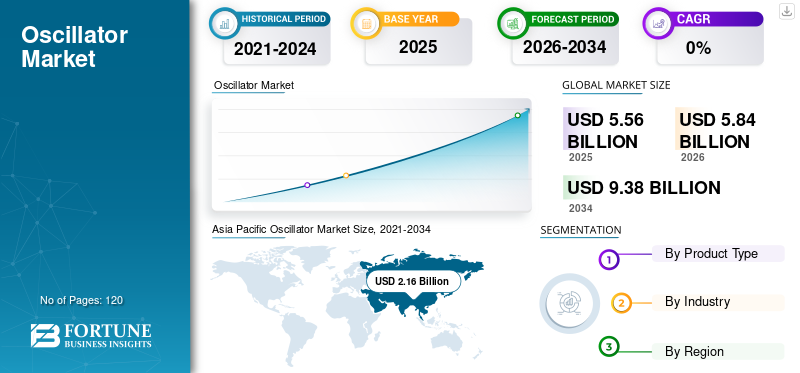
The global oscillator market size was valued at USD 5.56 billion in 2025. The market is projected to grow from USD 5.84 billion in 2026 to USD 9.38 billion by 2034, exhibiting a CAGR of 6.1% during the forecast period. Asia Pacific dominated the oscillator market with a market share of 38.85% in 2025.
The oscillator refers to electronic components that generate a stable periodic signal, typically a clock or timing signal, used to synchronize and control electronic systems. These devices are essential for many electronic networks by controlling touch interfaces, identifying objects' positions, communicating with one another wirelessly, and controlling the operation of machines and other industrial tools. More reliable and precise timing devices will continue to be developed due to the growing expectation for greater integration into nearly every daily life activity, along with the advent of wireless systems that require more frequent synchronized communications.
Many key industry players, such as Seiko Epson Corporation, Nihon Dempa Kogyo (NDK), TXC Corporation, Daishinku Corp. (KDS), and Murata Manufacturing, operating in the market, are continuously focusing on developing innovative products with high stability, low jitter, and miniaturized oscillators to address evolving performance requirements in automotive, telecom, and data center applications.
Download Free sample to learn more about this report.
Oscillator Market Key Takeaways
 Market Size & Forecast
- 2025 Market Size: USD 5.56 billion
- 2026 Market Size: USD 5.84 billion
- 2034 Forecast Market Size: USD 9.38 billion
- CAGR: 6.1% from 2026-2034
 Market Share
- Asia Pacific dominated the oscillator market with a 38.85% share in 2025.
- MEMS-based oscillators are projected to register the highest CAGR of 8.8% during the forecast period.
- Consumer electronics dominated the oscillator market in 2025.
 Key Regional Highlights
Asia Pacific
Asia Pacific reached USD 2.16 billion in 2025, maintaining its leadership position in the global market.
North America
North America is projected to reach USD 1.67 billion in 2026, securing its position as the second-largest regional market.
Europe
Europe is expected to reach USD 1.23 billion in 2026, supported by a CAGR of 5.8% during the forecast period.
U.S.
The market is estimated at USD 1.33 billion in 2026, accounting for approximately 22.8% of global sales.
Japan
The market is estimated at USD 0.43 billion in 2026, representing roughly 7.4% of global revenues.
Read More

OSCILLATOR MARKET TRENDS
Increasing Electronic Content per Vehicle Driving Demand for High-Reliability Automotive Oscillators
In the automotive sector, the amount of electronic content per vehicle continues to increase, resulting in a higher number of control units and high-speed digital communications interfaces for advanced driver assist systems (ADAS), infotainment, telematics, vehicle networking, and EV (electric vehicle) power distribution systems. All of these subsystems require stable clock/reference signals. As vehicles integrate additional cameras, radar, and domain controllers, the number of timing points, where oscillators are used, is increasing. Automotive environments also impose strict reliability requirements, including large temperature ranges, shock, and vibration exposure. causing an increased need for automotive-qualified oscillators (AEC-Q100) and high-performance, low-jitter oscillators. With the growing trend of EV architectures and zonal/centralized computing, there will be an increased reliance on reliable timing for keeping subsystems synchronized. As a result, the number of oscillators per vehicle is expected to be greater and the number of higher value oscillators.
- For instance, in March 2025, Epson launched a new automotive-focused MHz crystal oscillator SG-8201CGA that is AEC-Q100 compliant and positioned for high precision automotive use.
Download Free sample to learn more about this report.
MARKET DYNAMICS
MARKET DRIVERS
Rapid Industrial Automation and IIoT Deployment to Fuel Market Growth
With the rise of industrial automation and IIoT, the demand for the product has increased significantly. This is due to the growing number of connected controllers, sensors, gateways, and industrial Ethernet devices deployed in factories that all require reliable clock signals for data conversion, communication, and control systems.
In addition, as more robotics, machine vision, and real-time motion control are added to production lines, the need for deterministic latency and tight synchronization continues to increase, which creates an increased need for stable timing with low jitter. The rugged and wide temperature oscillators, including MEMS-based devices that can withstand extreme operating conditions on factory floors, also contribute to increased demand. This has resulted in continued growth in the number of oscillator sockets per manufacturing site, and a continued migration toward higher-performance oscillators.
- For instance, in September 2024, the International Federation of Robotics reported 4,281,585 industrial robots operating in factories in 2023 (+10% YoY) and annual installations of 541,302 units, indicating sustained automation deployment that expands the installed base of timed and synchronized equipment.
MARKET RESTRAINTS
Increasing Clock Integration in Semiconductor Devices to Limit Industry Growth
By integrating clock generation and PLL functions into modern system-on-chip, microcontrollers, RF transceivers, and power management ICs, designers can rely on integrated timing blocks. This will reduce the number of standalone oscillators that need to be placed on the board, thus lowering the number of external components, the cost of the bill of materials, PCB space, and design complexity for high-volume applications such as smartphones, IoT devices, and consumer electronics. As integration improves, certain low and mid-range oscillator sockets may be eliminated, limiting unit growth in commodity segments.
MARKET OPPORTUNITIES
Growing Adoption of MEMS Oscillators Boosts Industry Growth
The growing use of MEMS oscillators represents a significant market opportunity, as MEMS timing devices have superior shock and vibration endurance, smaller size, and greater reliability than quartz-based timing devices. This makes them an attractive option for a large number of applications that are subject to severe environmental stresses, including automotive, industrial automation, aerospace, and edge computing. With support from the chips and integration of MEMS technology with semiconductor manufacturing processes, these types of devices also provide enhanced programmability by allowing for greater frequency variations. As jitter specifications become tighter and temperature ranges increase, MEMS oscillators are being utilized more frequently as performance enhancements instead of just quartz replacements. The result will be higher unit volumes and increased average selling prices across the advanced application segment.
Segmentation Analysis
By Product Type
Crystal Oscillator Led Owing to their Widespread Application in Consumer Electronics
Based on product type, the market is divided into crystal oscillators, MEMS-based oscillators, digitally controlled oscillators, and voltage controlled oscillators.
Crystal oscillator dominated the global market in 2025, owing to their widespread application in consumer electronics, telecommunication systems, automotive applications, and various industrial uses that need accurate and stable frequency control. These factors include the inexpensive cost of crystal oscillators, small size, high frequency stability, and ability to be used for mass-produced electronics, which will continue to be key considerations in choosing timing devices for applications with high volume.
MEMS-based oscillators are expected to grow at the highest CAGR of 8.8% over the forecast period, owing to their superior shock resistance, miniaturization advantages, and increasing adoption in automotive, industrial, and high-performance computing applications requiring enhanced reliability and stability.
To know how our report can help streamline your business, Speak to Analyst
By Industry
Consumer Electronics Segment Led the Market due to the Massive Shipment Volumes of Gadgets
Based on industry, the market is classified into telecommunication, automotive, consumer electronics, aerospace & defense, industrial, medical, and others.
Consumer electronics dominated oscillator market share in 2025. This is owing to the massive shipment volumes of smartphones, laptops, wearables, gaming devices, and smart home products, all of which require multiple timing components per device. The combination of high-volume production and frequent product refreshing results in a steady and reliable demand for crystal and MEMS oscillators at a low cost.
Automotive is expected to grow at the highest CAGR of 8.9% over the forecast period. This is owing to increasing electronic content per vehicle, expansion of ADAS and EV architectures, rising demand for high reliability, and automotive-grade timing solutions.
Oscillator Market Regional Outlook
By geography, the market is categorized into North America, South America, Europe, the Middle East & Africa, and Asia Pacific.
Asia Pacific
Asia Pacific Oscillator Market Size, 2021-2034 (USD Billion)
To get more information on the regional analysis of this market, Download Free sample
Asia Pacific held the largest market share in 2024, valued at USD 2.09 billion, and also maintained its leading share in 2025, with USD 2.16 billion. The market in the region is expected to increase, as the large concentration and volume of electronics manufacturing facilities located in China, Taiwan, South Korea, and Japan produce high volumes of consumer devices, networking devices, and automotive electronics. Additionally, the presence of many key oscillator manufacturers and a strong established supply chain for semiconductors in the region is the key factor driving the oscillator market growth. In the region, India and China are both estimated to reach USD 0.31 billion and USD 0.52 billion, respectively, in 2026.
- For instance, in May 2024, Seiko Epson announced an investment to expand production capacity for crystal devices, including oscillators, at its Miyazaki facility in Japan to address growing automotive and industrial demand.
China Oscillator Market
China’s market is projected to be one of the largest worldwide, with 2026 revenues estimated at around USD 0.52 billion, representing roughly 8.9% of global sales.
To know how our report can help streamline your business, Speak to Analyst
Japan Oscillator Market
The Japanese market in 2026 is estimated at around USD 0.43 billion, accounting for roughly 7.4% of global revenues. This is owing to the strong presence of major crystal and MEMS timing manufacturers. Additionally, the growing production of automotive electronics and the ongoing demand from advanced industrial and networking equipment sectors are the key factors driving growth.
India Oscillator Market
The Indian market in 2026 is estimated at around USD 0.31 billion, accounting for roughly 5.3% of global revenues.
North America
North America is estimated to reach USD 1.67 billion in 2026 and secure the position of the second-largest region in the market. This is owing to rapid expansion in AI-driven data centers, high-speed networking, and defense-grade positioning and timing systems, which is increasing demand for low-jitter, high-stability timing devices. Additionally, the presence of a large number of Precision Timing Vendors and Electronics Programs is the key factor driving the market. These Precision Timing Vendors and Electronic Programs will provide ongoing support for the continual upgrade of products and the faster adoption of MEMS technology and higher-reliability oscillator solutions.
- For instance, in December 2025, Jones Lang LaSalle IP, Inc. (JLL) reported more than 35 GW of data center capacity under construction in North America. This highlights the scale of infrastructure buildout that increases timing component demand across servers, switches, and optical networks.
U.S. Oscillator Market
Based on North America’s significant contribution and the U.S. dominance within the region, the U.S. market can be analytically approximated at around USD 1.33 billion in 2026, accounting for roughly 22.8% of global sales.
Europe
Europe is projected to grow at a CAGR of 5.8% in the coming years, which is the third-highest among all regions, and reach a valuation of USD 1.23 billion by 2026. The market is observing significant growth in the region, owing to an increasing demand for precision timing in 5G installations and telecom networks, with an emphasis on synchronization, therefore increasing the use of stable and low-jitter timing elements in all network hardware. Additionally, the growth of the market in the region will be driven by the increase/decrease of data center expansion and AI-driven upgrades to readiness levels for AI technology, which will increase the timing requirements of servers, switches, and optical interconnects.
U.K Oscillator Market
The U.K. market in 2026 is estimated at around USD 0.24 billion, representing roughly 4.1% of global revenues.
Germany Oscillator Market
Germany’s market is projected to reach approximately USD 0.23 billion in 2026, equivalent to around 3.9% of global sales.
South America
South America is expected to witness moderate growth in this market during the forecast period. The market is set to reach a valuation of USD 0.38 billion in 2026. This is owing to expanding telecom infrastructure, increasing consumer electronics penetration, and gradual modernization of industrial and automotive electronics across key economies such as Brazil and Argentina.
Middle East & Africa
The Middle East & Africa is estimated to reach USD 0.31 billion in 2026 and is expected to grow at a prominent growth rate in the coming years. This is owing to accelerating investments in telecom infrastructure, including 5G network deployment and fiber expansion, which increases demand for stable timing components in base stations and transport networks. Additionally, data centre growth, smart city projects, and industrial diversification programs that depend on reliable synchronization and control systems throughout connected infrastructure will also spur growth. In the Middle East & Africa, the GCC is set to reach a value of USD 0.10 billion in 2026.
COMPETITIVE LANDSCAPE
Key Industry Players
Key Players Emphasis on Advancements to Meet Evolving Requirements in 5G Networks
The global market holds a semi-consolidated market structure, with prominent players such as Seiko Epson Corporation, Nihon Dempa Kogyo (NDK), TXC Corporation, Daishinku Corp. (KDS), and SiTime Corporation holding significant positions. The leadership of these companies is supported by continuous strategic initiatives, including expansion of automotive-grade and high-stability oscillator portfolios, development of low-jitter timing solutions for data centers and telecom infrastructure, and advancement of MEMS-based oscillators for harsh environment applications. Market participants are also strengthening integration of the product with clock generators, synchronization ICs, and system-level timing architectures to meet evolving requirements in 5G networks, AI servers, industrial automation, and electric vehicles. Additionally, collaborations with automotive OEMs, networking equipment manufacturers, and industrial system integrators are enabling improved reliability, compact form factors, and faster customization cycles.
- For instance, in February 2025, SiTime reported strong annual revenue growth driven by increasing adoption of its MEMS timing portfolio across communications, data center, and industrial applications, highlighting the industry’s focus on high-performance timing solutions.
Other notable players in the global market include Microchip Technology, Rakon Limited, Kyocera Corporation, Abracon, and Murata Manufacturing. These companies are expected to emphasize new product launches, enhanced temperature stability, improved phase noise performance, and supply chain expansion to strengthen their competitive positioning and expand their global footprint during the forecast period.
LIST OF KEY OSCILLATOR COMPANIES PROFILEDSeiko Epson Corporation (Japan)
- Nihon Dempa Kogyo (NDK) (Japan)
- TXC Corporation (Taiwan)
- Daishinku Corp. (KDS) (Japan)
- Murata Manufacturing (Japan)
- Microchip Technology (U.S.)
- Rakon Limited (New Zealand)
- Kyocera Corporation (Japan)
- Abracon (U.S.)
- SiTime Corporation (U.S.)
KEY INDUSTRY DEVELOPMENTS
- December 2025: Abracon announced enhancements to manufacturing capacity, production redundancy, inventory, and a Quick-Turn Service to support rising demand for its MEMS oscillator portfolio across IoT and industrial markets.
- December 2025: SiTime launched the ENDR-TTT Endura Super-TCXO, positioned for ruggedized precision timing, including industrial applications with wide temperature operation and high shock resistance.
- September 2025: NDK launched a very compact automotive-grade crystal oscillator-related development positioned for next-generation automotive communications.
- April 2025: Kyocera Corporation developed a new facility in Pennsylvania, U.S., to support high-quality, low-noise quartz crystal frequency control products.
- January 2025: Abracon introduced multiple new MEMS oscillator families and highlighted an expanded portfolio of 50+ series, 1,700+ part numbers, aimed at electronics-driven industries, including industrial applications.
- October 2024: KDS launched a differential output crystal oscillators featuring world-class low phase jitter and low phase noise, targeting AI servers, optical modules, automotive Ethernet, and 5G base stations.
- January 2024: Rakon announced the launch of its next-generation MercuryX IC-OCXO range for AI and cloud data centers and next-generation telecom networks. The announcement highlights extended holdover performance and the use of Rakon in house technologies to deliver compact, high-stability timing.
REPORT COVERAGE
The global oscillator market analysis includes a comprehensive study of the market size & forecast by all the market segments included in the report. It includes details on the market dynamics and market trends expected to drive the market over the forecast period. It provides information on key aspects, including an overview of technological advancements, pipeline candidates, the regulatory environment, and product launches. Additionally, it details partnerships, mergers & acquisitions, and key industry developments and prevalence by key regions. The global market research report also provides a detailed competitive landscape with information on the market share and profiles of key operating players.
Request for Customization to gain extensive market insights.
Report Scope & Segmentation
| ATTRIBUTE | DETAILS |
| Study Period | 2021-2034 |
| Base Year | 2025 |
| Estimated Year | 2026 |
| Forecast Period | 2026-2034 |
| Historical Period | 2021-2024 |
| Growth Rate | CAGR of 6.1% from 2026 to 2034 |
| Unit | Value (USD Billion) |
| By Product Type |
|
| By Industry |
|
| By Region |
|
Frequently Asked Questions
According to Fortune Business Insights, the global market value stood at USD 5.56 billion in 2025 and is projected to reach USD 9.38 billion by 2034.
In 2025, the market value stood at USD 2.16 billion.
The market is expected to exhibit a CAGR of 6.1% during the forecast period (2026-2034).
By product type, the crystal oscillator segment led the market.
Rapid industrial automation and IIoT deployment are the key factors driving the market.
Seiko Epson Corporation, Nihon Dempa Kogyo (NDK), TXC Corporation, Daishinku Corp. (KDS), and Murata Manufacturing are the top players in the global market.
Asia Pacific dominated the market in 2025.


- 2021-2034
- 2025
- 2021-2024
- 120
Get 30-60 hrs Free Customization
Expand Regional and Country Coverage, Segments Analysis, Company Profiles, Competitive Benchmarking, and End-user Insights.




















Related Reports
-
US +1 833 909 2966 ( Toll Free )
-
Get In Touch With Us