Pea Milk Market Size, Share & Industry Analysis, By Product Format (Shelf Stable and Refrigerated), By Packaging Type (Aseptic Cartons (Tetra Pak), Plastic Bottles, Pouches, and Others), By Flavor (Non-Flavored and Flavored [Chocolate, Vanilla, and Others]), By Nature (Organic and Conventional), By Distribution Channel (Supermarkets/Hypermarkets, Convenience Stores, Online Retail, and Others), and Regional Forecast, 2026-2034
 Download Free Sample
(Offer valid till 15th Oct 2026)

Pea Milk Market Size and Future Outlook
 Listen to Audio Version
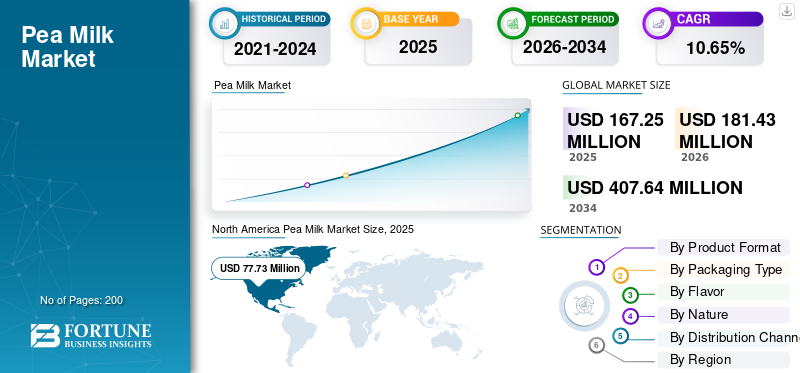
The pea milk market size was valued at USD 167.25 million in 2025 and is projected to grow from USD 181.43 million in 2026 to USD 407.64 million by 2034, exhibiting a CAGR of 10.65% during the forecast period. North America dominated the pea milk market with a market share of 46.47% in 2025.
Pea milk refers to a plant-based milk alternative primarily made from yellow peas or pea protein. It is positioned as a dairy-free, lactose-free, nut-free, soy-free milk and protein-rich beverage suitable for consumers seeking alternative dairy products to conventional dairy milk, almond milk, oat milk, and soy milk. The product is generally sold in plain, vanilla, chocolate, and other flavored ready-to-drink pea milk variants and is available through supermarkets, hypermarkets, convenience stores, online retail, and specialty channels.
The market is gaining momentum due to rising consumer preference for high-protein plant-based diets, increasing lactose intolerance awareness, demand for allergen-friendly milk alternatives, and growing interest in sustainable food choices. Pea milk formulations benefit from their stronger protein positioning compared to almond, rice, and coconut milk, while also offering a more neutral allergen profile than soy and nut-based milk alternatives.
The global market growth is also supported by the presence of pea milk and pea-protein beverage brands such as Ripple Foods, Sproud International AB, vly Foods GmbH, Mighty Drinks Ltd., and The Not Company, along with broader plant-based beverage companies expanding into high-protein dairy alternatives. Ripple Foods offers dairy-free milk alternatives, Sproud states that its plant drink is made from pea protein, vly positions itself as a milk alternative made from pea protein, and Mighty Drinks markets vegan pea milk alternatives fortified with calcium, vitamin D, and B12.
Download Free sample to learn more about this report.
Pea Milk Market Key Takeaways
 Global Market Size & Forecast
- 2025 Market Size: USD 167.25 million
- 2026 Market Size: USD 181.43 million
- 2034 Forecast Market Size: USD 407.64 million
- CAGR: 10.65% from 2026-2034
 Market Share
- North America market held a 46.47% share in 2025, valued at USD 77.73 million, driven by strong plant-based milk awareness and demand for allergen-friendly beverages.
- The shelf-stable market dominated in 2025 with USD 98.89 million, supported by longer shelf life and lower refrigerated distribution needs.
- The non-flavored market dominated in 2025 with USD 119.44 million, driven by its versatility across household and foodservice applications.
 Key Regional Highlights
North America
The market reached USD 77.73 million in 2025, driven by strong plant-based milk awareness and allergen-friendly demand.
Asia Pacific
The market reached USD 24.55 million in 2025, driven by urbanization, rising incomes, and lactose intolerance awareness.
Europe
The market reached USD 50.88 million in 2025, supported by vegan awareness and sustainable food demand.
U.S.
The market reached USD 68.02 million in 2025, driven by supermarket distribution and plant-based milk demand.
Japan
The market is growing steadily, supported by rising demand for plant-based beverages and increasing consumer preference for high-protein dairy alternatives.
Read More

Pea Milk Market Trends
Demand for Shelf-Stable Pea Milk, Barista Applications, and Blended Plant-Protein Beverages to Shape Market Trends
A key trend shaping the pea milk market growth is the shift toward shelf-stable, ambient plant-based milk formats that can move beyond premium refrigerated aisles. Pea milk is increasingly suitable for aseptic cartons as pea protein beverages can be processed for a longer shelf life while retaining their protein-led positioning. This supports wider retail reach, online bulk purchasing, export shipments, and better availability in countries where chilled plant-based milk infrastructure is still limited. As a result, shelf-stable pea milk is becoming more important for supermarkets, e-commerce, foodservice distributors, and emerging-market retail expansion.
Another important trend is the growing use of pea milk in coffee, smoothies, protein shakes, cereals, and at breakfast occasions. Brands are focusing on improved mouthfeel, neutral taste, better foam performance, and reduced beany notes to make pea milk more acceptable in everyday consumption. Barista-style and flavored formats are especially important as they help reduce taste barriers and make pea milk more comparable with oat and dairy milk in café-led and home beverage use.
- For instance, in January 2025, Sproud, the Sweden-based pea milk manufacturer, expanded its plant-based beverage portfolio by introducing a new sugar-free pea milk alternative. The product is formulated without added sugar while maintaining a creamy texture and nutritional profile, making it suitable for consumers seeking lower-sugar dairy alternatives.
MARKET DYNAMICS
Market Drivers
Download Free sample to learn more about this report.
Rising Demand for Highly Functional and Nutrition-Led Dairy Alternatives is Driving Pea Milk Consumption
One of the major factors driving market expansion is the shift from general plant-based milk consumption toward more functional and nutrition-led dairy alternatives. Health-conscious consumers are increasingly assessing plant-based beverages based on protein content, sugar level, fortification, taste, mouthfeel, coffee performance, and environmental positioning. This benefits the market as functional pea beverages offer such end-users higher nutrition than many low-protein plant milks.
Shelf-stable pea milk is also becoming an important growth factor. It supports wider distribution, lower cold-chain dependence, longer storage life, easier export movement, and better availability in online retail and emerging markets. This is particularly relevant in Asia Pacific, South America, and Middle East & Africa, where modern retail is expanding but refrigerated plant-based milk distribution is still more limited outside major cities.
- According to the Good Food Institute, the U.S. retail plant-based food sector reached USD 7.9 billion in 2025, while plant-based milk remained one of the largest plant-based categories. It also reported that plant-based milk was purchased by 38% of U.S. households in 2025, with 75% of buyers purchasing more than once, showing that milk alternatives remain one of the most repeatable plant-based food categories.
|
Rank |
Market Driver |
Expected Impact on Market Growth |
CAGR Contribution, 2026–2034 |
Impact: 2026-2028 |
Impact: 2029-2031 |
Impact: 2032-2034 |
|
1 |
Rising consumer preference for plant-based, dairy-free, and vegan beverages driven by health, sustainability, and lactose intolerance |
High |
+4.00% |
High |
High |
High |
|
2 |
Increasing product innovation, improved taste, clean-label formulations, and protein-rich positioning by leading manufacturers |
High |
+3.25% |
High |
High |
Medium |
|
3 |
Expansion of retail distribution, e-commerce, cafés, and foodservice adoption of pea milk, including barista formulations |
Medium-High |
+2.80% |
Medium |
High |
High |
|
4 |
Growing investments, strategic partnerships, and expansion of pea protein production capacity supporting wider commercialization |
Medium |
+2.40% |
Medium |
Medium |
High |
|
5 |
Rising consumer awareness regarding environmental sustainability, lower carbon footprint, and water-efficient crop cultivation |
Medium-Low |
+2.15% |
Medium |
Medium |
High |
|
6 |
Others, including organic product launches, private-label expansion, fortified nutrition offerings, and penetration into emerging economies |
Low |
+1.75% |
Low |
Low |
Medium |
|
Total Gross Growth Contribution |
+16.35% |
Market Restraints
Strong Competition from Established Oat and Almond Milk Alternatives Limits Pea Milk’s Shelf Penetration and Consumer Adoption
Pea milk faces strong competitive pressure as the plant-based milk category is already led by alternatives that consumers understand better, especially almond milk and oat milk. As a result, pea milk often struggles to secure the same shelf space, marketing support, and repeat-purchase rate, even though it offers strong nutritional benefits such as higher protein content.
Within plant-based milk, almond and oat products have already built strong consumer positions. Almond milk has historically been one of the most widely consumed plant-based milk alternatives, while oat milk has gained rapid acceptance due to its creamy texture, neutral taste, and strong use in coffee and barista applications.
|
Rank |
Market Restraint |
Expected Impact on Market Growth |
CAGR Contribution, 2026–2034 |
Impact: 2026-2028 |
Impact: 2029-2031 |
Impact: 2032-2034 |
|
1 |
Strong competition from established oat, almond, soy, and coconut milk alternatives limiting shelf penetration and consumer adoption |
High |
−2.10% |
High |
High |
Medium |
|
2 |
Consumer taste perception challenges, lower awareness compared with established plant-based milk categories, and limited repeat purchases |
Medium-High |
−1.60% |
High |
Medium |
Medium |
|
3 |
Relatively higher retail prices, supply chain limitations, and fluctuations in pea protein ingredient costs |
Medium |
−1.25% |
Medium |
Medium |
Medium |
|
4 |
Others, including regulatory labeling requirements, limited availability in developing markets, and competition from conventional dairy |
Low |
−0.75% |
Low |
Low |
Low |
|
Total Market Reduction |
−5.70% |
Market Opportunities
Expansion in Barista, Café, And Foodservice Applications to Create New Growth Potential
Pea milk has strong growth potential in barista-style beverages, cafés, QSR chains, hotels, and foodservice channels, as brands improve taste, foam stability, and texture to compete with oat milk in coffee applications. As oat milk gained popularity largely due to its strong performance in coffee, pea milk brands are now trying to enter the same high-frequency consumption space with added advantages such as higher protein, lower sugar, and allergen-free positioning.
- For instance, in November 2024, Swedish pea milk brand Sproud launched Barista ZERO, a sugar-free pea-based milk alternative designed specifically for coffee use. The product is made from yellow split peas and is positioned as a barista-grade milk with smooth texture, creamy mouthfeel, neutral taste, and long-lasting microfoam for latte art. Sproud also highlighted that pea protein offers twice the protein of oat milk, giving the product a stronger nutritional positioning compared to mainstream oat-based barista milks.
SEGMENTATION ANALYSIS
By Product Format
Extended Ambient Shelf Life Strengthens Shelf-Stable Segment’s Leadership
Based on product format, the market is segmented into shelf stable and refrigerated.
The shelf stable segment held the highest pea milk market share, valued at USD 98.89 million in 2025, supported by its longer shelf life, lower dependence on refrigerated distribution, and suitability for bulk transportation and inventory storage. Aseptic packaging enables pea milk to remain stable at ambient temperatures before opening, allowing manufacturers and retailers to reduce cold-chain expenses, limit product spoilage, and expand distribution across both developed and emerging markets. The segment is also expected to grow at the fastest CAGR of 11.13% from 2026 to 2034.
The refrigerated segment is projected to grow at the moderate CAGR of 9.92% during the forecast period.
To know how our report can help streamline your business, Speak to Analyst
By Packaging Type
Aseptic Cartons Dominated Due to Longer Shelf Life, Better Storage Convenience, and Strong Fit with Plant-based Milk Retailing
Based on packaging type, the market is segmented into aseptic cartons, plastic bottles, pouches, and others.
The aseptic cartons segment dominated the market and was valued at USD 90.44 million in 2025. This growth is owing to their strong compatibility with shelf-stable plant-based milk, longer storage life, lighter transportation profile, and wide acceptance in supermarkets and online retail.
Pouches are projected to grow at the fastest CAGR of 13.31% from 2026 to 2034, supported by affordability, lower packaging weight, refill-oriented formats, and suitability for emerging markets, foodservice, and institutional buyers.
By Flavor
Non-flavored Segment Led Due to its Wider Daily Use Across Coffee, Cereal, Smoothies, Cooking, and Baking
Based on flavor, the market is segmented into non-flavored and flavored, with flavored segment further divided into chocolate, vanilla, and others.
The non-flavored segment dominated the market and was valued at USD 119.44 million in 2025, as plain pea milk is the most versatile format for household and foodservice use. It is widely used in coffee, tea, cereal, smoothies, cooking, baking, and direct consumption.
The flavored segment is projected to grow at the fastest CAGR of 12.42% from 2026 to 2034. Flavored pea milk is growing faster as brands use chocolate, vanilla, and other unsweetened pea milk variants to attract children, younger consumers, and first-time plant-based milk buyers.
By Nature
Wider Availability, Lower Price Point, and Better Manufacturing Scalability Led to Conventional Segment Dominance
Based on nature, the market is segmented into organic and conventional.
The conventional segment dominated the market and was valued at USD 123.47 million in 2025, due to broader retail availability, lower production cost, stronger supply-chain scalability, and wider use by mainstream pea milk brands. Conventional pea milk remains more affordable for mass-market consumers and is easier for companies to scale across supermarkets, online channels, and foodservice distribution.
Organic pea milk is projected to grow at the fastest CAGR of 12.86% over the forecast period, supported by clean-label demand, premium health positioning, organic retail expansion, and rising consumer willingness to pay more for products perceived as natural, sustainable, and minimally processed.
By Distribution Channel
Supermarkets/Hypermarkets Segment Dominated Due to Strong Shelf Visibility and Routine Grocery Purchases
Based on distribution channel, the market is segmented into supermarkets/hypermarkets, convenience stores, online retail, and others.
The supermarkets/hypermarkets segment dominated the market and was at USD 94.02 million in 2025, owing to strong shelf visibility, established chilled and shelf-stable dairy-alternative sections, and regular household grocery purchases. These stores allow consumers to compare pea milk directly with oat, almond, soy, and dairy milk, which supports trial and repeat purchase.
The online retail segment is projected to grow at the fastest CAGR of 14.48% over the forecast period.
Pea Milk Market Regional Outlook
Regionally, the market is studied across North America, Europe, Asia Pacific, South America, and Middle East & Africa.
North America
North America Pea Milk Market Size, 2025 (USD Million)
To get more information on the regional analysis of this market, Download Free sample
North America dominated the global market and was valued at USD 77.73 million in 2025. The segment is predicted to grow at a CAGR of 10.06% during the forecast period. This growth is driven by high consumer awareness of plant-based milk, strong availability of dairy alternatives, demand for lactose-free nutrition and allergen-friendly beverages, and the presence of pea milk brands such as Ripple Foods. The region is comparatively mature, but pea milk continues to gain space due to its protein advantage and nut-free positioning.
U.S. Pea Milk Market
The U.S. dominates the North American market and was valued at approximately USD 68.02 million in 2025. This is supported by strong supermarket distribution, natural grocery retail, online grocery penetration, and consumer demand for plant-based milk alternatives.
Europe
Europe was valued at USD 50.88 million in 2025 and is expected to grow at a CAGR of 10.38% during the forecast period. Growth is supported by high vegan and flexitarian awareness, premium plant-based beverage adoption, strong regulatory focus on labeling transparency, and demand for sustainable food products.
Germany Pea Milk Market
Germany market was valued at approximately USD 13.92 million in 2025, supported by strong plant-based food culture, high acceptance of vegan products, and the presence of pea-protein milk brands such as vly.
U.K. Pea Milk Market
The U.K. market was valued at approximately USD 12.15 million in 2025, driven by strong plant-based milk adoption, vitamin B12 fortified milk, high café and coffee-shop usage of dairy alternatives, growing interest in allergen-friendly and sports nutrition drinks, and the presence of brands such as Mighty Drinks and Sproud.
Asia Pacific
Asia Pacific was valued at USD 24.55 million in 2025 and is probable to expand at the fastest CAGR of 12.88% during the forecast period. Growth is driven by rising urbanization, increasing disposable income, growing lactose intolerance awareness, expanding e-commerce, and rising demand for premium imported and local plant-based beverages.
China Pea Milk Market
China was valued at approximately USD 5.66 million in 2025, supported by strong online retail, rising interest in plant-based protein, growing demand for lactose-free products, and premiumization in urban beverage consumption.
India Pea Milk Market
India was valued at roughly USD 2.95 million in 2025, supported by growing health awareness, increasing vegan and lactose-free product availability, expanding modern retail, and rising demand for protein-rich beverages.
South America and Middle East & Africa
South America was valued at USD 9.93 million in 2025 and is predicted to grow at a CAGR of 11.68% during the forecast period. This growth is driven by rising demand for healthy beverages, plant-based snacks and dairy alternatives, premium retail expansion, and growing online availability of imported plant-based milk brands.
The Middle East & Africa market was valued at USD 4.16 million in 2025 and is expected to grow at a CAGR of 7.34% over the forecast period. Growth is driven by premium grocery retail, expatriate demand, vegan and lactose-free product availability, and rising awareness of fortified dairy alternatives.
Brazil Pea Milk Market
Brazil dominates the South American market and was valued at approximately USD 6.34 million in 2025, supported by its large packaged food industry, expanding supermarket chains, rising interest in wellness beverages, and gradual growth of plant-based dairy alternatives in urban retail channels.
COMPETITIVE LANDSCAPE
Key Industry Players
Key players Focus on Protein-Led Positioning, Better Taste, and Retail Expansion to Strengthen Their Market Position
The competitive landscape of the pea milk market is shaped by product formulation, protein content, taste masking, texture improvement, fortification, retail shelf access, price positioning, and brand trust. Pea milk brands compete directly with oat, almond, soy, coconut, and blended plant-based milks, so taste and everyday usability remain critical.
Large plant-based beverage companies have an advantage in distribution, manufacturing scale, retailer relationships, and marketing budgets. However, specialist pea milk brands are gaining visibility by focusing on high protein, allergen-friendly claims, sustainability, zero or low sugar, and barista-style performance. As competition increases, companies are expected to invest in better sensory profiles, shelf-stable formats, flavored variants, children’s nutrition benefits, and stronger online retail models.
List of Key Pea Milk Companies Profiled
- Ripple Foods (U.S.)
- Sproud International AB (Sweden)
- vly Foods GmbH (Germany)
- Mighty Drinks Ltd. (U.K.)
- The Not Company (Chile)
- Califia Farms, LLC (U.S.)
- Danone S.A. (France)
- Qwrkee Foods Limited (U.K.)
- Nestlé S.A. (Switzerland)
- Elmhurst Milked Direct LLC (U.S.)
KEY INDUSTRY DEVELOPMENTS
- February 2026: KWS and vly developed a taste-optimized organic pea for plant-based milk alternatives. The resulting protein is used in vly Bio High Protein, while vly also expanded with vly Bio Barista.
- September 2025: Sproud launched a low-sugar Matcha pea milk in the U.K., made with pea protein and positioned as high-protein, low-sugar, foamable, and suitable for hot or cold beverages.
- May 2025: Lantmännen Biorefineries acquired a 10% stake in Sproud, strengthening its presence across the pea protein value chain.
- July 2024: Ripple Foods launched Ripple Shake Ups Protein Shakes, a kids-focused plant-based protein shake offering 13g plant-based protein and 3g fiber per serving.
- July 2023: Ripple expanded its kids’ milk portfolio with Ripple Kids Unsweetened Original Milk, containing plant protein, DHA omega-3 fortified drinks, and choline per serving.
REPORT COVERAGE
The global pea milk market report analyses the market in depth and highlights crucial aspects such as market trends, dynamics, supply chains, prominent companies, investment in research and development, and end-use. Besides this, the report also provides insights into the market analysis and highlights significant industry developments.
Request for Customization to gain extensive market insights.
Report Scope & Segmentation
| ATTRIBUTE | DETAILS |
| Study Period | 2021-2034 |
| Base Year | 2025 |
| Estimated Year | 2026 |
| Forecast Period | 2026-2034 |
| Historical Period | 2021-2024 |
| Growth Rate | CAGR of 10.65% from 2026 to 2034 |
| Unit | Value (USD Million) |
|
Segmentation |
By Product Format
|
|
By Packaging Type
|
|
|
By Flavor
|
|
|
By Nature
|
|
|
By Distribution Channel
|
|
|
By Region
|
Frequently Asked Questions
Fortune Business Insights says that the global market was valued at USD 167.25 million in 2025 and is anticipated to reach USD 407.64 million by 2034.
The global market is expected to grow at a CAGR of 10.65% over the forecast period.
By distribution channel, the supermarkets/hypermarkets segment led the market.
North America held the largest market share in 2025.
Rising demand for high-protein, allergen-friendly, and shelf-stable pea milk formats is driving pea milk adoption.
Ripple Foods, Sproud International AB, vly Foods GmbH, Mighty Drinks Ltd., and The Not Company are the leading players in the market.
Shelf-stable pea milk, barista applications, and blended plant-protein beverages are key market trends.


- 2021-2034
- 2025
- 2021-2024
- 200
-
(Offer valid till 15th Oct 2026)
Get 30-60 hrs Free Customization
Expand Regional and Country Coverage, Segments Analysis, Company Profiles, Competitive Benchmarking, and End-user Insights.



















Related Reports
-
US +1 833 909 2966 ( Toll Free )
-
Get In Touch With Us