Pediatric Vaccines Market Size, Share & Industry Analysis, By Type (Live Attenuated, Inactivated, Recombinant/Conjugate/Subunit, mRNA Vaccine, and Others), By Disease Indication (Viral Diseases {Hepatitis A, Hepatitis B, Polio, RSV, Influenza, HPV, Measles/Mumps/Rubella, Rotavirus, Shingles and Others} and Bacterial Diseases {Pneumococcal Diseases, Diphtheria/Tetanus/Pertussis, Meningococcal Diseases and Others}), By Route of Administration (Oral and Parenteral), By Distribution Channel (Hospital & Retail Pharmacies, Government Suppliers and Others), and Regional Forecasts, 2026-2034
 Download Free Sample
KEY MARKET INSIGHTS
 Listen to Audio Version
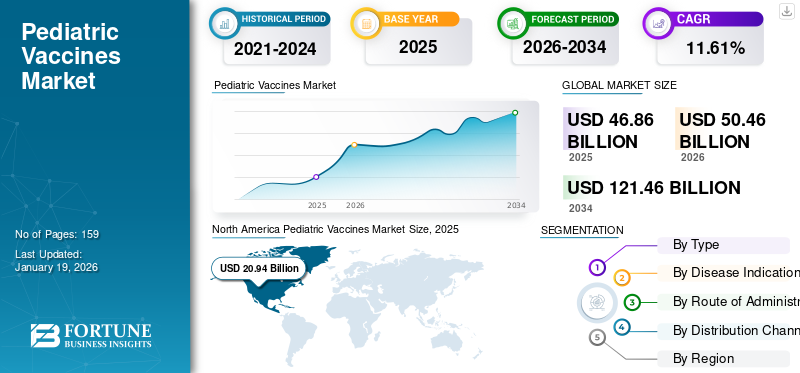
The global pediatric vaccines market size was valued at USD 46.86 billion in 2025. The market is projected to grow from USD 50.46 billion in 2026 to USD 121.46 billion by 2034, exhibiting a CAGR of 11.61% during the forecast period. North America dominated the pediatric vaccines market with a market share of 51.84% in 2025.
The global pediatric vaccines market is projected to grow with a positive growth trend due to increasing demand for the pediatric vaccines. Various established players such as GSK plc., Merck & Co., Inc., and Sanofi operating in the market are focusing on capacity expansion to support the global market for pediatric vaccines.
Children's vaccinations are crucial for developing the immune system and preventing life-threatening diseases in children. The vaccination shields from numerous diseases such as malaria, polio, pneumococcal, measles, mumps, and others. The market is primarily motivated by the increasing government support to meet the vaccination coverage gap and a rise in the prevalence of vaccine-preventable infectious diseases. Additionally, many government and nonprofit entities support eradicating such diseases and enhancing life expectancy.
Furthermore, rising investments for protecting children from vaccine-preventable diseases are expected to grow the market in the forthcoming years.
- For instance, in June 2025, the Gates Foundation invested USD 1.60 billion over the next five years to support Gavi, the Vaccine Alliance, which provides lifesaving vaccines to more than half of the world’s children.
Download Free sample to learn more about this report.
Pediatric Vaccines Market Key Takeaways
 Market Size & Forecast
- 2025 Market Size: USD 46.86 billion
- 2026 Market Size: USD 50.46 billion
- 2034 Forecast Market Size: USD 121.46 billion
- CAGR: 11.61% from 2026–2034
 Market Share
- North America dominated the pediatric vaccines market with a 51.84% share in 2025.
- The recombinant/conjugate/subunit segment accounted for the largest market share in 2025.
- The viral diseases segment accounted for the largest market share in 2025.
 Key Regional Highlights
North America
North America held a 51.84% share in 2025, valued at USD 20.94 billion.
Asia Pacific
Asia Pacific held a significant market position in 2025, valued at USD 11.97 billion.
Europe
Europe accounted for a major share in 2025, valued at USD 9.47 billion.
U.S.
The market continues to dominate North America, supported by strong regulatory approvals, product launches, and government-backed immunization programs.
Japan
The market is expected to grow steadily, driven by increasing vaccination coverage, government immunization initiatives, and rising awareness of vaccine-preventable diseases.
Read More

MARKET DYNAMICS
MARKET DRIVERS
Government Support Coupled with Increasing Vaccination Programs to Drive Market Growth
The global pediatric vaccines market observed a shift in focus on mass vaccination programs for children. The global market is poised to grow due to the rising demand for pediatric vaccination programs to protect children from life-threatening diseases and increasing government support. These factors have led to many vaccination and immunization programs for children. Such factors augment the demand for pediatric vaccines.
Furthermore, various international organizations are collaborating with the governments of several countries for the vaccine procurement and organization of immunization programs to support protection against various diseases.
- For instance, in January 2025, GAVI reported that since 2023, more than 9.8 million doses of malaria have been procured and delivered by UNICEF to children in 17 endemic countries in Africa. In these countries, malaria vaccines are offered sub-nationally through their routine childhood immunization programs.
MARKET RESTRAINTS
Vaccine Hesitancy in Low and Middle-Income Countries to Hamper Market Growth
Vaccine hesitancy is one of the leading factors hampering the adoption of vaccines in low-income countries. This hesitancy is cultivated from various factors revolving around the safety of vaccines, such as negative beliefs based on myths, misinformation, and mistrust of the health care professional or public health care system, and geographic barriers. Additionally, an underdeveloped healthcare infrastructure and geographic inaccessibility are some of the factors hampering the adoption of vaccines in the market.
- For instance, in July 2023, GAVI reported that in 2019, the World Health Organization (WHO) identified vaccine hesitancy as one of its top ten threats to global health. The hesitancy toward the vaccine has only increased since the COVID-19 pandemic.
MARKET OPPORTUNITIES
Increasing Research and Development Initiatives Provide Opportunities for Growth
A surge in research and development programs for expanding protection against various new diseases offers growth avenues for the market. Currently, there are no approved vaccines for highly contagious diseases such as Enterotoxigenic Escherichia coli (ETEC) and Lassa fever. Many companies are focusing on research initiatives for developing a vaccine that protects against such diseases, offering lucrative growth opportunities for the market.
- For example, in February 2024, NIH published a report titled ‘The Importance of Lassa Fever and Its Disease Management in West Africa’ that stated Lassa fever, an acute viral hemorrhagic illness, is endemic primarily in parts of the West African region. Annually, there are around 5,000 deaths from Lassa fever and an estimated 100,000 to 300,000 cases. There are currently no approved vaccines that protect against Lassa fever. Such a high prevalence of these contagious diseases creates market expansion avenues by streamlining focus on the development of such essential vaccines.
MARKET CHALLENGES
Unavailability of Cold Storage Infrastructure to Pose Significant Challenges for the Market
One of the major challenges for the global pediatric vaccines market growth is the wastage of vaccines due to improper storage, inefficiency, or loss of potency due to degeneration. Vaccines are mostly stored in cold temperatures to preserve their potency.
Additionally, distribution and supply shortages in lower and middle-income countries result in limited availability of pediatric vaccines in remote areas. A break in the cold chain vaccine transport is also a challenge. Cold chain systems are struggling to efficiently support national immunization programs in ensuring the availability of safe and potent vaccines.
- For instance, in May 2021, Sustainable Energy for All reported that approximately 2.7 billion people lack dependable access to vaccines as a result of insufficient supply chains and cold chain-related logistics capabilities. Such factors pose a significant challenge for the market.
PEDIATRIC VACCINES MARKET TRENDS
Emergence of Combination Vaccines Fuels Newer Market Trend
Children's immunization schedules have become increasingly complex, expensive, and unsustainable. Managing the cost and complexity of storing and administering multiple separate vaccines is burdensome. Combination vaccines could provide a solution to these inconveniences. Combining combination vaccines simplifies vaccination schedules and potentially assists in increasing vaccine coverage among children.
Undermining the advantages of combination vaccines, many key operational entities in the global pediatric vaccines market focus on launching new, effective combination vaccines and regulatory approvals from numerous regulatory bodies.
- For instance, in July 2025, GAVI launched the hexavalent vaccine in Mauritania and Senegal. The vaccine has been distributed for the first time in low-income countries. The combination vaccine protects against six diseases: diphtheria, tetanus, pertussis (whooping cough), hepatitis B, Haemophilus influenzae type B (Hib), and poliomyelitis. It replaces the five-in-one pentavalent and inactivated polio vaccines (IPV), previously administered separately.
Download Free sample to learn more about this report.
Segmentation Analysis
By Type
Increasing New Product Launches in Recombinant Vaccines Drive Segmental Dominance
Based on type, the market is segmented into live attenuated, inactivated, recombinant/conjugate/subunit, mRNA vaccine, viral vectors vaccines, toxoid, and others.
The recombinant/conjugate/subunit segment dominated the pediatric vaccine segment. The high market share was attributed to its varied applications and improved efficiency. Additionally, the segment is expected to grow significantly due to numerous collaborations with government institutes and other operational entities in the market.
- For instance, in January 2021, Merck collaborated with UNICEF to establish the first global Ebola vaccine stockpile with ERVEBO, a live recombinant viral vaccine for future outbreak preparedness.
The live attenuated segment is expected to grow with a significant CAGR over the forecast period. Live attenuated vaccines elicit an immune response for a longer period. Also, live attenuated vaccines are largely used to protect against diseases such as measles, mumps, and RSV.
Furthermore, key established players are streamlining their focus on research and development to develop more effective and safer vaccines for protection against varied diseases in children.
- For instance, in May 2023, Codagenix Inc. initiated dosing in a pediatric phase 1 study that evaluated the efficiency of CodaVax-RSV, a live-attenuated vaccine candidate for the prevention of disease caused by respiratory syncytial virus (RSV). The study had an age de-escalation, dose escalation design evaluating safety and immunogenicity in the 6-month to 5-year-old population. The trial also received fast-track approval.
The inactivated segment in the pediatric vaccine market is forecast to grow with a significant CAGR. Inactivated vaccines offer enhanced stability and safety and are largely used in the immunization programs. The segment is expected to grow due to government support and regulatory approval.
- For instance, in April 2022, India granted emergency approval to two inactivated vaccines, Covaxin and Corbevax, for protection against COVID-19 in children under 12.
The mRNA vaccine is expected to grow with a significant market share in the forecast years. The mRNA vaccines showcased efficiency in protecting from various diseases. The segment is expected to grow due to its advantages, such as easy scalability and fast modification. Furthermore, approvals by different regulatory bodies also support the segment's growth.
- For instance, Moderna, Inc. received approval from the U.S. FDA for a supplemental Biologics License Application (sBLA) for Spikevax, a COVID-19 vaccine. The vaccine is administered to children from 6 months to 11 years of age who are at increased risk for COVID-19.
Viral vectors, vaccines, and toxoid segments also accounted for growth with a stable CAGR in the forecast years to protect against viral and bacterial infections and a heightened immune response.
By Disease Indication
Increasing Prevalence of Viral Diseases to Lead to Segmental Dominance
Based on disease indication, the market is divided into viral diseases and bacterial diseases.
Among these, the viral diseases segment dominated the market. The high market share of the segment is attributed to the high prevalence of numerous viral diseases such as measles, mumps, rubella, hepatitis, HPV, influenza, and polio. Many key players are collaborating to enhance the immunization programs and extend their reach to combat the rising prevalence of viral diseases and the development of the immune system in children.
- For instance, in May 2024, the Lao People’s Democratic Republic (PDR) collaborated with GAVI and launched a nationwide measles and rubella (MR) vaccination campaign. This initiative, unveiled at Vientiane Center in the capital, focused on children under five and emphasized providing immunization to over half a million vulnerable children against these vaccine-preventable diseases.
On the other hand, the bacterial diseases segment is expected to grow with a significant CAGR over the forecast years. The high growth rate of the segment is attributed to various ongoing research, new product development, and product launches for prevention and protection against numerous bacterial diseases.
- For instance, in November 2024, Abbott launched its Pneumococcal Conjugate Vaccine, PneumoShield 14, for children over 6 weeks of age. Abbott’s PCV-14 valent (Pneumococcal Conjugate Vaccine) offers broad protection, covering the highest number of serotypes of pneumococcal disease. Such developments are expected to drive the growth of the segment.
By Route of Administration
Various Mass Immunization Initiatives by Government to Propel Growth of Oral Vaccines
Based on route of administration, the market is bifurcated into oral and parenteral.
The oral segment is expected to lead the market and is expected to generate substantial revenues in the forecast years. The high market share is attributed to the oral segment due to the numerous benefits of oral vaccines, such as easy administration. These factors result in a preference for oral pediatric vaccines for massive immunization programs.
- For instance, in May 2025, the WHO reported that in 2024, national vaccination coverage for the third oral polio vaccine (OPV3) dose was 44.0% in Papua New Guinea.
On the other hand, the parenteral segment is expected to grow with a stable CAGR in the forthcoming years. The parenteral administered vaccines effectively induce systemic response and provide long-term protection against various infectious diseases. Following these advantages, various established players are streamlining their focus on research and development for next-generation vaccine delivery systems.
- For instance, in June 2025, Emory University and Micron Biomedical announced the first clinical trial of a novel rotavirus vaccine, CC24, delivered via dissolvable microarray technology. CC24 is a uniquely inactivated rotavirus vaccine developed by the CDC to allow for an alternative to oral administration. This marks the first clinical evaluation of any drug or vaccine delivered via patch or microarray sponsored by the U.S. Centers for Disease Control and Prevention (CDC).
By Distribution Channel
Increasing Collaboration with Government Agencies to Propel Dominance of Government Suppliers Segment
Based on distribution channel, the market is segmented into hospital & retail pharmacies, government suppliers, and others.
The government suppliers segment is expected to dominate the pediatric vaccines market in the forecast period. The significant share of government suppliers is attributed to strategic collaboration of companies with the government agencies, aiding large-scale vaccination programs for children and extending their presence in remote areas.
- For instance, in June 2020, Panacea Biotec Ltd, an Indian company, signed a contract with the United Nations International Children's Emergency Fund (UNICEF) to supply 40.0 million bivalent oral doses of polio vaccines. The valuation of the contract reached USD 5.2 million.
The hospital & retail pharmacies are expected to grow substantially during the forecast period. The incremental growth of the segment is due to the ease of access and a robust distribution network. Additionally, various strategic collaborations catalyzed the segmental growth.
- For instance, in March 2022, LloydsPharmacy and Pfizer U.K.’s Vaccines business collaborated to develop an enhanced pneumococcal vaccination service across the Lloyds Pharmacy estate to respond to increasing demand, improve consumer choice, and help protect against respiratory infection.
- Similarly, in March 2024, Wholehealth Pharmacy partnered with I Boost Immunity to launch a national campaign called Dose4Dose. Through the collaboration, for every eligible vaccine for diseases, including HPV, Meningitis B, Pneumonia, RSV, and Shingles at a Wholehealth pharmacy in Canada, a matching dose of a children's measles, polio, or tetanus vaccine was donated through UNICEF Canada, to donate up to 30,000 doses worldwide until March 2025.
The others segment is also expected to grow with a stable CAGR during the forecast period due to various government initiatives and child immunization programs that aim to expand their reach in remote areas
PEDIATRIC VACCINES MARKET REGIONAL OUTLOOK
By region, this market is divided into North America, Europe, Asia Pacific, Latin America, and the Middle East & Africa.
North America
North America Pediatric Vaccines Market Size, 2025 (USD Billion)
To get more information on the regional analysis of this market, Download Free sample
The North America market accounted for USD 20.94 billion in 2025, representing 51.84% of the global industry, and is expected to reach USD 22.9 billion in 2026. The dominant position of the region is attributed to robust infrastructure, government support and numerous research and development initiatives, and strategic collaboration with operational entities of the vaccine market.
- For instance, in September 2022, the Coalition for Epidemic Preparedness Innovations (CEPI) collaborated with VBI Vaccines Inc. to advance the development of multivalent vaccines for coronavirus. The vaccine candidate aimed to provide broad and durable protection against multiple variants of the COVID-19-causing coronavirus.
U.S.
The U.S. holds a dominant market share of the North American region. The high market share is attributed to various product launches and approvals by regulatory bodies in the region.
- For instance, in August 2023, Pfizer Inc. received approval from the U.S. FDA for ABRYSVO, a Respiratory Syncytial Virus vaccine. The vaccine is indicated for the prevention of LRTD and severe LRTD caused by RSV in infants from birth up to six months of age by active immunization of pregnant individuals at 32 through 36 weeks’ gestational age—such developments to reinforce the country’s position in the global pediatric vaccines market.
Europe
Europe recorded a market size of USD 9.47 billion in 2025, capturing 49.66% of the global market share, and is projected to reach USD 9.91 billion in 2026. The region experiences high immunization coverage through government-supported childhood vaccination programs. The U.K., Germany, and France have robust national schedules covering measles, mumps, and rubella, pneumococcal, and HPV vaccines. Despite all initiatives, there is a gap in the supply of pediatric vaccines, creating demand in the region.
- For instance, in July 2024, UNICEF reported that 123,000 children in Europe and Central Asia are missing out on lifesaving vaccines.
The region is witnessing numerous product launches and regulatory approvals to meet this rising demand for pediatric vaccines.
- For instance, in July 2023, Abrysvo received marketing approval from the European Commission to protect against disease caused by the respiratory syncytial virus (RSV). The vaccine is indicated for passive immunization of infants from birth through 6 months of age following administration of the vaccine to the mother during pregnancy.
Asia Pacific
In 2025, the Asia Pacific region represented USD 11.97 billion, accounting for 54.09% of the worldwide market, and is projected to grow to USD 13.1 billion in 2026. The high growth rate of the market in the region is attributed to the rising prevalence of infectious diseases such as measles, which affect children
- For instance, in May 2025, GAVI reported a surge of measles across East Asian countries. Vietnam recorded 81,691 suspected measles cases, 2,682 cases in Mongolia, whereas 2,150 cases of measles were recorded in Cambodia. Measles cases across the region are at their highest level since 2020, according to World Health Organization (WHO) data. Such a high prevalence is expected to boost the global pediatric vaccines market.
Latin America and the Middle East & Africa
Latin America and the Middle East & Africa are estimated to hold a substantial market share during the forecast period. The Middle East & Africa contributed 47.03% to the global market in 2025, with a valuation of USD 0.84 billion, and is projected to reach USD 0.83 billion in 2026. The high market share of the region is attributed to various vaccinations, government support, and initiatives from global organizations such as the WHO to eradicate vaccine-preventable diseases in the region. The Latin American market was valued at USD 3.64 billion in 2025, accounting for 61.14% of global revenue, and is estimated to reach USD 3.72 billion in 2026.
- For instance, in July 2023, the Essential Immunization Recovery Plan was launched by the WHO to close the gap in the vaccination drive during the COVID-19 pandemic. Under this initiative, more than 5.0 million children who did not receive a single dose of an essential routine vaccine in the African region were vaccinated.
COMPETITIVE LANDSCAPE
KEY INDUSTRY PLAYERS
Focus on Strategic Expansion Opportunities by Key Players to Propel Market Progress
The global pediatric vaccines market is consolidated, featuring prominent players such as Sanofi, Merck & Co., Inc., and GSK plc. The substantial share of these companies is due to strategic activities such as new product launches, mergers, acquisitions, and collaboration with various operational entities for robust product offerings and expansion in production capacity.
Other notable players in the global market include Bharat Biotech, Panacea Biotec, Beijing Institute of Biological Products Co., Ltd. These companies are anticipated to prioritize regulatory approvals and collaborations to boost their global pediatric vaccines market share during the forecast period.
- For instance, in April 2024, Bharat Biotech collaborated with Bilthoven Biologicals B.V., a subsidiary of Serum Institute of India Private Limited, to strengthen oral polio vaccine OPV production and supply security.
LIST OF KEY PEDIATRIC VACCINES COMPANIES PROFILED
- Merck & Co., Inc. (U.S.)
- Sanofi. (France)
- Bharat Biotech. (India)
- GSK plc. (U.K.)
- SINOVAC (China)
- Serum Institute of India Pvt. Ltd. (India)
- HAFFKINE BIO-PHARMACEUTICAL CORPORATION LTD. (India)
- Panacea Biotec (India)
- Bio Farma (India)
- AJ Vaccines A/S (Denmark)
- Beijing Institute of Biological Products Co., Ltd. (China)
KEY INDUSTRY DEVELOPMENTS
- November 2025: The World Health Organization (WHO) announced the successful end of the poliovirus outbreak in Indonesia following nearly three years of intensive vaccination efforts. The milestone highlights the effectiveness of paediatric immunization programs in controlling vaccine-preventable diseases.
- June 2025: Merck received approval from the U.S. FDA for ENFLONSIA (clesrovimab-cfor) for the prevention of respiratory syncytial virus (RSV) lower respiratory tract disease in neonates (newborns) and infants. ENFLONSIA is a monoclonal antibody (mAb) vaccine that protects for 5 months, a typical RSV season.
- May 2025: Sanofi received approval from the U.S. FDA for MenQuadfi for use in infants aged 6 weeks and older. The expanded indication enables earlier protection against four major meningococcal serogroups and supports routine childhood vaccination.
- March 2025: Bavarian Nordic launched Vimkunya, the first virus-like particle (VLP) chikungunya vaccine for individuals aged 12 years and above. The vaccine demonstrated a 97.8% antibody response within 21 days, supporting protection against chikungunya infection.
- March 2025: Pfizer received approval from the European Commission for PREVENAR 20 for use in children aged 6 weeks to under 18 years. The vaccine provides protection against 20 pneumococcal serotypes, expanding coverage for paediatric immunization.
- February 2025: GSK received approval from the U.S. FDA for its five-in-one meningococcal conjugate vaccine for paediatric use. The vaccine offers protection against multiple meningococcal serogroups, strengthening immunization against invasive meningococcal disease.
- June 2024: Gavi, the Vaccine Alliance, announced that the lower-income countries it supports can introduce four additional vaccines: preventive Ebola, human rabies vaccine for post-exposure prophylaxis, multivalent meningococcal conjugate, and hepatitis B birth dose.
- March 2023: Merck received approval from the U.S. FDA for adding the intramuscular (IM) route of administration in the U.S. Product Insert (USPI) for Merck’s Measles/Mumps/RubellaV family of vaccines, VARIVAX, and ProQuad.
- June 2022: Merck received approval for expanded indication by the U.S. FDA for VAXNEUVANCE (Pneumococcal 15-valent Conjugate Vaccine) to include children 6 weeks through 17 years of age. VAXNEUVANCE is indicated for active immunization to prevent invasive disease caused by Streptococcus pneumoniae serotypes.
- September 2021: Pfizer Inc. collaborated with BioNTech SE and announced positive results from a Phase 2/3 trial of the COVID-19 vaccine showing a favorable safety profile and robust neutralizing antibody responses in children 5 to 11 years of age.
REPORT COVERAGE
The global pediatric vaccines market report comprises market analysis emphasizing key aspects such as prevalence, pipeline candidates, regulatory environment, and product launches. The report also examines the technological advancements in vaccines and notable industry developments, including mergers, partnerships, and acquisitions. Furthermore, it provides a detailed regional analysis of various segments, and the trends associated with the market are covered in the report.
Request for Customization to gain extensive market insights.
|
ATTRIBUTE |
DETAILS |
|
Study Period |
2021-2034 |
|
Base Year |
2025 |
|
Estimated Year |
2026 |
|
Forecast Period |
2026-2034 |
|
Historical Period |
2021-2024 |
|
Growth Rate |
CAGR of 11.61% from 2026 to 2034 |
|
Unit |
Value (USD Billion) |
|
Segmentation |
By Type
|
|
By Disease Indication
|
|
|
By Route of Administration
|
|
|
By Distribution Channel
|
|
|
By Region
|
Frequently Asked Questions
According to Fortune Business Insights, the global market size was USD 46.86 billion in 2025 and is projected to reach USD 121.46 billion by 2034.
In 2025, North America stood at USD 19.61 billion.
Registering a CAGR of 11.61%, the market will exhibit rapid growth over the forecast period (2026-2034).
Based on type, the recombinant/conjugate/subunit segment is expected to lead the pediatric vaccines market during the forecast period.
Government support, coupled with increasing vaccination programs, to drive the market growth.
Sanofi, Merck & Co., Inc., and GSK plc. are the major players in the global market.
North America dominated the market in 2025.



- 2021-2034
- 2025
- 2021-2024
- 159
Get 30-60 hrs Free Customization
Expand Regional and Country Coverage, Segments Analysis, Company Profiles, Competitive Benchmarking, and End-user Insights.













.webp)






Related Reports
-
US +1 833 909 2966 ( Toll Free )
-
Get In Touch With Us