Peer-to-Peer Lending Market Size, Share & Industry Analysis, By Type (Consumer Lending and Business Lending), By Loan Security (Secured Loans and Unsecured Loans), By Application (Direct Web Platform, Mobile App Channels, and Aggregator Platform), By End User (Personal/Household and Commercial/Enterprises), and Regional Forecast, 2026 – 2034
 Download Free Sample
KEY MARKET INSIGHTS
 Listen to Audio Version
The global peer-to-peer lending market size was valued at USD 7.29 billion in 2025 and is projected to grow from USD 8.33 billion in 2026 to USD 33.81 billion by 2034, exhibiting a CAGR of 19.1% during the forecast period. North America dominated the global market with a share of 53.91% in 2025.
Peer-to-Peer (P2P) lending is a form of digital financing that allows individuals or businesses to borrow and lend money directly through online lending marketplace, without the involvement of traditional banks or financial intermediaries. These platforms act as marketplaces, connecting borrowers who need funds with investors seeking better returns on their capital. P2P lending offers faster approvals, lower interest rates for borrowers, and higher yields for investors compared to conventional banking.
The market’s growth is being driven by rising demand for alternative lending solution options among individuals and small businesses. Traditional banks often have strict lending criteria and lengthy approval processes, which limit credit access for many borrowers. P2P platforms bridge this gap by offering quick, accessible, and flexible loans through digital channels.
Major companies in the P2P lending market, including Prosper Marketplace, Kiva, Bondora, and Mintos, are pursuing strategies such as technological innovation, product diversification, and market expansion to strengthen their positions. They are investing in AI-driven credit assessment, blockchain-based transaction systems, and enhanced data analytics to improve risk evaluation and lending efficiency.
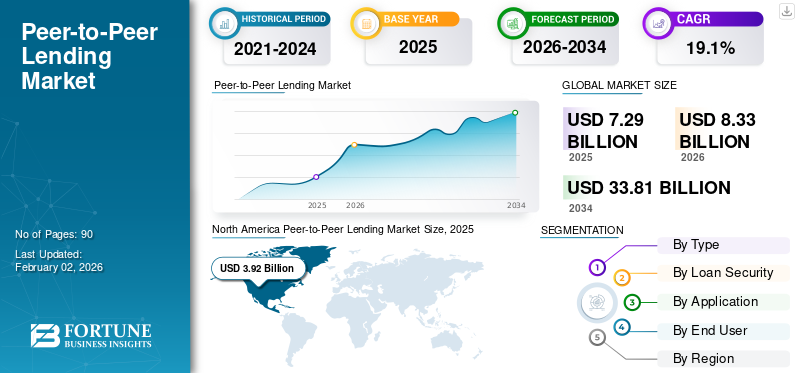
Download Free sample to learn more about this report.
Peer-to-Peer Lending MARKET KEY TAKEAWAYS
 Market Size & Forecast
- 2025 Market Size: USD 7.29 billion
- 2026 Market Size: USD 8.33 billion
- 2034 Forecast Market Size: USD 33.81 billion
- CAGR: 19.1% from 2026–2034
 Market Share
- North America dominated the peer-to-peer lending market with a 53.91% share in 2025.
- Direct web platform segment led the market with a 49% share in 2025.
- Unsecured loans dominated the market owing to high borrower preference for collateral-free financing.
 Key Regional Highlights
North American
North America led the market with a valuation of USD 3.92 billion in 2025, supported by strong fintech ecosystems and platform maturity.
Europe
Europe reached USD 1.29 billion in 2025, driven by regulatory support and high digital lending adoption.
Asia Pacific
Asia Pacific is expanding rapidly, supported by rising alternative credit demand and SME financing needs.
U.S.
Estimated at USD 3.23 billion in 2025, driven by strong platform penetration and digital lending adoption.
Japan
Steady growth supported by increasing fintech integration and rising demand for alternative lending solutions.
Read More

MARKET DYNAMICS
Market Drivers
Increasing Need for Alternative Credit Channels to Drive the Growth of the Peer-to-Peer Lending Market
In emerging economies, P2P platforms also play a crucial role in promoting financial inclusion by bridging the gap between lenders and borrowers. Borrower-lender matching are turning to P2P platforms that offer faster approvals, simplified application processes, and flexible lending terms through digital channels. These platforms cater specially to underserved segments such as startups, freelancers, and low-credit-score borrowers, who are often overlooked by conventional financial institutions.
Moreover, P2P lending provides competitive interest rates for borrowers and higher returns for investors, making it an attractive alternative to traditional savings or investments. The rise of digital banking, fintech lending model innovation, and mobile-based financial services has further accelerated this shift toward decentralized credit systems. Overall, the growing demand for flexible, accessible, and transparent credit solutions continues to propel the expansion of the global P2P lending market.
Market Restraints
High Credit Risk and Loan Defaults to Restrict Market Growth
High credit risk and loan defaults pose a significant challenge to the growth of the Peer-to-Peer (P2P) lending market. Since most P2P loans origination are unsecured, platforms often lend to individuals or small businesses with limited or no credit history, increasing the p2p risk assessment of non-repayment. P2P platforms rely heavily on digital P2P credit scoring models that may not always capture a borrower’s true repayment ability. When default rates rise, it directly impacts investor returns and erodes confidence in the platform’s reliability. For instance, in 2024, several P2P platforms in the U.S. and Europe reported higher delinquency rates due to inflationary pressures and tightening consumer credit conditions. This forced many firms to adopt stricter credit policies, enhance AI-driven risk analytics, and increase loan diversification to mitigate exposure.
Market Opportunities
Growth of Mobile and App-Based Lending Create Major Market Opportunity in Coming Years
With the rapid expansion of smartphone usage, affordable internet access, and digital payment ecosystems, borrowers and investors are increasingly preferring mobile-first lending solutions. P2P platforms are leveraging mobile apps to offer instant loan approvals, real-time tracking, and seamless digital documentation, making borrowing faster and more convenient than traditional bank processes. Mobile platforms also integrate AI chatbots, biometric verification, and e-KYC systems, enabling secure and user-friendly onboarding experiences. For lenders, app-based platforms provide easy P2P portfolio management, automated investment diversification p2p options, and transparent performance dashboards.
Peer-To-Peer Lending Market Trends
Rising Digitalization and Technological Advancements is Considered to be a Significant Peer-to-Peer Lending Market Trend
The widespread adoption of digital technologies, such as artificial intelligence (AI), machine learning (ML), blockchain, and big data analytics, has transformed how lending platforms operate and evaluate creditworthiness. These innovations allow P2P platforms to automate loan processing, enhance credit scoring accuracy, detect fraud in real time, and offer seamless digital experiences to users. For instance,
- According to RBI data, digital lending platforms facilitated personal loans worth over USD 1.8 million in 2022-23, showing a 120% growth compared to the previous year. This surge reflects how instant loan apps are filling crucial gaps in India’s credit ecosystem, particularly for the 300 million+ Indians.
With increasing internet penetration and smartphone usage, more borrowers and investors are accessing P2P lending platforms through mobile apps and digital interfaces, driving convenience and accessibility. In 2024, several leading platforms such as LendingClub and Bondora introduced AI-powered tools to personalize loan offers and improve borrower profiling, significantly reducing approval times. Blockchain technology is also being integrated to ensure secure, transparent, and tamper-proof transactions, strengthening trust between borrowers and lenders.
SEGMENTATION Analysis
By Type
Increasing Demand for Personal Loans and Debt Consolidation Accelerated the Consumer Lending Segment Growth
Based on type, the market is divided into consumer lending and business lending.
Consumer lending captured the largest peer-to-peer lending market share in 2025 owing to increasing demand for personal loans and debt consolidation. Many individuals seek faster and more convenient borrowing options for managing expenses such as education, medical bills, or home renovations. P2P platforms provide instant approvals, minimal paperwork, and lower interest rates compared to traditional banks, attracting a large pool of retail borrowers. For instance,
- In 2025, platforms such as Prosper and LendingClub recorded strong growth in personal loan volumes driven by household financing needs.
Business Lending is anticipated to grow at the highest CAGR of 20.6% during the forecast period owing to increasing SME demand for flexible financing. Traditional banks often impose strict lending criteria, lengthy approval processes, and collateral requirements, making it difficult for SMEs to access capital.
By Loan Security
Rising Unsecured Loans Preference by Borrowers Boosted Segment Growth
Based on loan security, the market is divided into secured loans and unsecured loans.
Unsecured loans captured the largest peer-to-peer lending market share in 2025. Most borrowers prefer unsecured loans for personal, education, or short-term financial needs since they do not require collateral, making these loans more convenient compared to traditional bank loans. P2P platforms have leveraged advanced digital credit assessment tools to manage risk and extend unsecured credit to a wider range of borrowers, especially in emerging economies.
Secured loans are anticipated to grow at the highest CAGR of 21.7% during the forecast period owing to increasing adoption of asset-backed lending models that reduce default risk and enhance investor confidence. Platforms are increasingly offering loans backed by real estate, vehicles, or other valuable assets, ensuring greater repayment security and lower interest rates for borrowers.
By Application
Direct Web Platform Segment due to Enhanced Security Features
Based on application, the market is divided into direct web platform, mobile app channels, and aggregator platform.
Direct web platform captured the largest share in 2025. Many early P2P lending companies initially operated through web-based portals, offering users a transparent interface for loan comparison, application, and investment tracking. The web platforms also provide comprehensive financial dashboards, robust data analytics, and enhanced security features, attracting both individual borrowers and institutional investors. For instance,
- LendingClub, one of the P2P lending pioneers, initially built its operations entirely around direct web-based platforms, enabling borrowers to easily post loan requests and investors to review and fund them online.
Mobile app channels anticipated to grow at the highest CAGR of 22.4% during the forecast period owing to the rapid increase in smartphone penetration, digital banking adoption, and convenience of real-time loan processing.
To know how our report can help streamline your business, Speak to Analyst
By End User
Rising Demand for Personal Loans By Users to Capture Major Share in The Market
Based on end user, the market is analyzed into personal/household and commercial/enterprises.
Personal/household captured the largest peer-to-peer lending market share in 2025 owing to the rising demand for personal loans, home renovation financing, education loans, and debt consolidation among individuals. The convenience of obtaining funds quickly without the need for collateral, coupled with competitive interest rates and simplified digital application processes, has made P2P platforms a preferred borrowing option for consumers. For instance,
- In 2025, Prosper Marketplace reported originating over USD 5.8 billion in personal loans, marking a 12% year-over-year growth, while LendingClub facilitated approximately USD 7.1 billion in household lending through its digital platform
Commercial/enterprises are anticipated to grow at the highest CAGR of 21.5% during the forecast period owing to the rising demand for working capital, equipment financing, and business expansion loans among small and medium-sized enterprises (SMEs).
Peer-to-Peer MARKET REGIONAL OUTLOOK
By geography, the market is categorized into Europe, North America, Asia Pacific, South America, and the Middle East & Africa.
North America Peer-to-Peer Lending Market Size, 2025 (USD Billion) To get more information on the regional analysis of this market, Download Free sample
The North America held the dominant share in 2025, valued at USD 3.92 billion, driven by the strong presence of established and well-regulated P2P lending platforms. Countries such as the U.S. and Canada have developed robust fintech ecosystems supported by clear regulatory guidelines, which foster investor confidence and borrower participation. Platforms such as LendingClub and Prosper operate under transparent frameworks that ensure consumer protection and risk management. For instance,
- In April 2025, LendingClub reported a 15% year-over-year increase in loan originations in North America, attributing this growth to favorable U.S. fintech regulations and the rising adoption of digital lending technologies among consumers.
In 2025, the U.S. peer-to-peer lending market is estimated to reach USD 3.23 billion. The U.S. peer to peer lending platform market benefited from a mature fintech ecosystem, where platforms such as LendingClub, Prosper Marketplace, and Funding Circle continue to expand their offerings.
Download Free sample to learn more about this report.
The market in Europe is estimated to reach USD 1.29 billion in 2025, securing a strong position due to the region’s robust regulatory framework, high digital adoption, and mature fintech ecosystem. Countries such as the U.K., Germany, and the Nordics lead in platform innovation and investor confidence, supported by the European Crowdlending Platform Provider Regulation which harmonizes cross-border peer-to-peer lending operations.
The region combines mature markets such as U.K. with high-growth opportunities in the lending sector. Backed by these factors, countries including the U.K. are anticipated to record the valuation of USD 0.35 billion, Germany to record USD 0.23 billion, and France to record USD 0.17 billion in 2025.
After Europe, Asia Pacific region is projected to record the highest growth rate of 22.6% and touch the valuation of USD 1.35 billion in 2025. In the region, India and China both are estimated to reach USD 0.42 billion and USD 0.11 billion respectively in 2025. The region’s growth is supported by the rising demand for alternative credit among underserved consumers and SMEs who face limited access to traditional bank financing. Many individuals and small businesses in Asia Pacific are new-to-credit or lack collateral, prompting them to seek flexible, fast, and digitally driven lending options offered by P2P platforms.
South America and Middle East & Africa regions would witness a moderate growth in this market over the forecast period. South America market in 2025 is set to record USD 0.30 billion as its valuation. The market in South America is driven increasing urbanization and infrastructure development projects across countries like Brazil, Chile, and Colombia are creating strong leasing opportunities.
In Middle East & Africa, GCC is set to attain the value of USD 0.16 billion in 2025. MEA Peer-to-peer lending market growth is supported by regulatory initiatives, such as fintech sandboxes and P2P licensing frameworks in the UAE, Saudi Arabia, and South Africa.
COMPETITIVE LANDSCAPE
Strategic Partnerships by Key Players to Ensure Co-Funding Support
Key players in the Peer-to-Peer (P2P) lending market are adopting diversified growth strategies to strengthen their market positions. Leading platforms such as LendingClub, Funding Circle, Mintos, Bondora, Faircent, and EstateGuru are focusing on segment specialization targeting SME, property-backed, and consumer segments for tailored growth. Many are expanding strategic partnerships with banks, fintechs, and institutional investors to ensure liquidity and co-funding support.
List of Key Peer-to-Peer Companies Profiled
- Prosper Marketplace (U.S.)
- Kiva (U.S.)
- Bondora (Estonia)
- Mintos (Latvia)
- PeerBerry (Lithuania)
- LendingClub (U.S.)
- Funding Circle (U.S.)
- EstateGuru (Estonia)
- CrowdProperty (U.K.)
- com (India)
- Faircent (India)
- Bondster Marketplace, Ltd. (Czech Republic)
- RateSetter (U.K.)
- Debitum Investments (Latvia)
- Transactree Technologies Pvt Ltd (India)
- And others
KEY INDUSTRY DEVELOPMENTS
- In September 2025, Funding Circle announced a USD 348 million forward flow agreement with TPG Angelo Gordon and Barclays. This partnership would continue to support Funding Circle's term loan proposition for small businesses across the U.K.
- In June 2025, EstateGuru introduced EG Grow, a new investment product designed as an alternative to traditional bank deposits and investment funds. The launch comes amid a resurgence in the Baltic real estate markets, where investor activity is steadily increasing. While Estonia’s market is gradually regaining momentum, both Latvia and Lithuania are already experiencing significantly stronger growth, reflecting renewed confidence in the region’s property sector.
- In April 2025, Funding Circle, the U.K.’s SME finance platform partnered with Bayview Asset Management, LLC for its Term Lending product, across two different credit facilities with J.P. Morgan and Citi. This collaboration with Bayview underscores a unified and ongoing commitment to the growth of small businesses across the U.K.
- In April 2025, Prosper Marketplace, the peer-to-peer lending platform in the U.S. announced a USD 500 million forward flow agreement led by funds managed by affiliates of Fortress Investment Group (“Fortress”) alongside Edge Focus. The USD 500 million forward flow purchase agreement would help Prosper increase access to credit as more borrowers seek a personal loan to refinance high-interest rate credit card debt.
- In September 2024, Kiva, a global nonprofit and social impact organization that expands financial access for underserved communities, announced a partnering with thrive and OpenAI to help small businesses and social enterprises leverage artificial intelligence to operate more effectively, grow, and compete in an increasingly digital economy.
REPORT COVERAGE
The report provides a detailed analysis of the market and focuses on key aspects such as leading companies, types, and leading applications of the product. Besides, the report offers insights into the market trends and highlights key industry developments. In addition to the factors above, the report encompasses several factors that contributed to the growth of the market in recent years.
Request for Customization to gain extensive market insights.
REPORT SCOPE & SEGMENTATION
|
ATTRIBUTE |
DETAILS |
|
Study Period |
2021-2034 |
|
Base Year |
2025 |
|
Estimated Year |
2026 |
|
Forecast Period |
2026-2034 |
|
Historical Period |
2021-2024 |
|
Growth Rate |
CAGR of 19.1% from 2026 to 2034 |
|
Unit |
Value (USD Billion) |
|
Segmentation |
By Type · Consumer Lending
By Loan Security · Secured Loans
By Application · Direct Web Platform · Mobile App Channels
By End User · Personal/Household · Commercial/Enterprises By Region · North America (By Type, By Loan Security, By Application, By End User and By Country) o U.S. o Canada o Mexico · Europe (By Type, By Loan Security, By Application, By End User and By Country) o U.K. o Germany o France o Italy o Spain o Russia o Benelux o Nordics o Rest of Europe · Asia Pacific (By Type, By Loan Security, By Application, By End User, and By Country) o China o India o Japan o South Korea o ASEAN o Oceania o Rest of Asia Pacific · Middle East & Africa (By Type, By Loan Security, By Application, By End User, and By Country) o Turkey o Israel o GCC o North Africa o South Africa o Rest of MEA · South America (By Type, By Loan Security, By Application, By End User, and By Country) o Brazil o Argentina o Rest of South America |
|
Companies Profiled in the Report |
· Prosper Marketplace (U.S.) · Kiva (U.S.) · Bondora (Estonia) · Mintos (Latvia) · PeerBerry (Lithuania) · LendingClub (U.S.) · Funding Circle (U.S.) · EstateGuru (Estonia) · CrowdProperty (U.K.) · i2ifunding.com (India) |
Frequently Asked Questions
The market is projected to reach USD 33.81 billion by 2034.
In 2025, the market was valued at USD 3.92 billion.
The market is projected to grow at a CAGR of 19.1% during the forecast period.
By end user, the personal/household segment led the market.
Increasing need for alternative credit channels to drive the growth of the peer-to-peer lending market.
Prosper Marketplace, Kiva, Bondora, and Mintos are the top players in the market.
North America is expected to hold the highest market share.



- 2021-2034
- 2025
- 2021-2024
- 90
Get 30-60 hrs Free Customization
Expand Regional and Country Coverage, Segments Analysis, Company Profiles, Competitive Benchmarking, and End-user Insights.













-
US +1 833 909 2966 ( Toll Free )
-
Get In Touch With Us