Pension Funds Market Size, Share & Industry Analysis, By Plan Type (Defined Contribution Plans, Defined Benefit Plans, and Hybrid and Mixed Plans), By Pension Arrangement (Occupational Pension Plans, Personal Pension Plans, Public Pension Reserve Funds, and Others) By Participant Type (Private-Sector Employees, Public-Sector Employees, Self-Employed Individuals, and Other Eligible Participants), and Regional Forecast, 2026-2034
 Download Free Sample
Pension Funds Market Size and Future Outlook
 Listen to Audio Version
The global pension funds market size was valued at USD 72.77 trillion in 2025. The market is projected to grow from USD 75.77 trillion in 2026 to USD 115.19 trillion by 2034, exhibiting a CAGR of 5.4% during the forecast period. North America dominated the pension funds market with a market share of 56.97% in 2025.
Pension funds are professional retirement savings portfolios created for collecting contributions from employers, employees, governments, or individuals and investing them to provide income during retirement. Pension funds facilitate retirement planning, long-term saving, income security, wealth building, and reduce dependency on retirement benefits funded by the government.
Public sector employees, private sector employees, self-employed individuals, employers, governments, labor unions, and other eligible participants employ pension funds. Individuals utilize pension funds to build up their retirement savings, earn long-term returns, manage longevity risk, and retain their living standards after retirement. Employers and governments use pension funds to meet their retirement liabilities, provide employee benefits, and improve the financial security of their employees. Market growth factors include an aging population, increased life expectancy, increased formal employment, pension reform, automatic enrollment, increased contribution rates, and retirement planning awareness. This market involves public pension organizations, occupational pension funds, corporate retirement plans, pension fund administrators, investment managers, and consultants.
Some well-known pension organizations are Government Pension Investment Fund, National Pension Service, ABP, CalPERS, CPPIB, and AustralianSuper. These institutions hold significant amounts of retirement funds and offer pensions under defined benefit, defined contribution, and hybrid pension schemes.
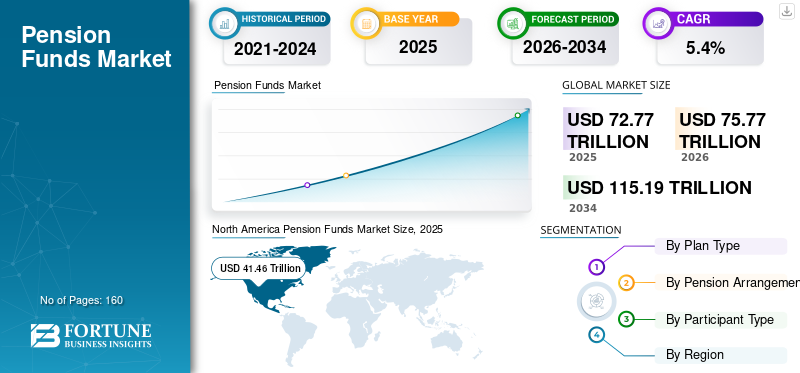
Download Free sample to learn more about this report.
Pension Funds Market KEY TAKEAWAYS
 Global Market Size & Forecast
- 2025 Market Size: USD 72.77 trillion
- 2026 Market Size: USD 75.77 trillion
- 2034 Forecast Market Size: USD 115.19 trillion
- CAGR: 5.4% from 2026–2034
 Market Share
- North America dominated the pension funds market with a 56.97% share in 2025.
- Defined contribution plans led the market with a 62.42% share in 2025.
- Occupational pension plans dominated with a 72.68% share in 2025.
 Key Regional Highlights
North America
North America led the market with USD 41.46 trillion in revenues in 2025.
Europe
Europe is projected to grow at a 4.9% rate during the forecast period.
Asia Pacific
Asia Pacific is expected to reach USD 13.03 trillion in 2026, ranking third globally.
U.S.
U.S. The market is projected to reach USD 39.90 trillion in 2026, representing approximately 48.01% of global revenues.
Japan
Japan A major regional pension market supported by its large-scale retirement savings system and aging population.
Read More

PENSION FUNDS MARKET TRENDS
Digitalization of Pension Administration and Member Services to Shape Market Trends
Digital technologies are being introduced by pension funds and retirement service providers to streamline processes, increase accessibility for members, and decrease expenses related to the running of their services. Cloud platforms, mobile apps, artificial intelligence-supported customer support tools, digital onboarding, automation of compliance processes, and self-service portals let members check their pension accounts, modify personal details, manage their contributions, see the results of investments, and order different kinds of services online. Such innovations help save paper and time, increase transparency, accuracy, compliance, and involvement of pension scheme participants. Digital platforms also allow consolidating various data about individuals and providing tailored retirement information for members.
- For example, in May 2025, the process of transferring Mandatory Provident Fund schemes to the eMPF Platform continued in Hong Kong. This centralized platform was introduced to automate pension processes. All 24 MPF schemes should be integrated into it before the end of 2025.
MARKET DYNAMICS
MARKET DRIVERS
Download Free sample to learn more about this report.
Rising Retirement-Planning Awareness to Facilitate Market Growth
Rising awareness related to retirement planning, income stability, health care costs, longevity, and decreasing reliance on familial care is pushing the population to invest in work pensions and personal pension programs. Higher life expectancy implies that people have to arrange funds for a longer period after their retirement. Still, at the same time, rising inflation, medical expenses, housing costs, and uncertainty about the sufficiency of government benefits lead to increasing necessity of systematic saving. The development of financial knowledge, growth of the middle-class population, easy online access to pension accounts, financial wellness programs at workplaces, tax advantages, and online retirement calculators make people engage in pension funds. This is expected to boost the pension funds market growth in the coming years.
- For Instance, in November 2025, India’s Pension Fund Regulatory and Development Authority (PFRDA) participated in the “Retire Smart India: NPS Zaruri Hai” awareness initiative, which highlighted the importance of early retirement planning and National Pension System participation.
|
Rank |
Market Drivers |
Expected Impact on Market Growth |
Estimated Gross CAGR Contribution |
Impact: 2026–2028 |
Impact: 2029–2031 |
Impact: 2032–2034 |
|
1 |
Ageing population, increasing life expectancy, and growing need for long-term retirement income security |
Very High |
1.70% |
High |
High |
High |
|
2 |
Expansion of employer-sponsored occupational pension schemes |
High |
1.45% |
High |
High |
High |
|
3 |
Government pension reforms, automatic enrolment, and mandatory retirement savings programs |
Moderately High |
1.25% |
High |
High |
Medium |
|
4 |
Rising retirement-planning awareness and growth in voluntary pension participation |
Moderate |
1.0% |
Medium |
High |
High |
|
5 |
Digital transformation of pension administration and member engagement |
Moderately Low |
0.80% |
Medium |
Medium |
High |
|
6 |
Others, including tax incentives, pension portability, employment formalization, and product innovation |
Low |
0.60% |
Low |
Medium |
Medium |
|
|
Total Gross Growth Contribution |
|
6.80% |
|
|
|
MARKET RESTRAINTS
Volatility in Interest Rates and Investment Returns to Restrain Market Growth
Pension funds face complex regulations that include pension funding, investment restrictions, fiduciary responsibilities, protection of members, actuarial valuation, tax regulations, governance, data protection, and accounting. Pension funds must undertake audits, risk assessment, stress testing, and other processes to ensure compliance with regulations related to pension liabilities and investment performance. Diverse regulatory systems in different nations add to the complexities faced by multinational companies and their pension funds. Changes in pension regulations, accounting regulations, investment regulations, and disclosure regulations necessitate upgrading of systems, policy changes, legal advice, actuarial analysis, and education of employees. All these activities increase costs while limiting flexibility. Non-compliance may result in financial penalties, reputation risks, and low levels of trust among members. Therefore, complexity in regulation hampers the ability of pension funds to enter new markets and grow.
|
Rank |
Market Restraints |
Expected Restraining Impact on Market Growth |
Estimated Negative CAGR Contribution |
Impact: 2026–2028 |
Impact: 2029–2031 |
Impact: 2032–2034 |
|
1 |
Financial-market volatility and investment-return uncertainty |
Very High |
-0.60% |
High |
High |
Medium |
|
2 |
Rising pension liabilities and funding deficits |
High |
-0.45% |
Medium |
High |
High |
|
3 |
Complex regulatory, governance, and compliance requirements |
Moderate |
-0.25% |
High |
Medium |
Medium |
|
4 |
Others, including contribution gaps, administrative inefficiencies, and fragmented pension systems |
Low |
-0.10% |
Low |
Medium |
Medium |
|
|
Total Negative Growth Contribution |
|
-1.4% |
|
|
|
MARKET OPPORTUNITIES
Expanding Pension Coverage among Underserved Workers to Create Growth Opportunities
Limited enrollment in pension programs by self-employed people, gig economy workers, informal sector workers, agriculture workers, and employees in small and medium-sized firms can provide considerable room for growth in the global pension funds industry. Increasing attention is being paid by governments, companies, pension administrators, and retirement service providers to expanding access to occupational, individual, and voluntary pension programs. Growing trends of employment formalization, increasing financial inclusion, favorable pension policies, and growth of automatic enrollment pension programs are contributing to better access to formal retirement savings programs for the underserved workers. Digitized onboarding, mobile banking solutions, digital identity verification, transportable pension schemes, and flexible contribution systems are adding another dimension to the accessibility of pension products for those who earn irregular incomes. These changes are lowering the participation barriers and helping pension providers gain access to an untapped worker population.
- For instance, in January 2026, Ireland officially launched My Future Fund. This national retirement savings scheme provides pension access to more than 760,000 employees who were previously not actively contributing to a workplace pension.
MARKET CHALLENGES
Challenge of Meeting Return Requirements While Honoring Liability Commitments
It is the constant challenge of pension funds to generate appropriate returns while preserving adequate liquidity and minimizing risks. The fund managers have to distribute the fund contributions among equities, bonds, infrastructure, real estate, private equity, and other types of investments in such a way that there will be enough money available for making payments on the scheduled pensions. It means that increasing investments in alternatives could result in higher long-term return expectations; however, the fund management would experience difficulties with the valuation and illiquidity of its holdings. Moreover, on the one hand, the conservative investment policy could help to preserve the fund, but on the other hand, it might not provide the necessary returns.
Segmentation Analysis
By Plan Type
Defined Contribution Plans Led Market Due to Its Employer Preference and Greater Member Flexibility
Based on plan type, the market is segmented into defined contribution plans, defined benefit plans, hybrid and mixed plans.
The defined contribution plans segment dominated the pension funds market share, accounting for 62.42% in 2025, as employers favor retirement plans that have clear contributions and low long-term funding risk. There are also improved features of portability and flexibility in the segment, which makes these plans more compatible with increased workforce mobility, contract work, and shifting career trends. Additionally, contributors can choose contribution amounts and investment strategies in line with their incomes and retirement goals.
The defined benefit plans segment is projected to grow at a 5.2% CAGR during the forecast period. This is mainly due to increased funding status, interest rate rises, and improved asset-liability management among many funded pension plans in the industry. Rising interest rates lower the present value of the long-term pension liabilities, and hence increase funding ratios and optimize the allocation of assets. The segment is also driven by sustained demand among government employees, governments, big companies, and unions as an employee benefit.
By Pension Arrangement
Occupational Pension Plans Dominated Market Due to Strong Employer-Sponsored Participation
By pension arrangement, the market is segmented into occupational pension plans, personal pension plans, public pension reserve funds, and others.
The occupational pension plans segment dominated the market in 2025, accounting for 72.68%, as it is integrated in employer-sponsored retirement plans and sustained via periodic payments from employers, employees, or both. This arrangement gains even more traction due to automatic enrollment laws, compulsory workplace pension schemes, and employer-sponsored retirement benefits in some developed nations. Occupational pensions have the advantage of professional management of funds, diversity of investments, reduced administration costs due to economies of scale and employer match contributions, which makes them better than individual retirement plans.
The personal pension plans segment is expected to grow at a CAGR of 5.2% over the forecast period, as people become more interested in contributing to their own retirement funds independently of any occupational pension plans. Growing awareness of retirement, increasing life expectancy, and worries regarding the level of government pension fund benefits are motivating people to save money on top of the government pension schemes. Self-employment and freelancing are becoming popular and contributing to the demand for personal pension plans by individuals without occupational pension plans.
By Participant Type
Private-sector Employees Dominated Market as They Constitute Largely in Formal Workforce
On the basis of participant type, the market is segmented into private-sector employees, public-sector employees, self-employed individuals, and other eligible participants.
The private-sector employees dominated with 65.8% market share in 2025, supported by their significant presence in the formal workforce and broader access to employer-sponsored pension schemes. Payroll deductions, employer contributions, automatic enrollment, and government-funded workplace pensions make participation consistent and recurrent.
The self-employed individuals segment is expected to register rapid growth with a CAGR of 6.2% from 2026 to 2034, as entrepreneurship, gig employment, and independent contract labor continue to grow across the globe. Many of these people do not participate in the conventional occupational pension scheme, leaving a lot of scope for them to join the category. Digitized pensions, flexible contribution periods, mobile transactions, transportable retirement accounts, and an easy onboarding process have been helping self-employed people participate in the pension program despite fluctuating income streams. Pension awareness campaigns along with pension inclusion initiatives have been encouraging self-employed people to open voluntary pension accounts.
Pension Funds Market Regional Outlook
Based on geography, the market is classified into North America, Europe, Asia Pacific, South America, and the Middle East & Africa.
North America
North America Pension Funds Market Size, 2025 (USD Trillion)
To get more information on the regional analysis of this market, Download Free sample
North America accounted for the largest share of revenues in 2025, valued at USD 41.46 trillion, and is projected to grow to USD 64.97 trillion by 2034. North America has a dominant position in the global pension funds industry due to the considerable size of employer-sponsored retirement plans, namely 401(k), defined benefit, public employee, and individual retirement accounts in the U.S. and Canada. Further development is being driven by large volumes of contributions based on payrolls, employer matching, taxation advantages for retirement savings, and further growth of professionally-managed defined contribution plans. Also, significant investments of large public pension organizations in private equity, infrastructure, private credit, and real assets are expected to enhance performance.
U.S. Pension Funds Market
In 2026, the U.S. is projected to reach USD 39.90 trillion, accounting for approximately 48.01% of global revenues.
Europe
Europe is projected to record a 4.9% growth rate during the forecast period, reaching USD 15.17 trillion in 2025. Market growth is driven by the introduction of the automatic enrollment system, changes in the occupational pensions scheme, and mergers of small plans into bigger retirement schemes. Nations such as the U.K., the Netherlands, Switzerland, and the Nordic nations have well-developed systems of workplace pensions, which provide consistent payments from employers and employees. The aging population and budgetary pressures on the pensions system managed by the government are prompting policymakers to improve alternative schemes. Moreover, European pensions organizations are making investments in infrastructure, renewable energy, and long-life assets.
U.K. Pension Funds Market
The U.K. market is expected to reach USD 4.63 trillion in 2026, accounting for 6.10% of global revenues.
Germany Pension Funds Market
Germany's market is projected to reach USD 1.52 trillion in 2026, accounting for approximately 2.00% of global revenues.
France Pension Funds Market
France’s market is projected to reach USD 1.11 trillion in 2026, accounting for approximately 1.47% of global revenues.
Asia Pacific
In 2026, the Asia Pacific market is expected to reach USD 13.03 trillion, ranking third globally. The Asia Pacific region will continue to experience rapid growth as a result of the establishment of mandatory retirement savings schemes, formalized employment, and pension programs in the developing countries. Growing household incomes, urbanization, and salaried employment will result in more potential contributors. The presence of Australia's compulsory superannuation scheme, as well as large-scale pension systems in Japan, South Korea, Singapore, and Malaysia, creates the regional basis for asset buildup. Emerging markets have started establishing digitized pension schemes, flexible contributions schemes, and voluntary retirement options to attract self-employed and informal employees.
China Pension Funds Market
China’s market is expected to reach nearly USD 3.24 trillion in 2026, accounting for 4.28% of global revenues.
India Pension Funds Market
India’s market is projected to reach USD 0.54 trillion in 2026, accounting for 0.71% of global revenues.
South America and Middle East & Africa
Both South America and the Middle East & Africa are expected to grow moderately in the coming years. The South America market is predicted to reach USD 1.55 trillion in 2026. South America’s development is being driven by the process of reconfiguring pension systems, expanding individual retirement savings, and initiatives to enhance coverage among informal workers and low-income individuals. Countries such as Chile, Brazil, Colombia, and Peru are undertaking evaluations of their pension contribution systems, adequacy of benefits, and the balance of public and private pension systems. The high level of informal work in the region has been one factor constraining participation in pension systems, thus providing ample room for the use of digitized registration, streamlined contribution processes, and non-contributory and partial contributory pension schemes.
GCC Pension Funds Market
In 2026, the GCC market is expected to reach USD 1.27 trillion, accounting for 1.67% of total revenues.
COMPETITIVE LANDSCAPE
Key Industry Players
Digital Administration and Diversified Investment Strategies to Strengthen Market Positions of Key Players
Major players within the global pension funds market, including Government Pension Investment Fund, Government Pension Fund Global, National Pension Service, and Canada Pension Plan Investment Board, have been focusing on building their market position through diversification of investment portfolios into public equities, fixed income investments, infrastructure, real estate, private equity, private credit, and other alternative asset classes. Competitive advantage is becoming increasingly linked to providing stable long-term returns, sufficient fund-level asset and liability management, a good governance structure, and proper risk management.
LIST OF KEY PENSION FUND COMPANIES PROFILED
- Government Pension Investment Fund (GPIF) (Japan)
- National Pension Service (NPS) (South Korea)
- Canada Pension Plan Investment Board (CPPIB) (Canada)
- California Public Employees' Retirement System (CalPERS) (U.S.)
- California State Teachers' Retirement System (CalSTRS) (U.S.)
- Government Pension Fund Global (Norway)
- Caisse de dépôt et placement du Québec (CDPQ) (Canada)
- ABP Pension Fund (Netherlands)
- PFZW (Netherlands)
- AustralianSuper (Australia)
KEY INDUSTRY DEVELOPMENTS
- July 2026: PFRDA established the ASCEND Panel to strengthen collaboration between global pension funds and India's National Pension System (NPS), promoting knowledge exchange, investment best practices, and pension sector development.
- June 2026: PFRDA launched the AI-powered "Pension Sahayak" portal to improve pension grievance redressal, automate member support, and enhance digital pension administration
- May 2026: The U.K. government introduced new Local Government Pension Scheme (LGPS) investment regulations, requiring stronger governance, greater investment collaboration, and improved long-term returns for pension members
- January 2026: PFRDA announced an Expert Committee to develop an Assured Payout framework under the National Pension System, aiming to enhance retirement income security for subscribers.
- May 2025: The U.K. government advanced the Local Government Pension Scheme pooling reform, requiring administering authorities to transfer investment implementation to larger authorized pension pools. The initiative aims to improve governance, reduce duplication, strengthen scale, and expand access to infrastructure and private-market investments.
REPORT COVERAGE
The pension funds market report provides a detailed assessment of all segments, highlighting key drivers, trends, opportunities, restraints, and challenges shaping industry growth. It also covers technological advancements, major industry developments, market share analysis, and comprehensive profiles of leading companies.
Request for Customization to gain extensive market insights.
Report Scope & Segmentation
| ATTRIBUTE | DETAILS |
| Study Period | 2021-2034 |
| Base Year | 2025 |
| Estimated Year | 2026 |
| Forecast Period | 2026-2034 |
| Historical Period | 2021-2024 |
| Growth Rate | CAGR of 5.4% from 2026 to 2034 |
| Unit | Value (USD Trillion) |
| Segmentation | By Plan Type, Pension Arrangement, Participant Type, and Region |
| By Plan Type |
|
| By Pension Arrangement |
|
| By Participant Type |
|
| By Region |
|
Frequently Asked Questions
Fortune Business Insights says that the global market value stood at USD 72.77 trillion in 2025 and is projected to reach USD 115.19 trillion by 2034.
In 2025, the market value in North America stood at USD 41.46 trillion.
The market is expected to grow at a CAGR of 5.4% over the forecast period of 2026-2034.
The defined contribution plans segment led the market by plan type.
Rising retirement-planning awareness is driving market growth.
Government Pension Investment Fund, Government Pension Fund Global, and National Pension Service are the prominent players in the market.
North America dominated the market in 2025.



- 2021-2034
- 2025
- 2021-2024
- 160
Get 30-60 hrs Free Customization
Expand Regional and Country Coverage, Segments Analysis, Company Profiles, Competitive Benchmarking, and End-user Insights.













Related Reports
-
US +1 833 909 2966 ( Toll Free )
-
Get In Touch With Us