Perfusion Bioreactors Market Size, Share & Industry Analysis, By Product (Consumables, Instruments, Software & Services), By Application (Monoclonal Antibody Production, Recombinant Protein & Enzyme Production, Cell Therapy Manufacturing, Viral Vector & Gene Therapy Production, Vaccine Production, Process Development & Scale-up), By Cell Type (CHO, HEK293, Stem, T Cells & Other Immune Cells), By End User (Pharmaceutical & Biotechnology Companies, CDMOs/CMOs, Academic & Research Institutes, Cell & Gene Therapy Manufacturing Centers, and Others), and Regional Forecast, 2026-2034
 Download Free Sample
Perfusion Bioreactors Market Size and Future Outlook
 Listen to Audio Version
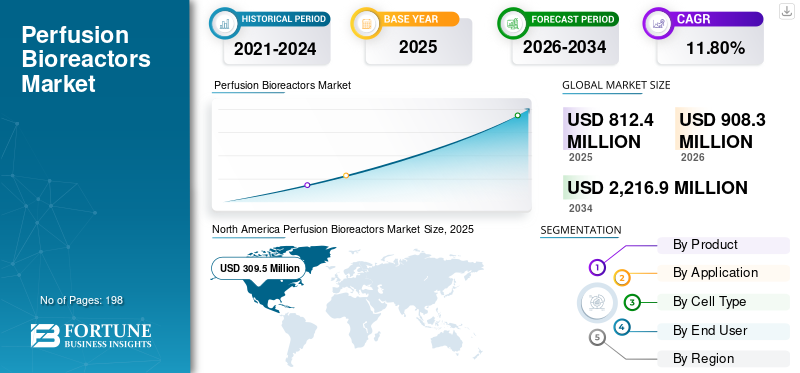
The global perfusion bioreactors market size was valued at USD 812.4 million in 2025. The market is projected to grow from USD 908.3 million in 2026 to USD 2,216.9 million by 2034, exhibiting a CAGR of 11.80% during the forecast period. North America dominated the perfusion bioreactors market with a market share of 38.1% in 2025.
The global market encompasses bioreactor systems, cell-retention devices, single-use consumables, control software, and associated services utilized for operating continuous or intensified cell culture processes. The market is becoming increasingly significant as biopharmaceutical firms face pressure to enhance productivity, minimize manufacturing footprint, and ensure consistent product quality. Demand is driven by the expansion of biologics, biosimilars, cell and gene therapies, and ongoing biomanufacturing, as businesses require scalable and automated solutions for both research and development and GMP production.
Key players operating in the global market include Sartorius AG, Danaher Corporation (Cytiva), Thermo Fisher Scientific Inc., and Merck KGaA. These companies are focusing on single-use perfusion platforms, automated benchtop and pilot-scale systems, integrated cell-retention technologies such as ATF/TFF, and software-enabled process control to strengthen their market presence.
Download Free sample to learn more about this report.
Perfusion Bioreactors Market KEY TAKEAWAYS
 Global Market Size & Forecast
- 2025 Market Size: USD 812.4 million
- 2026 Market Size: USD 908.3 million
- 2034 Forecast Market Size: USD 2,216.9 million
- CAGR: 11.80% from 2026–2034
 Market Share
- North America dominated the perfusion bioreactors market with a 38.1% share in 2025.
- The monoclonal antibody production segment accounted for the largest market share in 2025.
- The CHO cells segment accounted for the largest market share in 2025.
 Key Regional Highlights
Asia Pacific
Asia Pacific reached USD 240.7 million in 2026, driven by expanding biologics and biosimilar manufacturing.
North America
North America reached USD 309.5 million in 2025, supported by advanced biologics manufacturing and continuous bioprocessing.
Europe
Europe is driven by strong biologics manufacturing infrastructure and rising bioprocessing investments.
U.S.
U.S. reached USD 315.2 million in 2026, fueled by strong biopharmaceutical manufacturing capabilities.
Japan
Japan reached USD 54.7 million in 2026, driven by growing biologics and cell therapy production.
Read More

PERFUSION BIOREACTORS MARKET TRENDS
Development of Automated and AI-enabled Perfusion Bioreactor Systems is a Major Trend Observed in the Global Market
The rise of automated and AI-driven perfusion bioreactor systems is becoming a significant trend as biomanufacturers aim to minimize manual intervention, enhance batch consistency, and speed up process optimization. Perfusion culture necessitates ongoing management of feed rate, cell density, dissolved oxygen, pH, metabolites, and harvest flow, making automation essential for sustaining stable long-term processes. With the advancement of biologics, cell therapies, viral vectors, and recombinant proteins toward more intense and continuous production, companies are implementing digital bioreactor platforms that integrate sensors, cloud monitoring, automated controls, and AI-based optimization. This enables researchers to identify process variations sooner, enhance reproducibility, and decrease the time needed to scale up from process development to GMP manufacturing. The trend is additionally favoring smaller-scale manufacturing as automated perfusion systems can uphold high cell densities and enhance productivity without needing excessively large batch reactors. Consequently, suppliers are progressively incorporating software, remote monitoring, and data analysis into bioreactor systems to enhance the scalability and manageability of perfusion workflows.
- For instance, in April 2025, Culture Biosciences launched Stratyx 250, described as a mobile, cloud-integrated bioreactor designed to offer automation, remote process control, and flexibility.
MARKET DYNAMICS
MARKET DRIVERS
Download Free sample to learn more about this report.
Increasing Biologics and Biosimilar Production to Boost Market Growth
The global rise in biologics and biosimilar manufacturing significantly drives the market, as these therapies necessitate high-yield, reliable, and scalable cell culture systems. With the increasing demand for monoclonal antibodies, recombinant proteins, vaccines, and biosimilars, manufacturers are transitioning to upstream processing to boost productivity without significantly increasing bioreactor batch capacity. Perfusion bioreactors sustain high cell density by constantly providing fresh media and eliminating waste, facilitating extended production periods and improved process stability. This is particularly crucial for manufacturers of biosimilars, since maintaining cost-efficiency and consistent product quality are vital for competing against branded biologics. The rising investment in biologics production by pharmaceutical companies and CDMOs is consequently boosting the demand for perfusion-ready bioreactors, single-use systems, media/feed consumables, and cell-retention technologies. With the increase in global biologics capacity among companies, perfusion platforms are anticipated to witness greater adoption in both process development and commercial production.
- For instance, in November 2025, Sandoz announced an agreement to acquire Just-Evotec Biologics EU SAS in Toulouse to expand its in-house biosimilar development and manufacturing capabilities.
MARKET RESTRAINTS
High Setup and Operational Costs to Limit Market Growth
High installation and operational expenses limit the global market, as these systems necessitate sophisticated bioreactors, cell-retention devices, sensors, automation software, sterile single-use materials, and trained personnel. In contrast to conventional batch or fed-batch systems, perfusion processes operate continuously, requiring manufacturers to invest in dependable control systems, media supply, filtration modules, and monitoring tools to ensure stable extended-duration cultures. This raises both capital investments and regular operating expenses, particularly for small to mid-sized biopharma firms and academic users. Intense media usage, the potential for membrane fouling, the necessity for validation, and the complexity of processes can increase cost pressures for scaling-up. Consequently, certain manufacturers might postpone implementation until they witness evident market demand, solid process knowledge, and adequate financial support. Although perfusion enhances productivity, its increased initial and operational costs may restrict quicker market entry.
- For instance, in February 2025, a report published in the journal Trends in Biotechnology stated that full-scale implementation of continuous bioprocessing remains slow. The report noted that adoption of new technologies in regulated industries is cautious and that implementing continuous bioprocessing in a new facility requires significant capital investment.
MARKET OPPORTUNITIES
Expansion of Continuous Bioprocessing Technologies to Offer Lucrative Opportunities
Expansion of continuous bioprocessing technologies is creating a strong opportunity for the global market, as manufacturers are moving from traditional batch-based production toward more productive, flexible, and cost-efficient manufacturing models. Perfusion bioreactors are central to this shift, as they allow continuous supply of fresh media, removal of waste, and steady product harvest while maintaining high cell densities. This helps companies improve facility utilization, reduce equipment footprint, and support faster scale-up of biologics, biosimilars, recombinant proteins, and advanced therapies. Continuous processing also enhances process consistency by allowing culture conditions to be monitored and controlled over longer production runs. As CDMOs and biopharma companies invest in intensified and connected manufacturing platforms, demand is expected to rise for perfusion-ready bioreactors, cell-retention devices, PAT tools, automation software, and single-use consumables. Therefore, suppliers providing integrated upstream perfusion and continuous manufacturing solutions are well-positioned to capitalize on emerging growth opportunities.
- For instance, in October 2024, Enzene Biosciences launched EnzeneX 2.0, the next generation of its fully connected continuous manufacturing platform for biologics.
MARKET CHALLENGES
Regulatory Compliance and Validation Requirements Pose a Key Challenge to Market Growth
Regulatory compliance and validation needs continue to pose significant challenges for the worldwide market, as perfusion processes involve greater complexity compared to traditional batch or fed-batch systems. These systems function for extended periods and necessitate ongoing management of cell density, media replacement, product collection, sterility, and essential quality characteristics. Consequently, manufacturers need to produce more robust data on process validation, equipment qualification, contamination control, and continuous process verification prior to the use of perfusion systems in GMP production. Modifications in bioreactor design, cell-retention systems, media strategies, automation software, or scaling methods may necessitate extra validation efforts, thereby raising time, costs, and the burden of regulatory documentation. This challenge is greater for biologics, biosimilars, viral vectors, and cell therapies, as product quality is closely tied to live-cell culture environments. As a result, companies might implement perfusion at a slower pace unless they possess robust CMC, quality, and regulatory competencies.
- For instance, in January 2025, ProductLife Group highlighted that continuous manufacturing of biologics faces regulatory and technical challenges such as long-term cell line stability, media optimization, process control, and maintaining consistent product quality during extended mammalian cell culture runs. These issues directly reflect the validation burden faced by perfusion-based bioprocesses, where regulators expect strong evidence of process robustness and quality consistency.
Segmentation Analysis
By Product
Recurring Use of Various Consumables Supported Segment Expansion
In terms of product, the market is divided into software and services, consumables, instruments, and others.
The consumables segment held the major global perfusion bioreactors market share in 2025. This is attributed to the continuous and repeated use of various consumables, including sterile media bags, tubing sets, and filters throughout perfusion workflows. Additionally, these consumables are replaced after each production cycle, creating a steady recurring demand. Moreover, the shift toward single-use perfusion systems has further increased adoption, as biopharma companies prefer disposable components to reduce cleaning validation, contamination risk, and changeover time.
- For instance, in September 2025, Distek expanded its BIOne Single-Use Bioreactor line with models designed for integration with perfusion technologies, including Repligen XCell ATF and KrosFlo TFDF.
The software and services segment is anticipated to rise with a CAGR of 13.41% over the forecast period.
To know how our report can help streamline your business, Speak to Analyst
By Application
Increased Demand for Antibody Therapeutics Boosted Monoclonal Antibody Production Segment Growth
Based on application, the market is classified into monoclonal antibody production, recombinant protein & enzyme production, cell therapy manufacturing, viral vector & gene therapy production, vaccine production, process development & scale-up, and others.
The monoclonal antibody production segment accounted for the dominant market share in 2025. This can be attributed to the fact that monoclonal antibodies are among the most widely manufactured biologics and require high-yield mammalian cell culture platforms. The segment also benefits from strong use of CHO-based production platforms, where perfusion helps enhance viable cell density and volumetric output. The segment is also supported by large commercial volumes, expanding biosimilar pipelines, and growing interest in continuous biologics manufacturing. Furthermore, the segment is set to hold a 35.0% share in 2026.
- For instance, in January 2025, Stämm announced that its continuous bioreactor increased monoclonal antibody productivity by up to 30x in European and American pilot studies.
The cell therapy manufacturing segment is anticipated to rise with a CAGR of 14.39% over the forecast period.
By Cell Type
Established Use of CHO Cells in Biologics Manufacturing Boosted Segment Growth
On the basis of cell type, the market is divided into CHO cells, HEK293 cells, stem cells, T cells & other immune cells, and others.
In 2025, the CHO cells segment led the market as these are the most widely used host system for commercial monoclonal antibody and recombinant protein production. These cells are preferred as they support high productivity, stable expression, scalable growth, and human-like protein glycosylation, which are critical for biologics manufacturing. The segment also benefits from broad regulatory familiarity, established cell-line development platforms, and wide use across pharma, biotech, and CDMO facilities. Furthermore, the segment is set to hold a 48.2% share in 2026.
- For instance, in August 2025, a study published by Springer Nature highlighted the need to accelerate monoclonal antibody process development using CHO host cells. The study noted that single-use high-throughput bioreactor systems, such as Ambr 250, offer a promising platform for automated and controlled CHO cell cultures.
The HEK293 cells segment is anticipated to rise with a CAGR of 12.52% over the forecast period.
By End User
Strong In-house Biologics Manufacturing Capabilities to Drive Segment Dominance
Based on end user, the market is segmented into pharmaceutical & biotechnology companies, CDMOs/CMOs, academic & research institutes, cell & gene therapy manufacturing centers, and others.
The pharmaceutical & biotechnology companies segment dominated the market in 2025, as these companies are the primary developers and commercial manufacturers of various products, including vaccines and biosimilars. Large biopharma companies increasingly invest in perfusion-ready and intensified upstream platforms to improve yield, reduce production footprint, and support consistent product quality at scale. These companies also have stronger capital budgets, process development teams, regulatory expertise, and GMP infrastructure, making them early adopters of advanced bioreactor technologies. Furthermore, the segment is set to hold a 45.3% share in 2026.
- For instance, in April 2026, Aurobindo Pharma’s subsidiary TheraNym Biologics announced an investment of around USD 150-175 million to build a greenfield large-scale biologic drug substance manufacturing facility for Merck & Co., Inc.
The CDMOs/CMOs segment is projected to witness 13.39% growth rate during the forecast period.
Perfusion Bioreactors Market Regional Outlook
Based on region, the global market is divided into Asia Pacific, Latin America, Europe, North America, and the Middle East & Africa.
North America
North America Perfusion Bioreactors Market Size, 2025 (USD Million)
To get more information on the regional analysis of this market, Download Free sample
The North American market was valued at USD 278.8 million in 2024 and dominated the global market. In 2025, the region maintained its leading position, with USD 309.5 million. The regional growth is driven by the strong presence of large biopharmaceutical companies, advanced biologics manufacturing facilities, and high adoption of continuous bioprocessing technologies.
U.S. Perfusion Bioreactors Market
The U.S. market led the North American region and is projected to reach around USD 315.2 million in 2026, representing about 34.7% of the global sales.
Europe
Europe market is growing at a CAGR of 11.02% during the forecast period due to strong biologics manufacturing infrastructure, established regulatory pathways, and rising investment in advanced bioprocessing.
U.K. Perfusion Bioreactors Market
The U.K. market in 2026 is poised to reach around USD 46.1 million, representing roughly 5.1% of global revenues.
Germany Perfusion Bioreactors Market
Germany’s market is projected to reach approximately USD 61.5 million in 2026, equivalent to around 6.8% of global sales.
Asia Pacific
The Asia Pacific market is expected to reach a valuation of USD 240.7 million in 2026. Asia Pacific is expected to witness the fastest growth during the forecast period due to expanding biologics and biosimilar manufacturing in China, India, South Korea, Japan, and Singapore. The region also benefits from rising demand for affordable biosimilars, vaccines, and cell therapy products. Lower production costs, growing technical expertise, and increasing partnerships with global bioprocess technology providers are further supporting the product adoption.
Japan Perfusion Bioreactors Market
The Japanese market in 2026 is poised to reach around USD 54.7 million, accounting for roughly 6.0% of global revenues.
China Perfusion Bioreactors Market
China’s market is projected to reach around USD 82.6 million in 2026, representing roughly 9.1% of global sales.
India Perfusion Bioreactors Market
The Indian market in 2026 is estimated to touch around USD 29.5 million, accounting for roughly 3.2% of global revenues.
Latin America and Middle East & Africa
The growth in the Middle East & Africa and Latin America regions is anticipated to be moderate in the coming years. Key factors such as increasing demand for vaccines, biosimilars, increasing healthcare investment, and growing interest in local biologics production are expected to boost the perfusion bioreactors market growth in these regions. The Latin American market is estimated to reach around USD 44.9 million in 2026.
In the Middle East Africa region, the GCC market is projected to reach approximately USD 16.7 million in 2026, representing about 1.8% of worldwide revenues.
COMPETITIVE LANDSCAPE
Key Industry Players
Key Players are Focusing on Integrated Perfusion-Ready Platforms To Gain Competitive Edge
The global perfusion bioreactors market reflects a moderately competitive landscape, consisting of established bioprocess technology suppliers and several specialized players. Key players include Sartorius AG, Danaher Corporation (Cytiva), Thermo Fisher Scientific Inc., Merck KGaA, and others. The companies are focusing on integrated perfusion-ready platforms that reduce equipment complexity, improve cell-retention control, and support high-density mammalian cell culture.
- For instance, in August 2023, Sartorius and Repligen launched an integrated system combining Sartorius Biostat STR bioreactor with Repligen XCell ATF upstream intensification technology to simplify intensified seed-train and N perfusion implementation for biopharmaceutical manufacturers.
Other significant participants include Repligen Corporation, Eppendorf SE, PBS Biotech, Inc., and Getinge AB. These firms are strengthening their presence through single-use systems, scalable bioreactor platforms, perfusion consumables, and software-enabled process control.
LIST OF KEY PERFUSION BIOREACTORS COMPANIES PROFILED
- Sartorius AG (Germany)
- Danaher Corporation (Cytiva) (U.S.)
- Thermo Fisher Scientific Inc. (U.S.)
- Merck KGaA (Germany)
- Repligen Corporation (U.S.)
- Eppendorf SE (Germany)
- PBS Biotech, Inc. (U.S.)
- Getinge AB (Sweden)
- Infors AG (Switzerland)
- Meissner Filtration Products, Inc. (U.S.)
KEY INDUSTRY DEVELOPMENTS
- December 2025: PBS Biotech launched MiniPRO, a multi-parallel Vertical-Wheel bioreactor platform for scalable, closed-system cell therapy process development. The system supports up to 24 independent cultures with real-time control and perfusion media exchange, strengthening its relevance in cell therapy perfusion workflows.
- September 2025: FUJIFILM Biosciences commercially launched BalanCD HEK293 Perfusion A, a cell culture medium designed for HEK293 cells and perfusion-based viral vector production. The product supports high-density, intensified, and continuous AAV/LV production for gene therapy applications.
- August 2025: Thermo Fisher Scientific introduced the 5L DynaDrive Single-Use Bioreactor to accelerate process development and enable scale-up from 1 L to 5,000 L. The system supports modern bioprocessing workflows and includes BioTitan retention devices, making it relevant for intensified and perfusion-linked upstream processing.
- May 2025: ABEC introduced its Advanced Therapy Bioreactor (ATB), a single-use, closed, and fully automated bioreactor platform for advanced therapy medicinal products.
- February 2025: Sunflower Therapeutics collaborated with PharmNXT Biotech and signed a distribution agreement for a perfusion bioreactor. The agreement enabled the company to commercially launch its Daisy Petal Perfusion Bioreactor System in Asia, a significant step in the company’s ongoing product commercialization.
REPORT COVERAGE
The global perfusion bioreactors market analysis includes a thorough evaluation of the market size and forecasts for every segment highlighted in the report. It offers insights into the market dynamics and trends expected to drive the market throughout the forecast period. The global market report provides an understanding of essential factors, including technological progress, product innovations, the regulatory environment, and the launch of new products. Additionally, it details partnerships, mergers & acquisitions, and key developments in the industry within the market. The global market forecast report also provides an in-depth competitive landscape, including information on market share and profiles of key active players.
Request for Customization to gain extensive market insights.
Report Scope & Segmentation
| ATTRIBUTE | DETAILS |
| Study Period | 2021-2034 |
| Base Year | 2025 |
| Estimated Year | 2026 |
| Forecast Period | 2026-2034 |
| Historical Period | 2021-2024 |
| Growth Rate | CAGR of 11.80% from 2026-2034 |
| Unit | Value (USD Million) |
| Segmentation | By Product, Application, Cell Type, End User, and Region |
| By Product |
|
| By Application |
|
| By Cell Type |
|
| By End User |
|
| By Region |
|
Frequently Asked Questions
According to Fortune Business Insights, the global market value stood at USD 812.4 million in 2025 and is projected to reach USD 2,216.9 million by 2034.
In 2025, the market value stood at USD 309.5 million.
The market is expected to exhibit a CAGR of 11.80% during the forecast period.
By product, the consumables segment led the market.
Growth of biologics, biosimilars, cell and gene therapies, and continuous biomanufacturing are the key factors driving the market.
Sartorius AG, Danaher Corporation (Cytiva), Thermo Fisher Scientific Inc., and Merck KGaA are some of the prominent players in the global market.
North America dominated the market in 2025.



- 2021-2034
- 2025
- 2021-2024
- 198
Get 30-60 hrs Free Customization
Expand Regional and Country Coverage, Segments Analysis, Company Profiles, Competitive Benchmarking, and End-user Insights.













.webp)






Related Reports
-
US +1 833 909 2966 ( Toll Free )
-
Get In Touch With Us