Pharmaceutical Filtration Market Size, Share & Industry Analysis, By Type (Depth Filters, Cartridge Filters, Membrane Filters, Syringe Filters, and Consumables & Others), By Application (Final Product Processing, Raw Material Filtration, Virus Filtration, Cell Separation, and Others), By Technique (Microfiltration, Ultrafiltration, Cross Flow Filtration, Nanofiltration, and Others), By Scale of Operation (R&D Scale, Pilot-scale, and Commercial Scale), By End User (Pharmaceutical & Biotechnology Companies, Research and Academic Institutions, and Others), and Regional Forecast, 2026-2034
 Download Free Sample
Pharmaceutical Filtration Market Size and Future Outlook
 Listen to Audio Version
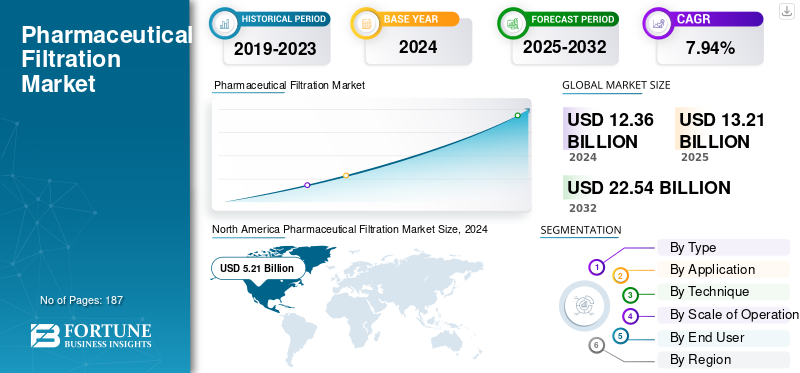
The global pharmaceutical filtration market size was valued at USD 12.36 billion in 2025. The market is projected to grow from USD 13.21 billion in 2026 to USD 26.90 billion by 2034, exhibiting a CAGR of 8.36% during the forecast period. North America dominated the global pharmaceutical filtration market with a market share of 45.09% in 2025. Expanding biopharmaceutical manufacturing, especially biologics, vaccines, and biosimilars, is raising demand for sterile, high-performance filtration systems.
The pharmaceutical filtration market is projected to witness substantial growth in the upcoming years, attributing to its crucial role in removing and inactivating contamination during the drug development and manufacturing process. As the prevalence of various key diseases increases, there is a corresponding spike in drug development, which drives the demand for pharmaceutical filtration solutions. Such factors collectively contribute to the growth of the pharmaceutical filtration market worldwide. In addition, to maintain a competitive edge, various key players are focusing on strategic activities such as collaboration and acquisitions to enhance their product offerings.
- For instance, in September 2025, Merck KGAA partnered with Siemens to accelerate digital transformation by delivering integrated software solutions, systems, and consumables for drug discovery, development, and manufacturing.
The market is dominated by several key players, with Merck KGaA and Sartorius AG occupying leading positions. Advanced technology integration and strengthened product offerings through collaborations further reinforce the position of these companies in the global market.
Download Free sample to learn more about this report.
PHARMACEUTICAL FILTRATION MARKET KEY TAKEAWAYS
 Market Size & Forecast
- 2025 Market Size: USD 12.36 billion
- 2026 Market Size: USD 13.21 billion
- 2034 Forecast Market Size: USD 26.90 billion
- CAGR: 8.36% from 2026–2034
 Market Share
- North America dominated the pharmaceutical filtration market with a 45.09% share in 2025.
- The cartridge filters segment is projected to grow at the highest 8.68% CAGR.
- The virus filtration segment is expected to grow at a 9.30% CAGR.
 Key Regional Highlights
North America
North America held 45.09% of the market in 2025 with USD 5.57 billion, reaching USD 5.97 billion in 2026.
Europe
Europe accounted for USD 3.54 billion and 28.63% share in 2025, rising to USD 3.78 billion in 2026.
Asia Pacific
Asia Pacific captured 24.74% of the market with USD 3.06 billion in 2025 and is projected to reach USD 3.31 billion in 2026.
U.S.
The market is projected to reach USD 5.49 billion by 2026.
Japan
The market is projected to reach USD 0.60 billion by 2026.
Read More

MARKET DYNAMICS
MARKET DRIVERS
Expansion of Biopharmaceutical Manufacturing to Propel Market Growth
The rapid growth of the biologics, such as vaccines, biologics, biosimilar cell and personalized medicines, is creating global pharmaceutical filtration demand. Pharmaceutical companies extensively utilize filtration systems and are expanding their biomanufacturing capacity to meet the increasing demand for effective drug products.
- For instance, in September 2025, Merck launched a USD 161.81 million filter manufacturing facility in Ireland. The manufacturing facility aimed to strengthen the company’s in-region-for-region supply resilience.
MARKET RESTRAINTS
Filter Fouling to Restrict Market Expansion
One of the major factors restricting the market's growth is filter fouling. Particulate clogs the filter media, which reduces flow rates and filtration efficiency over time. The particulates reduce flow rates and filtration efficiency over time. This results in frequent filter replacements, increased operational costs, and process downtime, ultimately impacting overall productivity. Furthermore, addressing fouling can require costly revalidation and quality checks, further hindering the market's growth.
- For instance, in May 2024, the Journal of Membrane Science published an article titled ‘Investigation of fouling in perfusion cell culture processes using alternating tangential flow filtration’ which reported ways to reduce fouling.
MARKET OPPORTUNITIES
Rising Investment for Next-Generation Membranes to Offer Lucrative Growth Opportunities
Owing to the high importance of pharmaceutical filtration, several market players are investing significantly to expand their filtration capacity. These investments support the development of next-generation membranes that offer superior chemical compatibility, thermal stability, and high flow rates. Continuous R&D efforts are also leading to the emergence of smart membranes, which improve productivity in continuous bioprocessing environments.
- For instance, in May 2023, 3M invested USD 146.0 million to expand its capabilities and further support biotech manufacturing. The news investment aimed to accelerate the company’s development and delivery of vital filtration solutions for pharmaceutical manufacturing applications.
PHARMACEUTICAL FILTRATION MARKET TRENDS
Shift toward Single-Use Technologies (SUTs) is a Prominent Global Pharmaceutical Filtration Market Trend
The shift toward Single-Use Technologies (SUTs) has emerged as a prominent trend in the global pharmaceutical filtration market. These single-use filtration systems eliminate the need for cleaning and sterilization between production batches, significantly reducing downtime and validation costs. They support smaller batch production and minimize the risk of cross-contamination, ensuring higher product purity. Leading players expanded their single-use filtration portfolios, introducing scalable systems for upstream and downstream applications. Such developments are anticipated to drive the global pharmaceutical filtration market growth.
- For instance, in September 2024, Sartorius AG launched Vivaflow SU, a tangential flow filtration (TFF) system that enables more efficient and sustainable ultrafiltration and diafiltration processes for feed volumes ranging from 100 to 1,000 mL.
MARKET CHALLENGES
Variability in Raw Material Poses a Significant Challenge for Market Growth
One of the major challenges in the pharmaceutical filtration market is the variability in raw materials, as even minor inconsistencies in their composition or quality can significantly impact the performance and reliability of pharmaceutical filtration products. This forces manufacturers to perform additional testing, revalidation, and batch qualification, leading to increased costs and longer production timelines.
Download Free sample to learn more about this report.
Segmentation Analysis
By Type
Growing Usage inSterilization-Grade Filtration Boosted Segment Growth
Based on type, the market is classified into depth filters, cartridge filters, membrane filters, syringe filters, and consumables & others.
To know how our report can help streamline your business, Speak to Analyst
The membrane filters segment is projecteed to dominate the market with a share of 32.34% in 2026, as they are increasingly used for sterilization-grade filtration. Strict regulations necessitate controlled microbial control in sterile manufacturing processes, driving the adoption of advanced membrane filtration systems.
- For instance, in June 2024, Asahi Kasei announced that it had begun selling a membrane system in April 2024 to produce WFI (water for injection), a type of sterile filtration of water used for injection preparation.
The cartridge filters are the fastest-growing segment with a projected CAGR of 8.68% during the forecast period.
By Application
High Demand for Biologics And Biosimilars Encouraged the Final Product Processing Segment Growth
In terms of application, the market is categorized into final product processing, raw material filtration, virus filtration, cell separation, and others.
The final product processing segment is projecteed to dominate the market with a share of 49.15% in 2026. The segment's dominance is attributed to the high demand for biologics and biosimilars in the treatment of various diseases. Additionally, increasing automation to meet growing demand is expected to further drive segment growth.
- For instance, in October 2023, Telescope Innovations Corp partnered with Mott Corporation to commercialize a novel robotic sampling probe for chemical analysis and purification. This new technology enabled accurate analysis of intractable chemistries in pharmaceutical and chemical manufacturing, supporting the continued segment's growth.
The virus filtration segment is expected to grow at a CAGR of 9.30% over the forecast period.
By Technique
Microfiltration Segment Dominated due to its Key Benefits
In terms of technique, the market is categorized into microfiltration, ultrafiltration, cross-flow filtration, nanofiltration, and others.
In 2024, the microfiltration segment is projecteed to dominate the market with a share of 40.40% in 2026. The segment’s prominence is owing to its advantages over other filtration techniques. Its key benefits include the physical removal of bacteria and particulates, operation under mild conditions that protect product quality, and high process efficiency compared to filtration techniques. To leverage these advantages, companies are investing in new product launches to improve quality.
- For instance, in May 2025, Nephros expanded its S100 microfiltration line to support bacterial retention in various settings.
The nanofiltration segment is expected to grow at a CAGR of 10.46% over the forecast period.
By Scale of Operation
Large-scale Usage of Pharmaceutical Filtration in Various Bioprocess SystemsBoosted the Growth of the Commercial Segment
Based on the scale of operation, the market is categorized into R&D scale, pilot-scale, and commercial scale.
The commercial segment is projecteed to dominate the market with a share of 78.65% in 2026. The large-scale utilization of pharmaceutical filtration in various bioprocess systems drives the dominance of the segment.
- For instance, in March 2023, Evonik launched a new GMP facility in Germany to manufacture lipids for advanced pharmaceutical drug delivery applications. These facilities extensively utilize pharmaceutical filtration solutions, supporting the growth of the segment.
The R&D scale segment is expected to grow at a CAGR of 6.70% over the forecast period.
By End User
Pharmaceutical & Biotechnology Companies Segment Due to Its Extensive Applications
In terms of end user, the market is categorized into pharmaceutical & biotechnology companies, research and academic institutions, and others.
The pharmaceutical & biotechnology companies segment accounted for the largest share of the market in 2024. In 2025, the segment is anticipated to dominate with a 72.2% share. The dominance of the segment is attributed to the extensive application of these solutions in the production of various biopharmaceutical applications.
- For instance, in July 2023, Sartorius AG added a cell culture media manufacturing facility in Puerto Rico. The facility expanded the company’s cell culture media capacities.
The research and academic institutions segment is expected to grow at a CAGR of 6.75% over the forecast period.
Pharmaceutical Filtration Market Regional Outlook
By geography, the market is categorized into Europe, North America, Asia Pacific, Latin America, and the Middle East & Africa.
North America
North America contributed approximately USD 5.57 Billion to the global market in 2025, accounting for 45.09% share, and is expected to reach USD 5.97 Billion in 2026. The region is anticipated to dominate and grow at a significant CAGR due to increasing manufacturing activities of biologics and biosimilars. The increased production of biopharmaceuticals is expected to drive the pharmaceutical filtration market growth in the region. In 2025, the U.S. market is estimated to reach USD 5.49 billion by 2026. Underscoring the advantages, key companies are focusing on strategic activities, such as mergers and collaborations, to expand and enhance their product offerings.
North America Pharmaceutical Filtration Market Size, 2025 (USD Billion)
To get more information on the regional analysis of this market, Download Free sample
- For instance, in December 2024, Ahlstrom acquired ErtelAlsop, a manufacturer of liquid depth filter media. The acquisition strengthened the company’s position in the life science filtration market.
Europe
In 2025, the Europe market stood at USD 3.54 Billion, representing 28.63% of global demand, and is projected to grow to USD 3.78 Billion in 2026 and maintaining its position as the second-largest regional market. Growth is supported by the commissioning of new manufacturing facilities and rising demand for advanced filtration solutions across industrial and commercial applications. The region benefits from stringent regulatory standards focused on product quality, environmental compliance, and operational efficiency, encouraging the adoption of high-performance filtration technologies. Strong industrial infrastructure and ongoing investments in production modernization further contribute to market expansion. The U.K., Germany, and France are expected to remain key contributors, reaching USD 0.70 billion, USD 1.09 billion by 2026 and USD 0.54 billion, respectively, in 2025.
Asia Pacific
The Asia Pacific region captured 24.74% of the global market in 2025, generating USD 3.06 Billion in revenue, and is projected to reach USD 3.31 Billion in 2026, ranking as the third-largest regional market globally. Growth is driven by rapid industrialization, expanding manufacturing activities, and increasing investments in infrastructure development across emerging economies. Supportive government initiatives aimed at strengthening industrial output and environmental management continue to create favorable market conditions. Rising awareness regarding process efficiency and quality standards is further accelerating the adoption of filtration solutions across multiple end-use industries. The Japan market is valued at USD 0.60 billion by 2026, the China market is valued at USD 1.18 billion by 2026, and the India market is valued at USD 0.87 billion by 2026.
Latin America and the Middle East & Africa
In 2025, Middle East & Africa generated USD 0.43 Billion, contributing 3.45% to global market revenue, and is projected to grow to USD 0.44 Billion in 2026. Latin America recorded a market size of USD 0.61 Billion in 2025, capturing 4.97% of the global market share, and is projected to reach USD 0.64 Billion in 2026. Rising investments in regional healthcare initiatives to enhance pharmaceutical self-sufficiency to further drive growth in these regions. In the Middle East & Africa, the GCC region is set to reach a value of USD 0.16 billion by 2025.
COMPETITIVE LANDSCAPE
Key Industry Players
Key Companies Focus on Strategic Collaborations to Support Their Leading Position
The global pharmaceutical filtration market exhibits a concentrated structure, with a few companies operating actively worldwide. These players are actively involved in product innovation, strategic partnerships, and geographic expansion. They actively invest in technology advancement and offer a wide array of product offerings for efficient filtration systems.
Danaher Corporation, Merck KGaA, and Sartorius AG are some of the significant players in the market. A comprehensive range of healthcare BPO services, enabling efficient operations and collaborations with other market entities, are a few characteristics that support these players' dominance.
- For instance, in July 2024, IDEX Corporation acquired Mott, a microfiltration business specializing in the design, customization, and manufacturing of sintered porous metal components used in fluidic applications.
Other prominent players in the market include Avantor, Inc., Cytiva, 3M, and others. These companies are undertaking various strategic initiatives, such as investments in R&D to strengthen their market presence.
LIST OF KEY PHARMACEUTICAL FILTERATION COMPANIES PROFILED:
- Danaher Corporation. (U.S.)
- Merck KGaA (Germany)
- Sartorius AG (Germany)
- 3M (U.S.)
- Repligen Corporation (U.S.)
- Parker Hannifin Corp (U.S.)
- Eaton (Ireland)
- Thermo Fisher Scientific Inc. (U.S.)
- Cytiva (U.S.)
- Avantor, Inc. (U.S.)
KEY INDUSTRY DEVELOPMENTS
- July 2025: Asahi Kasei Corporation launched a new spinning plant for its Planova virus removal filters in Japan to strengthen life science’s global bioprocess supply capabilities. The initiative was backed by a grant from Japan’s Ministry of Economy, Trade, and Industry (METI).
- July 2025: Repligen Corporation partnered with Novasign to develop and integrate Novasign’s machine learning and modeling workflow into Repligen filtration systems. The collaboration enabled the company’s unique modeling workflow to be integrated into tangential flow filtration (TFF) systems.
- June 2024: Cytiva launched high-concentration biologic drugs using its Supor Prime sterilizing-grade filters. The Supor Prime filters were designed to help drug developers achieve higher yields, reduce premature blockages, and limit the costs associated with filtration losses.
- April 2025: Parker Bioscience Filtration launched SciLog NFF+ PF. This innovative solution was designed to help biopharmaceutical manufacturers integrate Pre-Use Post-Sterilization Integrity Testing (PUPSIT) into their filtration processes, ensuring product safety and quality.
- December 2020: Sartorius AG acquired WaterSep BioSeparations LLC. The acquisition expanded the company's offering in crossflow filtration units for easy-to-use bioprocessing devices.
REPORT COVERAGE
The global pharmaceutical filtration market analysis provides a comprehensive study of market size & forecast by all segments included in the report. It includes details on the market dynamics and market trends expected to drive the market in the forecast period. It also provides overviews of technological advancements, product development, key industry developments, mergers & acquisitions, and strategic insights into market growth. The research report also encompasses a detailed competitive landscape with information on market share and profiles of key operating players.
Request for Customization to gain extensive market insights.
Report Scope & Segmentation
|
Attribute |
Details |
|
Study Period |
2021-2034 |
|
Base Year |
2025 |
|
Forecast Period |
2026-2034 |
|
Historical Period |
2021-2024 |
|
Growth Rate |
CAGR of 8.36% from 2026-2034 |
|
Unit |
Value (USD Billion) |
|
Segmentation |
By Type, Application, Technique, Scale of Operation, End User, and Region |
|
By Type |
|
|
By Application |
|
|
By Technique |
|
|
By Scale of Operation |
|
|
By End User |
|
|
By Geography |
|
Frequently Asked Questions
Fortune Business Insights says that the global market value stood at USD 12.36 billion in 2025 and is projected to reach USD 26.90 billion by 2034.
In 2025, the market value stood at USD 5.57 billion.
The market is expected to exhibit a CAGR of 8.36% during the forecast period (2026-2034).
The membrane filters segment led the market in terms of type.
Rising investment in next-generation membranes is a key factor driving market growth.
Danaher Corporation, Merck KGaA, and Sartorius AG are some of the prominent players in the market.
North America dominated the market in 2025.



- 2021-2034
- 2025
- 2021-2024
- 187
Get 30-60 hrs Free Customization
Expand Regional and Country Coverage, Segments Analysis, Company Profiles, Competitive Benchmarking, and End-user Insights.













.webp)






Related Reports
-
US +1 833 909 2966 ( Toll Free )
-
Get In Touch With Us