Photonic Sensor Market Size, Share & Application Analysis, By Type (Image Sensors, Fiber Optic Sensors, Biophotonic Sensors, and Others), By Technology (Fiber Optic Technology, Laser/Optical Tech, Biophotonic Tech, and Others), By Application (Manufacturing, Energy & Utilities, Healthcare, Automotive, Aerospace & Defense, Consumer Electronics, and Others), and Regional Forecast, 2026–2034
 Download Free Sample
 Photonic Sensor Market Size
 Listen to Audio Version
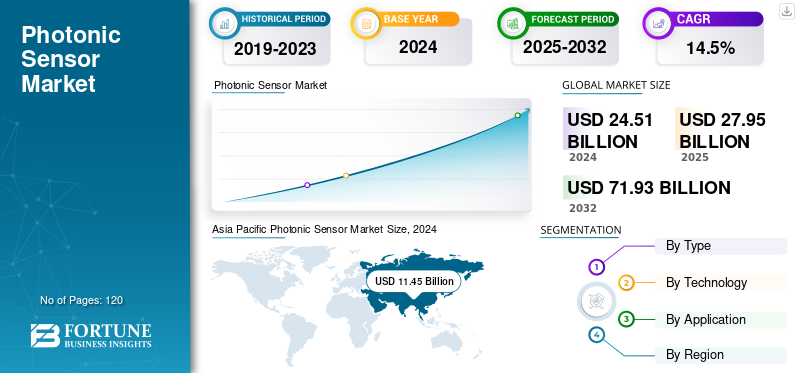
The global photonic sensor market size was valued at USD 27.95 billion in 2025. The market is projected to grow from USD 31.9 billion in 2026 to USD 88.98 billion by 2034, exhibiting a CAGR of 13.68% during the forecast period. Asia Pacific dominated the photonic sensor market with a market share of 47.06% in 2025.
The market refers to the industry focused on the development, production, and deployment of sensors that utilize light-based technologies to detect and measure physical, chemical, or biological parameters. These sensors are widely used across sectors such as manufacturing, energy & utilities, healthcare, automotive, aerospace & defense, and consumer electronics. The market is experiencing significant growth, driven by increasing demand for high-precision and high-speed sensing solutions in key areas such as autonomous vehicles, consumer electronics, and industrial automation.
The top players in the market include Banner Engineering Corporation, Baumer Holding AG, STMicroelectronics N.V., Hamamatsu Photonics K.K., Omron Corporation, Honeywell International Inc., Teledyne Technologies Incorporated, Keyence Corporation, Pepperl+Fuchs SE, and Panasonic Holdings Corporation. They are actively engaged in developing advanced photonic sensing solutions, expanding product portfolios, and investing in research and innovation to enhance sensing accuracy, efficiency, and integration across diverse industrial and commercial applications. For instance,
- In March 2023, EFFECT Photonics, a leading provider of integrated optical solutions, raised USD 40 million from Invest-NL, Innovation Industries, and other investors. The funding will accelerate product development and market expansion.
Download Free sample to learn more about this report.
MARKET DYNAMICS
MARKET DRIVERS:
Growing Adoption of Automation and Advanced Sensing Technologies Drives Market Growth
The growing adoption of automation and advanced sensing technologies is a major factor driving the photonic sensor market growth. Industries are increasingly integrating these sensors into automated systems to enable real-time monitoring, precise measurements, and enhanced process control. These sensors play a critical role in improving operational efficiency, reducing downtime, and ensuring product quality in manufacturing and industrial environments. Furthermore, advancements in optical and photonic technologies are expanding the application scope of these sensors, further fueling market demand.
MARKET RESTRAINTS:
High Development Costs and Lack of Standardization to Restrain Market Expansion
High development costs and a lack of standardization are major factors restraining the growth of the market. The design and production of these sensors require advanced materials and precision engineering, resulting in increased manufacturing expenses. The absence of standardized protocols and compatibility among different sensor technologies further complicates large-scale adoption and integration across industries. These challenges collectively hinder market penetration, particularly in developing regions and cost-sensitive applications.
MARKET OPPORTUNITIES:
Integration of Photonic Sensors with IoT and AI Creates New Growth Opportunities
The growing integration of photonic sensing technologies with the Internet of Things (IoT) and Artificial Intelligence (AI) presents significant opportunities for the expansion of the photonic sensor market. In addition, advancements in photonic technologies and the growing adoption of Industry 4.0 are fueling the development of optical sensors, fiber optic sensors, and biophotonic sensors that offer superior accuracy and energy efficiency. For instance,
- AI with photonic sensors can detect defects under 0.5 mm with over 98% accuracy.
This convergence enables the development of intelligent and connected sensing systems capable of real-time data collection, analysis, and decision-making. Such integration enhances operational efficiency, predictive maintenance, and automation across industries such as healthcare, manufacturing, and smart infrastructure. As a result, the adoption of AI- and IoT-enabled sensors is expected to accelerate, driving innovation and expanding the market’s future growth potential.
PHOTONIC SENSOR MARKET TRENDS:
Rising Adoption of Miniaturized and Energy-Efficient Photonic Sensors to Drive Market Demand
Download Free sample to learn more about this report.
The increasing adoption of miniaturized and energy-efficient sensors for portable and wearable devices is emerging as a significant trend in the market. For instance,
- The global miniaturized electronics market was valued at around USD 47.25 billion in 2024 and is projected to reach approximately USD 51.25 billion by 2025.
Advancements in photonic integration and microfabrication technologies are enabling the development of compact sensors with enhanced performance and low power consumption. These sensors are increasingly being incorporated into wearable health monitoring systems, smart consumer electronics, and industrial equipment for real-time data analysis and control. This trend is expected to drive market expansion by catering to the growing demand for lightweight, high-performance, and energy-efficient sensing solutions.
SEGMENTATION ANALYSIS
By Type
Image Sensors Segment Dominates Due to their Broad Use in Electronics and Automation
Based on type, the market is divided into image sensors, fiber optic sensors, biophotonic sensors, and others.
The image sensors segment leads the market and is expected to grow at the highest CAGR of 46.72% due to their extensive use in consumer electronics, healthcare imaging, and industrial automation, supported by advancements in CMOS and CCD technologies. Fiber optic sensors hold the second-largest share of 29.8% owing to their high sensitivity, reliability, and increasing adoption in structural health monitoring and oil & gas applications.
By Technology
Fiber Optic Technology Leads for its Speed and Reliability
Based on technology, the market is separated into fiber optic technology, laser/optical tech, biophotonic tech, and others.
Fiber optic technology holds the largest photonic sensor market share of 36.29% as it enables high-speed, interference-free data transmission and is widely utilized in communication, defense, and industrial sensing systems. Biophotonic tech is expected to grow at the highest CAGR of 16.4% due to rising demand for advanced medical diagnostics, bio-imaging, and life sciences research applications.
To know how our report can help streamline your business, Speak to Analyst
By Application
Manufacturing Segment Dominates the Market, Driven by Rising Precision and Automation Needs
By application, the market is fragmented into manufacturing, energy & utilities, healthcare, automotive, aerospace & defense, consumer electronics, and others.
Manufacturing dominates the market with 24.61% of the overall share owing to the widespread use of these sensors for precision measurement, automation, and quality control in production environments. The automotive segment is projected to grow at the highest rate of 17.4% due to the increasing integration of photonic sensors in ADAS, LiDAR, and safety systems for autonomous and connected vehicles.
Photonic Sensor Market Regional Outlook
By geography, the market is categorized into North America, South America, Europe, the Middle East & Africa, and Asia Pacific.
Asia Pacific Photonic Sensor Market Size, 2025 ( USD Billion)
To get more information on the regional analysis of this market, Download Free sample
Asia Pacific
Asia Pacific contributed 47.06% to the global market in 2025, with a valuation of USD 13.15 Billion, and is projected to reach USD 15.12 Billion in 2026. It is also projected to grow at the maximum CAGR of 15.4% due to rapid industrialization, expanding electronics manufacturing, and increasing adoption of automation technologies across countries such as China, Japan, and South Korea. These countries are at the forefront of photonic innovation, making substantial investments in research and development, particularly in photonic sensor technology for medical diagnostics and smart manufacturing applications. The Japan market is projected to reach USD 3.57 billion by 2026. The China market is projected to reach USD 4.34 billion by 2026. The India market is projected to reach USD 2.8 billion by 2026.
China leads the market owing to its strong semiconductor and electronics manufacturing base, coupled with heavy investments in photonics and optical communication technologies. The country’s focus on industrial automation and smart manufacturing further reinforces its market leadership.
To know how our report can help streamline your business, Speak to Analyst
North America
In 2025, North America represented USD 5.3 Billion, accounting for 18.98% of the worldwide market, and is projected to grow to USD 6.07 Billion in 2026.The growth is driven by strong technological innovation, the presence of major sensor manufacturers, and the increasing adoption of advanced sensing systems in defense, healthcare, and autonomous vehicles. Continuous R&D investments and early adoption of IoT-based sensing technologies also drive regional growth. The U.S. market is projected to reach USD 3.57 billion by 2026
Europe
The Europe market generated USD 6.83 Billion in 2025, representing 24.44% of the global market landscape, and is expected to reach USD 7.75 Billion in 2026. owing to well-established automotive, healthcare, and industrial automation sectors. Supportive government policies and advancements in photonics research contribute to sustained market demand across the region. The UK market is projected to reach USD 1.85 billion by 2026. The Germany market is projected to reach USD 1.61 billion by 2026.
Middle East & Africa
The Middle East & Africa market was valued at USD 1.48 Billion in 2025, capturing 5.30% of global revenue, and is estimated to reach USD 1.64 Billion in 2026. Growth in the region is comparatively slower due to limited technological infrastructure and lower adoption of advanced sensing technologies. Additionally, economic constraints and a relatively smaller industrial base continue to restrict large-scale market expansion, although ongoing digitalization efforts are expected to create gradual growth opportunities.
South America
The South American market is projected to expand at a CAGR of 12.3% over the forecast period. Despite increasing industrial development, market growth remains moderate due to limited technological capabilities and slower adoption of advanced sensing solutions. Economic challenges and a smaller manufacturing sector also hinder widespread deployment, resulting in a slower growth rate compared to more developed regions.
Latin America
The market in Latin America reached USD 1.18 Billion in 2025, representing 4.22% of total market revenue, and is projected to reach USD 1.32 Billion in 2026.
COMPETITIVE LANDSCAPE
Key Industry Players:
Key Players Focus on Launching New Products to Strengthen their Market Position
Market players launch new products to enhance their market positioning by leveraging technological advancements, addressing diverse consumer needs, and staying ahead of competitors. They prioritize portfolio enhancement through strategic collaborations, acquisitions, and partnerships to strengthen their offerings. Such strategic product launches help companies maintain and grow their market share in a rapidly evolving landscape.
LIST OF KEY PHOTONIC SENSOR COMPANIES PROFILED:
- Banner Engineering Corporation (U.S.)
- Baumer Holding AG (Switzerland)
- STMicroelectronics N.V. (Switzerland)
- Hamamatsu Photonics K.K. (Japan)
- Omron Corporation (Japan)
- Honeywell International Inc. (U.S.)
- Teledyne Technologies Incorporated (U.S.)
- Keyence Corporation (Japan)
- Pepperl+Fuchs SE (Germany)
- Panasonic Holdings Corporation (Japan)
KEY INDUSTRY DEVELOPMENTS:
- In October 2025, the Applied Magnetics and Photonics Laboratory secured funding to develop advanced photonic sensors. The project aims to design sensors that can operate reliably in extreme environments, including deep-sea exploration, deep-earth drilling, nuclear reactors, and outer space.
- In September 2025, Aeva introduced Eve 1V, a next-generation non-contact motion sensor based on silicon photonics FMCW technology. The product enhances industrial measurement accuracy and reliability while eliminating the need for physical contact.
- In May 2025, Lumotive announced that its beam-steering technology is powering E-Photonics’ new LiDAR-based Intelligent Transportation Systems (ITS). Presented at the ITS Show in Spain, the solutions aim to improve traffic management, parking systems, and pedestrian monitoring with greater flexibility and scalability.
- In March 2025, Keysight Technologies launched Photonic Designer, a photonic design automation software that ensures high-precision and compliance-based design validation. The software optimizes the design-to-manufacturing process by resolving challenges related to fragmented tools and inconsistent simulations.
- In March 2025, Aeluma, Inc. confirmed its participation in SPIE Defense + Commercial Sensing 2025 to present advancements in AI-driven photonics, quantum computing, and sensing technologies. The event underscores Aeluma’s focus on delivering scalable, high-performance solutions for defense, communication, and industrial applications.
REPORT COVERAGE
The global market analysis provides an in-depth study of the size & forecast by all the market segments included in the report. It includes details on the market dynamics and market trends expected to drive the market in the forecast period. It offers information on the technological advancements, new Type launches, key industry developments, and details on partnerships, mergers & acquisitions. The market research report also encompasses a detailed competitive landscape with information on the market share and profiles of key operating players.
Request for Customization to gain extensive market insights.
REPORT SCOPE & SEGMENTATION
| ATTRIBUTE | DETAILS |
| Study Period | 2021-2034 |
| Base Year | 2025 |
| Estimated Year | 2026 |
| Forecast Period | 2026-2034 |
| Historical Period | 2021-2024 |
| Growth Rate | CAGR of 13.68% from 2026-2034 |
| Unit | Value (USD Billion) |
| Segmentation |
By Type
By Technology
By Application
By Geography
|
Frequently Asked Questions
Fortune Business Insights says that the global market value stood at USD 27.95 billion in 2025 and is projected to reach USD 88.98 billion by 2034.
In 2025, the market value stood at USD 27.95 billion.
The market is expected to exhibit a CAGR of 13.15% during the forecast period (2026-2034).
The image sensors segment leads the market by type.
Growing adoption of automation and advanced sensing technologies is a key factor driving market growth.
Banner Engineering Corporation, Baumer Holding AG, STMicroelectronics N.V., and Hamamatsu Photonics K.K. are some of the prominent players in the market.
Asia Pacific dominated the market in 2025.
Major factors that are expected to favor product adoption include the rising automation, technological advancements, and integration with IoT and AI.



- 2021-2034
- 2025
- 2021-2024
- 120
Get 30-60 hrs Free Customization
Expand Regional and Country Coverage, Segments Analysis, Company Profiles, Competitive Benchmarking, and End-user Insights.




















Related Reports
-
US +1 833 909 2966 ( Toll Free )
-
Get In Touch With Us