Physiotherapy Services Market Size, Share & Industry Analysis, By Technique (Electrotherapy, Hydrotherapy, Physical Exercise, Cryotherapy, Heat Therapy, Light Therapy, Manual Therapy / Massage, and Others), By Application (Pain Management, Rehabilitation and Recovery, Body Conditioning, Health Wellness, and Others), By Indication (Orthopedic, Cardiovascular, Neurological, and Others), By Age Group (18-24, 25-44, 45-64, 65-84, and 85+), By Service Provider (Hospitals, Outpatient Clinics, Physiotherapy Centers, and Others), and Regional Forecast, 2026-2034
 Download Free Sample
Physiotherapy Services Market Size and Future Outlook
 Listen to Audio Version
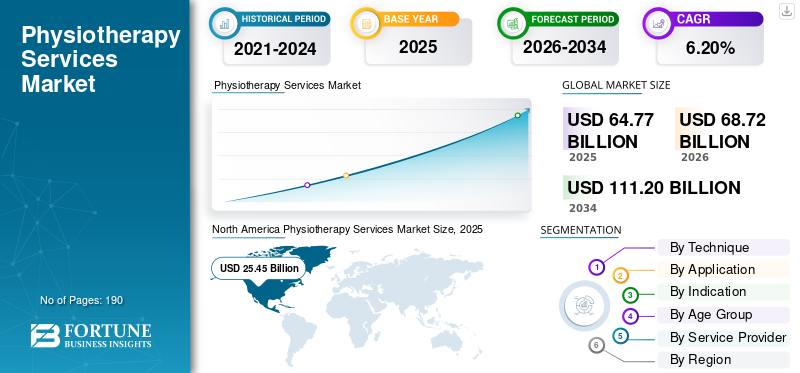
The global physiotherapy services market size was valued at USD 64.77 billion in 2025. The market is projected to grow from USD 68.72 billion in 2026 to USD 111.20 billion by 2034, exhibiting a CAGR of 6.20% during the forecast period. North America dominated the physiotherapy services market with a market share of 39.29% in 2025
The global market is supported by increasing demand for pain management, mobility restoration, and rehabilitation services among patients with musculoskeletal, neurological, orthopedic, and age-related conditions. These services are delivered through hospitals, physiotherapy clinics, sports and fitness facility centers, and home-care settings. The market is witnessing the expansion of outpatient clinic networks and home-based treatment models, contributing to improving access to personalized rehabilitation. The rising elderly population, increasing incidence of injuries, and growing preference for non-pharmacological pain management are some of the factors supporting global market growth. Key players operating in the space are streamlining their focus toward expanding their services and monetizing on the growth potential.
- In October 2024, U.S. Physical Therapy acquired a management organization supporting 50 physical therapy clinics, primarily located in New York. The clinics provided outpatient physical and speech therapy services, along with physical therapy services in patients’ homes. The development highlights the growing focus of physiotherapy service providers on expanding clinic networks, strengthening regional coverage, and increasing access to outpatient and home-based rehabilitation services.
Furthermore, key players, such as Select Medical Holdings Corporation, Encompass Health Corporation, Upstream Rehabilitation Inc., and Athletico Physical Therapy, are actively involved in strategic collaborations, acquisitions, and investment initiatives to expand their market presence.
Download Free sample to learn more about this report.
Physiotherapy Services Market Key Takeaways
 Global Market Size & Forecast
- 2025 Market Size: USD 64.77 billion
- 2026 Market Size: USD 68.72 billion
- 2034 Forecast Market Size: USD 111.20 billion
- CAGR: 6.20% from 2026-2034
 Market Share
- North America dominated the physiotherapy services market with a market share of 39.29% in 2025.
- The others segment is expected to grow at a CAGR of 7.58% over the global physiotherapy services market forecast period.
- North America maintained a leading position in 2025 at USD 25.45 billion.
 Key Regional Highlights
North America
North America was valued at USD 24.25 billion in 2024 and maintained its growth momentum with a leading position in 2025 at USD 25.45 billion.
Europe
Europe is projected to register a CAGR of 5.28% over the forecast period and is set to reach a valuation of USD 19.81 billion by 2026.
Asia Pacific
Asia Pacific held the third-largest share in the market in 2025 and is projected to account for approximately USD 16.90 billion by 2026.
U.S.
The U.S. market is estimated at around USD 24.92 billion in 2026, accounting for roughly 36.26% of the global market.
Japan
Japan's market is projected to be among the largest worldwide, with 2026 revenues estimated at around USD 3.80 billion, accounting for approximately 5.53% of global sales.
Read More

PHYSIOTHERAPY SERVICES MARKET TRENDS
Growing Adoption of Home-Based Physiotherapy Services is an Emerging Trend Observed
Home-based physiotherapy is emerging as a key market trend as patients increasingly seek convenient rehabilitation services without making frequent visits to hospitals or clinics. This care model is particularly suitable for older adults, post-surgical patients, individuals with chronic conditions, and people facing mobility or transportation difficulties. Delivering physiotherapy at home enables therapists to provide personalized treatment, assess patients within their daily living environment, and support greater continuity throughout the recovery period. Physiotherapy providers are therefore expanding home-based programs to improve accessibility, patient convenience, treatment adherence, and long term functional outcomes. The continued shift toward decentralized and patient-centered healthcare is expected to strengthen the adoption of these services.
- In January 2024, Lifespark partnered with Luna to launch Lifespark Physical Therapy at Home, an outpatient physiotherapy service delivered directly to clients’ homes. The collaboration was designed to provide continued rehabilitation support, including for individuals who still required therapy after becoming ineligible for episodic Medicare home-health services.
MARKET DYNAMICS
MARKET DRIVERS
Download Free sample to learn more about this report.
Rising Musculoskeletal and Chronic Disease Burden to Drive Demand for Physiotherapy Services
The increasing prevalence of musculoskeletal disorders and chronic diseases is creating sustained demand for physiotherapy services across healthcare settings. Conditions such as lower back pain, osteoarthritis, stroke, cardiovascular diseases, chronic respiratory disease, and diabetes can reduce mobility, muscle strength, balance, and the ability to perform daily activities. Physiotherapy supports pain reduction, functional recovery, physical conditioning, and long-term management, often requiring multiple treatment sessions over an extended period. Population aging and the rising survival of patients with chronic illnesses are therefore expanding the addressable patient base and supporting recurring demand for physiotherapy services. Clinics are increasingly participating in strategic collaborations to expand their services.
- In July 2025, Physitrack entered into a commercial partnership with Pure Physiotherapy, a provider of musculoskeletal services across NHS and private-sector care settings. The partnership supported the delivery of digitally enabled and outcome-focused rehabilitation across the company’s clinical network.
|
Rank |
Market Driver |
Expected Impact on Market Growth |
Estimated Gross Market Growth Contribution (USD Billion) |
Impact: 2026-2028 |
Impact: 2029-2031 |
Impact: 2032-2034 |
|
1 |
Rising musculoskeletal and chronic-disease burden |
High |
14.40 |
High |
High |
High |
|
2 |
Ageing and longer survival with disability. |
High |
11.20 |
Medium |
High |
High |
|
3 |
Growth in orthopedic procedures and post-acute rehabilitation capacity |
High |
9.80 |
High |
High |
Medium |
|
4 |
Direct access and migration toward outpatient care |
Medium-High |
8.50 |
Medium |
High |
High |
|
5 |
Expansion of insurance coverage and government rehabilitation investment |
Medium |
7.10 |
Medium |
Medium |
High |
|
6 |
Others |
Low |
4.20 |
Low |
Low |
Low |
|
Total Gross Growth Contribution |
55.20 |
MARKET RESTRAINTS
Physiotherapist Shortages and Geographic Maldistribution to Limit Service Availability
Physiotherapy is a labor-intensive service and requires direct and repeated interaction between patients and trained professionals. Shortages of qualified physiotherapists can therefore restrict appointment capacity, increase patient waiting periods, and reduce the frequency or duration of rehabilitation sessions. The concentration of professionals in metropolitan and higher-income areas further limits service availability across rural, remote, and underserved communities. High workloads, inadequate remuneration, professional burnout, and limited career-development opportunities can also weaken workforce retention and increase recruitment costs for service providers. Consequently, workforce shortages and uneven geographic distribution may prevent physiotherapy organizations from expanding at the same pace as patient demand, thereby restraining physiotherapy services market growth.
- In March 2025, a study published in the journal Physical Therapy reported a persistent shortage of physical therapists in the U.S., estimating a deficit of 12,070 full-time-equivalent professionals in 2022. The study also found that 57% of surveyed physical therapists considered the supply in rural areas insufficient, compared with only 9% who considered it adequate. These findings highlight how workforce shortages and regional imbalances can reduce treatment availability and create significant barriers to the timely delivery of physiotherapy services.
|
Rank |
Market Restraint |
Expected Impact on Market Growth |
Estimated Reduction in Market Size (USD Billion) |
Impact: 2026-2028 |
Impact: 2029-2031 |
Impact: 2032-2034 |
|
1 |
Physiotherapist shortages and uneven workforce distribution |
High |
4.60 |
High |
High |
Medium |
|
2 |
Reimbursement pressure and administrative burden |
Medium-High |
3.70 |
High |
Medium |
Medium |
|
3 |
Affordability and high out-of-pocket exposure in emerging markets |
Medium |
2.60 |
Medium |
Medium |
Low |
|
4 |
Others |
Low |
1.82 |
Low |
Low |
Low |
|
Total Market Reduction |
12.72 |
MARKET OPPORTUNITIES
Formalization of Physiotherapy Services and Rehabilitation Infrastructure Expansion to Create Growth Opportunities
Emerging markets present significant growth opportunities as governments and healthcare providers strengthen rehabilitation infrastructure and introduce formal standards for allied healthcare professions. Physiotherapy services in many low- and middle-income countries remain fragmented, concentrated in major cities, and frequently delivered outside organized clinical networks. Professional registration, standardized education, licensing requirements, and institutional accreditation can improve service quality, patient confidence, and referrals from physicians and insurers. Additionally, the expansion of hospitals, primary care centers, sports medicine facilities, and rehabilitation departments can extend physiotherapy services into smaller cities and underserved communities. Formalization and infrastructure investment can unlock a large unmet patient population for organized physiotherapy providers.
- In April 2026, India’s National Commission for Allied and Healthcare Professions announced the implementation of 17 mandatory curricula including Physiotherapy, along with institutional standards and professional registration processes. The initiative is expected to improve workforce standardization, strengthen professional recognition, and support the development of organized physiotherapy services across the country.
MARKET CHALLENGES
Standardizing Clinical Quality and Patient Outcomes Across Providers Remains a Key Market Challenge
The fragmented structure of the market makes it difficult to maintain consistent treatment quality across settings. Differences in therapist experience, clinical protocols, treatment intensity, documentation practices, and the use of outcome measurement tools can result in varying patient experiences and rehabilitation outcomes. As service networks expand, maintaining personalized care while enforcing common clinical standards may increase operational complexity and affect patient confidence in organized physiotherapy services.
- In November 2025, WebPT’s State of Rehab Therapy Report highlighted wide differences in patient experience and retention across rehabilitation clinic sizes. Providers working in larger organizations reported greater workloads, more bureaucracy, and a more impersonal care environment. They were less likely to consider their practices as delivering a best-in-class patient experience.
Segmentation Analysis
By Technique
Physical Exercise Segment Dominated Owing to Its Central Role Across Physiotherapy Programs
Based on the technique, the market is categorized into electrotherapy, hydrotherapy, physical exercise, cryotherapy, heat therapy, light therapy, manual therapy / massage, and others.
The physical exercise segment dominated the market in 2025. Therapeutic exercises form the foundation of most physiotherapy treatment plans across orthopedic, neurological, cardiovascular, and post-surgical conditions. Strengthening, stretching, balance, gait, and mobility exercises help patients reduce pain, restore movement, improve muscle function, and regain independence. These physical exercises can be customized according to the patient’s condition and continued through supervised clinic sessions or home-exercise programs. Their applicability across different age groups and care settings results in high treatment frequency and repeated service utilization. Consequently, the broad clinical use, lower equipment dependency, and central role of exercise in long-term rehabilitation supported the segment’s leading market share.
- In May 2025, Bioliberty launched Lifehub Clinic, a rehabilitation solution combining soft-robotic wearables with repetitive, gamified therapeutic exercises. The platform was designed to help therapists deliver high-intensity exercise therapy and support movement recovery among patients with neurological impairments. The launch highlighted the continued focus of rehabilitation providers and technology developers on exercise-based interventions as a core component of physiotherapy delivery.
The others segment is expected to grow at a CAGR of 7.58% over the global physiotherapy services market forecast period.
To know how our report can help streamline your business, Speak to Analyst
By Application
Rehabilitation and Recovery Segment Dominated Due to Broad Post-Injury and Post-Surgical Demand
Based on application, the market is segmented into pain management, rehabilitation and recovery, body conditioning, health wellness, and others.
In 2025, the rehabilitation and recovery segment accounted for the largest market share based on application. Physiotherapy is widely prescribed after surgeries, injuries, strokes, neurological events, and periods of prolonged hospitalization. These patients generally require structured treatment programs involving repeated sessions to restore mobility, strength, coordination, and the ability to perform daily activities. Rehabilitation may continue from the inpatient stage to outpatient or home-based care, thereby generating sustained service demand throughout the recovery pathway. The wide range of conditions requiring functional recovery and the longer duration of care consequently supported the segment’s dominant position.
- In July 2024, Encompass Health inaugurated a 50-bed rehabilitation hospital in Rhode Island. The facility provided intensive physical, occupational, and speech therapy to patients recovering from strokes, brain and spinal injuries, amputations, and complex orthopedic conditions. The development demonstrates the substantial and recurring demand for structured rehabilitation and recovery services following serious illnesses and injuries.
The health wellness segment is projected to grow at a CAGR of 6.96% during the forecast period.
By Indication
Orthopedic Indication Dominated Owing to the High Burden of Musculoskeletal Conditions
Based on the indication, the market is segmented into orthopedic, cardiovascular, neurological, and others.
The orthopedic segment dominated the market in 2025. A large patient population affected by back pain, osteoarthritis, fractures, joint injuries, sports-related conditions, and post-operative mobility limitations is in need of physiotherapy services. Orthopedic patients frequently undergo multiple sessions involving exercise therapy, manual therapies, pain management, and movement retraining before returning to normal activities. In addition, joint-replacement surgeries, workplace injuries, sedentary lifestyles, and sports participation continue to expand the volume of patients requiring orthopedic rehabilitation, representing the largest underlying source of rehabilitation demand.
- In September 2025, the Government Institute of Medical Sciences in Noida opened a dedicated physiotherapy and sports-injury rehabilitation center. The facility was established in response to increasing cases of osteoarthritis, chronic pain, joint problems, and muscle injuries and includes technologies for pain relief, balance training, and musculoskeletal rehabilitation. The development highlights the growing patient demand for physiotherapy services focused on orthopedic and mobility-related conditions.
The neurological segment is projected to grow at a CAGR of 6.75% during the forecast period.
By Age Group
45–64 Age Group Dominated Due to Rising Musculoskeletal Risks and Higher Treatment Utilization
Based on the age group, the market is segmented into 18-24, 25-44, 45-64, 65-84, and 85+.
In 2025, the 45–64 age group segment dominated, capturing the largest physiotherapy services market share. The high share was allocated to the segment as individuals in this category experience an increasing incidence of back pain, joint degeneration, occupational injuries, repetitive-strain conditions, and lifestyle-related mobility problems. Greater access to employer-sponsored insurance, private healthcare, and workplace rehabilitation programs further supports physiotherapy utilization within this population. The age group also requires more frequent management of chronic and degenerative conditions, while retaining a stronger ability and willingness to participate in active rehabilitation than some older patients. This combination of a large patient base, rising disease burden, and higher treatment uptake supported the segment’s leading share.
- In May 2024, Hinge Health launched Hinge Health Global to provide personalized digital musculoskeletal care to employees of multinational organizations. The solution was introduced to address chronic pain, disability, absenteeism, and reduced productivity across the global workforce. The launch reflects the strong commercial demand for physiotherapy and musculoskeletal-care services among working-age adults.
The 85+ segment is projected to grow at a CAGR of 8.35% over the forecast period.
By Service Provider
Outpatient Clinics Segment Dominated Owing to Convenient and Cost-Efficient Service Delivery
Based on the service provider, the market is segmented into hospitals, outpatient clinics, physiotherapy centers, and others.
The outpatient clinics segment dominated the market in 2025 as most physiotherapy patients do not require hospitalization and can receive treatment through scheduled clinic visits. These clinics provide convenient access to repeated sessions while generally carrying lower operating and treatment costs than inpatient hospital-based rehabilitation. Outpatient settings can manage a broad range of cases and offer flexible appointment schedules close to patients’ homes or workplaces. Specialized therapists, therapy equipment, and standardized treatment programs further strengthen patient preference for these facilities. The ability to handle high patient volumes and expand through multi-location clinic networks therefore supported the segment’s market leadership.
- In September 2024, Healyos partnered with Apollo Clinic to provide physiotherapy services across five outpatient clinic locations in Pune, India. The partnership expanded access to organized physiotherapy through Apollo Clinic’s established healthcare network. The development highlights the growing preference among service providers for outpatient delivery models that improve patient convenience, geographic coverage, and treatment accessibility.
The others segment is projected to grow at a CAGR of 7.44% over the forecast period.
Physiotherapy Services Market Regional Outlook
By region, the market is categorized into Europe, North America, Asia Pacific, Latin America, and the Middle East & Africa.
North America
North America Physiotherapy Services Market Size, 2025 (USD Billion)
To get more information on the regional analysis of this market, Download Free sample
North America was valued at USD 24.25 billion in 2024 and maintained its growth momentum with a leading position in 2025 at USD 25.45 billion. The high prevalence of musculoskeletal disorders, sports injuries, and post-surgical rehabilitation needs supports growth in North America. Strong insurance coverage and extensive outpatient physiotherapy networks improve service utilization.
U.S. Physiotherapy Services Market
Given North America's substantial contribution and the U.S. dominance in the region, the U.S. market is estimated at around USD 24.92 billion in 2026, accounting for roughly 36.26% of the global market.
Europe
Europe is projected to register a CAGR of 5.28% over the forecast period, with the second-largest growth among all regions, and is set to reach a valuation of USD 19.81 billion by 2026. The rising elderly population and increasing burden of chronic mobility-related conditions are driving demand for physiotherapy services. Public healthcare systems increasingly integrate rehabilitation into long-term and post-acute care pathways. Expansion of community-based and outpatient services also supports market growth.
Germany Physiotherapy Services Market
The Germany market size is estimated at USD 3.65 billion in 2026, accounting for roughly 5.31% of the global market.
U.K. Physiotherapy Services Market
U.K.'s market size is projected to reach approximately USD 3.06 billion by 2026, equivalent to around 4.46% of the global market.
Asia Pacific
Asia Pacific held the third-largest share in the market in 2025 and is projected to account for approximately USD 16.90 billion by 2026. Rapid urbanization, improving healthcare infrastructure, and rising awareness of rehabilitation are expanding the patient base and driving market growth in the region. Growth in private hospitals and organized clinic networks further improves service availability.
China Physiotherapy Services Market
The Chinese market in 2026 is estimated at around USD 5.20 billion, accounting for approximately 7.57% of the global market.
Japan Physiotherapy Services Market
Japan's market is projected to be among the largest worldwide, with 2026 revenues estimated at around USD 3.80 billion, accounting for approximately 5.53% of global sales.
India Physiotherapy Services Market
The Indian market size is estimated at around USD 2.13 billion in 2026, accounting for roughly 3.11% of global revenue.
Latin America and Middle East & Africa
Latin America and the Middle East & Africa regions are expected to witness moderate growth in this market during the forecast period. However, Latin America is estimated to reach a valuation of USD 3.12 billion by 2026. The market is growing due to expanding private healthcare facilities and increasing demand for orthopedic and sports rehabilitation. Greater awareness of non-pharmacological pain management is encouraging physiotherapy uptake. Investments in urban outpatient clinics are also improving access to structured services. In the Middle East & Africa region, the GCC is set to reach a valuation of USD 0.58 billion by 2026.
South Africa Physiotherapy Services Market
The South African market value is projected to reach approximately USD 0.27 billion by 2026, accounting for roughly 0.39% of global revenue.
COMPETITIVE LANDSCAPE
Key Industry Players
Strategic Acquisitions and Service Network Expansion among Key Providers to Strengthen Market Competition
The global physiotherapy services market is moderately fragmented, with competition led by multi-location outpatient clinic operators, hospital-based rehabilitation networks, independent physiotherapy centers, and digitally enabled service providers. Major participants such as Select Medical, U.S. Physical Therapy, ATI Physical Therapy, and Ivy Rehab are focusing on geographic expansion, specialized rehabilitation programs, hybrid care delivery, and partnerships with hospitals, insurers, and local clinic owners to strengthen their market position. These companies are increasingly combining clinic-based treatment with virtual consultations, home exercise support, and standardized clinical pathways to improve accessibility, patient retention, and treatment outcomes.
- In August 2025, the U.S. Physical Therapy acquired a 60% interest in a physiotherapy practice operating three clinics. The acquired practice generated approximately USD 5.3 billion in annual revenue and recorded around 28,000 patient visits annually. The acquisition highlights the growing use of partnership-based acquisitions by larger physiotherapy providers to expand regional coverage while retaining local clinical expertise and management involvement.
Several companies are adopting acquisitions, clinic partnerships, service diversification, and digital-care integration as key growth strategies to expand their patient reach. Large providers are strengthening their competitive position through broader referral networks, centralized administration, payer relationships, and standardized quality-management systems. At the same time, independent clinics continue to compete through personalized care and specialty expertise. Companies with skilled therapist networks, hybrid service capabilities, and measurable clinical outcomes are likely to gain a competitive advantage as demand for accessible and coordinated physiotherapy services increases.
LIST OF KEY PHYSIOTHERAPY SERVICES COMPANIES PROFILED
- Select Medical Holdings Corporation (U.S.)
- Encompass Health Corporation (U.S.)
- Upstream Rehabilitation Inc. (U.S.)
- Athletico Physical Therapy (U.S.)
- ATI Physical Therapy, Inc. (U.S.)
- S. Physical Therapy, Inc. (U.S.)
- PT Solutions Physical Therapy (U.S.)
- Ivy Rehab Network, Inc. (U.S.)
- Lifemark Health Group (Canada)
- CBI Health (Canada)
- Nuffield Health (U.K.)
KEY INDUSTRY DEVELOPMENTS
- July 2026: Ensora Health expanded its Fusion EHR platform, which brings its multi-discipline therapy record fully into adult physical therapy. Fusion was built to run Physical Therapy (PT), Occupational Therapy (OT), and Speech-Language Pathology (SLP) as first-class disciplines in one shared EHR.
- June 2026: Physitrack plc collaborated across 37 clinical sites and approximately 400 practitioner licenses for one of the U.K.'s largest independent healthcare providers, with expansion potential as the network grows. The deal entails enterprise-wide standardization across 37 clinical sites and approximately 400 practitioner licenses nationwide.
- May 2026: PharmEasy launched an online physiotherapy service aimed at expanding access to guided pain management and rehabilitation from home. The new service combined consultations with certified physiotherapists and AI-powered movement analysis to help users identify pain sources and follow structured recovery plans remotely.
- September 2025: FlexifyMe raised INR 20 crore (~USD 2.4 million) in pre-Series A funding in order to accelerate its hybrid care expansion through online and offline centers, supporting the launch of advanced posture and gait analysis labs, and strengthening clinical research partnerships. The platform combines AI-driven diagnostics, physiotherapy, and personalized care plans to address chronic pain and mobility issues.
- July 2025: XRHealth partnered with Kemtai, an innovator in AI-driven computer vision exercise coaching. This collaboration was aimed to combine XRHealth's extended reality (XR) platforms with Kemtai's advanced motion analysis technology to deliver a breakthrough in physical therapy experiences, enhancing both clinical outcomes and patient engagement.
REPORT COVERAGE
The report provides a detailed global physiotherapy services market analysis across key segments. The study offers market insights by technique, application, indication, age group, and service provider. It presents regional analysis across North America, Europe, Asia Pacific, Latin America, and the Middle East & Africa, along with country-level assessments where applicable. The global market report further includes market dynamics, such as key growth drivers, restraints, challenges, trends, and opportunities, together with the competitive landscape, partnerships, acquisitions, and other strategic developments undertaken by leading service providers.
Request for Customization to gain extensive market insights.
Report Scope & Segmentation
| ATTRIBUTE | DETAILS |
| Study Period | 2021-2034 |
| Base Year | 2025 |
| Estimated Year | 2026 |
| Forecast Period | 2026-2034 |
| Historical Period | 2021-2024 |
| Growth Rate | CAGR of 6.20% from 2026 to 2034 |
| Unit | Value (USD Billion) |
| Segmentation | By Technique, Application, Indication, Age Group, Service Provider, and Region |
| By Technique |
|
| By Application |
|
| By Indication |
|
| By Age Group |
|
| By Service Provider |
|
| By Region |
|
Research Methodology
1. Bottom Up Approaches
Approach 1: Revenues and Market Share of Major Physiotherapy Service Providers
- Estimation of physiotherapy and rehabilitation service revenues from annual reports, SEC filings, investor presentations, earnings releases, acquisition disclosures, and company websites of key providers such as Select Medical, Encompass Health, U.S. Physical Therapy, ATI Physical Therapy, Athletico, Upstream Rehabilitation, PT Solutions, Ivy Rehab, Lifemark Health Group, and Nuffield Health.
- Segregation of physiotherapy revenues from occupational therapy, speech therapy, hospital accommodation, fitness services, diagnostics, and other non-physiotherapy activities.
- Assessment of each provider’s clinic network, patient visits, therapist workforce, geographic presence, payer mix, utilization rates, and average revenue per visit.
- Estimation of revenues generated by private chains, independent clinics, hospital physiotherapy departments, home-care providers, and virtual physiotherapy platforms.
- Triangulation of identified provider revenues with the estimated organized-provider share in each country and region.
- The summation and extrapolation of company-level physiotherapy revenues were used to estimate the global market.
Approach 2: Patient-Level Physiotherapy Visit and Service Revenue Analysis
- Assessment of the adult population receiving physiotherapy for orthopedic, neurological, cardiovascular, sports injury, postoperative, pain-management, and other conditions.
- Estimation of treated patients using disease prevalence, diagnosis rates, referral rates, treatment access, insurance coverage, and physiotherapy utilization.
- Mapping of average treatment episodes per patient, sessions per episode, repeat treatment, and long-term rehabilitation requirements.
- Collection of average realized physiotherapy fees by country, treatment setting, payer category, and service type.
- The number of treated patients in key countries and regions was multiplied by the average number of annual sessions and realized revenue per session to estimate the market.
- The resulting country estimates were aggregated to estimate the regional and global market values.
Approach 3: Physiotherapy Workforce and Treatment-Capacity Model
- Collection of registered and practicing physiotherapist numbers from professional associations, government workforce databases, labor statistics, and national healthcare authorities.
- Conversion of registered physiotherapists into active clinical full-time equivalents after excluding administrative, academic, non-practicing, and part-time personnel.
- Assessment of patients treated per therapist per day, average working days, session duration, facility utilization, and appointment occupancy.
- Segmentation of the workforce across hospitals, outpatient clinics, physiotherapy centers, home care, long-term care, and other service settings.
- Estimation of annual treatment visits by multiplying the clinical physiotherapy workforce by average therapist productivity and capacity utilization.
- Annual treatment visits were multiplied by the average realized revenue per session to estimate country-level market revenue.
- The summation of country-level workforce-based revenues was used to estimate the regional and global market.
2. Top Down Approaches
Approach 1: Healthcare Expenditure and Rehabilitation Services Allocation Analysis
- Analysis of total healthcare expenditure, outpatient healthcare expenditure, rehabilitation spending, long-term care spending, and household out-of-pocket expenditure across key countries.
- Estimation of the proportion of national healthcare expenditure attributable to rehabilitation and allied-health services.
- Further allocation of rehabilitation expenditure to clinical physiotherapy services after excluding occupational therapy, speech therapy, respiratory therapy, rehabilitation devices, and hospital accommodation.
- Assessment of public versus private healthcare spending, insurance penetration, government reimbursement, workers’ compensation, and patient-paid physiotherapy expenditure.
- Comparison of mature and emerging markets based on therapist density, service availability, treatment utilization, healthcare access, and average physiotherapy pricing.
- Country-level physiotherapy expenditure was aggregated across North America, Europe, Asia Pacific, Latin America, and the Middle East & Africa.
- The regional estimates were summed to calculate the global physiotherapy services market.
3.List of Key Sources
- World Health Organization
- World Physiotherapy
- OECD
- World Bank
- Eurostat
- S. Centers for Medicare & Medicaid Services
- S. Bureau of Labor Statistics
- National healthcare ministries and reimbursement authorities
- National physiotherapy associations and practitioner registries
- Company annual reports, SEC filings, investor presentations, and earnings releases
- Government healthcare expenditure, workforce, demographic, and insurance databases
- Public reimbursement schedules and physiotherapy fee databases.
4.Primary Interviews
Supply Side Interviews: 60%
- Key Respondents: Discussions with physiotherapy service providers, clinic operators, hospital rehabilitation departments, insurance companies, and industry associations to understand market size, service pricing, therapist productivity, clinic utilization, payer mix, and regional market dynamics. Key respondents include senior executives, clinic owners, operations managers, rehabilitation heads, business development managers, and reimbursement specialists.
Demand Side Interviews: 40%
- Key Respondents: Discussions with physiotherapists, orthopedic surgeons, neurologists, cardiologists, referring physicians, patients, employers, and third-party administrators to analyze physiotherapy utilization, referral patterns, treatment frequency, number of sessions per patient, affordability, insurance coverage, and preference for hospitals, outpatient clinics, physiotherapy centers, home care, and virtual physiotherapy services.
Frequently Asked Questions
According to Fortune Business Insights, the global market value stood at USD 64.77 billion in 2025 and is projected to reach USD 111.20 billion by 2034.
In 2025, the market value stood at USD 25.45 billion.
The market is expected to grow at a CAGR of 6.20% over the forecast period.
The physical exercise segment is expected to lead the market by technique.
Rising musculoskeletal and chronic-disease burden is the key factor driving the market growth.
Select Medical Holdings Corporation, Encompass Health Corporation, Upstream Rehabilitation Inc., and Athletico Physical Therapy are among the major players in the global market.
North America dominated the market in 2025.



- 2021-2034
- 2025
- 2021-2024
- 190
Get 30-60 hrs Free Customization
Expand Regional and Country Coverage, Segments Analysis, Company Profiles, Competitive Benchmarking, and End-user Insights.













.webp)






Related Reports
-
US +1 833 909 2966 ( Toll Free )
-
Get In Touch With Us