Phytonutrients Market Size, Share & Industry Analysis, By Type (Carotenoids, Plant Sterols, Flavonoids, Curcumin, and Others), By Source (Fruits and Vegetables, Grains & Cereals, Legumes & Pulses, Herbs & Spices, and Others), By Form (Dry and Liquid), By Application (Nutraceuticals, Pharmaceuticals, Animal Nutrition, and Personal Care & Cosmetics), and Regional Forecast, 2026-2034
 Download Free Sample
(Offer valid till 31st Oct 2026)

Phytonutrients Market Overview
 Listen to Audio Version
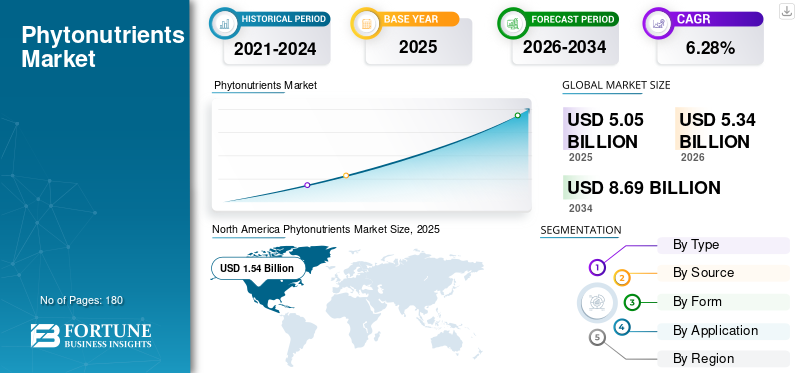
The global phytonutrients market size was valued at USD 5.05 billion in 2025. The market is projected to grow from USD 5.34 billion in 2026 to USD 8.69 billion by 2034, exhibiting a CAGR of 6.28% during the forecast period. North America dominated the phytonutrients market with a market share of 30.5% in 2025.
Phytonutrients, or phytochemicals, are natural substances found in plants such as fruits, vegetables, grains, and herbs. Although they are not essential nutrients such as vitamins, phytonutrients support health by offering antioxidant and anti-inflammatory properties. Common types of phytonutrients include flavonoids, carotenoids, and polyphenols. The market is expanding rapidly as more consumers focus on preventive healthcare, seek natural and functional foods, and choose plant-based diets. More uses in dietary supplements, nutraceuticals, and fortified foods, along with a push for clean-label products, are helping these trends spread in the global food and beverage industry. The global market is witnessing steady growth, driven by strong demand in North America and the Middle East & Africa, an emerging market due to rising health awareness and the adoption of plant-based nutrition.
Companies such as BASF SE, DSM-Firmenich, Kemin Industries, and others are key players in this market. New product launches and partnerships with related companies are key strategies boosting product sales and supporting market growth.
Download Free sample to learn more about this report.
PHYTONUTRIENTS MARKET Key Takeaways
 Market Size & Forecast
- 2025 Market Size: USD 5.05 billion
- 2026 Market Size: USD 5.34 billion
- 2034 Forecast Market Size: USD 8.69 billion
- CAGR: 6.28% from 2026–2034
 Market Share
- North America dominated the phytonutrients market with a market share of 30.5% in 2025.
- Flavonoids hold the second-largest market share and are expected to grow at a CAGR of 6.46% during the forecast period.
- Herbs & spices make up the second-largest share of the market and are expected to grow at a CAGR of 6.35% during the forecast period.
 Key Regional Highlights
North America
North America reached USD 1.54 billion in 2025 and is the leading region. This growth comes from strong consumer interest in preventive healthcare and a high demand for dietary supplements and functional foods.
Asia Pacific
The Asia Pacific market was valued at USD 1.49 billion in 2025. This growth stems from its large population, higher disposable incomes, and greater awareness of health and wellness.
Europe
The European market reached a valuation of USD 1.36 billion in 2025. Europe is a well-established market for phytonutrients with a strong consumer preference for natural and organic products.
U.S.
The market reached USD 1.33 billion in 2025, supported by a well-established nutraceutical industry and growing focus on preventive wellness.
Japan
The market was valued at approximately USD 0.31 billion in 2025, accounting for around 6.05% of global revenue, driven by demand for health-focused nutrition products.
Read More

PHYTONUTRIENTS MARKET TRENDS
Clean-Label Movement and Technological Advancements Accelerating Innovation in Phytonutrient Applications
More people are choosing clean-label, naturally sourced ingredients, paying closer attention to labels, and steering clear of artificial additives. Foods and drinks with added phytonutrients, including antioxidant-rich juices and fortified snacks, are becoming more popular in both developed and emerging markets. Companies are also using new extraction and processing methods, such as supercritical fluid extraction and microencapsulation, to make phytonutrients more stable and effective. The integration of phytonutrient-based beauty and personal care products, often referred to as “nutricosmetics,” is also expanding its scope of application. Digital health trends and easier access to nutrition information are shaping what people buy, increasing demand for plant-based health products supported by science.
MARKET DYNAMICS
MARKET DRIVERS
Download Free sample to learn more about this report.
Rising Preventive Healthcare Awareness Driving Increased Demand for Phytonutrient-Enriched Products
The phytonutrients market is growing quickly due to increased adoption of preventive healthcare and long-term wellness products. With the rising incidence of obesity, heart disease, and diabetes worldwide, people are looking for functional food products and supplements that contain plant-based nutrients. Phytonutrients are becoming more popular in the food, beverage, and supplement industries because they offer antioxidant, anti-inflammatory, and immune-boosting benefits. Therefore, the shift toward plant-based diets and clean-label products is also increasing demand, as people prefer natural ingredients over synthetic ones. Moreover, growing research and clinical evidence of phytonutrient benefits are building consumer trust and motivating companies to incorporate these compounds into more products.
MARKET RESTRAINTS
High Production Costs and Stability Challenges Limiting Market Scalability and Adoption
A major challenge for this market is the high cost of extracting, purifying, and stabilizing phytonutrients, which raises the final price of products. Moreover, many phytonutrients break down when exposed to heat, light, or oxygen during processing and storage, reducing their effectiveness and shortening shelf life. The lack of consistent regulations across regions also makes it harder for manufacturers to obtain approvals, label products, and make health claims. Moreover, supply chain issues, especially when sourcing certain plant extracts, can affect how consistently and how much companies can produce, hindering the global phytonutrients market growth.
MARKET OPPORTUNITIES
Growing Demand for Personalized and Plant-Based Nutrition Creating New Market Expansion Avenues
A major opportunity is the rising demand for personalized nutrition. Phytonutrients can be adjusted to fit each person’s health needs, taking into account their genetics, lifestyle, and diet. As more people choose plant-based and vegan diets, there are new ways to add phytonutrients to creative food and drink products. New advances in encapsulation and delivery technologies are making phytonutrients more stable and easier for the body to absorb. This allows them to be used in more industries. Partnerships among food companies, biotech firms, and research groups are driving new ideas and products.
Segmentation Analysis
By Type
High Usage of Natural Colorants in Food and Drinks Support Carotenoids Segmental Growth
The market is segmented by type into carotenoids, plant sterols, flavonoids, curcumin, and others.
The carotenoids segment held the largest phytonutrients market share in 2025, due to consumer preferences for vision, immunity, and skin health. Beta-carotene, lutein, astaxanthin, and lycopene are common ingredients in dietary supplements, functional foods, and cosmetics, especially those for eye health and anti-aging. Carotenoids are also widely used as natural colorants in food and drinks, which supports the trend toward clean-label products.
The flavonoids hold the second-largest market share and are expected to grow at a CAGR of 6.46% during the forecast period. Flavonoids make up the second-largest share because they offer many health benefits and are found in a wide range of plants, including fruits, vegetables, tea, and cocoa. Flavonoids are widely used in functional foods and beverages, as well as in supplements, because they are versatile and usually cost less than carotenoids. Nevertheless, as more people seek plant-based and natural options, demand for flavonoids continues to grow worldwide.
By Source
Abundant Availability and High Consumer Preference for Natural Nutrition Driving Dominance of Fruits and Vegetables
Based on source, the market is segmented into fruits and vegetables, grains & cereals, legumes & pulses, herbs & spices, and others.
The fruits and vegetables segment accounted for the largest market share in 2025, as they are widely available, affordable, and rich in bioactive compounds such as flavonoids, carotenoids, and polyphenols. People around the world eat these foods regularly, and they are common in both traditional diets and modern functional foods. This makes it easy to access the raw materials needed. Their versatility means they can be easily added to juices, supplements, fortified foods, and drinks, which helps with large-scale production and sales.
Herbs & spices make up the second-largest share of the market, which is expected to grow at a CAGR of 6.35% during the forecast period. Herbs and spices make up the second-largest share of the market because they are highly potent and rich in phytonutrients such as curcumin, allicin, and capsaicin. These ingredients are commonly used in nutraceuticals, traditional medicine, and functional foods. However, their strong flavors and specific usage patterns restrict their application in mainstream food and beverage products.
By Form
Enhanced Stability, Longer Shelf Life, and Cost-Efficient Handling Driving Dominance of Dry Form Segment
By form, the market is bifurcated into dry and liquid.
The dry forms segment led the global market in 2025, as they are more stable, last longer, and are easier to store and transport. Dry phytonutrients are less likely to break down from moisture, light, or microbes compared to liquid forms. This makes them better suited for large-scale industrial use. These dry forms are common in dietary supplements such as tablets, capsules, and powders, which make up the majority of the nutraceutical market. Dry forms also help reduce packaging and shipping costs, which is especially important for global distribution.
Liquid is another major segment with a 6.65% CAGR during the forecast period. Liquid forms have the second-largest market share because they are absorbed quickly and have high bioavailability. They are especially popular in ready-to-drink products and in formulas for children or older adults, where easy consumption matters. However, their market share remains lower than that of dry forms due to a shorter shelf life and greater susceptibility to degradation from environmental factors such as heat, light, and oxidation.
By Application
To know how our report can help streamline your business, Speak to Analyst
Shift Towards Preventive Healthcare Awareness Led to Dominance of Nutraceutical Applications
The market is segmented by application into nutraceuticals, pharmaceuticals, animal nutrition, and personal care & cosmetics.
The nutraceuticals segment led the global market share in 2025, driven by a global shift toward preventive healthcare and wellness-focused habits. These foods and beverages, along with supplements, are valued for their antioxidant, anti-inflammatory, and immune-boosting effects and are commonly available in capsule, tablet, powder, and functional food forms. The growth of e-commerce and direct-to-consumer supplement brands has made these products easier for people to access.
The animal nutrition segment accounted for the second largest market share in 2025 and is expected to register a CAGR of 6.26% during the forecast period. Animal nutrition is the second-largest market, with more phytonutrients now used as natural feed additives to boost animal health, immunity, and productivity. As restrictions on antibiotics in livestock increase, more producers are turning to plant-based options such as essential oils, flavonoids, and carotenoids to support gut health and disease resistance. Phytonutrients help improve feed efficiency, support better growth, and enhance the quality of products such as meat, milk, and eggs.
Phytonutrients Market Regional Outlook
By region, the market is categorized into Europe, North America, Asia Pacific, South America, and the Middle East & Africa.
North America
North America Phytonutrients Market Size, 2025 (USD Billion)
To get more information on the regional analysis of this market, Download Free sample
North America reached USD 1.54 billion in 2025 and is the leading region. The North American market is well developed. This growth comes from strong consumer interest in preventive healthcare and a high demand for dietary supplements and functional foods. The U.S. leads the region because it has a strong nutraceutical industry, advanced research, and many people choose clean-label products. As lifestyle-related diseases become more common, more people are looking for antioxidant-rich ingredients. The region also has a strong distribution network, including e-commerce, which makes products easier to access.
U.S. Phytonutrients Market
In 2025, the U.S. market reached USD 1.33 billion. The U.S. leads the global market due to its strong nutraceutical industry and widespread focus on preventive healthcare.
High demand for dietary supplements, functional drinks, and clean-label products is fueling market growth. The market also gains from advanced research, ongoing product innovation, and the presence of leading companies. As chronic diseases become more common, more people are choosing products with antioxidant-rich ingredients.
Asia Pacific
The Asia Pacific market was valued at USD 1.49 billion in 2025. This growth stems from its large population, higher disposable incomes, and greater awareness of health and wellness. China, India, and Japan play a major role in this growth with strong traditional medicine systems, and rising demand for herbal and plant-based products support the market. The region also has plenty of raw materials, especially fruits, vegetables, herbs, and spices, which support local production.
India Phytonutrients Market
The India market in 2025 was valued at around USD 0.24 billion, accounting for roughly 4.84% of global market revenues.
China Phytonutrients Market
China’s market in 2025 was valued at approximately USD 0.48 billion, accounting for roughly 9.47% of the global market share. The market is growing quickly as more people focus on health, the middle class expands, and the country’s tradition of herbal medicine remains strong. Combining Traditional Chinese Medicine (TCM) with modern nutraceuticals is increasing the demand for plant-based bioactive compounds.
Japan Phytonutrients Market
The Japanese market in 2025 reached a valuation of around USD 0.31 billion, accounting for roughly 6.05% of global market revenues.
Europe
The European market reached a valuation of USD 1.36 billion in 2025. Europe is a well-established market for phytonutrients with a strong consumer preference for natural and organic products.
Germany, France, and the U.K are leading the market as more people look for functional foods and plant-based nutrition. The region focuses on sustainability, clean-label ingredients, and traceability, which fit well with what phytonutrients offer. An aging population and more health-conscious consumers are also increasing demand for nutraceuticals. Strict rules on new foods and health claims can slow the pace at which products reach the market.
Germany Phytonutrients Market
The German market in 2025 reached around USD 0.28 billion, representing roughly 5.51% of global market revenues. The country has a well-established nutraceutical and functional food industry, supported by high health awareness and demand for preventive healthcare solutions.
U.K Phytonutrients Market
The U.K market reached approximately USD 0.20 billion in 2025, equivalent to around 3.98% of global market sales.
South America and Middle East & Africa
Over the forecast period, South America is expected to experience significant growth in this market. The South America market in 2025 recorded USD 0.39 billion. The South American market is emerging, driven by rising consumer awareness of natural health products and the expansion of the food and beverage industry. Brazil and Argentina stand out as important markets due to their strong agricultural sectors and abundant raw materials. Functional foods and dietary supplements are becoming increasingly popular, especially in cities, driving market growth. The Middle East & Africa region reached a valuation of USD 0.27 billion in 2025. The market in the Middle East and Africa is still developing, but has strong growth potential. Urbanization, greater health awareness, and higher demand for dietary supplements are the main factors driving growth in the region. Countries including the UAE and Saudi Arabia are leading the market because people have more disposable income, and retail infrastructure is expanding. In Africa, growth is supported by increasing interest in plant-based and traditional remedies.
Still, limited awareness, price sensitivity, and weak supply chains can slow market growth.
UAE Phytonutrients Market
The UAE market is set to grow at a CAGR of 4.68% during the forecast period. A strong retail network and the growing presence of international nutraceutical brands help support the market. Since local production is limited, the region relies heavily on imports, which can affect prices.
COMPETITIVE LANDSCAPE
Key Industry Players
Increasing Demand for Functional and Clean-Label Ingredients Driving Intensified Competition Among Manufacturers
The phytonutrients market is fragmented. Both global ingredient manufacturers and regional botanical extract suppliers compete across a range of applications. Major companies such as DSM-Firmenich, BASF SE, Givaudan, and Kerry Group focus on high-value, science-backed phytonutrients. They use strong research and development and global distribution networks to stay competitive. These companies prioritize product innovation, improved bioavailability, and clean-label solutions to maintain their competitive edge. Mergers, acquisitions, and partnerships are common strategies for expanding product lines and entering new markets. As demand for personalized nutrition and functional ingredients grows, competition is increasing. Companies are responding by focusing on innovation, quality, and meeting regulations.
LIST OF PHYTONUTRIENTS COMPANIES PROFILED IN REPORT
- BASF SE (Germany)
- DSM-Firmenich (Netherlands)
- Kemin Industries (U.S.)
- Givaudan (Switzerland)
- Kalsec (U.S.)
- Nexira (France)
- Indena S.p.A. (Italy)
- OmniActive Health Technologies (India)
- Sabinsa Corporation (U.S.)
- Divi’s Nutraceuticals (India)
KEY INDUSTRY DEVELOPMENTS
- February 2026: Activ’Inside teamed up with Molécules d’Intérêt Biologique (MIB) to open a joint laboratory in France. Their goal is to advance research on how the body absorbs phytonutrients and how they support health. The country’s National Research Agency (ANR) supports the facility.
- September 2025: Novella Innovative Technology, Ltd., a biotech start-up, has introduced Novella Strawberry. This new product features next-generation bioactives made from whole strawberry cells and is currently patent-pending. This natural complex is the first in Novella's line of fruit-cell nutraceutical solutions.
- July 2025: PhytoGaia, a supplier of palm-based phytonutrients, has received approval to start a new six-month clinical trial to study how its proprietary STGaia affects healthy aging. This patent-pending blend combines plant squalene with tocotrienols and tocopherol, all extracted from palm fruits.
- March 2025: The Hong Kong Polytechnic University (PolyU) and Amway (China) have signed a Memorandum of Understanding to set up the Joint Laboratory for Phytonutrients and Ageing Research. They plan to provide research funding, work together to train postdoctoral researchers, and support the growth of the health industry in the Greater Bay Area.
- July 2021: Lycored has partnered with Herbalife Nutrition to include its unique nutrient blend in a new Herbalife SKIN product, LycoGlow. This once-daily softgel is made to improve your skin’s texture and appearance. It helps promote smoothness, brightness, and firmness for overall skin health.
REPORT COVERAGE
The global phytonutrients market forecast provides an in-depth study of market size & forecast by all the market segments included in the report. The market analysis includes details on the product portfolios, market dynamics, and market trends expected to drive the market during the forecast period. It offers information on the technological advancements, new product launches, key industry developments, and details on partnerships, mergers & acquisitions. The industry also encompasses a detailed competitive landscape, including market segmentation, market share, and profiles of key operating players.
Request for Customization to gain extensive market insights.
Report Scope & Segmentation
| ATTRIBUTE | DETAILS |
| Study Period | 2021-2034 |
| Base Year | 2025 |
| Estimated Year | 2026 |
| Forecast Period | 2026-2034 |
| Historical Period | 2021-2024 |
| Growth Rate | CAGR of 6.28% from 2026-2034 |
| Unit | Value (USD Billion) |
| Segmentation | By Type, By Source, By Form, By Application, and Region |
| By Type |
|
| By Source |
|
| By Form |
|
| By Application |
|
| By Region |
|
Frequently Asked Questions
Fortune Business Insights says that the global market value stood at USD 5.05 billion in 2025 and is projected to reach USD 8.69 billion by 2034.
In 2025, North Americas market value stood at USD 1.54 billion.
The market is expected to exhibit a CAGR of 6.28% during the forecast period.
By type, the carotenoid support segment led the global market in 2025.
Rising preventive healthcare awareness is driving increased demand for phytonutrient-enriched products.
BASF SE, DSM-Firmenich, and Kemin Industries are the major players in the phytonutrients market.
North America held the largest market share in 2025.
Clean-label movement and technological advancements are accelerating innovation in phytonutrient applications.



- 2021-2034
- 2025
- 2021-2024
- 180
-
(Offer valid till 31st Oct 2026)
Get 30-60 hrs Free Customization
Expand Regional and Country Coverage, Segments Analysis, Company Profiles, Competitive Benchmarking, and End-user Insights.




















Related Reports
-
US +1 833 909 2966 ( Toll Free )
-
Get In Touch With Us