Plastic Trays Market Size, Share & Industry Analysis, By Material (Polypropylene (PP), Polyethylene Terephthalate (PET), Polystyrene (PS), Polyvinyl Chloride (PVC), and Others), By End-use Industry (Food & Beverages, Pharmaceuticals, Electrical & Electronics, Consumer Goods, and Others), and Regional Forecast, 2026-2034
 Download Free Sample
(Offer valid till 15th Oct 2026)

KEY MARKET INSIGHTS
 Listen to Audio Version
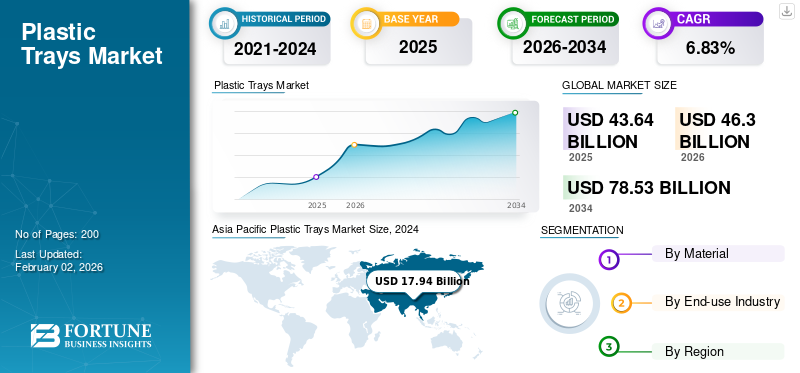
The global plastic trays market size was valued at USD 43.64 billion in 2025 and is projected to grow from USD 46.3 billion in 2026 to USD 78.53 billion by 2034, exhibiting a CAGR of 6.83% during the forecast period.
A plastic tray is a shallow receptacle, generally featuring a flat base and low edges, crafted from plastic. These trays serve many functions, ranging from serving meals to organizing and moving objects, and provide advantages such as durability, food safety, a lightweight structure, and affordability. The market is experiencing significant expansion in various sectors, such as food and beverage, pharmaceuticals, cosmetics, electronics, and consumer products. As e-commerce continues to surge, there is a growing demand for sturdy, protective, and stackable trays for shipping ready-to-eat meals, cosmetics, and delicate items, which is further fueling the market expansion.
- According to the International Trade Administration, global revenue from B2C e-commerce is projected to reach USD 5.5 trillion by 2027, with an ongoing compound annual growth rate of 14.4%. The major categories for B2C e-commerce, ranked in order, include consumer electronics, fashion, furniture, toys/hobbies, bio-health pharmaceuticals, media & entertainment, beverages, and food.
Download Free sample to learn more about this report.
Plastic Trays Market Key Takeaways
 Global Market Size & Forecast
- 2025 Market Size: USD 43.64 billion
- 2026 Market Size: USD 46.3 billion
- 2034 Forecast Market Size: USD 78.53 billion
- CAGR: 6.83% from 2026–2034
 Market Share
- Asia Pacific dominates the global plastic trays market share.
- Polypropylene (PP) is the dominating material segment of the market.
- The food and beverages segment dominated the market share in 2024.
 Key Regional Highlights
Asia Pacific
The leading regional market, driven by the expanding packaging industry, growing food retail and food service sectors, and increasing demand for sustainable packaging solutions across the region.
North America
The second-largest regional market, supported by strong demand for sustainable packaging and the growing consumption of ready-to-eat meals, fresh produce, and packaged food products.
Europe
Market growth is fueled by stringent packaging regulations, rising recycling initiatives, increasing sustainability awareness, and strong demand from the pharmaceutical sector.
U.S.
Growing demand for flexible plastic trays in food packaging, combined with the country's well-established flexible packaging industry, continues to support market expansion.
Japan
Demand is expected to grow steadily, supported by increasing adoption of high-quality, sustainable packaging solutions across the food and consumer goods industries.
Read More

MARKET DYNAMICS
MARKET DRIVERS
Growing Demand for Frozen, Ready-to-Eat, and Microwavable Meals Drives Market Growth
The growing need for frozen and microwavable ready-to-eat (RTE) meals is expected to boost the market for dual-ovenable trays and containers during the forecast period. This trend can be attributed to busy lifestyles and increasing urbanization. Consumers are seeking convenient meal options that require minimal preparation time. Major global food companies are tapping into this market to capitalize on the rising demand for ready-to-eat meals. Numerous areas experience a significant need for plastic trays in sectors such as ready-to-eat meals, fresh produce and meat packaging, and takeout and delivery services. The increase in meal kits, frozen meals, and pre-prepared foods necessitates the use of durable, lightweight, and temperature-resistant plastic trays, thus driving the global plastic trays market growth.
- Cafe Spice, a company based in New Windsor, N.Y., recognized for its ready-to-eat Indian meals for both food service and branded retail markets, disclosed its plans to adopt a more sustainable and eco-friendly retail packaging option, as stated by the company. The manufacturer declared that its retail product packaging will switch to clear polypropylene plastic trays. This update has begun to roll out to the market and will continue in the upcoming weeks.
MARKET RESTRAINTS
Increasing Environmental Awareness and Strict Regulatory Frameworks Impede Market Growth
The market for plastic trays, while strong due to its cost-effectiveness, lightweight features, and versatility across industries such as food and beverage, pharmaceuticals, and electronics, is encountering increasing challenges that could hinder its expansion. Rising environmental concerns and stringent regulations—such as the Europe Union’s Single-Use Plastics Directive aimed at disposable trays are leading to a global movement toward more sustainable alternatives to traditional plastics, which frequently come with higher prices and insufficient recycling plastic infrastructure. Additionally, manufacturers face the unpredictability of raw material costs, especially for petroleum-based resins including PET and polystyrene, which significantly impact profit margins. Henceforth, the growing environmental concerns and stringent regulatory frameworks hamper the market growth.
MARKET OPPORTUNITIES
Increasing Demand for Plastic Trays in Electronics Sector Will Offer Potential Growth Opportunities
The electronics industry continues to grow due to the rise in disposable income, the implementation of smart and interconnected products, the increase in e-commerce, and government support for domestic manufacturing. The demand for plastic trays in the electronics sector is experiencing significant growth, fueled by advancements in semiconductors, automation in manufacturing, and the need to safely transport delicate components. Plastic trays are essential in the electronics sector, mainly serving as Electrostatic Discharge (ESD) trays that safeguard delicate components. These trays are commonly utilized for packaging and distributing electronic items, ensuring their safe transport by dissipating damaging static charges and protecting components from physical damage. It thus offers lucrative growth opportunities to the market.
PLASTIC TRAYS MARKET TRENDS
Implementation of Smart Technologies into Trays Emerges as a Key Trend
The plastic tray market is undergoing a significant shift toward sustainable practices, customization, and the incorporation of advanced technologies. Consumers are increasingly on the lookout for environmentally friendly options, while brands are leveraging personalization to develop trays that meet individual preferences and requirements. Smart packaging solutions, such as QR codes and NFC chips, are gaining traction for enhancing customer interaction and monitoring the freshness of products. Technologies related to smart packaging, such as QR codes and NFC chips, provide means for tracking the freshness and authenticity of products. Increasingly adopting interactive features, including loyalty programs and access to product information, becoming possible with smart packaging, emerges a key trend in the growth of the tray packaging market.
Download Free sample to learn more about this report.
Segmentation Analysis
By Material
Remarkable Advantages Provided by Polypropylene Material Boost Segmental Growth
Based on material, the market is divided into polypropylene (PP), polyethylene terephthalate (PET), polystyrene (PS), polyvinyl chloride (PVC), and others.
Polypropylene (PP) is the dominating material segment of the market. Polypropylene (PP) trays provide numerous advantages for packaging, such as strength, resistance to moisture and chemicals, and recyclability. These qualities render PP trays appropriate for a wide range of uses, including food and beverages, pharmaceuticals, and e-commerce. Known for their capacity to endure substantial weight and resist damage, polypropylene trays are perfect for safeguarding products during both storage and transport, thus driving the segmental development.
Polyethylene terephthalate (PET) is the second-dominating material segment of the market. PET trays provide a variety of advantages for packaging, especially in the food sector. These trays are preferred for their ability to be recycled, durability, clarity, and capacity to preserve product freshness. They are widely used for meat packaging as they accommodate different cuts and effectively highlight the product.
By End-use Industry
Rising Utilization of Plastic Trays in Food Delivery Industry Drives Segment’s Growth
Based on end-use industry, the market is segmented into food & beverages, pharmaceuticals, electrical & electronics, consumer goods, and others.
The food and beverages segment dominated the market share in 2024. Growing consumer demand for ready-to-eat and convenience options, combined with the rise of food production, delivery and takeaway services and the proliferation of quick-service restaurants, is anticipated to propel the development of the dual-ovenable trays and containers market during the forecast period. Furthermore, advancements in packaging technologies, including improved heat resistance and eco-friendly materials, along with stricter environmental regulations, are projected to enhance the growth of this segment.
On the other hand, the pharmaceuticals segment is expected to witness steady growth during the forecast period. Trays offer numerous benefits in the pharmaceutical industry, particularly in relation to the efficient management, protection, and sterilization of pharmaceutical goods and equipment. It thus contributes to the segment’s expansion.
Plastic Trays Market Regional Outlook
By geography, the market is categorized into North America, Europe, Asia Pacific, and the Rest of the World.
Asia Pacific
Asia Pacific Plastic Trays Market Size, 2024 (USD Billion)
To get more information on the regional analysis of this market, Download Free sample
The Asia Pacific region dominates the global plastic trays market share. The region has seen considerable growth driven by the rapidly expanding packaging sector, the growth of food retail and food service industries, and rising consumer consciousness about sustainable packaging options across the region. The food service sector in the area is on the rise due to a boost in tourism, improved consumer lifestyles, and increased disposable income.
- As reported by the Food Export Organization, China's food industry saw steady expansion in 2022, with top companies reporting revenues of USD 1.3 trillion, which represents a 5.6% increase compared to the previous year. Additionally, China continues to import greater amounts of food ingredients.
North America
North America is the second-largest market. Sustainable development offers the greatest potential within the plastic tray packaging sector in the region. Moreover, the rapidly growing flexible packaging sector is also cushioning the market expansion. Increasing demand for ready-to-eat (RTE) meals, fresh or pre-cut fruits and vegetables, meats, and poultry necessitates the use of flexible plastic trays for packaging to ensure preservation, cleanliness, and visual appeal in the U.S. It thus drives the market growth in the U.S.
- According to the Flexible Packaging Association, flexible packaging ranks as the second largest segment in the U.S. packaging industry. The largest market for flexible packaging is food (both retail and institutional), representing roughly 50% of deliveries. Additional sectors for flexible packaging consist of pet food – 2%; personal care – 5%; beverages – 6%; other non-food items – 9%; industrial uses – 7%; consumer goods – 2%; and medical and pharmaceutical – 16%
Europe
Europe is a significant market for plastic trays. Government bodies and organizations' growing emphasis on decreasing the environmental impact and boosting packaging recycling drives market growth. The strict packaging regulations in the Europe Union, along with a heightened awareness of sustainability, encourage the adoption of biodegradable and recycled trays. Additionally, the pharmaceutical industry plays a role in the expansion of the market.
- For example, the research-driven pharmaceutical industry can play a crucial role in revitalizing Europe’s growth and ensuring its future competitiveness in an evolving global market. In 2023, it allocated around USD 54,110 million for R&D within Europe.
Latin America
The Latin America region is expected to observe considerable growth. The market for plastic trays, especially in Brazil, is witnessing significant growth, spurred by the booming e-commerce and retail industries, along with rising urbanization and industrial development. This demand is driven by the necessity for efficient, economical, and long-lasting storage and packaging options, especially within the food and beverage, logistics, and agricultural sectors.
Middle East & Africa
The Middle East and Africa region is expected to grow moderately in the coming years. The growing food and beverage industry, characterized by higher consumption of packaged items and convenience meals, significantly boosts the demand for plastic trays. Additionally, the expansion of the pharmaceutical sector, along with improvements in cold chain logistics, is increasing the need for durable and temperature-resistant plastic trays for the storage and transport of medications and medical equipment.
COMPETITIVE LANDSCAPE
Key Industry Players
Continuous Development and Introduction of New Products by Key Companies Resulted in their Dominating Positions
The global plastic trays market is concentrated with companies such as Amcor Plc, Berry Global Inc., Winpak Ltd., Pactiv Evergreen Inc., Sonoco Products Company, and Sealed Air accounting for a significant share. Amcor Plc and Berry Global Inc. are the leading manufacturers, accounting for the largest global market share.
Amcor is a global frontrunner in the creation and manufacturing of sustainable packaging solutions. The company collaborates with multiple sectors, such as food, beverage, pharmaceuticals, and home and personal care, to safeguard products and boost brand attractiveness. Amcor emphasizes innovation, sustainability, and a customer-focused approach, providing an extensive array of packaging options, including flexible packaging, rigid containers, specialty cartons, trays, and others.
Berry Global Group, Inc. is a prominent global provider of cutting-edge packaging solutions, recognized for its extensive array of products in rigid, flexible, and non-woven materials. Prioritizing sustainability and collaboration with customers, Berry strives to provide protective solutions that are lighter and more easily recyclable or reusable. The company functions in over 250 locations around the globe, catering to various markets such as healthcare, personal care, and food and beverage.
Additionally, ProAmpac and Placon are among the other prominent players in the market. Focus on significant investments in the research & development of innovative products has supported the cosmetic companies' share in the market and boosted the market expansion of glass cosmetics packaging.
- In July 2024, ProAmpac, a frontrunner in flexible packaging and material science, unveiled its cutting-edge ProActive Recyclable Fresh Tray FT-1000. This innovative, patent-pending tray made of polypropylene is designated as plastic #5 and is suitable for curbside recycling. It brings an easily recyclable, lightweight foam tray to the food service and grocery sectors.
LIST OF KEY PLASTIC TRAYS COMPANIES PROFILED
- Amcor Plc (Switzerland)
- Berry Global Inc. (U.S.)
- Winpak Ltd. (Canada)
- Pactiv Evergreen Inc. (U.S.)
- Sonoco Products Company (U.S.)
- Sealed Air (U.S.)
- VisiPak (U.S.)
- ProAmpac (U.S.)
- EasyPak (U.S.)
- Placon (U.S.)
- Envaplaster (Spain)
- Klöckner Pentaplast (U.K.)
- Tekni-Plex Inc. (U.S.)
- Universal Plastics Group, Inc. (U.S.)
- Swissplast AG (Switzerland)
KEY INDUSTRY DEVELOPMENTS
- July 2025: Klöckner Pentaplast (kp) introduced kp Elite Nova, an advanced modified atmosphere packaging (MAP) tray that is the lightest in its category. The tray features a distinctive ribbed design that enhances strength in key areas while minimizing weight and material usage. As a result, it is approximately 10% lighter than any other tray in its class, all without sacrificing barrier performance, sealing integrity, or mechanical strength.
- June 2025: Amcor collaborated with Cofigeo, a French manufacturer, to create a cutting-edge three-compartment ready meal tray. This eco-friendly packaging solution is designed with a lightweight mono-material polypropylene structure. The innovative tray features compartments of varying sizes to keep different ingredients separate, has a shelf life of 12 months at ambient temperature, and is produced using near-infrared terracotta masterbatch to aid in the identification of the material at recycling facilities.
- August 2024: Pactiv Evergreen Inc., a prominent producer of packaging solutions for fresh food and beverages in North America, is thrilled to introduce its new Recycleware Reduced-Density Polypropylene (RDPP) meat trays. The Recycleware RDPP meat trays from Pactiv Evergreen provide an ideal option for packer processors looking for substitutes to foam polystyrene.
- April 2024: Klöckner Pentaplast (KP) introduced food packaging trays made entirely of 100% recycled PET. This accomplishment represents a significant advancement in the packaging sector and showcases what can be achieved with the right blend of knowledge and technology. The majority of rPET in the material recycling loop originates from plastic bottles, but only 30% is utilized in food packaging trays, with the bulk of this not being recovered. Consequently, millions of tonnes of rPET tray material are discarded every year.
- January 2024: Amcor introduced customizable polypropylene barrier trays and lidding solutions that are ready for recycling. The Revolution polypropylene barrier trays provide improved sealability, longer shelf life, and an attractive product presentation, making them ideal for fresh and processed meats, plant-based proteins, poultry, and ready-to-eat meals. Enhance the food packages with our comprehensive range of high-quality lidding solutions.
REPORT COVERAGE
The global plastic trays industry analysis provides market size & forecast by all the segments included in the report. It details the market dynamics and Plastic Trays market trends expected to drive the market during the forecast period. It offers information on the utilization of Plastic Trays in key regions/countries, company profiles, industry developments, new product launches, and details on partnerships, mergers & acquisitions in key countries. It covers a detailed competitive landscape with information on the market share and profiles of key players.
Request for Customization to gain extensive market insights.
Report Scope & Segmentation
|
ATTRIBUTE |
DETAILS |
|
Study Period |
2021-2034 |
|
Base Year |
2025 |
|
Estimated Year |
2026 |
|
Forecast Period |
2026-2034 |
|
Historical Period |
2021-2024 |
|
Growth Rate |
CAGR of 6.83% from 2026-2034 |
|
Unit |
Value (USD Billion) |
|
Segmentation |
By Material
|
|
By End-use Industry
|
|
|
By Region
|
Frequently Asked Questions
Fortune Business Insights says that the global market value stood at USD 46.3 billion in 2026 and is projected to record a valuation of USD 78.53 billion by 2034.
In 2024, the market value stood at USD 17.94 billion.
The market is expected to grow at a CAGR of 6.83% during the forecast period.
The electrical and electronics segment led the market by end-use industry.
The key factor driving the market is the growing demand for frozen, ready-to-eat, and microwavable meals.
Amcor Plc, Berry Global Inc., Winpak Ltd., Pactiv Evergreen Inc., Sonoco Products Company, and Sealed Air are the top players in the market.
Asia Pacific dominated the market in 2024.
Increased demand for the easy transportation of food and electronic products is one of the factors that is expected to favor product adoption.



- 2021-2034
- 2025
- 2021-2024
- 200
-
(Offer valid till 15th Oct 2026)
Get 30-60 hrs Free Customization
Expand Regional and Country Coverage, Segments Analysis, Company Profiles, Competitive Benchmarking, and End-user Insights.












Related Reports
-
US +1 833 909 2966 ( Toll Free )
-
Get In Touch With Us