Polyurethane Dispersions Market Size, Share & Industry Analysis, By Product Type (Anionic, Cationic, Non-Ionic, and Others), By Application (Coatings, Adhesives & Sealants, Leather & Synthetic Leather, Textiles & Technical Fabrics, and Others), and Regional Forecast, 2026-2034
 Download Free Sample
POLYURETHANE DISPERSIONS MARKET SIZE AND FUTURE OUTLOOK
 Listen to Audio Version
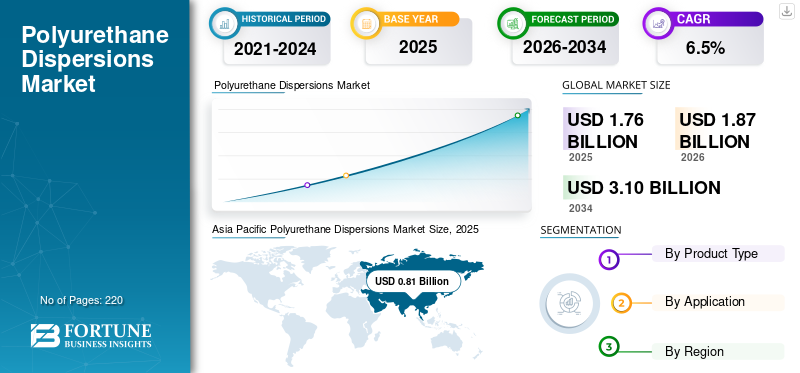
The global polyurethane dispersions market size was valued at USD 1.76 billion in 2025 and market is projected to grow from USD 1.87 billion in 2026 to USD 3.10 billion by 2034, exhibiting a CAGR of 6.5% during the forecast period. North america dominated the business aviation services market with a market share of 52.51% in 2025.
Polyurethane Dispersions (PUDs) are primarily water-based polyurethane resin systems in which polyurethane polymer particles are dispersed in water and used as film-forming binders in coatings, adhesives, leather finishing, synthetic leather, textiles, technical fabrics, packaging films, and specialty applications. They provide flexibility, abrasion resistance, adhesion, chemical resistance, soft-touch feel, and low-VOC performance compared with solvent-based polyurethane systems. A major demand driver is the increasing shift toward waterborne formulations, supported by stringent environmental regulations, brand sustainability targets, and rising adoption in automotive interiors, wood coatings, packaging, synthetic leather, and technical textiles.
Covestro, Wanhua Chemical, BASF, Lubrizol, and Allnex are the key players operating in the market.
Download Free sample to learn more about this report.
Polyurethane Dispersions Market Key Takeaways
 Global Market Size & Forecast
- 2025 Market Size: USD 1.76 Billion
- 2026 Market Size: USD 1.87 Billion
- 2034 Forecast Market Size: USD 3.10 Billion
- CAGR: 6.5% from 2026–2034
 Market Share
- North America dominated the market with a 52.51% share in 2025.
- The anionic segment held the dominant market share in 2025.
- The coatings segment accounted for the largest application market share in 2025.
 Key Regional Highlights
Asia Pacific
Asia Pacific reached USD 0.81 billion in 2025 and remained the largest and fastest-growing regional market.
North America led the global market with a 49.53% share in 2025.
North America maintained a leading position, supported by strong demand for low-VOC coatings and adhesive systems.
Europe
Europe witnessed steady growth, driven by sustainability regulations and increased adoption of water-based PUDs.
U.S.
The market reached USD 0.30 billion in 2025, accounting for approximately 17.0% of global sales.
Japan
The market reached USD 0.11 billion in 2025, representing approximately 6.3% of global sales.
Read More

POLYURETHANE DISPERSIONS MARKET TRENDS
Shift from Waterborne Binders toward Performance-Related Specialty Formulations is a Key Market Trend
The major trend in the market is the shift from standard waterborne binders toward specialty and hybrid PUD systems. Producers and formulators are increasingly focusing on UV-curable, bio-based, silicone-modified, acrylic-modified, polycarbonate-based, and high-performance polyurethane dispersions to improve durability, water resistance, scratch resistance, softness, and chemical resistance. This trend is especially visible in coatings, automotive interiors, synthetic leather, technical textiles, medical films, and packaging. The industry is moving beyond basic low-VOC positioning toward advanced performance differentiation, where PUDs are used to deliver both environmental compliance and premium end-use functionality.
MARKET DYNAMICS
MARKET DRIVERS
Download Free sample to learn more about this report.
Rising Focus on Environmental Regulations and Brand Sustainability Targets Fuels Market Growth
Market growth is attributed to the global transition from solvent-based resin systems to low-VOC, waterborne technologies. PUDs are gaining traction as they offer polyurethane-like flexibility, adhesion, abrasion resistance, chemical resistance, and soft-touch performance while reducing solvent emissions and improving workplace safety. Environmental regulations, brand sustainability targets, and customer preference for safer formulations are supporting PUD adoption across wood coatings, floor coatings, automotive interiors, leather finishing, synthetic leather, textiles, packaging, and industrial coatings. This shift is making PUDs an important material for formulators seeking both performance and sustainability benefits.
MARKET RESTRAINTS
Higher Cost and Formulation Complexity Limit Market Growth
The major restraint for the market is PUDs’ higher cost and formulation complexity compared with commodity waterborne binders such as acrylic emulsions and styrene-butadiene latexes. PUDs often require careful control of pH, particle size, viscosity, drying conditions, wetting, defoaming, and additive compatibility. In price-sensitive applications such as standard textiles, footwear, synthetic leather, and general coatings, customers may choose lower-cost alternatives unless PUDs provide a clear performance advantage. Water-based PUDs may also require crosslinkers or specialty additives to achieve higher water resistance, chemical resistance, or durability, increasing total formulation cost.
MARKET OPPORTUNITIES
Packaging, Automotive, and Technical Textiles Open Premium Growth Opportunities
A major opportunity lies in premium, high-performance applications where PUDs can replace solvent-based systems or upgrade lower-performing waterborne binders. Packaging films, mono-material flexible packaging, automotive interiors, technical textiles, breathable coatings, medical films, and specialty membranes are gaining popularity, as they require flexibility, adhesion, durability, low odor, and regulatory compliance. Asia Pacific offers volume-led growth through synthetic leather, textiles, footwear, packaging, and automotive supply chains, while Europe and North America offer premium growth in coatings, wood finishes, floor coatings, automotive interiors, and specialty adhesives. Advanced PUD grades can command stronger positioning where performance matters more than lowest cost. Thus, in turn, it benefits and drives the polyurethane dispersions market growth.
MARKET CHALLENGES
Matching Solvent-Based Performance Remains the Key Market Challenge
The central challenge for the PUD market is achieving solvent-based polyurethane performance in a water-based system. While PUDs offer strong environmental advantages, formulators still need to improve drying speed, early water resistance, chemical resistance, corrosion resistance, mechanical strength, and adhesion to difficult substrates such as low-energy plastics and films. These performance gaps can slow adoption in demanding coatings, packaging, adhesives, and industrial applications. The industry’s key challenge is to balance low-VOC compliance, cost, processability, and high performance without creating excessive formulation complexity or requiring major changes in customer production lines.
SEGMENTATION ANALYSIS
By Product Type
Anionic Segment to Lead Market Due to Its Broad Commercial Applicability
Based on the product type, the market is segmented into anionic, cationic, non-ionic, and others.
The anionic segment is anticipated to hold the dominant polyurethane dispersions market share during the forecast period. Demand for anionic PUDs is mainly driven by their broad commercial applicability, formulation stability, and cost-performance balance. They are widely used across coatings, adhesives, leather finishing, synthetic leather, textiles, and technical fabrics as they offer strong film formation, flexibility, abrasion resistance, and adhesion while remaining compatible with common water-based formulation systems. Their established production base, supplier availability, and proven performance make them the preferred choice for high-volume applications where customers need reliable performance without excessive formulation complexity.
The non-ionic segment is anticipated to rise with a CAGR of 6.8% over the forecast period. Demand for non-ionic PUDs is driven by the need for improved formulation compatibility, electrolyte stability, and performance consistency in more demanding applications. Non-ionic PUDs are preferred where ionic sensitivity can create stability issues, especially in coatings, specialty textiles, paper treatment, packaging films, and advanced adhesive systems. As formulators move toward complex, multi-additive, low-VOC systems, non-ionic PUDs are likely to gain importance as they can provide better compatibility with pigments, salts, crosslinkers, and functional additives while supporting premium performance requirements.
By Application
To know how our report can help streamline your business, Speak to Analyst
Low-VOC Performance Requirements to Fuel PUD Demand in Coatings
Based on the application, the market is segmented into coatings, adhesives & sealants, leather & synthetic leather, textiles & technical fabrics, and others.
The coatings segment is anticipated to hold the dominant market share during the forecast period. Demand for PUDs in coatings is primarily driven by the shift toward water-based, low-VOC coating systems that still deliver high performance. PUDs are increasingly used in wood coatings, floor coatings, plastic coatings, automotive interiors, and industrial coatings as they provide flexibility, abrasion resistance, adhesion, chemical resistance, and a premium surface appearance. As regulators, OEMs, and brand owners push for safer and more sustainable coatings, PUDs are gaining preference over solvent-based systems and lower-performance waterborne binders.
The adhesives & sealants segment is anticipated to rise with a CAGR of 6.6% over the forecast period. The need for flexible, durable, and low-emission bonding systems drives demand for PUDs in adhesives & sealants. PUD-based adhesives are used in footwear, packaging lamination, furniture, textiles, automotive interiors, and specialty assemblies where strong adhesion, elasticity, heat resistance, and substrate compatibility are important. Growth is supported by the replacement of solvent-based adhesives, rising demand for flexible packaging and laminated materials, and increasing customer preference for safer water-based adhesive technologies without sacrificing bond strength or processing performance.
POLYURETHANE DISPERSIONS MARKET REGIONAL OUTLOOK
By region, the market is segmented into North America, Europe, Asia Pacific, Latin America, and the Middle East & Africa.
Asia Pacific
Asia Pacific Polyurethane Dispersions Market Size, 2025 (USD Billion)
To get more information on the regional analysis of this market, Download Free sample
Asia Pacific is the largest and fastest-growing demand region for PUDs, driven by its strong manufacturing base in synthetic leather, textiles, footwear, packaging, coatings, automotive interiors, and consumer goods. China leads consumption due to scale, while India and Southeast Asia are expanding rapidly through footwear, textiles, and domestic manufacturing growth. Japan and South Korea support demand for higher-performance PUDs in automotive, electronics, films, and specialty coatings. The key regional driver is the combination of volume-led industrial growth and increasing adoption of water-based systems for sustainability and export-market compliance.
Japan Polyurethane Dispersions Market
Japan’s market was valued at approximately USD 0.11 billion in 2025, equivalent to around 6.3% of global sales.
China Polyurethane Dispersions Market
China’s market was valued at around USD 0.42 billion in 2025, representing roughly 23.9% of global sales.
India Polyurethane Dispersions Market
India’s market was valued at approximately USD 0.08 billion in 2025, equivalent to around 4.5% of global sales.
North America
Market growth in North America is primarily driven by the shift toward high-performance, low-VOC coating and adhesive systems. The region has strong consumption in wood coatings, floor coatings, industrial coatings, packaging adhesives, automotive interiors, and furniture applications, where customers require durability, abrasion resistance, flexibility, and regulatory compliance. Brand owners and manufacturers are increasingly replacing solvent-based systems with water-based alternatives to improve workplace safety and sustainability. The U.S. remains the key demand center, supported by advanced formulation capabilities and premium end-use applications.
U.S. Polyurethane Dispersions Market
The U.S. market was valued at around USD 0.30 billion in 2025, accounting for roughly 17.0% of global sales.
Europe
In Europe, demand for PUDs is strongly driven by environmental compliance and sustainability-led reformulation. Strict expectations around low-emission materials encourage the adoption of water-based PUDs in coatings, adhesives, automotive interiors, leather finishing, packaging, and technical textiles. European manufacturers also prioritize performance attributes such as chemical resistance, soft-touch feel, abrasion resistance, and durability, particularly in automotive, furniture, flooring, and industrial applications. Growth is supported by a mature but innovation-driven market, where PUDs are used to replace solvent-based systems while maintaining premium quality, regulatory alignment, and product differentiation.
U.K. Polyurethane Dispersions Market
U.K.’s market was valued at approximately USD 0.05 billion in 2025, equivalent to around 2.8% of global sales.
Germany Polyurethane Dispersions Market
Germany’s market was valued at USD 0.11 billion in 2025, equivalent to around 6.3% of global sales.
Latin America
Demand for PUDs in Latin America is mainly driven by growth in footwear, leather goods, furniture, packaging, construction coatings, and industrial coatings. Brazil represents the largest consumption base, supported by the leather, footwear, furniture, and coatings industries, while Mexico benefits from integration with North American automotive, packaging, and manufacturing value chains. The region is gradually shifting toward water-based coatings and adhesives as customers seek lower emissions, better worker safety, and improved product performance. Growth is supported by rising urbanization, consumer goods production, packaging demand, and the modernization of local formulation practices.
Brazil Polyurethane Dispersions Market
Brazil’s market was valued at approximately USD 0.06 billion in 2025, equivalent to around 3.4% of global sales.
Middle East & Africa
In the Middle East & Africa, demand for PUDs is driven by construction coatings, industrial coatings, packaging, furniture, textiles, footwear, and import-led specialty applications. Saudi Arabia and Gulf markets benefit from infrastructure activity, construction materials, and downstream formulation growth, while South Africa remains important for coatings, packaging, footwear, and industrial uses. The region as a whole is still at an early stage of water-based PUD adoption, creating room for gradual growth as manufacturers move toward safer, low-VOC materials. Demand is also supported by expanding packaging, urban development, and consumer-goods industries.
Saudi Arabia Polyurethane Dispersions Market
Saudi Arabia’s market was valued at approximately USD 0.02 billion in 2025, equivalent to around 1.1% of global sales.
COMPETITIVE LANDSCAPE
Key Industry Players
Market Witnesses Innovation-Led Competition as Producers Expand Specialty Waterborne Resin Portfolios
The global polyurethane dispersions industry is moderately consolidated, with large integrated chemical companies competing alongside specialized waterborne resin producers. Competition is shaped by product performance, application know-how, regional supply capability, sustainability positioning, and technical service rather than price alone. Leading players focus on low-VOC, high-solids, bio-based, hybrid, and specialty PUD grades for coatings, adhesives, leather, textiles, packaging, and automotive interiors. Asia Pacific is becoming increasingly important due to demand growth and local capacity expansion, while Europe and North America remain premium innovation centers. Top producers include Covestro, Wanhua Chemical, BASF, Lubrizol, and Allnex, among others.
LIST OF KEY POLYURETHANE DISPERSION COMPANIES PROFILED
- Alberdingk Boley GmbH (Germany)
- Allnex GMBH (Germany)
- BASF (Germany)
- Covestro AG (Germany)
- DIC CORPORATION (Japan)
- Lubrizol (U.S.)
- Mitsui Chemicals, Inc. (Japan)
- Stahl Holdings B.V. (Netherlands)
- UBE Corporation (Japan)
- Wanhua Chemical Group Co., Ltd. (China)
KEY INDUSTRY DEVELOPMENTS
- July 2025: Lubrizol introduced Sancure 942 Polyurethane Dispersion, a water-borne, high-solids PUD for advanced wood coatings. Designed for floor finishes and OEM applications, it offers strong wear protection, chemical resistance, adhesion, fewer coating layers, faster return to service, and sustainability benefits.
- October 2024: Stahl opened a new polyurethane dispersion manufacturing facility in Singapore to serve growing demand across Asia and the South Pacific. The facility will shorten lead times, strengthen regional supply, and support sustainability goals by expanding water-based coatings production while reducing solvent usage.
- July 2024: Jesons Industries and Alberdingk Boley partnered to expand polyurethane dispersion offerings in the Indian market. The collaboration will support coatings and adhesives customers with advanced PUD solutions, along with technical support and logistics services across multiple application areas.
- May 2024: Allnex launched UCECOAT 7701 BC, a MIT-free acrylated polyurethane dispersion for energy-curable pigmented wood furniture top-coats. Using a mass balance approach, the solution delivers fast reactivity, scratch and stain resistance, and combines waterborne sustainability with high-performance industrial coating durability.
- August 2023: Covestro completed construction on a new production facility for polyurethane dispersions (PUDs) in Shanghai, China. The company aims to supply mass-balanced, low-carbon-footprint PUDs in Asia Pacific, supplied from Shanghai and containing up to 80% alternative raw materials based on solids.
- September 2021: BASF and Sanyo Chemical signed an MoU to develop sustainable polyurethane dispersion (PUD) technologies jointly. The collaboration aims to accelerate water-based system adoption, improve product performance, reduce time-to-market, and leverage both companies’ global production networks to offer reliable, lower-carbon solutions globally.
REPORT COVERAGE
The global polyurethane dispersions market report provides a detailed analysis of the market. It focuses on key aspects such as profiles of leading companies, product types, and leading applications. Besides this, it offers insights into the analysis of key market trends and highlights key industry developments. In addition to the aforementioned factors, it encompasses several factors that have contributed to the growth of the market over recent years.
Request for Customization to gain extensive market insights.
Report Scope & Segmentation
| ATTRIBUTE | DETAILS |
| Study Period | 2021-2034 |
| Historical Period | 2021-2024 |
| Base Year | 2025 |
| Estimated Year | 2026 |
| Forecast Period | 2026-2034 |
| Unit | Volume (Kiloton), Value (USD Billion) |
| Growth Rate | CAGR of 6.5% during 2026-2034 |
| Segmentation | By Product Type, By Application, and By Region |
| By Product Type |
|
| By Application |
|
| By Region |
|
Frequently Asked Questions
Fortune Business Insights says that the global market size was USD 1.76 billion in 2025 and is projected to record a valuation of USD 3.10 billion by 2034.
In 2025, the market in Asia Pacific stood at USD 0.81 billion.
Registering a CAGR of 6.5%, the market will exhibit steady growth during the forecast period of 2026-2034.
The coatings application is expected to lead this market during the forecast period.
Rising focus on environmental regulations and brand sustainability targets is driving market growth.
Covestro, Wanhua Chemical, BASF, Lubrizol, and Allnex are the major players operating in the market.
Asia Pacific dominated the market share in 2025.



- 2021-2034
- 2025
- 2021-2024
- 220
Get 30-60 hrs Free Customization
Expand Regional and Country Coverage, Segments Analysis, Company Profiles, Competitive Benchmarking, and End-user Insights.


















-
US +1 833 909 2966 ( Toll Free )
-
Get In Touch With Us