Post-Harvest Treatment Market Size, Share & Industry Analysis, By Product Type (Coatings and Waxes, Fungicides, Cleaners, Sanitizers and Disinfectants, Ethylene Blockers and Ethylene Absorbers, and Others), By Form (Liquid and Powder), By Source (Synthetic and Natural), By Crop Type (Fruits [Citrus, Pome Fruits, Berries, Melons, and Others], Vegetables [Leafy Vegetables, Leguminous Vegetables, and Others], Roots & Tubers [Potatoes, Onions, Garlic, and Others], and Others), and Regional Forecast, 2026-2034
 Download Free Sample
(Offer valid till 30th Sep 2026)

Post-Harvest Treatment Market Size and Future Outlook
 Listen to Audio Version
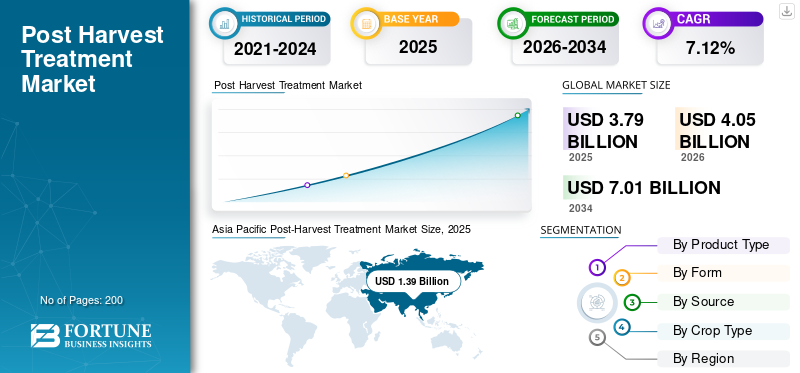
The global post-harvest treatment market size was valued at USD 3.79 billion in 2025 and is projected to grow from USD 4.05 billion in 2026 to USD 7.01 billion by 2034, exhibiting a CAGR of 7.12% during the forecast period. Asia Pacific dominated the post harvest treatment market with a market share of 50.92% in 2025.
Post-harvest treatments are solutions applied after harvesting to preserve the quality, shelf life, appearance, safety, and commercial value of fresh produce. These treatments include coatings and waxes, fungicides, cleaners, sanitizers and disinfectants, ethylene blockers and ethylene absorbers, and other specialty products used across fruits, vegetables, root crops, tubers, and bulb storage crops. They help control fungal decay, microbial contamination, moisture loss, sprouting, ripening-related deterioration, and quality losses during packing, storage, transportation, and retail distribution.
The strategic importance of post-harvest treatment is increasing as fresh produce supply chains become more global, export-oriented, and quality-sensitive. According to the Food and Agriculture Organization (FAO), global fruit and vegetable production reached 2.1 billion tons in 2023, increasing by 1% from 2022. This large horticulture production base creates strong demand for technologies that reduce spoilage, extend the shelf life, and preserve marketable quality across long-distance supply chains.
The global market demand is supported by leading post-harvest solution providers such as AgroFresh Solutions, Inc., DECCO Postharvest, JBT Marel Corporation, Xeda International, and Citrosol. These companies maintain active positions in post-harvest fungicides, coatings, sanitation systems, ethylene management, application technologies, and shelf-life extension solutions.
Download Free sample to learn more about this report.
Post Harvest Treatment Market Key Takeaways
 Global Market Size & Forecast
- 2025 Market Size: USD 3.79 billion
- 2026 Market Size: USD 4.05 billion
- 2034 Forecast Market Size: USD 7.01 billion
- CAGR: 7.12% from 2026–2034
 Market Share
- Asia Pacific dominated the post-harvest treatment market with a 50.92% share in 2025.
- The fungicides segment dominated the global market, valued at USD 2.20 billion in 2025.
- The ethylene blockers and ethylene absorbers segment is projected to grow at the fastest CAGR of 8.06% during 2026–2034.
 Key Regional Highlights
Asia Pacific
Asia Pacific led the market at USD 1.39 billion in 2025 and is projected to reach USD 2.77 billion by 2034.
North America
North America was valued at USD 0.92 billion in 2025 and is projected to reach USD 1.64 billion by 2034.
Europe
Europe was valued at USD 0.82 billion in 2025 and is projected to reach USD 1.42 billion by 2034.
U.S.
The market was valued at approximately USD 0.73 billion in 2025 and is projected to grow at a CAGR of 6.48% during 2026–2034.
Japan
The market is supported by demand for advanced post-harvest solutions that improve produce quality and shelf life.
Read More

Post-Harvest Treatment Market Trends
Increasing Shift Toward Antibiotic-Free Animal Nutrition to Shape Industry Trends
A major trend in the global market is the increasing focus on shelf-life extension, product appearance, and residue-compliant handling systems. Retailers, exporters, and distributors are placing stronger emphasis on reducing shrinkage, maintaining firmness, improving visual quality, and ensuring that fruits and vegetables meet food safety and residue standards across long supply chains. This is encouraging higher adoption of coatings, waxes, fungicides, sanitizers, cleaners, and ethylene-management products in commercial packhouses.
The market is also witnessing growing interest in natural-source and lower-residue post-harvest solutions. This trend is particularly visible in export-oriented fruits and vegetables, where buyers require compliance with country-specific maximum residue limits and private retailer standards. Rising consumer demand for safer, fresher, and residue-conscious produce is also encouraging the use of integrated treatment systems that maintain the shelf life of fruits without compromising food safety expectations.
- The Food and Agriculture Organization of the United Nations (FAO) reported that global food losses for fruits and vegetables increased from 23.2% in 2015 to 25.4% in 2023. Further, making them one of the highest-loss commodity groups due to perishability and handling requirements.
MARKET DYNAMICS
Market Drivers
Download Free sample to learn more about this report.
Rising Need to Reduce Post-harvest Food Losses to Support Market Growth
The global post-harvest treatment market growth is strongly supported by the rising need to reduce fresh produce losses after harvest. Fruits, vegetables, citrus, berries, melons, potatoes, onions, garlic, and leafy vegetables are highly perishable and vulnerable to fungal spoilage, physiological breakdown, water loss, sprouting, microbial contamination, and ethylene-related ripening. Post-harvest treatments help reduce these losses by controlling pathogens, maintaining surface quality, reducing respiration-related deterioration, and extending the commercial life of produce.
- According to the Food and Agriculture Organization (FAO), around 14% of the world’s food was lost after harvest and before reaching retail in 2019, representing approximately USD 400 billion per year in value. This statistic clearly indicates the economic importance of post-harvest loss reduction and supports demand for treatment solutions across fruits, vegetables, and storage crops. The increasing demand for fresh produce across urban retail, foodservice, and export markets further strengthens the need for reliable preservation technologies.
Market Restraints
Stringent Residue Regulations and Compliance Requirements to Limit Market Expansion
The growth of the market is being restrained by strict regulatory requirements related to pesticide residues, active ingredient approvals, food safety, and export-market compliance. Post-harvest fungicides and chemical treatments are often applied close to the final stages of the produce supply chain, making residue compliance a critical issue for exporters, packhouses, and retailers. Suppliers are required to provide product-specific safety data, application guidelines, residue studies, and technical documentation for different crops and geographies.
This challenge is particularly important for exporters that ship fruits and vegetables to markets with strict maximum residue limits. Regulatory differences across regions can increase compliance costs and create complexity for treatment suppliers and produce handlers. As a result, some packhouses may delay adoption of new chemical treatments unless residue performance, crop compatibility, and regulatory acceptance are clearly established. This restraint is also encouraging the development of natural-source coatings, biological treatments, and lower-residue alternatives.
- In the 2024 European Union report on pesticide residues in food, 9,842 samples were analyzed under the EU-coordinated Programme, with 1.2% found non-compliant. Under national sampling programmes, 86,449 samples were tested, with a 1.8% non-compliance rate.
Market Opportunities
Rising Demand for Natural and Export-oriented Post-harvest Solutions to Present Growth Opportunities
The rising demand for natural-source post-harvest treatments, edible coatings, bio-based sanitizers, and residue-conscious formulations is expected to create strong opportunities for market players. Fresh produce exporters are increasingly adopting solutions that help extend shelf life while meeting international buyer requirements. Natural coatings, plant-based formulations, and integrated post-harvest systems are gaining relevance as retailers and consumers become more focused on food safety, sustainability, and reduced chemical residues.
The opportunity is also supported by the economic value of the fresh produce sectors in major agricultural economies.
- According to the United States Department of Agriculture (USDA), the value of utilized production for U.S. vegetable crops reached USD 19.5 billion in 2023, with tomatoes, romaine lettuce, and carrots accounting for 34% of the utilized production value. This reflects strong commercial demand for quality-preservation solutions that reduce spoilage and maintain the demand for high quality fruits and vegetables in domestic and export channels.
SEGMENTATION ANALYSIS
By Product Type
Fungicides Segment Dominated the Market Due to Their Wide Use in Decay Control
Based on product type, the market is segmented into coatings and waxes, fungicides, cleaners, sanitizers and disinfectants, ethylene blockers and ethylene absorbers, and others.
The fungicides segment dominated the global market share, valued at USD 2.20 billion in 2025. Such growth is owing to their extensive use in controlling fungal decay, mold growth, citrus rot, storage diseases, and spoilage during transportation and storage. Fungal decay is one of the most common causes of quality deterioration after harvest, particularly during washing, grading, packing, cold storage, long-distance transportation, and retail distribution. Furthermore, the segment’s dominance is strongly supported by its broad application in high-value fruit categories such as citrus fruits, pome fruits, bananas, mangoes, berries, and stone fruits. Diseases such as green mold, blue mold, sour rot, anthracnose, grey mold, and stem-end rot can cause significant losses in these fruits if not effectively controlled.
The ethylene blockers and ethylene absorbers segment is projected to grow at the fastest CAGR of 8.06% during 2026-2034, supported by rising use in ripening control and shelf-life extension for climacteric fruits.
To know how our report can help streamline your business, Speak to Analyst
By Form
Liquid Segment Dominated the Market Due to Strong Use in Packhouse Application Systems
Based on form, the market is bifurcated into liquid and powder.
The liquid segment dominated the global post-harvest treatment market share and was valued at USD 3.02 billion in 2025. This growth is due to its widespread use in dips, drenches, sprays, waxing lines, sanitation systems, and automated packhouse application equipment. The segment is also expected to grow at a faster CAGR of 7.32% during 2026-2034. Liquid treatments are preferred in commercial fruit and vegetable handling as they provide uniform application, easy dilution, and strong compatibility with existing packhouse systems.
The powder segment was valued at USD 0.77 billion in 2025 and is projected to grow at a CAGR of 6.28% during the forecast period. The growth is supported by use in selected storage treatments, dry formulations, and applications where longer product stability and easier handling are required.
By Source
Synthetic Segment Dominated the Market Due to Strong Commercial Adoption
Based on the source, the market is segmented into synthetic and natural.
The synthetic segment dominated the global market and was valued at USD 2.83 billion in 2025. This growth is attributed to the widespread use of conventional fungicides, sanitizers, cleaners, coatings, and waxes across citrus, pome fruits, potatoes, onions, and other high-volume produce categories. The segment’s dominance is further supported by established efficacy, strong commercial adoption, and well-developed application protocols in packhouses and storage facilities.
The natural segment is projected to grow at the fastest CAGR of 8.40% during 2026-2034, increasing from USD 0.96 billion in 2025 to USD 1,982.69 billion by 2034.
By Crop Type
Fruits Segment Dominated the Market Due to High Treatment Intensity in Citrus and Pome Fruits
Based on crop type, the market is segmented into fruits, vegetables, roots & tubers, and others.
The fruits segment dominated the global market, valued at USD 2.27 billion in 2025. This growth is due to the high use of fungicides, coatings, waxes, cleaners, and ethylene-control products in citrus, apples, pears, berries, melons, and other export-oriented fruits. Within fruits, citrus dominated with USD 702.18 billion in 2025, supported by routine waxing, fungicide treatment, degreening, and long-distance shipment requirements.
The vegetables segment was valued at USD 0.82 billion in 2025 and is projected to grow at the fastest CAGR of 7.93% during the forecast period. This growth is supported by increasing use of sanitation and freshness-retention solutions.
Post-Harvest Treatment Market Regional Outlook
Regionally, the market is studied across North America, Europe, Asia Pacific, South America, and the Middle East & Africa.
North America
Asia Pacific Post-Harvest Treatment Market Size, 2025 (USD Billion)
To get more information on the regional analysis of this market, Download Free sample
North America market size was valued at USD 0.92 billion in 2025 and is projected to reach USD 1.64 billion by 2034, growing at a CAGR of 6.62% during 2026-2034. The growth is driven by advanced packhouse infrastructure, strong fresh fruit and vegetable distribution networks, and high adoption of fungicides, coatings, cleaners, sanitizers, and ethylene-management technologies.
U.S. Post-Harvest Treatment Market
The U.S. market dominated the North American market, valued at approximately USD 0.73 billion in 2025, and is estimated to record a CAGR of 6.48% during 2026-2034. The dominance is supported by large-scale specialty crop production, developed cold-chain networks, and strong use of post-harvest fungicides, coatings, and sanitizers in commercial fruit and vegetable handling.
Europe
The European market size was valued at USD 0.82 billion in 2025 and is projected to reach USD 1.42 billion by 2034, growing at a CAGR of 6.25% during 2026-2034. The region benefits from strong retail quality standards, export-oriented fruit and vegetable trade, and high awareness of food waste reduction.
Germany Post-harvest Treatment Market
The Germany market size was valued at approximately USD 0.13 billion in 2025, with an estimated CAGR of around 5.95% during 2026-2034. The growth is driven by the country’s organized fresh produce distribution system, strong retail structure, and demand for safe, residue-compliant post-harvest solutions in potatoes, apples, onions, and imported fruits.
U.K. Post-harvest Treatment Market
The U.K. market was valued at approximately USD 0.09 billion in 2025, with an estimated CAGR of around 5.13% during 2026-2034. The growth is supported by the country’s dependence on imported fresh produce, strict supermarket specifications, and rising demand for freshness-preserving technologies across retail supply chains.
Asia Pacific
Asia Pacific market size dominated the global market, valued at USD 1.39 billion in 2025, and is projected to reach USD 2.77 billion by 2034, growing at a CAGR of 8.06% during 2026-2034. The growth of the region is driven by expanding fruit and vegetable production, rising investments in cold-chain logistics, increasing exports of tropical fruits and vegetables. Higher use of post-harvest treatment technologies in China, India, Japan, Australia, and Southeast Asia further supports this growth.
China Post-harvest Treatment Market
China dominated the regional market, valued at approximately USD 0.58 billion in 2025, with an estimated CAGR of around 7.49% during 2026-2034. The growth is supported by the country’s large fruit and vegetable production base, expanding cold-chain infrastructure, and increasing adoption of coatings, fungicides, cleaners, and ethylene-control systems for domestic distribution and export channels.
South America and the Middle East & Africa
South America was valued at USD 0.46 billion in 2025 and is projected to reach USD 0.88 billion by 2034, growing at a CAGR of 7.43% during 2026-2034. Growth in the Latin America region is driven by strong fruit exports, citrus production, tropical fruit shipments, and increasing use of packhouse-level fungicide and coating systems in Brazil, Chile, Argentina, Peru, and other produce-exporting markets.
The Middle East & Africa market size was valued at USD 0.20 billion in 2025 and is projected to reach USD 0.30 billion by 2034, growing at a CAGR of 5.02% during 2026-2034. Such growth is supported by improving cold-chain infrastructure, rising fresh produce imports, and increasing use of quality-preservation technologies in citrus, dates, vegetables, and imported fruits. The region is expected to adopt such treatments gradually as organized retail, commercial farming, and export-oriented horticulture develop further.
Brazil Post-harvest Treatment Market
Brazil dominated the South American market, valued at approximately USD 0.27 billion in 2025, and is estimated to record a CAGR of around 7.67% during 2026-2034. The growth is supported by the country’s strong citrus, tropical fruit, potato, and vegetable production base, along with rising demand for post-harvest fungicides, coatings, sanitizers, and storage treatments in domestic and export supply chains.
COMPETITIVE LANDSCAPE
Key Industry Players
Key Players Focus on Shelf-life Extension, Residue Compliance, and Packhouse Integration
The competitive landscape of the global post-harvest treatment market is shaped by companies focusing on integrated solutions that combine fungicides, coatings, cleaners, sanitizers, ethylene management, application equipment, and digital monitoring systems. Product innovation is increasingly directed toward residue-compliant formulations, natural coatings, organic-compatible products, and precision dosing technologies.
Major key players in the market include AgroFresh Solutions, Inc., DECCO Postharvest, JBT Marel Corporation, Xeda International, and Citrosol. These companies are strengthening their portfolios through acquisitions, partnerships, product launches, and regional expansion to serve fruit and vegetable exporters, commercial growers, packhouses, and cold-chain operators.
The adoption of the global market size is expected to increase as producers, exporters, and retailers prioritize shelf-life extension, residue compliance, food safety, and quality retention across domestic and international fresh produce markets.
Key Players in the Market
|
Rank |
Company Name |
|
1 |
AgroFresh Solutions, Inc. |
|
2 |
DECCO Postharvest |
|
3 |
JBT Marel Corporation |
|
4 |
Xeda International |
|
5 |
Citrosol |
List of Key Post-Harvest Treatment Companies Profiled
- AgroFresh Solutions, Inc. (U.S.)
- DECCO Postharvest / UPL Group (Spain)
- JBT Marel Corporation (U.S.)
- Xeda International S.A. (France)
- Citrosol S.A. (Spain)
- Pace International LLC (U.S.)
- Fomesa Fruitech S.L.U. (Spain)
- Syngenta Group (Switzerland)
- Nufarm Limited (Australia)
- BASF SE (Germany)
KEY INDUSTRY DEVELOPMENTS
- September 2025: DECCO announced the expansion of its global footprint with a new plant in Valencia, Spain. The company stated that the facility supports customized coatings, decay-control products, sanitization and disinfection products, application technology, and on-site post-harvest services.
- July 2025: Fresh Inset Solutions introduced MaTri Powder, a high-purity 1-MCP post-harvest preservation product for the U.S. market. The product is aimed at apple growers, packers, and shippers and is applied in cold storage rooms to preserve freshness.
- May 2025: Biotalys and AgroFresh partnered to develop sustainable biological fungicides for post-harvest use. The collaboration targets fungal spoilage in fruits and vegetables and is relevant to the shift toward lower-residue and biological post-harvest fungicide solutions.
- January 2025: DECCO Ibérica received registration for DECCO Zox, described as the first azoxystrobin-based post-harvest citrus protection product registered in Europe. This strengthens DECCO’s position in the post-harvest fungicides segment and supports resistance-management strategies in citrus.
- September 2023: AgroFresh completed the acquisition of Tessara, a South Africa-based post-harvest solutions provider specializing in SO₂-generating sheets used to prevent decay in table grapes, berries, and flowers. This expanded AgroFresh’s reach in intelligent packaging and freshness protection for high-value fruit categories.
REPORT COVERAGE
The global industry report analyzes the market in depth and highlights crucial aspects such as global market trends, market dynamics, supply chains, prominent companies, investment in research and development, and end-use. Besides this, the report also provides insights into the global post-harvest treatment market analysis and highlights significant industry developments.
Request for Customization to gain extensive market insights.
Report Scope & Segmentation
| ATTRIBUTE | DETAILS |
| Study Period | 2021-2034 |
| Base Year | 2025 |
| Estimated Year | 2026 |
| Forecast Period | 2026-2034 |
| Historical Period | 2021-2024 |
| Growth Rate | CAGR of 7.12% from 2026 to 2034 |
| Unit | Value (USD Billion) |
|
Segmentation |
By Product Type
|
|
By Form
|
|
|
By Source
|
|
|
By Crop Type
|
|
|
By Region
|
Frequently Asked Questions
Fortune Business Insights says that the global market was valued at USD 3.79 billion in 2025 and is anticipated to reach USD 7.01 billion by 2034.
At a CAGR of 7.12%, the global market will exhibit steady growth over the forecast period.
By form, the liquid segment led the market.
Asia Pacific held the largest market share in 2025.
The rising need to reduce post-harvest food losses to support market growth.
AgroFresh Solutions, Inc., DECCO Postharvest, JBT Marel Corporation, Xeda International, and Citrosol are the leading players in the market.
Increasing shift toward antibiotic-free animal nutrition to shape industry trends.



- 2021-2034
- 2025
- 2021-2024
- 200
-
(Offer valid till 30th Sep 2026)
Get 30-60 hrs Free Customization
Expand Regional and Country Coverage, Segments Analysis, Company Profiles, Competitive Benchmarking, and End-user Insights.














Related Reports
-
US +1 833 909 2966 ( Toll Free )
-
Get In Touch With Us