 Download Free Sample



Get a Quote
Receive a tailored pricing based on your needs.
- Choose license type
- Multiple user options
- Custom scope & coverage
- Fast turnaround
"Designing Growth Strategies is in our DNA"
 Listen to Audio Version
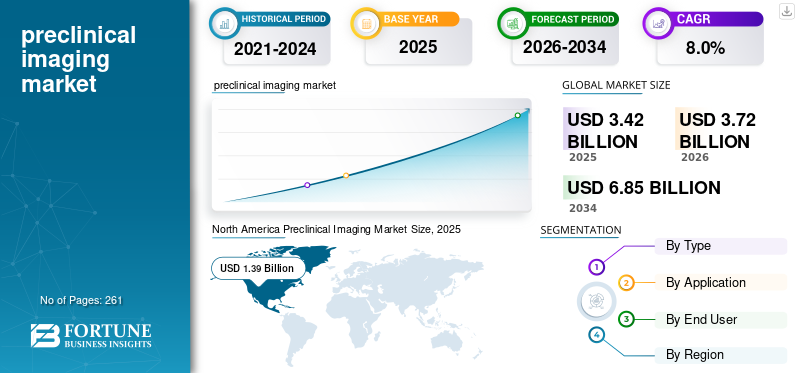
The global preclinical imaging market size was valued at USD 3.42 billion in 2025 and is projected to grow from USD 3.72 billion in 2026 to USD 6.85 billion by 2034, exhibiting a CAGR of 8.0% during the forecast period. North America dominated the preclinical imaging market with a market share of 40.64% in 2025.
Preclinical imaging is a non-invasive research and diagnostic technique that enables longitudinal monitoring of disease progression and therapeutic response, which is crucial for drug discovery and translational research. The rising prevalence of chronic diseases, including cancer, diabetes, and cardiovascular disorders, is further driving preclinical research and development and drug discovery activities, thereby boosting the adoption of preclinical imaging devices and software in the market. This, along with a growing number of clinical studies, is contributing significantly to the growth of the market.
Furthermore, increasing technological advancements, including improved spatial resolution and broader multimodal capabilities, are driving the focus of key companies, including FUJIFILM Corporation and Bruker, and are expected to support market growth.
Download Free sample to learn more about this report.
 Market Size & Forecast
 Market Share
 Key Regional Highlights
North America
North America maintained its leading position, reaching USD 1.39 billion in 2025.
Europe
Europe is projected to grow at a CAGR of 7.1% and reach USD 0.99 billion by 2026.
Asia Pacific
Asia Pacific is expected to reach USD 0.89 billion by 2026, making it the third-largest regional market.
U.S.
The market is projected to reach USD 1.35 billion by 2026, accounting for approximately 36.4% of global sales.
Japan
The market is estimated to reach USD 0.16 billion by 2026, representing around 4.2% of global revenues.
Read More

Expansion of Advanced Optical Imaging to Amplify Product Demand
Advanced optical imaging is emerging as a major trend in the market as researchers increasingly utilize fluorescence and bioluminescence imaging to study disease biology, monitor tumor growth, track cells, and evaluate therapeutic response in live small-animal models. The trend is primarily driven by the technology’s benefits in real-time imaging, non-invasive, high sensitivity, and compatibility with longitudinal study workflow.
Additionally, accessibility across different research settings, from large imaging setups to smaller biotech teams, makes optical imaging a practical molecular imaging tool for high-throughput preclinical studies. This, along with the growing focus of key companies on acquisitions and collaborations with other companies, is likely to fuel demand for the product.
Download Free sample to learn more about this report.
Rising Preclinical R&D and Drug Discovery Activity to Fuel Market Growth
The rising number of preclinical biomedical research and drug discovery activities is a major contributing factor to the growth of the global market. Pharmaceutical and biotechnology companies, contract research organizations, and academic institutes are focusing on investments in early-stage research to identify potential drug targets, evaluate therapeutic efficacy, and generate improved translational evidence before entering clinical trials. Along with this, increasing demand for preclinical imaging systems such as optical imaging, PET, SPECT, micro-CT, micro-MRI, and ultrasound is also expected to contribute to market growth, as these platforms enable researchers to monitor disease progression, biodistribution, and other critical parameters.
Additionally, continued growth in biopharma funding initiatives and increasing new drug approvals are leading sponsors to sustain or expand upstream research capacity. Therefore, the factors mentioned above, along with the growing focus of key companies towards R&D activities to launch innovative products, are anticipated to boost the adoption rate, thereby contributing to the global preclinical imaging market growth.
High Cost Associated with Technologically Advanced Systems and Software to Hamper Market Growth
There is a growing demand for these systems due to their advantages, including non-invasive operations and others. However, the high cost associated with technologically advanced equipment and software is anticipated to hamper the penetration rate for these systems, especially in developing countries, including Brazil, India, China, and others.
The high capital cost represents a huge expenditure, especially for mid-sized and small-sized healthcare facilities. Furthermore, additional costs associated with advanced imaging technologies, including periodic maintenance, software upgrades, or calibration of this equipment, further contribute to the financial burden.
Moreover, limited healthcare infrastructure, software, and maintenance expenses, along with financial sustainability, are expected to hamper the adoption rate of this technology in the market.
Technological Advancements to Create Market Opportunities
There is a growing focus on the incorporation of technological advancements in this equipment across the market. Technological advancements, including the integration of multimodal systems, AI-assisted imaging analysis, and others, are expanding access and utilization volumes for the identification and evaluation of potential drug candidates.
These innovations are improving study quality, enabling longitudinal study designs, and strengthening translational relevance from preclinical models to clinical development. At the same time, advancements in AI-enabled image reconstruction, radiomics, and multimodal imaging analysis are enhancing the quantification of complex datasets, which increases the value of imaging in oncology, cardiology, neurology, and infectious disease research. Therefore, these advancements are opening opportunities for companies and software providers to position premium devices around sensitivity, throughput, automation, and integrated analytics.
Limited Diagnosis in Developing Nations to Hamper Market Growth
There is an increasing focus on initiatives among governmental organizations to contribute to rising research and development activities in the biopharmaceutical sector. However, there is a limited availability of advanced devices, limited professional expertise and awareness, reduced utilization rates, coupled with inadequate research funding, especially in emerging countries.
In many lower-resource countries, the healthcare infrastructure is still underdeveloped, which slows procurement and makes it challenging for academic institutions, CROs, and research centers to justify investment in high-end preclinical systems, thereby limiting market growth.
Increasing Number of Preclinical Studies Fueled Hardware Segment Growth
Based on type, the market is classified into hardware and software. The hardware segment is further classified into instruments and consumables. Instruments are further subdivided into optical imaging, nuclear imaging, micro-MRI systems, micro-CT systems, ultrasound imaging, and others.
The hardware segment held the largest share in 2025. The growth is due to the increasing number of preclinical studies among researchers, resulting in a rising focus of key companies on launching novel systems.
To know how our report can help streamline your business, Speak to Analyst
The software segment is expected to grow at a CAGR of 8.5% over the forecast period.
Growing Prevalence of Chronic Conditions Boosted Oncology Segment Growth
Based on application, the market is segmented into oncology, cardiology, neurology, infectious diseases, and others.
The oncology segment held the dominant share of 38.3% in 2025 due to the rising prevalence of chronic conditions, including various forms of cancer. This results in a rising number of preclinical studies to study the potential candidate worldwide, thereby contributing to the adoption rate of these devices in the market.
The cardiology segment is set to flourish with a growth rate of 7.3% during the forecast period.
Increasing Number of R&D Activities Encouraged the Pharmaceutical and Biotechnological Segment Growth
Based on end user, the market is fragmented into pharmaceutical and biotechnology companies, academic & research institutes, Contract Research Organization (CRO), and others.
The pharmaceutical and biotechnology companies segment dominated the market in 2025. The increasing number of R&D activities, rising adoption of preclinical imaging devices and software, and the growing number of pharmaceutical and biotechnological companies are some of the crucial factors contributing to the growth of the segment in the market. Furthermore, the segment is set to hold an 42.4% share by 2026.
The Contract Research Organization (CRO) segment is projected to grow at a CAGR of 8.8% during the forecast period.
Based on region, the market has been studied across North America, Europe, Asia Pacific, Latin America, and the Middle East & Africa.
North America Preclinical Imaging Market Size, 2025 (USD Billion)
To get more information on the regional analysis of this market, Download Free sample
The North America market held the dominant share in 2024, valued at USD 1.29 billion, and also maintained its leading share in 2025, with USD 1.39 billion. The increasing prevalence of chronic conditions, growing number of preclinical studies, advanced healthcare infrastructure, technological advancements in preclinical imaging devices, and strong pharmaceutical R&D investments are some of the factors supporting the growth of the market.
Based on North America’s strong contribution and the U.S. dominance within the region, the U.S. market is expected to reach around USD 1.35 billion by 2026, accounting for roughly 36.4% of global sales.
Europe is projected to record a growth rate of 7.1% in the coming years, which is the second-highest among all regions. The region is likely to reach a valuation of USD 0.99 billion by 2026, supported by research institutions in the region.
The U.K. market is estimated at around USD 0.15 billion by 2026, representing roughly 4.1% of global revenues.
Germany’s market is projected to reach approximately USD 0.22 billion by 2026, equivalent to around 5.8% of global sales.
Asia Pacific is estimated to reach USD 0.89 billion by 2026 and secure the position of the third-largest region in the market. The fastest growth in preclinical studies, expanding healthcare capacity, and rising healthcare access are likely to support market growth. In the region, India is estimated to reach USD 0.10 billion by 2026.
The Japanese market is estimated at around USD 0.16 billion by 2026, accounting for roughly 4.2% of global revenues. Japan has historically reported a relatively growing number of preclinical studies, with a strong focus on the expansion of R&D facilities globally.
China’s market is projected to be one of the largest worldwide, with 2026 revenues estimated at around USD 0.29 billion, representing roughly 7.9% of global sales.
The Indian market is estimated at around USD 0.10 billion by 2026, accounting for roughly 2.7% of global revenues.
The Latin America and Middle East & Africa regions are expected to witness moderate growth in this market during the forecast period. The Latin America market is set to reach a valuation of USD 0.18 billion by 2026, driven by a gradual increase in public healthcare investment across the region.
The Middle East & Africa region is also expected to grow with a considerable growth rate due to rising R&D activities among key companies in the market. In the Middle East & Africa, the GCC is set to reach a value of USD 0.14 billion by 2026.
The South African market is projected to reach around USD 0.03 billion by 2026, representing roughly 0.8% of global revenues.
Key Players Focus on Launching New Devices to Boost Their Market Share
FUJIFILM Corporation and Bruker are the major companies in the market. A significant product portfolio, coupled with a strong focus on strategic initiatives worldwide, is one of the prominent factors supporting the dominance of these companies in the market. Moreover, the growing focus of key companies on the introduction of new devices is likely to boost their global preclinical imaging market share.
Other key players, including Revvity and others, are also growing in the market, primarily owing to their growing focus on acquisitions and collaborations among other players to strengthen their presence in the market.
The report provides a detailed global preclinical imaging market analysis and focuses on key aspects such as leading companies and market segmentation, including type, application, and end user. Besides this, the global report offers insights into the market growth trends and highlights key industry developments. In addition to the aforementioned factors, the report encompasses several factors that have contributed to the growth and advancement of the market over recent years.
Request for Customization to gain extensive market insights.
| ATTRIBUTE | DETAILS |
| Study Period | 2021-2034 |
| Base Year | 2025 |
| Estimated Year | 2026 |
| Forecast Period | 2026-2034 |
| Historical Period | 2021-2024 |
| Growth Rate | CAGR of 8.0% from 2026-2034 |
| Unit | Value (USD Billion) |
| Segmentation | By Type, Application, End User, and Region |
| By Type |
|
| By Application |
|
| By End User |
|
| By Region |
|
Fortune Business Insights says that the global market size was valued at USD 3.42 billion in 2025 and is projected to reach USD 6.85 billion by 2034.
In 2025, the North America regional market value stood at USD 1.39 billion.
Growing at a CAGR of 8.0%, the market will exhibit steady growth over the forecast period (2026-2034).
By type, the hardware segment led the market.
The introduction of novel devices is one of the major factors driving the market's growth.
FUJIFILM Corporation and Bruker are the major players in the global market.
North America dominated the market.
The growing number of preclinical studies is anticipated to drive the adoption of these products.

Get 30-60 hrs Free Customization
Expand Regional and Country Coverage, Segments Analysis, Company Profiles, Competitive Benchmarking, and End-user Insights.













.webp)






Related Reports
Get In Touch With Us
US +1 833 909 2966 ( Toll Free )
Receive a tailored pricing based on your needs.
Discuss your questions with our industry experts.
Have questions? Get quick answers before you purchase.

