Private Jet Charter Services Market Size, Share & Industry Analysis, By Range (Short-Haul, Medium-Haul & Long-Haul), By Business Model (Digital Charter Platforms, Traditional Charter Operators, Jet Card Providers, Fractional Ownership Operators & Aircraft Management Companies), By Service Type (On-Demand, Membership/Jet Card Programs, Fractional, Corporate, Air Ambulance/Medical & Cargo/Special Mission), By Application (Leisure Travel, Business, Sports & Entertainment, Government & VIP Transport, and Medical Evacuation & Emergency), and Regional Forecast, 2026-2034
 Download Free Sample
Private Jet Charter Services Market Size and Future Outlook
 Listen to Audio Version
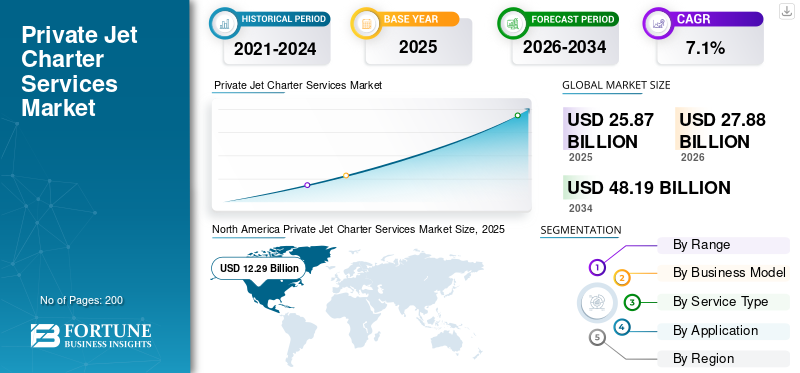
The global private jet charter services market size was valued at USD 25.87 billion in 2025 and is projected to grow from USD 27.88 billion in 2026 to USD 48.19 billion by 2034, exhibiting a CAGR of 7.1% during the forecast period. North America dominated the private jet charter services market with a market share of 47.51% in 2025.
The private jet charter services market represents a dynamic and rapidly evolving segment of the global aviation industry, catering to high-net-worth individuals, corporate executives, government officials, and time-sensitive travelers seeking superior flexibility, privacy, and comfort. The market is characterized by a diverse range of service models from on-demand charters and fractional ownership programs to jet card memberships and fleet subscriptions. Technological advancements in fleet modernization, digital booking platforms, and sustainable aviation fuel adoption are reshaping competitive dynamics. Growing preference for personalized travel experiences and increased demand for business aviation solutions continue to underpin strong expansion across both established and emerging markets globally.
Key players in the market include NetJets, VistaJet, Flexjet, Wheels Up, Air Charter Service, Air Partner, Jet Aviation, Luxaviation Group, flyExclusive, and GlobeAir. These companies compete through expansive global fleet networks, seamless digital booking platforms, fractional ownership and jet card programs, premium in-flight experiences, and tailored membership solutions. Their competitive edge is further defined by strategic partnerships with fixed-base operators, adoption of sustainable aviation fuels, robust safety certifications, and diversified service portfolios designed to serve corporate clients, ultra-high-net-worth individuals, leisure travelers, and government entities across intercontinental, transcontinental, and regional routes.
Download Free sample to learn more about this report.
Private Jet Charter Services Market Key Takeaways
 Global Market Size & Forecast
- 2025 Market Size: USD 25.87 billion
- 2026 Market Size: USD 27.88 billion
- 2034 Forecast Market Size: USD 48.19 billion
- CAGR: 7.1% from 2026–2034
 Market Share
- North America dominated the private jet charter services market with a 47.51% share in 2025.
- The medium-haul charter segment accounted for the largest market share in 2025.
- The traditional charter operators segment dominated the global market in 2025.
 Key Regional Highlights
North America
North America reached USD 12.29 billion in 2025 and remained the largest regional market.
Europe
Europe is projected to reach USD 7.08 billion in 2026, ranking as the second-largest regional market.
Asia Pacific was valued at USD 134.05 million in 2025 and is projected to grow at the fastest 8.48% CAGR through 2034.
Asia Pacific is projected to reach USD 4.92 billion in 2026, registering the highest regional CAGR of 8.0%.
U.S.
The market is estimated at USD 11.57 billion in 2026, supported by strong business aviation demand.
Japan
The market is estimated at USD 0.97 billion in 2026, expanding at a 7.3% CAGR during the forecast period.
Read More

PRIVATE JET CHARTER SERVICES MARKET TRENDS
Digital Transformation and Sustainability Initiatives are Reshaping Private Jet Charter Landscape
The market is undergoing a profound transformation driven by digitalization and growing environmental consciousness. Technology-enabled platforms offering instant quote generation, real-time fleet availability, and seamless booking experiences are redefining customer expectations. Simultaneously, operators are increasingly investing in sustainable aviation fuel and exploring hybrid-electric aircraft to reduce carbon footprints in response to regulatory pressures and eco-conscious clientele. The rise of empty-leg flight optimization, AI-driven demand forecasting, and in-flight connectivity upgrades are further distinguishing premium service providers. Additionally, the convergence of leisure and business travel often termed leisure is expanding the addressable market, attracting younger, tech-savvy high-net-worth travelers seeking bespoke aviation experiences.
MARKET DYNAMICS
MARKET DRIVERS
Download Free sample to learn more about this report.
Surging Demand for Flexible, Private, and Time-Efficient Air Travel among Corporate and High Net Worth Individuals to Drive Market Growth
Heightened demand for privacy, scheduling flexibility, and operational efficiency are the primary factors propelling the private jet charter services market growth. Corporate clients and ultra-high-net-worth individuals increasingly prioritize access to remote destinations, avoidance of commercial airport congestion, and the ability to conduct confidential meetings in transit. The proliferation of global business operations requiring rapid multi-city travel further amplifies charter demand. Additional drivers include the post-pandemic behavioral shift toward private aviation as a health and hygiene-conscious alternative, growing awareness of fractional ownership economics, and expanding fleet diversity enabling operators to match specific aircraft configurations to unique mission profiles from short regional hops to long-haul intercontinental journeys.
MARKET RESTRAINTS
High Operational Costs and Stringent Regulatory Frameworks Constrain Market Accessibility
The market faces significant restraints stemming from elevated operational expenditures, including aircraft maintenance, crew salaries, fuel costs, and airport handling fees, which collectively inflate service pricing beyond the reach of broader consumer segments. Stringent airworthiness regulations, pilot certification requirements, and cross-border operational permits create compliance burdens that particularly affect smaller charter operators seeking international route expansion. Insurance liabilities associated with high-value aircraft and passenger safety obligations further add to cost structures. Additionally, fluctuating aviation fuel prices introduce margin volatility, while limited availability of qualified aviation professionals constrains fleet expansion capacity, ultimately restricting the pace at which operators can scale services to meet rising demand.
MARKET OPPORTUNITIES
Expanding High Net Worth Individuals Population and Emerging Market Penetration Unlock Substantial Growth Potential
Significant growth opportunities exist within the market, particularly driven by the rapid expansion of the ultra-high-net-worth individual population across Asia Pacific, the Middle East, and Latin America. Increasing corporates adoption of charter services for executive travel, coupled with growing dissatisfaction with commercial airline reliability, presents operators with avenues to capture new customer segments. The rising popularity of fractional ownership models and flexible membership programs offers accessible entry points for first-time charter users. Furthermore, advancements in urban air mobility and very light jet technology are expected to open new short-haul and intra-city corridors, broadening market reach and stimulating demand from previously underserved regions and client demographics.
MARKET CHALLENGES
Environmental Scrutiny and Pilot Shortage Pose Structural Challenges to Long-Term Market Sustainability
The market faces structural challenges that threaten sustained growth trajectories. Intensifying environmental scrutiny from governments, advocacy groups, and the broader public has placed private aviation under significant reputational pressure, with increasing calls for carbon taxes, emissions caps, and operational restrictions on private flights. Simultaneously, a global shortage of qualified pilots exacerbated by retirements and flight school capacity constraints threatens operators' ability to maintain consistent service levels and expand fleets. Cybersecurity vulnerabilities within increasingly digitalized booking and operations platforms present additional risk vectors. Furthermore, geopolitical instability and evolving airspace access restrictions in conflict-affected regions periodically disrupt established charter routes, creating operational uncertainty for internationally active providers.
Segmentation Analysis
By Range
Growing Business Aviation Needs and Route Flexibility Fueled Demand for Medium-Haul Charter Segment
Based on range, the market is segmented into short-haul charter, medium-haul charter, and long-haul charter.
The medium-haul charter segment accounted for the largest private jet charter services market share in 2025. Demand for the segment is rising as corporate travelers and high-net-worth individuals increasingly seek efficient connectivity between major business hubs and secondary cities unreachable by direct commercial routes. Medium-haul charters offer the ideal balance between range capability, cabin comfort, and cost efficiency, making them a preferred choice for time-sensitive executive travel across intercontinental business corridors.
The long-haul charter segment is anticipated to rise with a CAGR of 6.9% over the forecast period.
By Business Model
Established Trust, Proven Safety Records, and Bespoke Service Standards Boosted Demand for Traditional Charter Operators Segment
Based on business model, the market is segmented into digital charter platforms/online brokers, traditional charter operators, jet card providers, fractional ownership operators, and aircraft management companies.
In 2025, the traditional charter operators segment dominated the global market. Demand for traditional charter operators remains resilient as discerning clients continue to value long-established safety reputations, personalized service culture, and deep operational expertise. Corporate accounts, government agencies, and loyal high-net-worth individuals favor traditional providers for complex, high-value missions requiring meticulous coordination, consistent crew familiarity, and guaranteed aircraft availability on critical travel schedules.
The digital charter platforms/online brokers segment is projected to grow at a CAGR of 7.9% over the forecast period.
By Service Type
Rising Preference for Flexible, Commitment-Free Travel Solutions is Accelerating Demand for On-Demand Charter Segment
Based on service type, the market is segmented into on-demand charter, membership/jet card programs, fractional charter services, corporate charter services, air ambulance/medical charter, and cargo/special mission charter.
The on-demand charter segment is anticipated to witness a dominating market share over the forecast period. Demand for the on-demand charter segment is surging as travelers increasingly prioritize booking flexibility without long-term contractual commitments. Digital platforms enabling instant aircraft availability checks, real-time pricing, and one-way empty-leg bookings have lowered access barriers significantly. Millennials, entrepreneurs, and spontaneous leisure travelers are driving adoption of on-demand services as a convenient alternative to rigid membership structures.
The membership/jet card programs segment is projected to grow at a high CAGR of 7.2% over the forecast period.
By Application
To know how our report can help streamline your business, Speak to Analyst
Post-Pandemic Corporate Travel Recovery and Productivity-Driven Aviation Preferences Expanded Demand for Business Travel Segment
Based on application, the market is segmented into leisure travel, business travel, sports & entertainment travel, government & VIP transport, and medical evacuation & emergency travel.
The business travel segment dominated the segmental market share in 2025. Demand for the business travel segment is strengthening as corporations resume global operations and prioritize executive time optimization. Private charter offers unparalleled productivity advantages confidential airborne meetings, direct routing to client locations, and elimination of commercial layovers. Multinational enterprises and SMEs managing cross-border teams increasingly justify charter expenditures as strategic operational investments rather than discretionary travel costs.
In addition, leisure travel segment is projected to grow at a CAGR of 7.8% during the forecast period.
Private Jet Charter Services Market Regional Outlook
By geography, the market is categorized into North America, Europe, Asia Pacific, and rest of the world.
North America
North America Private Jet Charter Services Market Size, 2025 (USD Billion)
To get more information on the regional analysis of this market, Download Free sample
North America held the dominant share in 2024, valuing at USD 11.53 billion, and also maintained the leading share in 2025, with USD 12.29 billion. The dominance is supported by a high concentration of ultra-high-net-worth individuals, mature corporate aviation culture, and an extensive network of private airfields facilitating seamless on-demand charter accessibility across the continent.
U.S. Private Jet Charter Services Market
Based on North America’s strong contribution and the U.S. dominance within the region, the U.S. market can be analytically approximated at around USD 11.57 billion in 2026, representing roughly 6.9% CAGR over the forecast period. The U.S. leads global demand, underpinned by the world's largest high net worth individual’s population, dense corporate headquarters concentration, and an unparalleled private airfield network enabling point-to-point charter connectivity across all fifty states.
Europe
Europe is estimated to reach USD 7.08 billion in 2026 and secure the position of second largest region in the market. Europe represents a significant and growing market, driven by strong intra-regional business travel demand, expanding high net worth individual’s population clusters in Western Europe, and increasing adoption of sustainable aviation practices among charter operators responding to stringent European Union environmental mandates.
U.K. Private Jet Charter Services Market
The U.K. market is estimated at around USD 1.73 billion in 2026, representing roughly 6.5% of CAGR over the forecast period. The U.K. sustains strong charter demand anchored by London's status as a global financial hub, robust intra-European business aviation needs, and growing leisure charter uptake among affluent British travelers favoring private access to Mediterranean and Caribbean destinations.
Germany Private Jet Charter Services Market
Germany’s market is projected to reach approximately USD 1.40 billion in 2026. Germany's market is driven by a powerful industrial and manufacturing corporate base, frequent executive travel requirements across European business centers, and growing demand from mid-sized enterprises seeking efficient private aviation alternatives to congested commercial airline routes.
Asia Pacific
Asia Pacific is projected to record a CAGR of 8.0% during the forecast period, which is the highest among all regions, and is set to reach a valuation of USD 4.92 billion by 2026. Asia Pacific is the fastest-growing regional market, propelled by rapid wealth creation in China, India, and Southeast Asia, rising awareness of private aviation benefits among new affluent demographics, and expanding private terminal infrastructure supporting charter operations at major regional airports.
China Private Jet Charter Services Market
China’s market is projected to be one of the largest in Asia Pacific, with 2026 revenues estimated at around USD 1.50 billion. China's private jet charter sector is expanding rapidly as domestic high net worth individual numbers surge, government modernization of general aviation infrastructure accelerates, and Chinese corporations increasingly leverage charter services for cross-border deal-making and executive mobility across Asia Pacific corridors.
Japan Private Jet Charter Services Market
The Japanese market is estimated at around USD 0.97 billion in 2026, accounting for roughly 7.3% of CAGR during the forecast period. Japan's market, while relatively nascent, is developing steadily driven by corporate demand for exclusive executive travel solutions, growing inbound luxury tourism supporting charter connectivity, and rising interest among Japanese HNWIs in fractional ownership and membership-based aviation programs.
India Private Jet Charter Services Market
The Indian market is estimated at around USD 0.86 billion in 2026. India's market is among the region's fastest expanding, fueled by a rapidly growing billionaire population, increasing corporate aviation adoption among technology and conglomerate sectors, and government investments in regional airport infrastructure enhancing private aviation accessibility nationwide.
Rest of the World
The rest of the world include Middle East & Africa and Latin America. These regions are expected to witness moderate growth in this market during the forecast period. The Middle East & Africa and Latin America market is set to reach a valuation of USD 1.63 billion and USD 1.01 billion in 2026. The growth is driven by sovereign wealth investments in aviation infrastructure, rising luxury tourism in Gulf States, and increasing corporate charter demand serving resource-sector business activities across emerging economies.
COMPETITIVE LANDSCAPE
Key Industry Players
Key Players Focus on Fleet Expansion, Flexible Access Models, and Premium Long-Range Charter Capacity to Boost Market Growth
The private jet charter services market is being strengthened by key players that are shifting competition from basic aircraft availability toward more flexible, scalable, and service-led private aviation models. Companies such as NetJets, VistaJet, Flexjet, Wheels Up, Air Charter Service, Air Partner, and Jet Aviation are focusing on fleet expansion, fractional ownership, jet card programs, on-demand charter platforms, aircraft management, premium long-haul capacity, and stronger global network coverage to capture rising demand from business travelers, high-net-worth individuals, leisure customers, sports teams, and government/VIP users. NetJets continues to anchor the market through its fractional ownership model, large private jet fleet, and global access positioning, while VistaJet is strengthening its premium charter proposition through a global private aviation model and versatile fleet coverage.
LIST OF KEY PRIVATE JET CHARTER SERVICES COMPANIES PROFILED IN REPORT
- NetJets (U.S.)
- VistaJet (Malta)
- Flexjet (U.S.)
- Wheels Up (U.S.)
- Air Charter Service (U.K.)
- Air Partner (U.K.)
- Jet Aviation (Switzerland)
- Luxaviation Group (Luxembourg)
- flyExclusive (U.S.)
- GlobeAir (Austria)
KEY INDUSTRY DEVELOPMENTS
- February 2025: Flexjet LLC placed a firm order for 182 Embraer aircraft, valued at around USD 7 billion, making it one of the most significant fleet expansion deals in the private aviation sector.
- January 2025: Qatar Executive strengthened its ultra-long-range charter offering by adding two Gulfstream G700 aircraft to its fleet, enhancing its capacity for premium long-haul private jet operations.
REPORT COVERAGE
This research offers a detailed analysis of emerging trends and rapidly adopted technologies in the industry across key regions. The report outlines key drivers of market growth and challenges to expansion, delivering a detailed overview of the industry landscape. The study highlights recent advancements to boost industry insights and support stakeholders in making well-informed decisions.
Request for Customization to gain extensive market insights.
Report Scope & Segmentation
| ATTRIBUTE | DETAILS |
| Study Period | 2021-2034 |
| Base Year | 2025 |
| Estimated Year | 2026 |
| Forecast Period | 2026-2034 |
| Historical Period | 2021-2024 |
| Growth Rate | CAGR of 7.1% from 2026-2034 |
| Unit | Value (USD Billion) |
| Segmentation | By Range, By Business Model, By Service Type, By Application, and By Region |
| By Range |
|
| By Business Model |
|
| By Service Type |
|
| By Application |
|
| By Region |
|
Frequently Asked Questions
According to Fortune Business Insights, the global market value stood at USD 25.87 billion in 2025 and is projected to reach USD 48.19 billion by 2034.
In 2025, the North Americas market value stood at USD 12.29 billion.
The market is expected to exhibit a CAGR of 7.1% during the forecast period of 2026-2034.
By medium-haul charter segment is expected to dominate the market.
Surging demand for flexible, private, and time-efficient air travel among corporate and high net worth individuals to drive market growth.
NetJets (U.S.), VistaJet (Malta), Flexjet (U.S.), Wheels Up (U.S.), and Air Charter Service (U.K.) are the top players in the market.
North America held the largest market share in 2025.



- 2021-2034
- 2025
- 2021-2024
- 200
Get 30-60 hrs Free Customization
Expand Regional and Country Coverage, Segments Analysis, Company Profiles, Competitive Benchmarking, and End-user Insights.




















Related Reports
-
US +1 833 909 2966 ( Toll Free )
-
Get In Touch With Us