Protein A Resins Market Size, Share & Industry Analysis, By Product (Agarose-Based Protein A, Glass/Silica-Based Protein A, and Organic Polymer-Based Protein A), By Format (Bulk Manufacturing Packs, Pre-packed Columns, and Others), By Source (Natural, Recombinant, and Others), By Application (Antibody Purification, Protein Purification, Plasma Fractionation, and Others), By End User (Pharmaceutical & Biotechnology Companies, CROS & CDMOs, Academic & Research Institutes, and Others), and Regional Forecast, 2026-2034
 Download Free Sample
Protein A Resins Market Size and Future Outlook
 Listen to Audio Version
The global protein A resins market size was valued at USD 1.79 billion in 2025. The market is projected to grow from USD 1.93 billion in 2026 to USD 3.75 billion by 2034, exhibiting a CAGR of 8.65% during the forecast period. North America dominated the protein a resins market with a market share of 39.66% in 2025.
Protein A resins are widely used in the downstream processing of various biopharmaceuticals as workhorse purification media, improving consistency and reducing the risk of impurities carrying forward. With expanding biologics pipelines, the market is poised for significant growth.
Emphasizing these key drivers, many companies are investing in the market and launching innovative products to scale their operations and strengthen their market position.
- For instance, in June 2024, Ecolab collaborated with Repligen Corporation and launched Purolite’s DurA Cycle, a protein A chromatography resin for large-scale purification processes. The development further solidifies the company’s dedication to advancing the bioprocessing industry. Such developments are expected to boost overall growth in the market.
Furthermore, leading players in the industry, such as Thermo Fisher Scientific Inc., Bio-Rad Laboratories, Inc., and Cytiva, are directing their resources toward research and development, expanding their offerings, and strengthening their market positions.
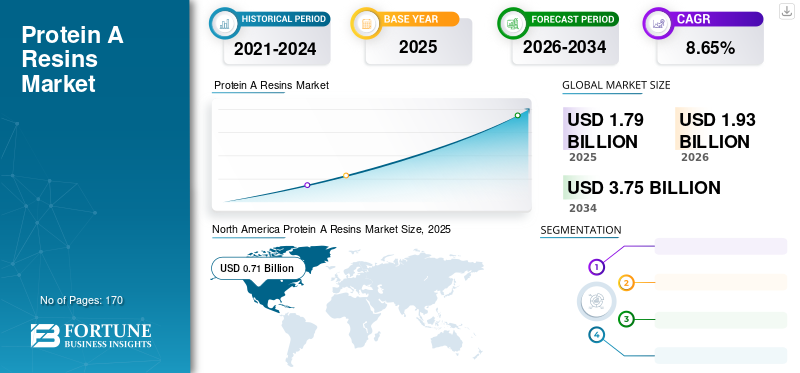
Download Free sample to learn more about this report.
PROTEIN A RESINS MARKET Key Takeaways
 Market Size & Forecast
- 2025 Market Size: USD 1.79 billion
- 2026 Market Size: USD 1.93 billion
- 2034 Forecast Market Size: USD 3.75 billion
- CAGR: 8.65% from 2026–2034
 Market Share
- North America dominated the protein A resins market with a market share of 39.66% in 2025.
- The organic polymer-based protein A segment is expected to witness strong growth with a CAGR of 12.56% during the forecast period.
- The pre-packed columns segment is projected to expand at a CAGR of 10.46% over the forecast period.
 Key Regional Highlights
North America
North America held the dominant share in 2024 at USD 0.66 billion and maintained its leading position in 2025 at USD 0.71 billion, supported by increasing antibody production capacity and growing clinical trial activities.
Europe
Europe is projected to grow at 7.96% over the coming years and reach a valuation of USD 0.47 billion by 2026, driven by the expansion of biologics manufacturing hubs and ongoing process intensification to improve plant productivity.
Asia Pacific
Asia Pacific is projected to attain USD 0.57 billion in 2026, supported by rising biologics manufacturing capacity and the commercialization of monoclonal antibody therapies.
U.S.
The U.S. protein A resins market is estimated at USD 0.70 billion in 2026, accounting for approximately 36.36% of the global market, driven by strong biopharmaceutical research and manufacturing activities.
Japan
The Japanese market is estimated to reach USD 0.14 billion in 2026, representing approximately 7.19% of the global market, supported by ongoing investments in biologics development and production infrastructure.
Read More

PROTEIN A RESINS MARKET TRENDS
Rising Adoption of Alkali-Tolerant (high-CIP) Protein A for Longer Resin Lifetime is Observed as Market Trend
One prominent global market trend is the increasing adoption of engineered, alkali-tolerant (high-CIP) Protein A resins. Bio manufacturers need to run more batches with the available assets while controlling the cost per gram. Buyers are shifting toward engineered Protein A ligands, as they offer more robust resin designs that can withstand harsh, repeated CIP while maintaining capacity stability, thereby extending resin lifetime, reducing changeovers, and improving manufacturing continuity. Underscoring these advantages, particularly in large-scale mAb production, adoption is rising. As global demand for the product rises, key companies are directing resources toward new product launches and strengthening their market positions.
- For instance, in September 2024, JSR Life Sciences, a JSR Group company, launched its next-generation protein A chromatography resin, Amsphere A+. Such developments are expected to boost market growth.
Download Free sample to learn more about this report.
MARKET DYNAMICS
MARKET DRIVERS
Rising Monoclonal Antibody Production Volumes to Fuel Market Growth
Rising monoclonal antibody (mAb) production volumes are a key market driver for the product growth. Protein A is the standard first purification step for most IgG mAbs, so resin demand increases directly as more batches are synthesized. As antibody production moves towards commercial manufacturing, producers need repeatable, high-throughput apprehension to keep up with higher facility utilization.
Additionally, higher upstream titers push downstream teams to process larger product loads faster, increasing the need for high-capacity, durable Protein A resins to maintain productivity and control cost per gram. Various key companies are focusing on expanding their biologics manufacturing capacity, which indirectly boosts product consumption and market growth.
- For instance, in April 2025, Merck & Co., Inc., started the construction of a biologics center of excellence in Wilmington, Delaware. The center comprised laboratory, manufacturing, and warehouse capabilities to enable commercial production of biologics and therapies, including potent antibody-drug conjugates (ADCs). Such expanded antibody production capacity will indirectly also drive the global protein A resins market growth.
MARKET RESTRAINTS
High Cost of Protein A Resin Per Study to Restrict Market Growth
High resin costs are restraining the growth of the market. Protein A capture media is one of the most expensive consumables in an antibody purification process. When companies are in early clinical stages or running only a few batches, they often cannot utilize the whole cycle life, which makes the cost per batch appear disproportionately high and delays purchase decisions. This pushes manufacturers to prolong resin use or evaluate alternative capture strategies. Such factors can lead to slower adoption, especially for smaller biotechnology companies with tighter budgets.
- For instance, in April 2025, Cytiva published a blog post stating that protein A resin costs can be a concern in early clinical stages, where only a few batches are produced and the resin's lifetime cannot be fully utilized.
MARKET OPPORTUNITIES
Expanding Biologics Manufacturing Capacity to Offer Market Growth Opportunity
Expanding biologics manufacturing capacity creates a direct growth opportunity for the market. Most commercial monoclonal antibody (mAb) processes rely on Protein A capture as the core first purification step. When pharmaceutical companies add new bioreactors or scale to larger single-use processes, they must also expand downstream throughput to avoid purification bottleneck. Such developments result in more protein A columns, more resin volume per campaign, and higher repeat purchases to support the growth of the global market.
- For instance, in May 2025, Bora Biologics expanded its FDA-registered San Diego biologics manufacturing facility, adding upstream and downstream GMP processing capabilities to meet rising demand for 2000L-scale single-use biologics manufacturing. Such developments increase protein A resin consumption for antibody purification and offer market growth opportunities.
MARKET CHALLENGES
Resin Lifetime Variability Poses a Critical Challenge to Market Growth
Resin lifetime variability is a significant market challenge for market growth, as protein A columns do not age predictably, even when the same resin is used. In practice, slight differences in feed quality, upstream changes, loading strategy, flow conditions, and cleaning discipline can cause uneven fouling and a gradual loss of binding capacity, resulting in fewer cycles achieved. When lifetime becomes uncertain, manufacturers build in extra safety margins, such as earlier resin replacement, tighter monitoring, and more frequent cleaning studies, which further increase costs.
- For instance, in November 2025, BioPhorum published guidance on microbial control and remediation of Protein A chromatography resin, noting that contamination/bioburden events can occur and that remediation effectiveness often depends on event-specific factors, such as organism type, column location, and others.
Segmentation Analysis
By Product
Proven Efficiency of Agarose-Based Protein A to Lead Segmental Growth
Based on product, the market is categorized into agarose-based protein A, glass/silica-based protein A, and organic polymer-based protein A.
Among these, the agarose-based protein A segment accounted for a substantial share in the global market in 2025. Agarose-based protein A is proven to be the most efficient matrix for large-scale mAb capture. As mAb plants scale up, they prioritize resins that deliver consistent performance across multiple batches and are widely accepted by regulators. Agarose backbones also support high flow and robust packing in large columns, helping plants maintain throughput and avoid bottlenecks. These advantages make agarose-based protein A the default choice for most commercial antibody-capture steps worldwide. Highlighting these advantages, numerous key companies are launching new products to support market growth.
- For instance, in February 2024, Purolite, an Ecolab company and manufacturer of synthetic and agarose-based bioprocessing resins, collaborated with Repligen Corporation to launch Praesto CH1, a new 70 μm (micron) agarose-based affinity protein A resin designed to purify specialized mAbs, such as bispecific and recombinant antibody fragments. Such developments are expected to drive the segment's growth.
The organic polymer-based protein A segment is expected to grow at a CAGR of 12.56% over the forecast period.
To know how our report can help streamline your business, Speak to Analyst
By Format
Large-scale Consumption by Bulk Manufacturing to Lead Segmental Growth
Based on format, the market is segmented into bulk manufacturing packs, pre-packed columns, and others.
In 2025, bulk manufacturing packs dominated the market as high-volume mAb purification was run in large, fixed downstream suites, where the economic drivers were the lowest cost per gram and the ability to scale column sizes to commercial demand. Buying resin in bulk allows manufacturers and CDMOs to reuse it across multiple cycles, spreading the high upfront cost. As commercial biologics volumes rose, the purchasing center shifted toward bulk resin procurement to control COGS and ensure supply continuity. These advantages, along with strategic collaborations, support growth.
- For instance, in November 2020, Purolite Ltd., a manufacturer of resin-based separation, purification, and extraction technologies, collaborated with WuXi Biologics to supply its Protein A capture resin, Praesto Jetted A50, for immediate use in a range of downstream monoclonal antibody purification processes. These factors lead to high utilization and reinforce the growth of the bulk segment.
The pre-packed columns segment is projected to grow at a CAGR of 10.46% during the forecast period for the global market.
By Source
Advantages Exhibited by Recombinant Protein A Resin to Drive Segmental Growth
Based on the source, the market is segmented into natural, recombinant, and others.
The recombinant segment accounted for the largest share of the global market. The dominant share is attributed to the segment, as biopharmaceutical manufacturers need consistent quality and lot-to-lot performance. Recombinant production reduces variability associated with natural sourcing and supports tighter control over ligand identity and impurity profiles. These advantages help with regulatory documentation and comparability. It also offers a longer lifetime, improving the cost per batch. Additionally, the innovative product launches for recombinant protein A resin reinforce the segment's dominance.
- For instance, in March 2020, Avantor, Inc. launched a new recombinant Protein A affinity chromatography resin used to purify antibodies during mAbs production.
In addition, the natural segment is projected to grow at a CAGR of 7.89% during the study period.
By Application
Increasing Antibody Production to Fuel Demand for Antibody Purification and Boost Segmental Growth
Based on the application, the market is segmented into antibody purification, protein purification, plasma fractionation, and others.
In 2025, antibody purification dominated the market by application. Protein A resins are primarily designed for the capture step of IgG monoclonal antibodies and Fc-containing proteins. As more mAbs and biosimilars move through clinical and commercial manufacturing, the demand for protein A resin for purification also rises. Plants also standardize on platform purification processes for antibodies, reinforcing the need for recurring resin purchases. The large volume of antibody programs and platform manufacturing makes antibody purification the core application for the product worldwide.
- For instance, in January 2025, Bio-Rad Laboratories, Inc. launched Nuvia wPrime 2A Media, an AEX-HIC mixed-mode resin. Bio-Rad's partners collaborated on the development of the resin. They successfully removed host cell proteins, high- and low-molecular-weight aggregates, impurities, and DNA from monoclonal and bispecific antibodies, and adeno-associated virus.
In addition, the protein purification segment is projected to grow at a CAGR of 8.87% during the study period.
By End User
Growing Demand Due to High Volume Manufacturing to Place Pharmaceutical & Biotechnology Companies in Leading Position
Based on the end user, the market is segmented into pharmaceutical & biotechnology companies, CROS & CDMOs, academic & research institutes, and others.
In 2025, pharmaceutical & biotechnology companies dominated, accounting for the largest share of commercial mAb portfolios responsible for validation and high-volume manufacturing. Due to these factors, these pharmaceutical & biotechnology companies consume the most Protein A resin. Additionally, they also invest in process optimization, which increases spend on high-performance Protein A platforms. Underscoring these advantages, many major companies are launching innovative products to meet market demand.
- For instance, in August 2025, Bio-Works Technologies AB launched WorkBeads affimAb Edge, a premium resin for the purification of monoclonal antibodies (mAbs). The product is designed to meet the high demands of the rapidly growing biopharmaceutical industry and strengthens Bio-Works’ position in the protein A resin market.
The CROS & CDMOs segment is projected to grow at a 10.61% CAGR during the study period.
Protein A Resins Market Regional Outlook
By region, the market is categorized into Europe, North America, Asia Pacific, Latin America, and the Middle East & Africa.
North America
North America Protein A Resins Market Size, 2025 (USD Billion)
To get more information on the regional analysis of this market, Download Free sample
North America held the dominant share in 2024 at USD 0.66 billion and maintained its leading position in 2025 at USD 0.71 billion. The market in North America is expected to grow significantly over the forecast period, driven by increased antibody production capacity, research and development, and rising clinical trials. Such factors are further boosting demand for downstream processing in the region.
U.S. Protein A Resins Market
Based on North America’s substantial contribution and the U.S. dominance in the region, the U.S. market can be estimated at around USD 0.70 billion in 2026, accounting for roughly 36.36% of the global market.
Europe
Europe is projected to grow at 7.96% over the coming years, the second-highest among all regions, and reach a valuation of USD 0.47 billion by 2026. The area is expected to experience robust growth driven by the expansion of biologics manufacturing hubs and ongoing process intensification to improve plant productivity.
U.K. Protein A Resins Market
The U.K. market in 2026 is estimated at around USD 0.07 billion, representing roughly 3.77% of the global market.
Germany Protein A Resins Market
Germany’s market is projected to reach approximately USD 0.12 billion in 2026, equivalent to around 6.30% of the global market.
Asia Pacific
Asia Pacific is estimated to reach USD 0.57 billion in 2026 and secure the position of the third-largest region in the market. The expanding biologics capacity and scale in the area, which are driving more mAbs from clinical to commercial stage, are driving market growth.
Japan Protein A Resins Market
The Japanese market in 2026 is estimated to be around USD 0.14 billion, accounting for approximately 7.19% of the global market.
China Protein A Resins Market
China’s market size is projected to be one of the largest worldwide, with 2026 revenues estimated at around USD 0.19 billion, representing approximately 9.96% of global sales.
India Protein A Resins Market
The Indian market value in 2026 is estimated at around USD 0.05 billion, accounting for roughly 2.43% of global revenue.
Latin America and the Middle East & Africa
Latin America and the Middle East & Africa regions are expected to witness moderate growth in this market space during the forecast period. The Latin America market is set to reach a valuation of USD 0.08 billion in 2026. The region is experiencing market growth driven by increased government support. In the Middle East & Africa, the GCC is set to reach USD 0.02 billion in 2026.
South Africa Protein A Resins Market
The South African market is projected to reach approximately USD 0.01 billion by 2026, accounting for roughly 0.35% of the global revenue.
COMPETITIVE LANDSCAPE
Key Industry Players
Focus on New Product Launches by Key Players to Propel Market Progress
The global market is highly consolidated, with key companies such as Thermo Fisher Scientific Inc., Bio-Rad Laboratories, Inc., GenScript, TransGen Biotech Co., Ltd., and Merck KGaA holding substantial protein A resins market share. Strategic partnerships, acquisitions, new product launches, and increasing demand, along with investment opportunities, will fuel the growth of these companies.
- For instance, in October 2025, Merck KGaA expanded its protein A capabilities through the acquisition of JSR’s Life Sciences chromatography business, such developments aimed to drive market growth.
Other notable players in the global market include Cytiva, IPSUM LIFESCIENCES LLP, Avantor, Inc., Agilent Technologies, Inc., and Ecolab. These companies are expected to prioritize strategic collaborations and new product launches to strengthen their positions during the forecast period for the global market.
LIST OF KEY PROTEIN A RESINS COMPANIES PROFILED
- Thermo Fisher Scientific Inc. (U.S.)
- Bio-Rad Laboratories, Inc. (U.S.)
- GenScript (China)
- TransGen Biotech Co., Ltd. (U.S.)
- Merck KGaA (Germany)
- Cytiva (U.K.)
- IPSUM LIFESCIENCES LLP (India)
- Avantor, Inc. (U.S.)
- (Japan)
KEY INDUSTRY DEVELOPMENTS
- June 2025: Ecolab Life Sciences launched a new resin, Purolite AP+50, to help achieve cost savings and optimize operations throughout the antibody manufacturing process.
- April 2025: Cytiva's expanded resin portfolio to support advances in the mAb and biosimilar markets with the launch of MabSelect SuRe 70 and MabSelect PrismA X resins and set new standards in affordability and productivity.
- October 2024: Sartorius AG launched Sartobind Rapid A Lab, featuring a Protein A matrix that offers a groundbreaking affinity chromatography unit to transform antibody purification processes.
- November 2022: Repligen Corporation extended its long-term supply agreement with Purolite, an Ecolab Company, for the development and manufacturing of affinity ligands focused on monoclonal antibodies and antibody fragments.
- March 2020: Avantor, Inc. launched a new recombinant Protein A affinity chromatography resin used to purify antibodies during mAbs production.
REPORT COVERAGE
The global protein A resins industry analysis includes a comprehensive study of the market size & forecast across all market segments included in the report. It contains details on the market dynamics and trends expected to drive the global market over the forecast period. It provides information on key aspects, including technological advancements, the regulatory environment, and product launches. Additionally, it details partnerships, mergers & acquisitions, and key industry developments. The global market research report also provides a detailed competitive landscape, including market share and profiles of key operating players.
Request for Customization to gain extensive market insights.
Report Scope & Segmentation
|
Study Period |
2021-2034 |
|
Base Year |
2025 |
|
Forecast Period |
2026-2034 |
|
Historical Period |
2021-2024 |
|
Growth Rate |
CAGR of 8.65% from 2026-2034 |
|
Unit |
Value (USD Billion) |
|
Segmentation |
By Product, Format, Source, Application, End User, and Region |
|
By Product |
|
|
By Format |
|
|
By Source |
|
|
By Application |
|
|
By End User |
|
|
By Region |
|
Frequently Asked Questions
According to Fortune Business Insights, the global market value stood at USD 1.79 billion in 2025 and is projected to reach USD 3.75 billion by 2034.
In 2025, the market value stood at USD 0.71 billion.
The market is expected to grow at a CAGR of 8.65% over the forecast period.
By product, the agarose-based protein A segment is expected to lead the market.
The increasing antibody production coupled with innovative product launches is driving the market growth.
Thermo Fisher Scientific Inc., Bio-Rad Laboratories, Inc., GenScript, and TransGen Biotech Co., Ltd, are the major players in the global market.
North America dominated the market in 2025.



- 2021-2034
- 2025
- 2021-2024
- 170
Get 30-60 hrs Free Customization
Expand Regional and Country Coverage, Segments Analysis, Company Profiles, Competitive Benchmarking, and End-user Insights.













.webp)






-
US +1 833 909 2966 ( Toll Free )
-
Get In Touch With Us