Recombinant Albumin Market Size, Share & Industry Analysis, By Dosage Form (Powder and Solutions), By Application (Therapeutics, Diagnostics, and Research), By End User (Hospital & Clinics, Pharmaceutical & Biotechnology Industry, and Research Institutes), and Regional Forecast, 2026-2034
 Download Free Sample
KEY MARKET INSIGHTS
 Listen to Audio Version
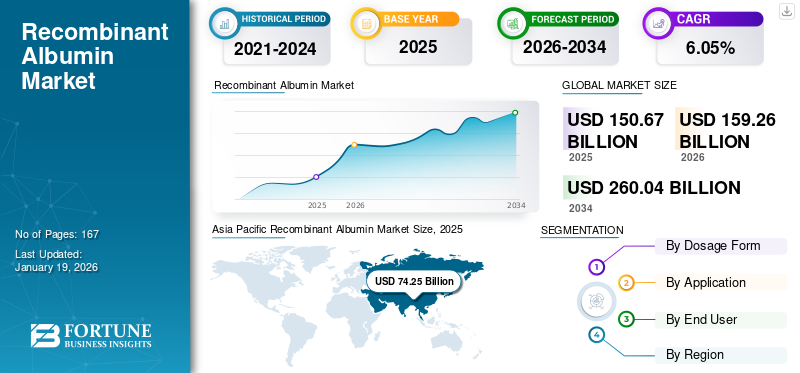
The global recombinant albumin market size was valued at USD 150.67 billion in 2025 and is projected to grow from USD 159.26 billion in 2026 to USD 260.04 billion by 2034, exhibiting a CAGR of 6.05% during the forecast period. Asia Pacific dominated the recombinant albumin market with a market share of 49.28% in 2025.
Recombinant albumin is a key plasma protein used in various therapeutic applications and drug formulation, ensuring high safety, scalability, and virus-free production while addressing key limitations associated with human-derived albumin. It offers a safer and tolerable alternative to human albumin and offers large-scale scale controlled, continuous production. It has wide areas of application, including drug delivery, diagnostic, and serves as a cell culture media supplement. This market is rapidly expanding, with strategic research and collaboration initiatives by key companies boosting market growth.
- For instance, in May 2025, Orion Corporation collaborated with Shilpa Medicare Limited to commercialize Recombinant Human Albumin in Europe.
The market encompasses several major players, with InVitria, FUJIFILM Wako Pure Chemical Corporation, and Sartorius AG at the forefront. Strategic collaboration coupled with innovative product launch, increasing research and development, and strong geographic presence expansion have supported the dominance of these companies in the global market.
Download Free sample to learn more about this report.
Recombinant Albumin Market Key Takeaways
 Market Size & Forecast
- 2025 Market Size: USD 150.67 Billion
- 2026 Market Size: USD 159.26 Billion
- 2034 Forecast Market Size: USD 260.04 Billion
- CAGR: 6.05% from 2026–2034
 Market Share
- Asia Pacific dominated the recombinant albumin market with a 49.28% share in 2025.
- The solution segment accounted for the largest share by dosage form.
- The therapeutics segment held the largest share by application.
 Key Regional Highlights
Asia Pacific
Asia Pacific generated USD 74.25 billion, accounting for 49.28% of the global market in 2025.
North America
North America reached USD 44.47 billion, representing 29.51% of the global market in 2025.
Europe
Europe generated USD 23.98 billion, contributing 15.92% of global market revenue in 2025.
U.S.
The country dominated the North American market due to its strong biopharmaceutical R&D and manufacturing base.
Japan
Strategic collaborations in biopharmaceutical development are supporting recombinant albumin market growth.
Read More

MARKET DYNAMICS
MARKET DRIVERS
Wide Application of Recombinant Albumin in Cell and Gene Therapy to Drive Market Growth
Recombinant albumin has emerged as a critical excipient in the development and manufacturing of advanced therapies such as cell and gene therapies. These therapies are extremely fragile and sensitive to manufacturing stress; thus, stabilizing agents are essential to maintain potency and therapeutic effectiveness. The ability of the product to stabilize cells, improve viability during culture, and protect delicate therapeutic molecules against aggregation or degradation makes it indispensable in this field. As the global pipeline of cell and gene therapies continues to expand, the integration of the product into their production processes offers substantial opportunities for recombinant albumin market growth. Thus, research activities are being conducted to explore its applications and commercialize its potential.
- For instance, in February 2021, Albumedix entered into a collaboration with the Cell and Gene Therapy Catapult (CGT Catapult) to investigate the use of Albumedix´s albumin-based solutions for advanced therapy applications, including viral vector manufacturing.
MARKET RESTRAINTS
Supply Limitations to Restrict Market Expansion
The manufacturing of recombinant albumin is a time-intensive process that requires advanced expression systems, strict GMP compliance, and costly purification technologies. These factors make the process challenging. Recombinant production faces numerous obstacles such as low yields, high production costs, and stringent regulatory oversight. These challenges can create supply bottlenecks, particularly as demand continues to rise in cell and gene therapies, vaccines, and biologics manufacturing. In addition, issues related to quality maintenance and supply chain stability further impact the industry, causing difficulties for key players.
- For instance, in July 2022, Mitsubishi Chemical Group Corporation terminated its business related to the manufacturing of recombinant human serum, as it was unable to establish a stable supply.
MARKET OPPORTUNITIES
Research and Development for Advancing Drug Delivery Systems to Create Lucrative Growth Opportunities
Nanoparticle albumin-bound (nab) technology is a crucial carrier for delivering low-aqueous solubility and high-toxicity therapeutic agents with fewer side effects. These factors make it ideally suitable for use in chemotherapy medication. Research and development aimed at expanding the application of such drug delivery systems offer lucrative growth opportunities in the market.
- For instance, in October 2024, Sandoz launched a generic paclitaxel formulation in the U.S. The paclitaxel albumin-bound particles for injectable suspension are indicated for the treatment of patients with metastatic breast cancer.
RECOMBINANT ALBUMIN MARKET TRENDS
Rising Emphasis of Key Players to Expand their Manufacturing Capacity Boosts Market Demand
In recent years, recombinant albumin has been increasingly used in cell & gene therapy and advanced biologics products manufacturing. Thus, the demand for high-purity and GMP-grade recombinant albumin is rapidly increasing among end users. To cater to this increasing demand, many key players are streaming their resources toward expanding manufacturing capacity. This represents a prominent trend in the global market, driven by increased demand.
- For instance, in March 2025, Yantai Projiji Pharmaceutical Technology Co., Ltd. reported the development of an expansion project for recombinant human albumin.
MARKET CHALLENGES
High Cost of Products to Hamper Market Growth
One of the significant factors challenging market growth is the high cost of recombinant albumin, coupled with supply chain and logistics constraints. The high cost of recombinant albumin is due to the complexity in upstream production, purification steps, and scale of the required biotechnological processes, including sophisticated equipment, dedicated labor, and extensive research and development. These constraints result in a higher cost of recombinant albumins and hamper their adoption in the market.
- For example, Optibumin 20 – Recombinant human albumin is priced as high as USD 1,660.0 for 100 mL.
Download Free sample to learn more about this report.
Segmentation Analysis
By Dosage Form
Low Risk of Contamination Encouraged the Solution Segment Growth
On the basis of dosage form, the market is classified into powder and solution. The solution segment accounted for the dominant market in 2024. The recombinant albumin in solution form provides various benefits such as decreased risk of contamination, improved consistency, and a ready-to-use formulation. Due to these factors, the segment is projected to grow on an upward trajectory in the forecast period. Additionally, many key players are focusing on new product launches to meet the rising demand, supporting segment growth.
- For instance, in February 2025, InVitria launched Optibumin 25, a recombinant human serum albumin (rHSA) available as a 25.0% solution. This recombinant albumin solution offers a safe and reliable alternative to serum-derived HSA for closed-system biomanufacturing in cell and gene therapy.
By Application
Increasing Application of Recombinant Albumin as an Excipient Boosted Growth in the Therapeutics Segment
In terms of application, the market is categorized into therapeutics, diagnostics, and research.
The therapeutic segment captured the largest recombinant albumin market share in 2024. Recombinant albumin plays an important role as a multifunctional excipient and an active component in modern therapies, due to its biocompatibility, stability, and drug-binding properties. Such wide-ranging applications are driving the segment’s growth.
- For instance, in March 2023, Albumedix collaborated with Heartseed and launched Recombumin as a critical excipient in the manufacture of the company’s HS-001 investigational cardiac remuscularization cell therapy.
By End User
Expansion of Manufacturing Capabilities Boosted Pharmaceutical & Biotechnology Industry Segment Growth
Based on end-user, the market is segmented into hospitals & clinics, the pharmaceutical & biotechnology industry, and research institutes.
In 2024, the global market was dominated by pharmaceutical and biotechnological companies in terms of end-users. Strategic collaboration, expansion of manufacturing capabilities, distribution, and commercialization partnerships among pharmaceutical companies are some key factors supporting the dominance of the segment.
- For instance, in June 2024, Dyadic International, Inc. partnered with Proliant Health and Biologicals (PHB) for the development and commercialization of recombinant albumin. The initial focus of the partnership was the commercialization of recombinant human serum albumin products, with an anticipated launch in 2025.
Recombinant Albumin Market Regional Outlook
By geography, the market is categorized into Europe, North America, Asia Pacific, Latin America, and the Middle East & Africa.
Asia Pacific Recombinant Albumin Market Size, 2025 (USD Billion)
To get more information on the regional analysis of this market, Download Free sample
Asia Pacific
Asia Pacific maintained a strong presence in the global market, reaching USD 74.25 billion in 2025, accounting for 49.28% share, and is expected to reach USD 79.76 billion in 2026 and the region’s high share is due to the rising prevalence of chronic kidney diseases such as hypoalbuminemia, along with increasing healthcare expenditure. Strategic collaborations among key companies in the region are also expected to support market growth.
- For instance, in March 2021, Albumedix Ltd. established a distribution agreement with FUJIFILM Wako Pure Chemical Corporation in Japan and China, including Hong Kong. The partnership strengthened the company’s commitment to advanced therapy and biopharmaceutical developers in the region.
North America
In 2025, the North America market stood at USD 44.47 billion, representing 29.51% of global demand, and is projected to grow to USD 46.47 billion in 2026.
The use of recombinant albumin for surgeries is not a standard practice in North America. Such factors limit the adoption of the product in the region. Moreover, U.S. dominated the market in north America due to large biopharma R&D & manufacturing base along with GMP approved manufacturing practices.
Europe
The Europe region captured 15.92% of the global market in 2025, generating USD 23.98 billion in revenue, and is projected to reach USD 24.85 billion in 2026. During the forecast period, the European region is projected to record a growth rate of 4.02% and reach the valuation of USD 24.0 million in 2025. Growth in the region is primarily driven by the advancing research capabilities and heightened demand for the product in therapeutic applications.
Latin America and Middle East & Africa
Over the forecast period, the Latin America and Middle East & Africa regions would witness a moderate growth in this market. The Latin America market in 2025 is set to reach a valuation of USD 6.1 million. Growing adoption of regenerative medicine and increasing use of recombinant albumin are key factors driving growth in the market. The Middle East & Africa market accounted for USD 1.87 billion in 2025, representing 1.24% of the global industry, and is expected to reach USD 1.91 billion in 2026. In 2025, Latin America represented USD 6.11 billion, accounting for 4.05% of the worldwide market, and is projected to grow to USD 6.27 billion in 2026.
COMPETITIVE LANDSCAPE
Key Industry Players
Key Companies Focus on a Strong Distribution Network to Maintain their Market Dominance
The global market shows a concentrated structure with a few large companies actively operating across the globe. These players are actively involved in product innovation, strategic partnerships, and geographic expansion.
Sartorius AG, FUJIFILM Wako Pure Chemical Corporation, and InVitria are some of the dominating players in the market. Their comprehensive range of recombinant albumin, global presence supported by strong distribution networks, and collaborations with research and academic institutes contribute significantly to their dominance in the market.
Apart from this, other prominent players include Sigma-Aldrich Chemicals Private Limited, Thermo Fisher Scientific Inc., and others. These companies are undertaking various strategic initiatives, such as investments in R&D and partnerships with pharmaceutical companies to enhance their market presence.
LIST OF KEY RECOMBINANT ALBUMIN COMPANIES PROFILED
- InVitria. (U.S.)
- FUJIFILM Wako Pure Chemical Corporation (Japan)
- Orion Corporation. (Finland)
- Sartorius AG (Germany)
- Thermo Fisher Scientific Inc. (U.S.)
- Merck KGaA (Germany)
KEY INDUSTRY DEVELOPMENTS
- August 2023: Dyadic International, Inc. announced positive results from third-party analytical testing of the company’s animal-free recombinant serum albumin. The Company developed stable cell lines to produce animal-free recombinant bovine serum albumin and recombinant human serum albumin at high levels.
- August 2022: Sartorius AG, through its French-listed subgroup Sartorius Stedim Biotech, acquired Nottingham, England’s Albumedix, a specialist in recombinant albumin-based solutions, for about USD 449.13 million.
- July 2025: Wuhan Healthgen Biotechnology received approval by The National Medical Products Administration for a rice-derived recombinant human albumin injection for the treatment of hypoalbuminemia (≤30g/L) caused by liver cirrhosis after the priority review and approval process.
- August 2024: Medsintez Plant collaborated with Tonghua Anrate Biopharmaceutical Co. to launched drug of recombinant human albumin. The drug was obtained using Pichia Pastoris cells by the recombinant DNA technology.
REPORT COVERAGE
The global recombinant albumin market analysis provides an in-depth study of market size & forecast by all the market segments included in the report. It includes details on the market dynamics and market trends expected to drive the market in the forecast period. It offers information on the technological advancements, new product launches, key industry developments, and details on partnerships, mergers & acquisitions. The market research report also encompasses a detailed competitive landscape with information on the market share and profiles of key operating players.
Request for Customization to gain extensive market insights.
Report Scope & Segmentation
|
ATTRIBUTE |
DETAILS |
|
Study Period |
2021-2034 |
|
Base Year |
2025 |
|
Estimated Year |
2026 |
|
Forecast Period |
2026-2034 |
|
Historical Period |
2021-2024 |
|
Growth Rate |
CAGR of 6.05% from 2026-2034 |
|
Unit |
Value (USD Billion) |
|
Segmentation |
By Dosage Form
|
|
By Application
|
|
|
By End User
|
|
|
By Geography
|
Frequently Asked Questions
Fortune Business Insights says that the global market size was valued at USD 159.26 billion in 2026 and is projected to reach USD 260.04 billion by 2034, exhibiting a CAGR of 6.05% during the forecast period.
In 2025, the market value stood at USD 74.25 billion.
The market is expected to exhibit a CAGR of 6.05% during the forecast period (2026-2034).
The solution segment led the market by dosage form.
The key factors driving the market are the expanding applications in biopharmaceutical manufacturing, strategic collaborations, and new product launches.
Sartorius AG, Orion Corporation, and InVitria are some of the prominent players in the market.
Asia Pacific dominated the market in 2025.



- 2021-2034
- 2025
- 2021-2024
- 167
Get 30-60 hrs Free Customization
Expand Regional and Country Coverage, Segments Analysis, Company Profiles, Competitive Benchmarking, and End-user Insights.













.webp)






Related Reports
-
US +1 833 909 2966 ( Toll Free )
-
Get In Touch With Us