Recycled Containerboard Market Size, Share & Industry Analysis, By Product Type (Linerboard and Corrugating Medium), By End-use Industry (Food & Beverages, Personal Care & Cosmetics, Healthcare, and Others), and Regional Forecast, 2026-2034
 Download Free Sample
(Offer valid till 15th Oct 2026)

KEY MARKET INSIGHTS
 Listen to Audio Version
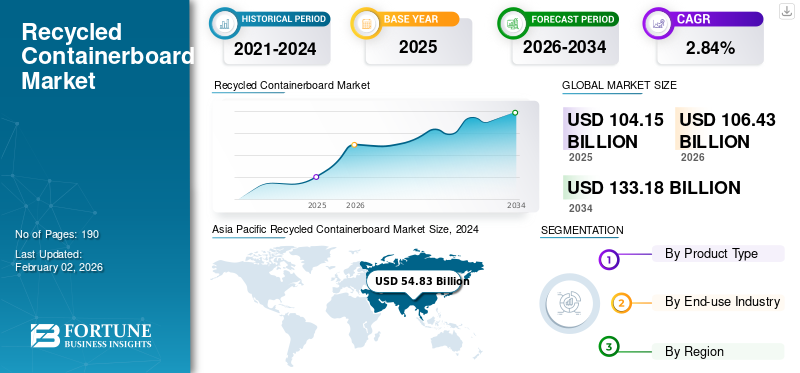
The global recycled containerboard market size was valued at USD 104.15 billion in 2025. The market is projected to grow from USD 106.43 billion in 2026 to USD 133.18 billion by 2034, exhibiting a CAGR of 2.84% during the forecast period. Asia Pacific dominated the recycled containerboard market with a market share of 53.71% in 2024.
Recycled paper fibers, mostly sourced from post-consumer waste, are used to make recycled containerboard, which reduces landfill waste and preserves natural resources. As companies strive to enhance their brand image by using sustainable materials, the e-commerce, food and beverage, and retail industries are driving this demand. Additionally, recycling incentives and penalties for wasteful practices by the government bodies contribute to the growth of the global recycled containerboard market.
- According to the American Forest & Paper Association, the cardboard recycling rate stated that in 2023 was 71% - 76%. Overall, nearly 33 million tons of cardboard were recycled, which is almost 90,000 tons per day.
International Paper and Georgia Pacific LLC are the key manufacturers, holding the highest share of the global market.
Download Free sample to learn more about this report.
Recycled Containerboard Market KEY TAKEAWAYS
 Global Market Size & Forecast
- 2025 Market Size: USD 104.15 billion
- 2026 Market Size: USD 106.43 billion
- 2034 Forecast Market Size: USD 133.18 billion
- CAGR: 2.84% from 2026–2034
 Market Share
- Asia Pacific dominated the recycled containerboard market with a 53.71% share in 2024.
- The linerboard segment accounted for the largest market share.
- Asia Pacific is expected to maintain its leading position during the forecast period.
 Key Regional Highlights
Asia Pacific
Asia Pacific dominated the market, driven by expanding industrial activity, rising recycling rates, and growing demand for sustainable packaging.
North America
North America held the second-largest market share, supported by increasing containerboard production and strong demand from the e-commerce sector.
Europe
Europe is a major market, driven by high recycling rates and strong circular economy initiatives.
U.S.
The U.S. market is supported by rising online shopping, increasing demand for sustainable packaging, and investments in advanced packaging technologies.
Japan
Japan is witnessing steady demand, supported by its strong recycling infrastructure and focus on sustainable paper packaging.
Read More

MARKET DYNAMICS
MARKET DRIVERS
Augmenting Demand from the Pharmaceutical Sector Drives Market Growth
The expansion of the pharmaceutical industry is leading to a higher demand for containerboards, which are utilized in secondary and tertiary packaging. This demand stems from the industry's dependence on packaging to safeguard and ship medications, alongside an increasing global need for pharmaceuticals. Although plastics are prevalent in primary packaging, paper and paperboard, particularly containerboard, play an essential role in the external layers of pharmaceutical packaging. The industry is witnessing significant growth owing to the growing demand from the pharmaceutical sector, particularly for injectable drugs and biologics. The growing occurrence of chronic diseases is further propelling the demand for sturdy packaging solutions, thereby driving the global recycled containerboard market growth.
- The Press Information Bureau (PIB) states that India's pharmaceutical sector for FY 2023-24 was valued at USD 50 billion, with domestic usage accounting for USD 23.5 billion and exports for USD 26.5 billion. India's pharmaceutical sector is regarded as the third largest globally by volume and ranks 14th for production value.
- In 2023, North America accounted for 53.3% of global pharmaceutical sales, with Europe contributing 22.7%. According to IQVIA (MIDAS, May 2024), the U.S. captured 67.1% of the sales from new medications introduced between 2018 and 2023, while Europe represented 15.8%.
MARKET RESTRAINTS
Volatility in Raw Material Prices and Availability of Recycled Fibers Hampers Market Expansion
Although the recycled containerboard market shows promising growth potential, it encounters various challenges that may restrict its expansion. A primary limitation is the availability of quality recycled fibers. The production of recycled containerboard relies heavily on the supply of high-grade paper waste for processing. Moreover, variations in raw material costs and energy expenses can impede the growth of the recycled containerboard market. The recycling process requires significant energy input, which raises production costs. Fluctuations in paper pulp and energy prices can greatly influence the cost structure of recycled containerboard packaging manufacturing, complicating profitability for producers, particularly in areas with elevated energy costs.
- For instance, the World Bank Group stated that the energy price index rose 9.7% in June 2025, driven by an 11.3% surge in crude oil prices, while the non-energy price declined by 1.1%
MARKET OPPORTUNITIES
Rising Focus on Eco-friendly Materials to Offer Potential Growth Opportunities
There is a growing emphasis on environmentally friendly packaging options as consumers and regulators encourage for greater recyclability and less plastic use. The trend is driving governments and companies to adopt recycled packaging solutions, including recycled containerboard. The inclination toward a circular economy provides manufacturers chances to utilize recycled containerboard. Recycled containerboard offers significant sustainability benefits by reducing landfill waste, conserving natural resources, and minimizing environmental impact compared to virgin materials. It's a cost-effective and versatile packaging solution with a lower carbon footprint, making it an attractive choice for businesses to enhance their brand image.
RECYCLED CONTAINERBOARD MARKET TRENDS
Rapid Expansion of the E-commerce Sector Emerges as a Key Trend
E-commerce's expansion has created a surge in demand for recycled containerboard, which is favored for its ability to protect products during transit and its customizability for branding. The rapid growth of online retail and food delivery is significantly raising demand for corrugated boxes made with recycled containerboard. Manufacturers in the e-commerce sector are increasingly using lightweight containerboard for its strength, cost-effectiveness, and lower carbon footprint. The global recycled containerboard industry is experiencing significant growth due to the booming e-commerce sector, which drives demand for lightweight and durable packaging solutions. The increasing popularity of online shopping and the need for protective packaging for shipped goods are emerging as key trends for market growth.
Download Free sample to learn more about this report.
Segmentation Analysis
By Product Type
Linerboard Segment Leads due to Rising E-commerce Industry
Based on product type, the market is divided into linerboard and corrugating medium.
The linerboard is the dominating segment of the market. Linerboard, which serves as the outer layer of corrugated boxes, is widely utilized in packaging due to its robustness and resilience. The expanding e-commerce industry has increased the need for linerboard, as it plays a crucial role in ensuring the safe shipping and packaging of goods. Linerboard enhances the overall durability of containerboard, making it resistant to crushing during stacking and transportation.
Corrugating medium is the second-leading segment of the industry. The corrugated medium in containerboard provides crucial benefits such as enhanced protection, stacking strength, and cushioning, safeguarding products during shipping and storage. It also contributes to the overall strength and durability of the box, while being a lightweight and recyclable material.
By End-use Industry
Food & Beverages Segment Led the Market due to the Containerboard’s Ability to Withstand Rough Handling During Shipping
Based on end-use industry, the industry is divided into food & beverages, personal care & cosmetics, healthcare, and others.
The food & beverages segment dominated the market in 2024. The sector is the frontrunner in the market as recycled containerboard provides excellent protection for a wide range of food items, including dry goods and perishables, while adhering to necessary hygiene standards. Its ability to endure moisture, physical stress, and rough handling during shipping makes it an optimal choice for food packaging. The recycled containerboard is also utilized for packaging fresh fruits and vegetables that must be transported over long distances. This increasing use in the packaging of frozen foods, fresh produce, ready-to-eat meals, and canned goods further drives growth in the segment.
The healthcare segment is expected to witness steady growth during the forecast period. The rapid growth of the healthcare sector has significantly increased the demand for containerboard as it's crucial for shipping fragile products such as pharmaceuticals and medical devices, thus enhancing the segment’s growth.
Recycled Containerboard Market Regional Outlook
By geography, the market is categorized into North America, Europe, Asia Pacific, Latin America, and the Middle East and Africa.
Asia Pacific
Asia Pacific Recycled Containerboard Market Size, 2024 (USD Billion)
To get more information on the regional analysis of this market, Download Free sample
The Asia Pacific region dominates the global market and is projected to maintain its lead, propelled by rapidly expanding industrial and consumer sectors in nations such as China and India. The rising need for eco-friendly packaging options, along with government efforts to encourage recycling, is anticipated to stimulate market expansion in this region. The rising recycling of containerboard in China majorly contributes to market growth.
- The United Nations Economic Commission for Europe (UNECE) states that in 2022, the production of wood pulp in China grew by 16.9% to 21.2 million tons, while recycled pulp experienced a 1.7% rise to 59.1 million tons and non-wood pulp was up 0.7% to 5.60 million tons. Excluding dissolving pulp, total production across all types of pulp grew by 5.0%, reaching 85.9 million tons.
North America
North America holds the second-largest recycled containerboard market share, supported by the presence of major players. Though recycled content is lower compared to Europe, there is growing interest in sustainability-driven packaging solutions. The quickly rising food and beverage sector in the region also supports market growth. Moreover, the increasing containerboard production in the region is also fostering market growth.
- The American Forest & Paper Association (AF&PA) published the Containerboard Quarterly report for Q4 2024. As outlined in the report, overall containerboard production in Q4 saw a 1% rise in comparison to Q4 2023. For the entire 12-month period of 2023, production increased by 5%. Operating rates for unbleached kraft liner and recycled medium improved over Q3 2024, while rates for recycled Liner and semi-chemical Medium declined.
The continuous growth of online shopping drives the need for strong and dependable containerboard packaging to safeguard products during transportation and fulfill consumer demands for sustainable and tailored options in the U.S. Investments in advanced technologies such as digital printing and smart packaging improve customization and tracking features, thereby boosting demand for containerboard in the U.S.
Europe
Europe is a significant market for recycled containerboard, leading the way in recycling efficiency with high recycled content in containerboard and a strong circular economy infrastructure. The market is experiencing advancements in biodegradable coatings and eco-friendly packaging solutions as producers respond to the increasing consumer interest in sustainable products. The growing emphasis of government bodies and organizations to decrease the environmental impact and boost the recycling of packaging also drives market growth.
- The Circular Economy Action Plan of the European Union, which focuses on minimizing the environmental effects of packaging, has significantly influenced the market. The EU has established bold recycling goals, targeting a 90% recycling rate for paper and cardboard by 2025. This initiative directly supports the adoption of recyclable packaging materials across the region.
Latin America
The Latin America region is expected to observe considerable growth. Containerboard, particularly that made from recycled materials, is gaining traction due to its environmental benefits. Consumers and businesses are increasingly prioritizing eco-friendly packaging options. Companies such as Klabin are investing in sustainable practices and technologies to meet this growing demand. Moreover, digital technologies are being integrated into industrial processes to improve efficiency and customization in containerboard production, thus driving market growth in the region.
Middle East & Africa
The Middle East and Africa region is expected to witness moderate growth in the coming years. The growth of the market is primarily driven by the growing demand for packaged products. Additionally, this growth is supported by a mix of increasing consumer spending, especially in the food and beverage industry, along with the growth of e-commerce.
COMPETITIVE LANDSCAPE
Key Industry Players
Key Companies are Introducing New Products to Gain a Competitive Edge
The global recycled containerboard market is concentrated with companies such as International Paper, Georgia Pacific LLC, DS Smith, Grief, Mondi, and Stora Enso, accounting for a significant share.
International Paper is a leading global producer of renewable fiber-based packaging and pulp products. Their core products include containerboard and corrugated packaging, and cellulose fibers used in various applications such as diapers and tissue products. They are particularly known for their strength and design in packaging for industries such as e-commerce and food processing.
Georgia-Pacific is a leading manufacturer and marketer of various paper, tissue, packaging, and building products. With over 150 facilities and approximately 30,000 direct employees, Georgia-Pacific plays a significant role in both the consumer and commercial markets.
Additionally, Mondi and Oji Fibre Solutions are among the other key leaders in the industry. Emphasis on significant funds in the R&D of state-of-the-art products has reinforced the pharmaceutical companies' share in the industry.
- In May 2025, Mondi started its new recycled containerboard mill in Italy. Mondi acquired the mill from Burgo Group at the beginning of 2023 for approximately USD 43.3 million, intending to transform the facility from manufacturing lightweight coated mechanical paper to producing recycled containerboard. The project commenced in May 2024 and signifies a USD 216 million investment for Mondi.
LIST OF KEY RECYCLED CONTAINERBOARD COMPANIES PROFILED
- International Paper (U.S.)
- Georgia-Pacific LLC (U.S.)
- DS Smith (U.K.)
- Greif (U.S.)
- Mondi (U.K.)
- Stora Enso (Finland)
- Cascades Inc. (Canada)
- Kruger (Canada)
- Sappi Ltd. (South Africa)
- Smurfit Kappa (Ireland)
- Daio Paper Corporation (Japan)
- Nine Dragons Paper (China)
- New-Indy Containerboard LLC (U.S.)
- Jackson Paper Manufacturing (U.S.)
- Oji Fibre Solutions (New Zealand)
KEY INDUSTRY DEVELOPMENTS
- July 2025: Greif, Inc., a worldwide leader in healthcare packaging products and services, revealed that it has finalized an agreement to sell its Containerboard business, which encompasses its CorrChoice sheet feeder network, in a cash deal valued at USD 1.8 billion to Packaging Corporation of America. The deal is anticipated to close by the end of Greif’s fiscal year 2025, subject to standard closing conditions and regulatory approvals.
- May 2025: Norwegian pulp and paper manufacturer Norske Skog started the production of recycled containerboard at its Golbey facility in France following an investment of around USD 453.1 million. The newly installed containerboard machine would boost the company’s capacity by 550,000 tons (t), bringing the total capacity of the group to 760,000t.
- April 2025: Stora Enso expanded its main packaging material range with the introduction of Performa Nova, an advanced folding boxboard (FBB) that offers both high yield and outstanding performance. This new board is created to address the increasing need for renewable, recyclable, and effective packaging solutions in areas such as dry, frozen, chilled food, and chocolate and confectionery.
- July 2024: PG Paper revealed a new strategic collaboration with Opal that centers on their containerboard offerings. This partnership features a distinct, lighter type of virgin Kraft Liner Board (KLB) boasting a bright, smooth surface perfect for high-quality, professional printing, and Fluting and Testliner grades made from 100% recycled materials.
- February 2023: Kruger Packaging disclosed plans to invest more than USD 30 million to upgrade its Place Turcot Containerboard Mill in Montréal. This significant transformation, set to be finished by 2025, would make the Place Turcot facility the first in North America to produce 100% recycled saturating kraft board, a material utilized in the production of high-pressure laminates for furniture, countertops, and decorative paneling.
REPORT COVERAGE
The global recycled containerboard industry analysis provides market size and forecasts by all segments included in the report. It contains details on the market dynamics and recycled containerboard market trends expected to drive the market during the forecast period. It offers information on the utilization of recycled containerboard in key regions, company profiles, key industry developments, new product launches, and details on partnerships, mergers & acquisitions in key countries. It covers a detailed competitive landscape with information on the market share and profiles of key players.
Request for Customization to gain extensive market insights.
Report Scope & Segmentation
|
ATTRIBUTE |
DETAILS |
|
Study Period |
2021-2034 |
|
Base Year |
2025 |
|
Estimated Year |
2026 |
|
Forecast Period |
2026-2034 |
|
Historical Period |
2021-2024 |
|
Growth Rate |
CAGR of 2.84% from 2026-2034 |
|
Unit |
Value (USD Billion) |
|
Segmentation |
By Product Type
|
|
By End-use Industry
|
|
|
By Geography
|
Frequently Asked Questions
Fortune Business Insights says that the global market value stood at USD 104.15 billion in 2025 and is projected to record a valuation of USD 133.18 billion by 2034.
In 2024, the market value stood at USD 54.83 billion.
The market is expected to grow at a CAGR of 2.84% during the forecast period.
The food & beverages segment led the market by end-use industry.
The key factor driving the market is the augmenting demand from the pharmaceutical sector.
International Paper, Georgia Pacific LLC, DS Smith, Mondi, Grief, and Stora Enso are the top players in the market.
Asia Pacific dominates the market.
Increased demand from the food, beverages, and healthcare sectors is one of the major factors that is expected to favor product adoption.



- 2021-2034
- 2025
- 2021-2024
- 190
-
(Offer valid till 15th Oct 2026)
Get 30-60 hrs Free Customization
Expand Regional and Country Coverage, Segments Analysis, Company Profiles, Competitive Benchmarking, and End-user Insights.








Related Reports
-
US +1 833 909 2966 ( Toll Free )
-
Get In Touch With Us