 Download Free Sample



Get a Quote
Receive a tailored pricing based on your needs.
- Choose license type
- Multiple user options
- Custom scope & coverage
- Fast turnaround
"Designing Growth Strategies is in our DNA"
 Listen to Audio Version
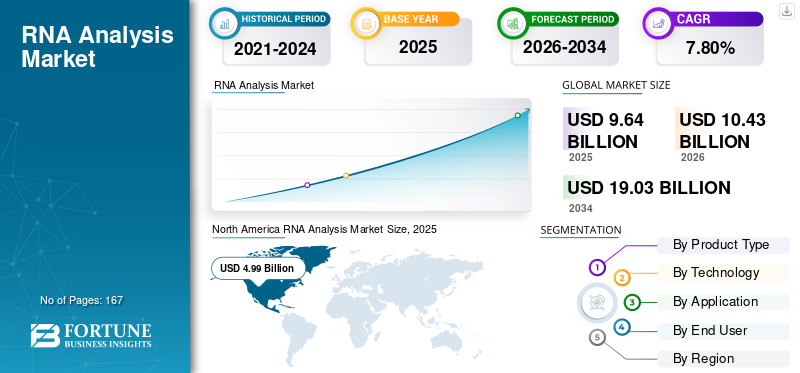
The global RNA analysis market size was valued at USD 9.64 billion in 2025 and is projected to grow from USD 10.43 billion in 2026 to USD 19.03 billion by 2032, exhibiting a CAGR of 7.80% during the forecast period. North America dominated the global RNA analysis market with a market share of 51.8% in 2025.
RNA analysis encompasses a wide range of products for the study and quantification of RNA molecules, including mRNA, miRNA, and other non-coding RNAs. These are useful for understanding gene expression, regulation, and cellular functions. The rising adoption of molecular diagnostics and drug development for early diagnosis and personalized treatment approaches is boosting market growth.
The increasing prevalence of cancer, genetic disorders, and infectious diseases has heightened the adoption of RNA analysis for diagnosis and treatment to propel the growth of the global RNA analysis market.
The market encompasses several major players, with Thermo Fisher Scientific Inc. and Illumina Inc. at the forefront. The robust portfolio and strategic activities support the dominance of these companies in the market.
Download Free sample to learn more about this report.
 Market Size & Forecast
 Market Share
 Key Regional Highlights
North America
North America remained the leading regional market, valued at USD 4.99 billion in 2025 and USD 5.41 billion in 2026, supported by strong research funding and biotechnology investments.
Europe
Europe is projected to be the second-fastest growing region, recording a CAGR of 7.59% and reaching a market value of USD 2.49 billion in 2025.
Asia Pacific
Asia Pacific ranked as the third-largest regional market in 2025, reaching USD 1.53 billion, driven by expanding genomics research and healthcare infrastructure.
U.S.
The U.S. RNA analysis market was valued at USD 4.75 billion in 2025, benefiting from advanced life sciences research and widespread adoption of molecular analysis technologies.
Japan
Japan continues to contribute significantly to the Asia Pacific market through ongoing investments in precision medicine, biotechnology research, and advanced diagnostic technologies.
Read More

Shift toward Precision Medicine and Oncology Genomics to Propel Market Growth
The key driver propelling the RNA analysis market is the shift toward precision medicine and oncology genomics. The increasing prevalence of genetic diseases and cancer is prompting patients and healthcare providers toward effective treatment options based on the genetic profile and tumor biology.
RNA analysis aids early diagnosis and prognosis of cancer, driving the development of RNA based targeted therapies, thereby improving treatment efficacy while reducing adverse effects.
As research in oncology genomics continues to expand, key market players are increasingly focused on offering innovative RNA-based diagnostic and therapeutic tools. Overall, such advancements are significantly accelerating the growth of the global RNA analysis market.
Product Recalls of RNA Analysis Kits to Restrict Market Growth
Product recall involving instruments and devices used for RNA Analysis hampers the brand image and consumers' trust, thus restricting market growth. Recall raise concern about safety and quality standards, leading to decreased demand from laboratories and research institutions. Such factors restrict the product sales and RNA analysis market growth.
Increasing Prevalence Of Neurological Diseases to Create Lucrative Growth Opportunities
The increasing prevalence of neurological diseases, infectious diseases, and cardiovascular conditions, along with the rising demand for precision medicine and diagnosis for such diseases, boosts the demand for the expansion of RNA sequencing and analysis technologies across a broader range of diseases.
Additionally, expanding into these applications is fostering innovation in molecular diagnostics and RNA therapeutics, fueling long-term growth in the rapidly evolving landscape of molecular medicine.
Development of Single-cell and Spatial Transcriptomics is a Key Market Trend
Currently available RNA analysis platforms often struggle with high costs, complex workflows, or insufficient sensitivity to detect rare transcripts. Single-cell and spatial transcriptomics address these gaps by offering higher throughput, enhanced spatial resolution, and seamless integration of multi-omics. This allows researchers to obtain more accurate, detailed, and scalable insights into cellular functions and tissue architecture.
Shortage of Skilled Personnel to Challenge Market Growth
A key challenge in the RNA analysis market is the shortage of skilled bioinformaticians and computational biologists capable of designing reliable workflows, managing pipelines, and interpreting complex data.
As a result, many labs that lack in-house expertise are forced to outsource analyses, increasing the overall cost, which hampers adoption and undermines confidence in the results.
Download Free sample to learn more about this report.
Increasing Product Launches of Reagents & Consumables Propelled the Segment’s Growth
The product type segment is divided into reagents & consumables, software & services, and instruments.
To know how our report can help streamline your business, Speak to Analyst
The reagents & consumables segment held a dominant portion of the RNA analysis market share in 2025. The rising research and development activities, along with an increased focus on genomic research, have boosted the segment’s growth in the market. Additionally, increasing new product launches will propel the segment’s growth.
The instruments segment is expected to grow at a CAGR of 6.87% over the forecast period.
Increasing Adoption of Sequencing-based Technologies Boosted the Segment’s Growth
In terms of technology, the market is categorized into PCR-based technologies, sequencing-based technologies, microarray-based technologies, RNA interference (RNAi)-based techniques, and others. The sequencing-based technologies segment accounted for the largest portion of the market. In 2025, the segment is anticipated to dominate with a 38.25% share. The maximum share of the segment is due to its increasing adoption of these technologies for RNA research and the rising introduction of new sequencing technology for genomic applications.
The PCR-based technologies segment is expected to grow at a CAGR of 3.85% over the forecast period.
Increasing Prevalence of Genetic Diseases Boosted the Drug Discovery & Development Segments' Growth
Based on application, the market is segmented into drug discovery & development, clinical diagnostics, cell biology research, toxicogenomics, comparative transcriptomics, and others.
The drug discovery & development segment held the dominating position in 2025. The drug discovery & development segment held a 29.80% share in 2025. The increasing prevalence of genetic diseases, cancer, and neurological conditions, along with the rising demand for personalized medicine, is expected to boost the segment’s growth in the market.
The clinical diagnostics segment is poised for growth, with a forecasted rate of 9.40% in the global RNA analysis market during the forecast period.
Increasing Funding Activities and Rising Research Programs to Boost the Pharmaceutical & Biotechnology Companies Segment
Based on end user, the market is segmented into pharmaceutical & biotechnology companies
academic & research institutes, CROs & CDMOs, and others. In 2025, the pharmaceutical & biotechnology companies segment is expected to witness a leading growth trajectory. The segment is set to hold 38.6% share in 2025. The rising adoption of products and services for RNA analysis to develop new therapeutics for various diseases is expected to boost the adoption of these products in these settings. Additionally, increasing funding activities to develop RNA therapeutics is contributing to the segment's growth in the market.
The academic & research institutes segment is projected to grow at a CAGR of 6.44% during the study period.
By geography, the market is categorized into Europe, North America, Asia Pacific, Latin America, and the Middle East & Africa.
North America RNA Analysis Market Size, 2025 (USD Billion) To get more information on the regional analysis of this market, Download Free sample
North America held the dominant share in 2025, valued at USD 4.99 billion, and also maintained its leading share in 2026 with USD 5.41 billion. The dominance of the regions in the market is driven by the presence of key players with advanced product offerings and a rising focus on investment in the RNA analysis market for research and development. In 2025, the U.S. market is estimated to reach USD 4.75 billion.
The U.S. is expected to dominate the North America region's market. The rising presence of proteomic research, combined with adequate funding and a supportive research environment, is boosting the country’s growth in the market.
Europe and the Asia Pacific are expected to experience notable growth in the coming years. During the forecast period, the European region is projected to record a growth rate of 7.59%, the second-highest among all regions, and reach a valuation of USD 2.49 billion in the RNA analysis market by 2025. Rising molecular biology research and increasing drug development for chronic diseases and genetic diseases, with active government support to boost market growth in the region. Backed by these factors, countries including the U.K. are expected to record the valuation of USD 0.54 billion, Germany to record USD 0.50 billion, and France to record USD 0.40 billion in 2025. After Europe, the Asia Pacific market is estimated to reach USD 1.53 billion by 2025 and secure the position of the third-largest region in the market. In the region, India and China are both estimated to reach USD 0.28 billion and USD 0.27 billion, respectively, in 2025.
The Latin America and Middle East & Africa regions would witness a moderate growth in the market over the forecast period. The Latin America market in 2025 is expected to reach a valuation of USD 0.39 billion. Increasing focus of key players to shift their presence in the region to boost market growth, but at a slower rate. In the Middle East and Africa MEA, the GCC is set to reach a value of USD 0.11 billion by 2025.
Expansion of Product Offering and Strong Research and Development Activities to Maintain Their Market Position
The global RNA analysis market exhibits a fragmented structure, with a large number of companies actively operating worldwide. These players have a robust product portfolio, backed by strong research and development capabilities.
Thermo Fisher Scientific Inc., Illumina Inc., and Agilent are among the leading companies in the industry. Their extensive product portfolios and ongoing new product launches are anticipated to strengthen their market positions.
Additionally, other significant players, such as Bio-Rad Laboratories and Bruker, are also prominent in the market. These companies are concentrating on providing a diverse range of assay kits and reagents to expand their market presence.
Request for Customization to gain extensive market insights.
|
ATTRIBUTE |
DETAILS |
|
Study Period |
2021-2034 |
|
Base Year |
2025 |
|
Estimated Year |
2026 |
|
Forecast Period |
2026-2034 |
|
Historical Period |
2019-2024 |
|
Growth Rate |
CAGR of 7.80% from 2026-2034 |
|
Unit |
Value (USD Billion) |
|
Segmentation |
By Product Type, Technology, Application, End User, and Region |
|
By Product Type |
· Reagents & Consumables · Instruments · Software & Services |
|
By Technology |
· PCR-based Technologies · Sequencing-based Technologies · Microarray-based Technologies · RNA interference (RNAi)-based Techniques · Others |
|
By Application |
· Drug Discovery & Development · Clinical Diagnostics · Cell Biology Research · Toxicogenomics · Comparative Transcriptomics · Others |
|
By End User |
· Pharmaceutical & Biotechnology Companies · Academic & Research Institutes · CROs & CDMOs · Others |
|
By Geography |
· North America (By Product Type, Technology, Application, End User, and Country) o U.S. o Canada · Europe (By Product Type, Technology, Application, End User, and Country/Sub-region) o Germany o U.K. o France o Spain o Italy o Scandinavia o Rest of Europe · Asia Pacific (By Product Type, Technology, Application, End User, and Country/Sub-region) o China o Japan o India o Australia o Southeast Asia o Rest of Asia Pacific · Latin America (By Product Type, Technology, Application, End User, and Country/Sub-region) o Brazil o Mexico o Rest of Latin America · Middle East & Africa (Product Type, Technology, Application, End User, and Country/Sub-region) o GCC o South Africa o Rest of the Middle East & Africa |
Fortune Business Insights says that the global market value stood at USD 9.64 billion in 2025 and is projected to reach USD 19.03 billion by 2034.
In 2024, the market value stood at USD 4.99 billion.
The market is expected to exhibit a CAGR of 7.80% during the forecast period (2026-2034).
The reagents & consumables segment led the market by product type.
The key factors driving the market are the shift toward precision medicine and oncology genomics.
Thermo Fisher Scientific Inc. and Agilent are some of the prominent players in the market.
North America dominated the market in 2025.
The increasing prevalence of neurological diseases is the key factor that is expected to favor product adoption.

Get 30-60 hrs Free Customization
Expand Regional and Country Coverage, Segments Analysis, Company Profiles, Competitive Benchmarking, and End-user Insights.













.webp)






Related Reports
Get In Touch With Us
US +1 833 909 2966 ( Toll Free )
Receive a tailored pricing based on your needs.
Discuss your questions with our industry experts.
Have questions? Get quick answers before you purchase.

