RNAi Crop Protection Market Size, Share & Industry Analysis, By Product Type (Topical RNAi Bioinsecticides, Topical RNAi Biofungicides, Topical RNAi Acaricides/Miticides, and Others), By Delivery Mode (Foliar Spray/Topical Spray, Seed Treatment/Seed Coating, Soil/Root-Zone Delivery, and Others), By Application (Insect Pest Control, Fungal Disease Management, Mite/Acarid Control, Weed Management, and Others), By Crop Type (Fruits, Vegetables & Tubers, Plantation, Tree & Specialty Crops, Oilseeds & Pulses, Corn & Other Row Crops, and Others), and Regional Forecast, 2026-2034
 Download Free Sample
(Offer valid till 30th Sep 2026)

RNAi Crop Protection Market Size and Future Outlook
 Listen to Audio Version
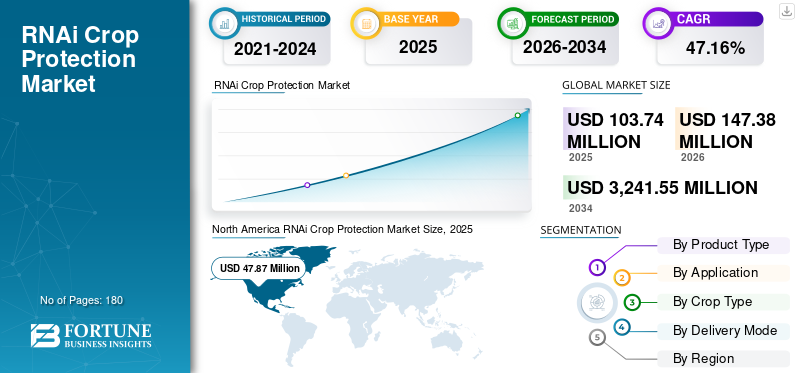
The global RNAi crop protection market size was valued at USD 103.74 million in 2025. The market is projected to grow from USD 147.38 million in 2026 to USD 3,241.55 million by 2034, exhibiting a CAGR of 47.16% during the forecast period. North America dominated the RNAi crop protection market with a market share of 46.14% in 2025.
RNAi crop protection refers to agricultural pest- and disease-control technologies that use RNA interference (RNAi) mechanisms to silence specific genes in insects, fungi, or weeds. These solutions typically use double-stranded RNA (dsRNA) molecules, which are delivered via topical sprays or seed treatments or incorporated into genetically engineered crops to disrupt biological functions in target organisms. The market is growing rapidly due to rising resistance against conventional pesticides and increasing regulatory pressure to reduce chemical pesticide usage. Additionally, advancements in dsRNA production and delivery technologies, along with growing investment from agrochemical and biotechnology companies, are accelerating the commercialization and field adoption of such products.
Companies such as GreenLight Biosciences, RNAissance Ag, AgroSpheres, Renaissance BioScience, and others are key players in this market. Mergers and acquisitions are the key strategy that is boosting product sales and supporting market growth.
Download Free sample to learn more about this report.
RNAi Crop Protection Market Takeaways
 Global Market Size & Forecast
- 2025 Market Size: USD 103.74 million
- 2026 Market Size: USD 147.38 million
- 2034 Forecast Market Size: USD 3,241.55 million
- CAGR: 47.16% from 2026–2034
 Market Share
- North America dominated the RNAi crop protection market with a 46.14% share in 2025.
- Insect pest control held the largest market share by application in 2025.
- Topical RNAi Bioinsecticides accounted for the largest share by product type in 2025.
 Key Regional Highlights
North America
North America led the RNAi crop protection market with a value of USD 47.87 million in 2025, supported by advanced agricultural technologies and strong adoption of precision crop protection solutions.
Europe
Europe accounted for USD 21.36 million in 2025, driven by increasing demand for sustainable agricultural practices and reduced chemical pesticide usage.
Asia Pacific
Asia Pacific reached USD 17.94 million in 2025, supported by growing agricultural innovation and rising demand for targeted pest management solutions.
U.S.
The U.S. RNAi crop protection market was valued at USD 42.13 million in 2025, supported by strong investment in biotechnology-based agricultural solutions and commercial RNAi product development.
Japan
The Japan RNAi crop protection market reached around USD 3.10 million in 2025, accounting for roughly 2.99% of global revenues, driven by advancements in agricultural biotechnology and sustainable farming practices.
Read More

RNAi CROP PROTECTION MARKET TRENDS
Shift Toward Encapsulated Delivery Systems and Crop-Specific RNAi Programs Driving Technology Evolution
The market is increasingly shifting toward nanoparticle-enabled and encapsulated delivery systems to improve dsRNA stability under field conditions. Companies are moving away from broad platform development toward highly crop-specific and pest-specific commercialization strategies, particularly in corn rootworm and specialty horticulture applications. Manufacturers are also integrating RNAi with existing biological and chemical crop protection programs. With the rise of contract manufacturing partnerships, there is a focus on reducing dsRNA production costs through fermentation-based synthesis, further boosting the RNAi crop protection market growth.
MARKET DYNAMICS
MARKET DRIVERS
Download Free sample to learn more about this report.
Rising Pest Resistance to Conventional Chemistries Fuels Adoption of Species-Specific RNAi Crop Protection Solutions
The market is growing mainly because pests are becoming increasingly resistant to traditional chemical pesticides and Bt traits, especially in large-scale crops such as corn and soybeans. RNAi targets specific pest species, helping reduce impacts on other organisms and meeting stricter pesticide-residue rules in North America and Europe. Major agrochemical companies are also investing in RNAi, as it allows precise pest control without harming non-target organisms. Additionally, regulatory pressure to reduce synthetic pesticide load and rising demand for efficient and sustainable crop protection solutions are further accelerating pilot deployments. The market is gaining momentum as RNA interference technology enables precise silencing of critical genes in pests, improving targeted pest control while reducing non-target environmental impact.
MARKET RESTRAINTS
dsRNA Stability Issues and High Manufacturing Costs Hinder Broad-Acre Commercial Scalability
The market faces major challenges in bringing dsRNA to farmers, especially in maintaining its stability and ensuring it works well in open fields. Sunlight, rain, and environmental microbes can degrade dsRNA rapidly in the field, reducing its effectiveness. Producing dsRNA on a large scale is more expensive than manufacturing traditional chemical pesticides. Moreover, varying regulatory rules, such as the classification of RNAi products across jurisdictions, also affect their market acceptance. Farmers are also slow to adopt dsRNA due to limited awareness, which leaves them unsure about its effectiveness under different farming conditions.
MARKET OPPORTUNITIES
Growth in SIGS-Based Pest Control and Specialty Crop Applications Creating New Commercial Pathways
Spray-induced gene silencing (SIGS) technologies offer promising approaches for targeting insecticide-resistant insects. High-value horticulture, greenhouse crops, and specialty agriculture are expected to be early adopters of these technologies, as they offer better economics and more controlled environmental impacts. Partnerships among RNAi developers, formulation companies, and precision agriculture providers are opening up new opportunities for integrated pest management. There are also long-term opportunities to expand beyond insect control, as RNAi-based fungicides and herbicides have not yet been widely explored.
Segmentation Analysis
By Application
Higher dsRNA Responsiveness in Insects and Strong Need for Resistance Management Led to Insect Pest Control Dominance
By application, the market is segmented into insect pest control, fungal disease management, mite/acarid control, weed management, resistance management programs, and others.
The insect pest control application segment held the largest market share in 2025. RNAi technology works especially well against insect pests, such as corn rootworm and Colorado potato beetle. It enables highly targeted gene silencing, making it especially useful for managing insect resistance as traditional insecticides and Bt traits become less effective.
The fungal disease management segment is expected to grow at 47.22% CAGR during the forecast period. Fungal disease management is the second-largest area of focus, driven by growing investment in RNAi-based fungicides, especially spray-induced gene silencing (SIGS).
To know how our report can help streamline your business, Speak to Analyst
By Product Type
Stronger Insect dsRNA Uptake and Easier Integration into Existing Spray Programs Boosted Dominance of Topical RNAi Bioinsecticides
Based on the product type, the market is segmented into Topical RNAi Bioinsecticides, Topical RNAi Biofungicides, Topical RNAi Acaricides/Miticides, Topical RNAi Bioherbicides, Topical RNAi Seed Treatment/Soil Delivery, and Topical RNAi Delivery/Formulation Platforms.
Topical RNAi Bioinsecticides accounted for the largest RNAi crop protection market share in 2025, as they represent the most commercially viable and field-tested application of RNAi technology in agriculture. Current product development is heavily focused on insect resistance management, particularly for pests such as corn rootworm, where conventional chemistries and Bt traits are losing efficacy. Topical sprays are easier to integrate into existing crop protection programs as they do not require genetically modified crops.
Topical RNAi Biofungicides are expected to grow at 47.16% CAGR during the forecast period. The segment holds the second-largest share as companies explore spray-induced gene silencing (SIGS) for fungal disease suppression. However, inconsistent fungal uptake mechanisms, challenges with environmental stability, and limited large-scale field validation led to slower commercialization.
By Crop Type
High Crop Value and Strong Need for Precision Boosted Fruits, Vegetables & Tubers Segment Growth
By crop type, the market is segmented into fruits, vegetables & tubers, plantation, tree & specialty crops, oilseeds & pulses, corn & other row crops, cereals & grains, and others.
The fruits, vegetables & tubers segment led the global market in 2025. These crops are valuable and easily affected by pests and diseases, which can reduce both their appearance and yield. These crops also have to meet stricter rules about pesticide residues, especially for exports, making RNAi-based solutions appealing as they leave fewer residues.
Plantation, tree & specialty crops are expected to grow at a CAGR of 47.00% during the forecast period. Plantation, tree, and specialty crops account for the second-largest share as farmers are interested in targeted protection for perennial crops such as citrus, grapes, and coffee.
By Delivery Mode
Ease of Integration into Existing Spray Programs and Faster Commercial Deployment Fueled Foliar Spray/Topical Spray Segment Growth
By delivery mode, the market is segmented into foliar spray/topical spray, seed treatment/seed coating, soil/root-zone delivery, and others.
The foliar spray/topical spray segment led the global market in 2025. They offer the quickest and most practical way to use RNAi technologies without genetically modifying crops. Topical delivery also allows for flexible and targeted treatment of specific pests when infestations are active, which is especially useful for horticulture and specialty crops. As a result, most current RNAi commercialization and field trials focus on spray-induced gene silencing (SIGS) platforms, which further strengthens this segment’s lead.
The seed treatment/seed coating segment accounted for the second-largest market share in 2025 and is expected to register 46.60% CAGR during the forecast period. Seed treatment and seed coatings protect crops early and require fewer applications, fueling segment growth.
RNAi Crop Protection Market Regional Outlook
By geography, the market is categorized into Europe, North America, Asia Pacific, South America, and the Middle East & Africa.
North America
North America RNAi Crop Protection Market Size, 2025 (USD Million)
To get more information on the regional analysis of this market, Download Free sample
North America held the largest market share, valued at USD 47.87 million in 2025. North America leads the way in commercial RNAi crop protection, with the U.S. at the forefront. Clear regulations and a strong biotech sector are helping accelerate product development and field use. Market activity is concentrated in high-value row crops such as corn and soybeans, particularly for pest resistance management against insects that have developed tolerance to conventional chemical and Bt-based controls.
U.S. RNAi Crop Protection Market
In 2025, the U.S. market was valued at USD 42.13 million. The U.S. is the most advanced RNAi crop-protection market, driven by strong regulatory engagement from the EPA and high private-sector investment in dsRNA technologies. Companies are focusing on spray-induced gene silencing (SIGS) and transgenic RNAi platforms that target specific field needs. Production costs and limited efficacy across different climate conditions limit large-scale commercialization.
Asia Pacific
The Asia Pacific market was valued at USD 17.94 million in 2025. Asia Pacific is emerging as a strategically important market due to high pest pressure, intensive agriculture, and rising regulatory scrutiny on chemical pesticide residues. China is investing heavily in RNAi technology through public biotechnology programs and domestic agrochemical companies, particularly for rice, corn, and horticulture applications. Japan and Australia are more focused on precision biological crop protection for specialty crops and export-oriented sustainable agriculture. Commercialization is uneven as many farms are fragmented, and farmers in several Asian countries are not yet fully aware of these technologies.
India RNAi Crop Protection Market
The India market in 2025 was valued at USD 2.91 million, accounting for roughly 2.80% of global revenues.
China RNAi Crop Protection Market
China’s market in 2025 was valued at USD 5.83 million, representing roughly 5.96% of global revenues. The market is driven by government-backed agricultural biotechnology programs targeting pest resistance management in rice, corn, and horticultural crops. Local agrochemical companies are investing more in fermentation-based dsRNA production to reduce costs and facilitate scaling up.
Japan RNAi Crop Protection Market
The Japan market in 2025 reached around USD 3.10 million, accounting for roughly 2.99% of global revenues.
Europe
The European market was valued at USD 21.36 million in 2025. Europe’s market is shaped by stringent regulatory oversight and a strong, sustainability-driven agricultural policy environment. Countries such as Germany, France, and the Netherlands are actively evaluating RNAi-based solutions as alternatives to conventional chemical pesticides under EU pesticide reduction targets. Growing public research groups and Agri-biotech partnerships are supporting technological advancement; however, wider adoption remains limited by lengthy approval processes and low farmer awareness.
Germany RNAi Crop Protection Market
The German market in 2025 was valued at USD 4.11 million, accounting for roughly 3.96% of global revenues. Germany’s market focuses mainly on research, with strong support from public biotechnology programs and EU sustainability goals. Commercial use remains limited due to regulatory uncertainty regarding how EFSA classifies RNAi-based crop protection products.
U.K. RNAi Crop Protection Market
The U.K. market was valued at USD 1.44 million in 2025, equivalent to around 1.39% of global sales.
South America and Middle East & Africa
Over the forecast period, South America is expected to experience significant growth in this market. The South America market in 2025 was valued at USD 11.28 million. South America’s market is still in the early commercialization phase, with Brazil representing the primary growth center due to its large soybean, corn, and sugarcane cultivation base. Market interest is strongly linked to resistance management against pests that have developed tolerance to conventional crop protection chemicals.
The Middle East & Africa region was valued at USD 5.30 million in 2025. The market in the Middle East & Africa is still fragmented and underdeveloped. Most commercial use is limited to a few controlled-environment agriculture projects in Gulf countries. Adoption is slow as biotechnology is not widely used, regulations are limited, and many farmers are not aware of advanced biological crop protection methods. Market activity in Africa is currently driven mainly by research collaborations and donor-supported agricultural innovation programs. As a result, the region remains at an exploratory stage rather than an active commercialization market.
UAE RNAi Crop Protection Market
The UAE market is set to grow at a CAGR of 42.84% during the forecast period. The UAE market remains highly specialized, focused mainly on controlled-environment agriculture projects and food security efforts. Most market activity is tied to greenhouse farming, hydroponics, and high-value horticulture.
COMPETITIVE LANDSCAPE
Key Industry Players
Partnership and Collaboration Driving Innovation and New Product Launch in Market
The RNAi crop protection market is highly concentrated, with major companies including GreenLight Biosciences, RNAissance Ag, AgroSpheres, and Renaissance BioScience, among others. Companies are investing in scaling up dsRNA manufacturing, supporting delivery stability, and navigating regulations. Companies are also investing heavily in RNAi platforms targeting insects, especially corn rootworm and pests resistant to other treatments. The market is also witnessing an increase in partnerships among biological crop protection companies, formulation experts, and precision agriculture providers, whose goal is to integrate RNAi into current integrated pest management (IPM) programs.
LIST OF KEY RNAi CROP PROTECTION COMPANIES PROFILED
- GreenLight Biosciences (U.S.)
- RNAissance Ag (U.S.)
- AgroSpheres (U.S.)
- Renaissance BioScience (Canada)
- Certis Belchim (Netherlands)
- BASF Agricultural Solutions (Germany)
- Pebble Labs (U.S.)
- FMC Corporation (U.S.)
- Bayer Crop Science (Germany)
- Tropic Biosciences (U.K.)
KEY INDUSTRY DEVELOPMENTS
- May 2025: Syngenta Vegetable Seeds collaborated with Tropic to deploy Tropic’s ground-breaking Gene Editing Induced Gene Silencing (GEiGS) technology platform in the market.
- May 2024: FMC entered into a research collaboration with biotechnology company AgroSpheres and with the help of this partnership the company aimed to innovate and develop new biocides.
- November 2023: Renaissance BioScience signed a joint development agreement (JDA) with Certis Belchim, a crop-protecting biocontrol agent manufacturer, to develop products that help to combat agricultural pests.
- August 2023: AgroSpheres, INC., entered into a multi-year collaboration with Bayer to develop novel modalities of biologicals to produce as crop protection products.
- February 2022: Certis Belchim BV partnered with Redestos SA to expand its market presence in the Balkan region. The partnership resulted in the formation of a new joint venture, KCB Agriscience B.V.
REPORT COVERAGE
The global RNAi crop protection market research provides an in-depth study of market sizes & forecast by all the market segments included in the report. Market analysis includes details on market dynamics and trends expected to drive the forecast. It offers information on the technological advancements, new product launches, key industry developments, and details on partnerships, mergers & acquisitions. The RNAi crop protection industry also encompasses a detailed competitive landscape, including market segmentation, market share, and profiles of key operating players.
Request for Customization to gain extensive market insights.
Report Scope & Segmentation
| ATTRIBUTE | DETAILS |
| Study Period | 2021-2034 |
| Base Year | 2025 |
| Estimated Year | 2026 |
| Forecast Period | 2026-2034 |
| Historical Period | 2021-2024 |
| Growth Rate | CAGR of 47.16% from 2026 to 2034 |
| Unit | Value (USD Million) |
| Segmentation | By Product Type, By Application, By Crop Type, By Delivery Mode, and Region |
| By Product Type |
|
| By Application |
|
| By Crop Type |
|
| By Delivery Mode |
|
| By Region |
|
Frequently Asked Questions
Fortune Business Insights says that the global market value stood at USD 103.74 million in 2025 and is projected to reach USD 3,241.55 million by 2034.
In 2025, the market value of North America stood at USD 47.87 million.
The market is expected to exhibit a CAGR of 47.16% during the forecast period.
By crop type, the fruits, vegetables & tubers segment led the global market in 2025.
Rising pest resistance to conventional chemistries is driving the adoption of species-specific RNAi crop protection solutions.
GreenLight Biosciences, RNAissance Ag, AgroSpheres, and Renaissance BioScience are key players in the market.
North America held the largest market share in 2025.
North America held the largest market share in 2025.



- 2021-2034
- 2025
- 2021-2024
- 180
-
(Offer valid till 30th Sep 2026)
Get 30-60 hrs Free Customization
Expand Regional and Country Coverage, Segments Analysis, Company Profiles, Competitive Benchmarking, and End-user Insights.














-
US +1 833 909 2966 ( Toll Free )
-
Get In Touch With Us