Rockwool Market Size, Share & Industry Analysis, By Product Type (Board & Slab, Rolls & Blankets, Pipe Sections, and Others), By End-Use Industry (Commercial & Institutional Buildings, Residential Buildings, Industrial Facilities, Marine Sector, and Others), and Regional Forecast, 2026-2034
 Download Free Sample
Rockwool Market Size and Future Outlook
 Listen to Audio Version
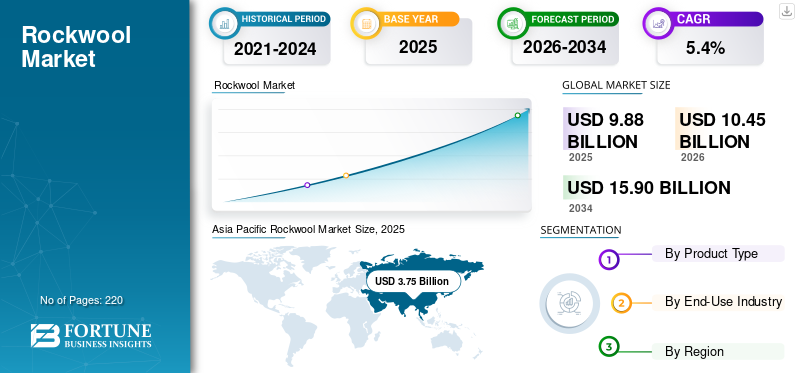
The global rockwool market size was valued at USD 9.88 billion in 2025. The market is projected to grow from USD 10.45 billion in 2026 to USD 15.90 billion by 2034, growing at a CAGR of 5.4% during the forecast period. North America dominated the rockwool market with a market share of 37.96% in 2025.
The market comprises a range of mineral-based insulation products designed to provide thermal resistance, acoustic control, fire protection, and enhance energy efficiency across building and industrial applications. The market covers key product types such as boards and slabs, rolls and blankets, pipe sections, and other specialized rockwool formats, which are used to improve building envelope performance, reduce heat loss, limit sound transmission, and enhance fire safety. These products are widely used across commercial and institutional buildings, residential buildings, industrial facilities, marine applications, and other specialty end uses, where non-combustibility, durability, moisture resistance, and high-temperature performance are important. Rising demand for energy-efficient buildings, stricter fire-safety requirements, expansion of commercial and industrial infrastructure, and increasing adoption of sustainable insulation solutions in both new construction and renovation projects are driving the market growth.
Furthermore, major key players include ROCKWOOL A/S, Knauf Insulation, Saint-Gobain, Owens Corning, and TECHNONICOL Group of Companies. Their competitive position is supported by strong mineral wool insulation portfolios, advanced manufacturing capabilities, established expertise in fire-resistant, energy-efficient, and sustainable building materials, and broad distribution networks.
Download Free sample to learn more about this report.
Rockwool Market Key Takeaways
 Global Market Size & Forecast
- 2025 Market Size: USD 9.88 Billion
- 2026 Market Size: USD 10.45 Billion
- 2034 Forecast Market Size: USD 15.90 Billion
- CAGR: 5.4% from 2026-2034
 Market Share
- North America dominated the Rockwool market with a revenue share of 37.96% in 2025.
- The rolls and blankets segment is projected to grow at a CAGR of 5.1% during the forecast period.
- The residential buildings segment is projected to grow at a CAGR of 4.8% during the forecast period.
 Key Regional Highlights
North America
North America remains a key market, supported by renovation activity, energy-efficiency requirements, and growing construction investment.
Europe
Europe is expected to reach a market valuation of USD 3.11 billion in 2026.
Asia Pacific
Asia Pacific led the Rockwool market with a valuation of USD 3.75 billion in 2025.
U.S.
The U.S. Rockwool market is estimated at USD 1.55 billion in 2026, accounting for approximately 87.4% of regional sales.
Japan
The Japanese Rockwool market is estimated at USD 0.53 billion in 2026, accounting for approximately 13.3% of regional revenues.
Read More

ROCKWOOL MARKET TRENDS
Growing Use of Rockwool in Technical and Industrial Insulation Applications to be a New Market Trend
One of the key trends in the market is the growing use of rockwool in technical and industrial insulation applications beyond conventional building insulation. Industrial users are increasingly adopting rockwool for pipes, tanks, boilers, ducts, process equipment, power plants, oil and gas facilities, marine systems, and HVAC networks where heat-loss reduction, acoustic control, fire resistance, and high-temperature performance are important. This trend is strengthening demand for higher-value products such as pipe sections, wired blankets, lamella mats, and customized insulation formats. As industrial facilities focus on energy efficiency, worker safety, process reliability, and maintenance cost reduction, rockwool is gaining importance as a durable technical insulation material.
- According to ROCKWOOL Technical Insulation, its stone wool insulation is used in energy, manufacturing, marine, and offshore applications, supporting Rockwool demand in technical insulation.
MARKET DYNAMICS
MARKET DRIVERS
Download Free sample to learn more about this report.
Rising Demand for Energy-Efficient and Fire-Safe Building Insulation to Drive Market Growth
One of the key drivers in the industry is the increasing demand for energy-efficient and fire-safe insulation materials across residential, commercial, institutional, and industrial buildings. Rockwool supports these requirements by helping reduce heat transfer, improve sound attenuation, and maintain performance under demanding temperature conditions. Its use is expanding across building envelopes, interior assemblies, mechanical insulation, and other applications where safety, comfort, and long-term reliability are important. As building owners, contractors, and infrastructure developers focus on reducing heat loss, improving indoor comfort, meeting fire-safety standards, and lowering energy consumption, the use of Rockwool insulation continues to expand.
- According to the European Commission, buildings use around 40% of EU energy, and 75% of EU buildings have poor energy performance, supporting demand for high-performance insulation materials such as rock wool.
Market Drivers - Impact & CAGR Contribution (2026–2034)
| Rank | Market Drivers | Overall Impact Rank | Contribution | Impact: 2026-2028 | Impact: 2029-2031 | Impact: 2032-2034 |
|---|---|---|---|---|---|---|
| 1 | Tightening Building Energy-Efficiency, Decarbonization, and Renovation Requirements | High | 1.80% | High | High | High |
| 2 | Expansion of Residential, Commercial, and Infrastructure Construction and Renovation | Medium | 1.55% | High | High | Medium |
| 3 | Rising Demand for Non-Combustible and Fire-Safe Building Insulation | High | 1.30% | High | High | High |
| 4 | Growing Use in Industrial Equipment, HVAC, Process, and Acoustic Insulation | Medium | 1.10% | High | High | High |
| 5 | Increasing Preference for Durable, Recyclable, and Lower-Life-Cycle-Carbon Insulation Materials | Medium | 0.95% | Medium | High | High |
| 6 | Others | Low | 0.70% | Medium | Medium | Medium |
| Total Positive Growth Contribution | 7.40% | |||||
Source: Fortune Business Insights
Download Free sample For In-Depth Market Drivers & Impact Forecasts
MARKET RESTRAINTS
High Production Costs and Energy-Intensive Manufacturing Limit Wider Adoption
The rockwool market growth faces a key restraint due to the energy-intensive nature of its manufacturing process and the cost sensitivity of major end-use industries. Rockwool production requires melting natural stone such as basalt at very high temperatures before converting it into insulation fibers, which makes production costs closely linked to energy prices, fuel availability, and plant operating efficiency. Since rockwool is used in cost-sensitive applications such as residential buildings, commercial construction, industrial insulation, and HVAC systems, increases in production, transportation, or installation costs can affect its competitiveness against alternative insulation materials.
- According to EURIMA, mineral wool is produced by melting raw materials at around 1,300°C to 1,500°C, supporting the view that Rockwool manufacturing is energy-intensive.
Market Restraints - Impact & Negative CAGR Contribution (2026–2034)
| Rank | Market Restraints | Overall Impact Rank | CAGR Contribution (pp) | Impact: 2026-2028 | Impact: 2029-2031 | Impact: 2032-2034 |
|---|---|---|---|---|---|---|
| 1 | Relatively High Upfront and Installation Costs in Price-Sensitive Applications | High | -0.80% | High | Medium | High |
| 2 | Energy-Intensive Manufacturing and Volatility in Energy, Raw Material, and Freight Costs | High | -0.55% | Medium | Medium | High |
| 3 | Construction-Sector Cyclicality and Competition from Fiberglass, Foam, and Other Insulation Materials | Medium | -0.40% | Medium | Medium | Medium |
| 4 | Others | Low | -0.25% | Low | Low | Low |
| Total Negative Growth Impact | -2.00% | |||||
Source: Fortune Business Insights
Download Free sample For In-Depth Market Restraints & Risk Analysis
MARKET OPPORTUNITIES
Expanding Green Building and Renovation Activities Creating Market Opportunities
One of the key opportunities in the market is the expanding use of high-performance insulation materials in green buildings, renovation projects, and energy-efficient infrastructure. Rockwool is well-suited for these applications as it provides thermal insulation, acoustic comfort, fire resistance, durability, and moisture resistance in a single material system. As governments, developers, and building owners continue investing in low-energy buildings, façade upgrades, roof insulation, public building renovation, and sustainable construction, demand for Rockwool products such as boards and slabs, rolls and blankets, and pipe sections is expected to increase.
- According to the European Commission, the revised Energy Performance of Buildings Directive supports a fully decarbonized building stock by 2050 and aims to increase renovation rates, creating opportunities for insulation materials including Rockwool.
MARKET CHALLENGES
Slowdown in Construction Activity and Competition from Alternative Insulation Materials Challenge Growth
The market faces a key challenge from cyclical construction activity and strong competition from alternative insulation materials. Since Rockwool demand is closely linked to residential buildings, commercial and institutional buildings, industrial facilities, and infrastructure projects, any slowdown in construction spending, delayed building permits, higher interest rates, or reduced real estate investment can directly affect market growth. At the same time, Rockwool competes with glass wool, EPS, XPS, polyurethane foam, cellulose, and other insulation materials that may offer lower upfront cost, lighter weight, or easier installation in certain applications.
- According to the U.S. Census Bureau, U.S. housing started in October 2023 were still 4.2% below October 2022, showing how construction slowdowns can pressure insulation demand.
Segmentation Analysis
By Product Type
Wide Use in Building Envelope Applications Supports Dominance of Boards & Slabs Segment
Based on product type, the market is segmented into board & slab, rolls & blankets, pipe sections, and others.
The boards & slabs segment holds the largest rockwool market share as these rigid formats are widely used where precise thickness, load-bearing consistency, and easy integration with prefabricated construction systems are required. Their standardized dimensions make them suitable for repetitive installation across large projects and help contractors achieve consistent insulation coverage with limited material movement during fitting.
- According to ROCKWOOL, its Comfort board stone wool board is used as exterior continuous insulation in residential and commercial construction, supporting boards and slabs as a major Rockwool product form.
The rolls & blankets segment is expected to grow at a CAGR of 5.1% over the forecast period.
By End-Use Industry
To know how our report can help streamline your business, Speak to Analyst
Commercial and Institutional Buildings Segment Holds the Largest Share of the Market
In terms of end-use industry, the market is categorized into commercial & institutional buildings, residential buildings, industrial facilities, the marine sector, and others.
The commercial & institutional buildings segment held the largest share of the industry in 2025, because these facilities often require controlled indoor temperatures, reduced transmission of noise between occupied spaces, and materials that can contribute to building-safety compliance. Demand is particularly strong in offices, schools, hospitals, hotels, airports, and public facilities where occupant comfort, operational continuity, and long-term maintenance performance influence material selection.
- According to Knauf Insulation, rock mineral wool slabs provide non-combustible fire protection, along with thermal and acoustic insulation, and are used across buildings, process industries, OEM applications, green roofs, and horticulture.
The residential buildings segment is expected to grow at a CAGR of 4.8% over the forecast period.
Rockwool Market Regional Outlook
By geography, the market is categorized into North America, Europe, Asia Pacific, Latin America, and the Middle East & Africa.
Asia Pacific
Asia Pacific Rockwool Market Size, 2025 (USD Billion)
To get more information on the regional analysis of this market, Download Free sample
In 2024, Asia Pacific accounted for the largest share of the market, valued at USD 3.53 billion, and continued to lead in 2025, valued at USD 3.75 billion. The region’s dominance is supported by large-scale construction activity, rapid urban infrastructure development, expanding industrial facilities, and growing demand for fire-safe and energy-efficient insulation across China, India, Japan, South Korea, and Southeast Asia. Across Asia Pacific, Rockwool demand is supported by the rapid addition of factories, logistics centers, data centers, transport hubs, and dense urban developments. The region’s large project pipeline creates demand for insulation solutions that can be installed at scale while meeting increasingly demanding building-performance requirements.
China Rockwool Market
By 2026, the Chinese market is projected to reach USD 1.81 billion. China remains the largest demand center in Asia Pacific, supported by its extensive construction base, large industrial sector, and strong domestic insulation manufacturing capacity, and increasing use of fire-resistant and energy-efficient building materials. The country’s focus on sustainable building practices, urban renewal, industrial modernization, and fire-safe construction continues to strengthen the use of Rockwool products.
To know how our report can help streamline your business, Speak to Analyst
India Rockwool Market
The Indian market is estimated at around USD 0.68 billion in 2026, accounting for roughly 17.1% of regional revenues.
Japan Rockwool Market
The Japanese market is estimated to be around USD 0.53 billion in 2026, accounting for roughly 13.3% of the regional revenues.
Europe
Europe is expected to record steady growth in the market over the forecast period, reaching a valuation of USD 3.11 billion by 2026. Growth in the region is supported by strong demand for fire-resistant, energy-efficient, and acoustic insulation materials across commercial and institutional buildings, and technical insulation applications. Continued focus on building renovation, energy conservation, fire safety, and sustainable construction practices is expected to support stable market expansion across Germany, France, the U.K., Italy, and the rest of Europe.
U.K. Rockwool Market
The U.K. market is estimated at around USD 0.44 billion in 2026, accounting for roughly 14.2% of regional revenues.
Germany Rockwool Market
Germany’s market is estimated at around USD 0.86 billion in 2026, accounting for roughly 27.7% of regional revenues.
North America
North America remains an important market for rock wool, supported by ongoing renovation activity, data-center development, warehouse construction, manufacturing investment, and upgrades to mechanical and process facilities. Regional demand is reinforced by tighter energy-efficiency requirements, greater attention to passive fire protection, and the need for insulation systems that perform reliably over long operating periods. In addition to conventional building applications, Rockwool is increasingly specified for equipment insulation, service ducts, plant rooms, utility spaces, and temperature-control systems where heat management and operational safety are critical.
U.S. Rockwool Market
Given North America’s significant contribution and the U.S. dominance in the region, the U.S. market is estimated at around USD 1.55 billion in 2026, accounting for roughly 87.4% of regional sales.
Latin America and Middle East & Africa
Latin America and the Middle East & Africa hold relatively smaller shares of the market, but both regions continue to offer meaningful growth potential. In Latin America, demand is supported by commercial construction, industrial facilities, infrastructure projects, and selective adoption of fire-safe and energy-efficient insulation materials across Brazil, Mexico, and other developing economies. The Middle East & Africa market is also expected to grow steadily, supported by large-scale construction, industrial development, energy infrastructure, oil and gas facilities, district cooling systems, and rising demand for non-combustible insulation materials. GCC countries benefit from high-rise construction, commercial buildings, hospitality projects, and industrial insulation demand, while South Africa and the rest of the region are supported by commercial buildings, mining-related facilities, power infrastructure, and broader industrial applications.
Brazil Rockwool Market
The Brazilian market is estimated at USD 0.28 billion in 2026, accounting for approximately 45.3% of regional revenues.
COMPETITIVE LANDSCAPE
Key Industry Players
Focus on Manufacturing Scale, Insulation Technology, and End-Use Reach by Key Players to Strengthen Market Share
The market is moderately consolidated, with competition shaped by manufacturers that can offer large-scale production capacity, consistent product quality, strong raw material access, and reliable distribution across building and industrial insulation applications.
Major participants such as ROCKWOOL A/S, Knauf Insulation, Saint-Gobain, Owens Corning, and TECHNONICOL Group of Companies benefit from broad mineral wool insulation portfolios, advanced manufacturing capabilities, established technical expertise, and strong regional and global supply networks.
LIST OF KEY ROCKWOOL COMPANIES PROFILED IN REPORT
- ROCKWOOL A/S (Denmark)
- Knauf Insulation (Belgium)
- Saint-Gobain (France)
- Owens Corning. (U.S.)
- TECHNONICOL Group of companies (Russia)
- İZOCAM A.Ş.(Turkey)
- Saudi Rockwool Factory (Saudi Arabia)
- ODE Yalata A.Ş. (Turkey)
- Ravago Building Solutions (Luxembourg)
- Polygon Insulation Private Limited (India)
- Huamei Energy-saving Technology Group Co., Ltd. (China)
KEY INDUSTRY DEVELOPMENTS
- April 2026: ROCKWOOL broke ground on a new USD 175 million stone wool manufacturing facility in Wallula, Washington, U.S. The plant will become the company’s fifth manufacturing facility in North America and is scheduled to begin commercial production in 2028, expanding its stone wool insulation capacity in the western U.S.
REPORT COVERAGE
The global rockwool market analysis provides an in-depth study of market size & forecast by all the segments included in the report. It includes details on market dynamics and trends expected to drive the market during the forecast period. It offers information on technological advancements, new product launches, key industry developments, and partnerships, mergers & acquisitions. The market research report also encompasses a detailed competitive landscape with information on the market shares and profiles of key players.
Request for Customization to gain extensive market insights.
Report Scope & Segmentation
| ATTRIBUTE | DETAILS |
| Study Period | 2021-2034 |
| Base Year | 2025 |
| Estimated Year | 2026 |
| Forecast Period | 2026-2034 |
| Historical Period | 2021-2024 |
| Growth Rate | CAGR of 5.4% from 2026-2034 |
| Unit | Value (USD Billion) and Volume (Kiloton) |
| Segmentation | By Product Type, End-Use Industry, and Region |
| By Product Type |
|
| By End-Use Industry |
|
| By Region |
|
Frequently Asked Questions
Fortune Business Insights says that the global market size was valued at USD 9.88 billion in 2025 and is projected to reach USD 15.90 billion by 2034.
Recording a CAGR of 5.4%, the market is slated to exhibit steady growth during the forecast period of 2026-2034.
The commercial & institutional buildings segment led in 2025.
Asia Pacific held the highest market share in 2025.
Rising demand for energy-efficient and fire-resistant insulation in buildings and industrial applications is driving the growth.



- 2021-2034
- 2025
- 2021-2024
- 220
Get 30-60 hrs Free Customization
Expand Regional and Country Coverage, Segments Analysis, Company Profiles, Competitive Benchmarking, and End-user Insights.


















Related Reports
-
US +1 833 909 2966 ( Toll Free )
-
Get In Touch With Us