Scramjet Engine Market Size, Share & Industry Analysis, By Engine Architecture (Pure Scramjet, Dual-Mode Ramjet/Scramjet, and Combined-Cycle Engines), By Platform (Missiles/Weapons, Experimental Vehicles, Hypersonic Aircraft Concepts, and Others), By Component (Inlet System, Combustor, Fuel Injection System, Nozzle, Thermal Protection Materials, and Others), By Fuel type (Hydrocarbon and Hydrogen), By Application (Defense strike, Research & demonstration, and Others), By End User (Military & Defense, Government Agencies, OEMs/Integrators, and Others), and Regional Forecast, 2026-2034
 Download Free Sample
Scramjet Engine Market Size and Future Outlook
 Listen to Audio Version
The scramjet engine market size was valued at USD 409.6 million in 2025. The market is projected to grow from USD 532.7 million in 2026 to USD 2,685.6 million by 2034, exhibiting a CAGR of 22.4% during the forecast period. North America dominated the scramjet engine market with a market share of 52.73% in 2025.
A scramjet engine is an air-breathing propulsion system that uses supersonic combustion and is designed for sustained hypersonic flight. It relies on atmospheric oxygen instead of carrying oxidizers, making it lighter and more efficient for high-speed use compared to rocket-based systems. The market is shifting from experimental testing to operational hypersonic programs, especially in the defense sector. Growing demand for long-range and high-speed strike capabilities, along with increasing investments in hypersonic propulsion systems, improvements in thermal management, materials, and propulsion integration, are speeding up investment in scramjet technologies.
The market consists of a focused group of players working on real-world hypersonic applications. Northrop Grumman and RTX have shown scramjet-powered systems in programs such as HAWC, while Boeing’s X-51A established the foundations for sustained hypersonic flight. In Europe, MBDA is leading system-level integration efforts through next-generation missile programs.
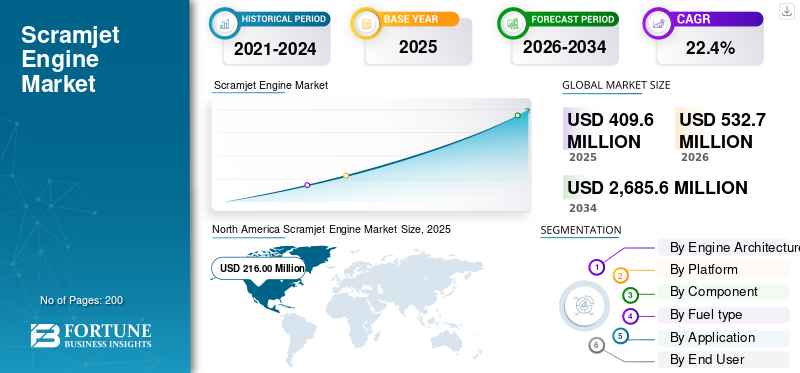
Download Free sample to learn more about this report.
Scramjet Engine Market Key Takeaways
 Global Market Size & Forecast
- 2025 Market Size: USD 409.6 Million
- 2026 Market Size: USD 532.7 Million
- 2034 Forecast Market Size: USD 2,685.6 Million
- CAGR: 22.4% from 2026–2034
 Market Share
- North America dominated the scramjet engine market with a 52.73% share in 2025.
- The combined-cycle engines segment is projected to grow at a CAGR of 24.9% during the forecast period.
- The space access concepts segment is expected to register a CAGR of 25.1% over the forecast period.
 Key Regional Highlights
North America
North America held the largest market share in 2025 and is projected to grow at a CAGR of 20.0% through 2034.
Europe
Europe accounted for 17.13% of the global market in 2025, supported by advanced hypersonic propulsion research.
Asia Pacific
Asia Pacific is anticipated to record the fastest regional growth, with a CAGR of 25.1% during the forecast period.
U.S.
The market was valued at approximately USD 205.7 million in 2025 and is projected to grow at a CAGR of 19.6%.
Japan
The market stood at around USD 12.5 million in 2025, representing approximately 12.63% of Asia Pacific revenues.
Read More

SCRAMJET ENGINE MARKET TRENDS
Shift from Isolated Propulsion Research to Weapon-Integrated Development Programs Is Emerging as a Key Market Trend
A major trend in the global market is the shift from isolated propulsion research to weapon-integrated development programs, which is significantly increasing investments in hypersonic propulsion systems. For years, scramjet development remained largely limited to laboratories, flight demonstrators, and technology-validation projects. However, the market scenario is now evolving as governments increasingly link scramjet propulsion to operational hypersonic cruise missile programs. This push is moving the market beyond theoretical engine development toward system integration, including manufacturability, advanced thermal management, and platform compatibility.
MARKET DYNAMICS
MARKET DRIVERS
Download Free sample to learn more about this report.
Rising Global Focus on Hypersonic Strike Capabilities is Driving Market Growth
The global scramjet engine market growth is being driven by the increasing global focus on hypersonic strike capabilities, mainly in the defense sector. Scramjet propulsion allows constant high-speed atmospheric flight, making it a critical technology for next-generation cruise missiles that require long range, high maneuverability, and reduced detection time. As geopolitical competition increases, several countries are prioritizing hypersonic weapon projects to strengthen deterrence capabilities and maintain strategic advantages. This shift has transformed scramjet engines from a research-oriented concept into a core enabling technology for modern defense systems, directly accelerating funding, testing, and deployment activities.
MARKET RESTRAINTS
High Thermal Stress and Limited Hypersonic Test Infrastructure Are Challenging Market Expansion
A major challenge in the scramjet engine market is that development difficulties extend beyond conceptual design and often arise during repeatable testing, thermal survivability, and validation under real hypersonic conditions. Scramjet systems need to operate under severe aerodynamic heating, combustion instability, and material stress, making development more complex than traditional propulsion programs. Additionally, the industry still relies on a small number of specialized wind tunnels, arc-jet facilities, and open-air hypersonic test ranges for experimentation and validation. This dependence slows down iterations, increases development costs, and extends program timelines. As a result, although demand for hypersonic systems is growing, market expansion remains constrained as the technical development and testing ecosystem continues to act as a bottleneck for commercialization and development.
MARKET OPPORTUNITIES
Expanding Hypersonic Demonstrator Programs Are Creating New Growth Opportunities in the Market
Key opportunity in the market lies in the expansion of hypersonic demonstrators and early-stage flight programs, especially in regions that are still building their propulsion capabilities. These programs create demand for the engine and for combustors, nozzles, thermal protection systems, testing infrastructure, and system integration support. As full-scale operational deployment is still limited, demonstrator activity opens a broader commercial path for suppliers, research institutions, and system developers. Moreover, many countries are entering the market through technology validation and prototype development initiatives, which can later translate into defense, aerospace, and space-related applications.
For instance, in December 2021, the Brazilian Air Force and the Brazilian Space Agency carried out the first flight test of the 14-X hypersonic demonstrator, described as Brazil’s first aspirated hypersonic technology demonstrator using a scramjet engine.
MARKET CHALLENGES
Unstable Supply Chains for Critical Materials and Advanced Manufacturing Are Challenging Market Expansion
A major challenge in the scramjet engine market is that advancements in propulsion design do not lead to scalable production. Scramjet systems rely on high-temperature materials, modern manufacturing methods, precise machining, and specialized sub-tier suppliers. Although governments are focusing on hypersonic programs, market growth continues to face delays as the supporting supply chain for critical materials and components is still not sufficiently resilient.
Impact of Ongoing Conflicts
The ongoing war in the Russia-Ukraine and Middle Eastern regions is having a major impact on the industry by speeding the need for cutting-edge hypersonic strike systems. These geopolitical tensions have highlighted the growing importance of high-speed and difficult-to-counter weapon systems, prompting nations to allocate resources toward advanced hypersonic technology, such as scramjet engines. As the current air defense system faces challenges in countering hypersonic weapons, speed and survivability are becoming key methods of deterrence strategies. This shift is driving substantial investments in scramjet technologies globally.
For instance, in March 2023, Russia reported the continued operational use of Kinzhal hypersonic missiles during the Ukraine conflict, highlighting the real-world deployment of hypersonic weapon systems.
Segmentation Analysis
By Engine Architecture
Dual-Mode Ramjet/Scramjet Segment Dominated due to its Ability to Support a Broader Operational Speed Range
In terms of engine architecture, the market is categorized into pure scramjet, dual-mode ramjet/scramjet, and combined-cycle engines.
The dual-mode ramjet/scramjet segment dominated the global market in 2025, as it offers a more practical transition path from controlled high-speed propulsion to sustained hypersonic operation than pure scramjet architectures. As the market is increasingly focused on weapon integration, repeatable flight performance, and scalable development, dual-mode systems are gaining importance as they support a broader operational speed range and align better with next-generation hypersonic cruise missile requirements.
The combined-cycle engines segment is expected to grow at a CAGR of 24.9% over the forecast period.
By Platform
Missiles/Weapons Segment Dominated the Market due to Stronger Funding and Deployment Opportunities in Missile Systems
On the basis of platform, the market is classified into missiles/weapons, experimental vehicles, hypersonic aircraft concepts, and space access concepts.
The missiles/weapons segment dominated the global market in 2025, as scramjet propulsion technologies are being commercialized first through hypersonic strike systems instead of civil aerospace or space-access platforms. Compared with experimental vehicles and concept-stage aircraft, missile programs offer a clearer route for funding, testing, integration, and operational deployment. This dominance also reflects the core advantage of the product, which enables sustained atmospheric hypersonic flight for long-range, fast-response, hard-to-intercept strike missions. As a result, market development is being shaped primarily by defense modernization programs and cruise-missile architectures, with scramjet engines increasingly integrated into advanced weapon-system architectures rather than remaining limited to standalone propulsion research.
The space access concepts segment is expected to grow at a CAGR of 25.1% over the forecast period.
By Component
Combustor Segment Dominated Due to Critical Role of Combustors in Scramjet Engine Performance
On the basis of component, the market is classified into inlet system, combustor, fuel injection system, nozzle, thermal protection materials, control & avionics, and others.
The combustor segment dominated the global market in 2025, as it serves as the core section where fuel-air mixing, flame stabilization, and sustained supersonic combustion occur. Additionally, a scramjet engine's performance depends heavily on a combustor's performance, resulting in operators investing significantly in combustor designs, cooling systems, ignition control, and combustion efficiency. As scramjet programs move from experimental validation toward weapon-integrated and longer-duration applications, the combustor remains the most important component for proving repeatable engine performance under real hypersonic conditions.
For instance, in January 2026, India’s DRDO successfully conducted a long-duration ground test of a full-scale actively cooled scramjet combustor. The test achieved a run time of more than 12 minutes and was described as a crucial milestone in hypersonic missile development.
The thermal protection materials segment is expected to grow at a CAGR of 24.7% over the forecast period.
By Fuel type
Operational Advantages of Hydrocarbon-fueled Scramjets Boosted Segment Growth
On the basis of fuel type, the market is classified into hydrocarbon and hydrogen.
The hydrocarbon segment holds the largest global scramjet engine market share as it offers a practical fuel solution for operational hypersonic systems, mainly in defense-led applications. Compared with hydrogen, hydrocarbon fuels are easier to store, handle, transport, and integrate into missile architectures, making them better suited for real-world deployment rather than only laboratory research or concept-stage testing. Additionally, the market is no longer being shaped only by combustion efficiency in research conditions. Instead, it is being driven by the transition toward weapon-integrated, field-relevant advanced propulsion systems. As more hypersonic programs move toward cruise missiles and deployable strike platforms, hydrocarbon-fueled scramjets continue to hold the dominating position as they align more closely with military logistics, platform packaging requirements, and operational readiness standards.
The hydrogen segment is expected to register the second-fastest growth during the forecast period, with a projected CAGR of 20.5%.
By Application
Defense Strike Segment Dominated the Market, driven by Rising Deployment of Hypersonic Offensive Weapon Systems
By application, the market is divided into defense strike, research & demonstration, and others.
The defense strike segment dominated the market in 2025, as scramjet propulsion technologies are being commercialized first through high-speed offensive weapon systems. Scramjet engines are particularly well-suited to strike missions that demand sustained atmospheric hypersonic flight, long standoff range, and reduced enemy reaction time. As defense programs move beyond basic propulsion validation, the strongest funding and procurement activities are increasingly concentrated on hypersonic cruise missiles and air-breathing strike weapons. Due to this, scramjet technology finds its clearest operational role and clearest deployment pathway within this defense strike application, allowing the segment to hold its leading position in the market.
To know how our report can help streamline your business, Speak to Analyst
The others segment is expected to register a CAGR of 26.4% over the forecast period.
By End User
Rising Demand for Hypersonic Strike Capabilities Encouraged the Military & Defense Segment Growth
Based on end user, the market is segmented into military & defense, government agencies, OEMs/integrators, and research organizations.
The military & defense segment dominated the global market in 2025, and is anticipated to grow at a CAGR of 23.6% during the forecast period. The growth is primarily driven by defense organizations, which are the leading institutions funding, testing, and transitioning scramjet propulsion technologies into real-world operational platforms. Unlike government labs or research bodies, military end users are driving demand through active operational weapon requirements, mainly for hypersonic cruise missiles that need sustained high-speed atmospheric propulsion.
The research organizations segment is expected to register a CAGR of 22.7% over the forecast period.
Scramjet Engine Market Regional Outlook
By geography, the market is categorized into North America, Europe, Asia Pacific, and the Rest of the World.
North America
North America Scramjet Engine Market Size, 2025 (USD Million)
To get more information on the regional analysis of this market, Download Free sample
North America holds the largest market share and is anticipated to grow at a CAGR of 20.0% during the forecast period. The region benefits from funded hypersonic weapon programs, proven flight-test history, and a strong propulsion-industrial base. The U.S. has moved beyond scramjet research and built a clearer pathway from engine validation to weapon integration through programs such as HAWC and HACM. Moreover, North America benefits from NASA’s earlier scramjet flight heritage and the presence of major private companies such as Northrop Grumman, RTX, and Boeing. These factors give the region a stronger commercialization and deployment foundation than other markets, enabling the region to continue to maintain its leading regional position globally.
U.S. Scramjet Engine Market
Based on the strong contribution of North America to the market and the dominant position of the U.S. within the region, the U.S. market stood at around USD 205.7 million in 2025, growing at a CAGR of 19.6%.
Europe
Europe held around 17.13% of the global market in 2025. The region is experiencing growth due to its strong propulsion research capabilities and the gradual expansion of its defense-oriented hypersonic ecosystem. The region’s strength comes from the combination of Russia’s missile-side hypersonic activity and Western Europe’s cutting-edge research capability, mainly through institutions such as ONERA, which has conducted scramjet combustor and supersonic-combustion research since the early 1990s. These developments have positioned Europe as a strategically relevant and technology-advanced market within the industry.
France Scramjet Engine Market
France market reached approximately USD 16.0 million in 2025, equivalent to around 22.78% of Europe's revenues.
U.K. Scramjet Engine Market
The U.K. market stood at around USD 13.4 million in 2025, representing roughly 19.04% of Europe's revenues.
Asia Pacific
Asia Pacific is anticipated to grow at a CAGR of 25.1% over the forecast period, driven by a combination of defense-driven hypersonic programs and long-running propulsion research efforts. Australia, India, Japan, and China are investing heavily in research and development on scramjet engine programs. For Instance, Australia’s SCIFiRE program is officially described as a Mach 5-class precision strike missile powered by an air-breathing scramjet engine. The region retains a strong demonstration and research layer through programs such as HIFiRE, which focus on the fundamental science of hypersonics and next-generation aeronautical systems.
China Scramjet Engine Market
The Chinese market 2025 revenues stood at around USD 37.6 million, representing roughly 37.87% of the global sales.
Japan Scramjet Engine Market
The Japanese market in 2025 stood at around USD 12.5 million, accounting for roughly 12.63% of Asia Pacific revenues.
Rest of the World (RoW)
The rest of the World (Middle East & Africa and Latin America) holds a comparatively smaller market share but is expected to grow at a CAGR of 24.2% during the forecast period. Growth in these regions is anchored by a few highly strategic and technical programs. For instance, Brazil’s 14-X/PropHiper has been described by the Brazilian government as the country’s first scramjet-based hypersonic demonstrator. That gives RoW a market structure that is more demonstrator-led and research-oriented than the major regions. Unlike other regions, where scramjet technologies are increasingly tied to operational strike systems, the Rest of the World is still shaped more by early-stage propulsion research, aerospace experimentation, and long-term strategic capability development.
Latin America Scramjet Engine Market
The market in Latin America reached around USD 15.6 million in 2025, accounting for roughly 64.54% of Rest of the World revenues.
Middle East & Africa Scramjet Engine Market
The Middle East & Africa market stood at around USD 8.6 million in 2025 and is expected to reach USD 59.8 million in 2034.
COMPETITIVE LANDSCAPE
Key Industry Players
Concentrated Player Base Defines the Competitive Landscape
The scramjet engine market is led by a small group of aerospace and defense private companies with the technical depth to work on hypersonic air-breathing propulsion. Northrop Grumman, RTX, Boeing, and Aerojet Rocketdyne under L3Harris are among the key players, as they are tied to government-backed hypersonic programs and have proven experience in flight testing, propulsion design, and system integration.
The competitive landscape is moving beyond engine development. Private Companies such as MBDA are pushing hypersonic missile integration in Europe, while research bodies and national programs in India, Japan, and Australia continue to build the wider technology base. The market remains difficult for new entrants, with progress shaped mainly by defense contracts, long development cycles, and partnerships between governments, primes, and specialist propulsion firms.
LIST OF KEY SCRAMJET ENGINE COMPANIES PROFILED
- Northrop Grumman Corporation (U.S.)
- RTX Corporation (U.S.)
- The Boeing Company (U.S.)
- L3Harris Technologies, Inc. (Aerojet Rocketdyne) (U.S.)
- Lockheed Martin Corporation (U.S.)
- GE Aerospace (U.S.)
- MBDA (France)
- BAE Systems plc. (U.K.)
- Mitsubishi Heavy Industries, Ltd. (Japan)
- China Aerospace Science and Technology Corporation (CASC) (China)
- Leidos, Inc. (U.S.)
KEY INDUSTRY DEVELOPMENTS
- February 2026: The U.K. Ministry of Defence awarded Amentum U.K. a USD 16.20 million contract to accelerate hypersonic missile development. The announcement shows that scramjet-relevant hypersonic weapon work is broadening beyond the traditional U.S.-led market.
- April 2025: India’s DRDO conducted a long-duration active-cooled scramjet subscale combustor ground test for more than 1,000 seconds at its Scramjet Connect Test Facility in Hyderabad, indicating that the system was moving closer to full-scale flight-worthy combustor readiness.
- December 2024: India’s DRDO announced a successful scramjet engine ground test, highlighting stable combustion, ignition, and thermal-management performance and describing the system as having potential for operational use in hypersonic vehicles. This marked a major propulsion-development milestone outside the U.S. and Europe.
- June 2024: Japan’s Ministry of Defense disclosed USD 168.23 million in related costs for a hypersonic aerodynamic and propulsion test unit at the Chitose Test Center to assess scramjet engines for hypersonic missiles.
- September 2023: DARPA announced the final successful flight of the HAWC program, with the Lockheed Martin vehicle powered by an Aerojet Rocketdyne scramjet completing the program’s objectives and delivering critical data for further Air Force hypersonic technology maturation.
- September 2022: The U.S. Air Force awarded RTX (Raytheon Missiles & Defense) a USD 985.35 million contract to develop and demonstrate Hypersonic Attack Cruise Missile (HACM) prototypes, describing HACM as an air-launched, scramjet-powered hypersonic weapon. This remains one of the most important contract awards in the market.
- July 2022: DARPA announced the third successful HAWC flight test, stating that the Raytheon-built demonstration vehicle again met test objectives and added new performance data for future hypersonic air-breathing weapons. The program reinforced the role of scramjet propulsion in operational strike-system development.
- September 2021: DARPA and the U.S. Air Force completed the first successful free-flight test of HAWC, with the Raytheon-built vehicle powered by a Northrop Grumman scramjet flying above Mach 5. This was one of the clearest early proofs that air-breathing hypersonic strike systems were moving beyond lab validation into realistic flight demonstration.
REPORT COVERAGE
The global scramjet engine market analysis provides an in-depth study of market size, market segmentation, company profiling, and forecast by all the market segments included in the report. It includes details on the market dynamics and trends that are expected to drive the market during the forecast period. It offers information on the technological advances, new product launches, key industry experts’ developments, and details on strategic partnerships, mergers & acquisitions. The market research report also encompasses a detailed competitive landscape with information on the market share and profiles of key market players.
Request for Customization to gain extensive market insights.
Report Scope & Segmentation
| ATTRIBUTE | DETAILS |
| Study Period | 2021-2034 |
| Base Year | 2025 |
| Estimated Year | 2026 |
| Forecast Period | 2026-2034 |
| Historical Period | 2021-2024 |
| Growth Rate | CAGR of 22.4% from 2026 to 2034 |
| Unit | Value (USD Million) |
|
Segmentation |
By Engine Architecture
|
|
By Platform
|
|
|
By Component
|
|
|
By Fuel type
|
|
|
By Application
|
|
|
By End User
|
|
|
By Region
|
Frequently Asked Questions
Fortune Business Insights says that the global market value stood at USD 409.6 million in 2025 and is projected to reach USD 2,685.6 million by 2034.
In 2025, the North American market value stood at USD 216.0 million.
The market is expected to exhibit a CAGR of 22.4% during the forecast period.
By platform, the missiles/weapons segment led the market.
Rising demand for hypersonic strike capabilities is a key factor driving market growth.
Key players in the market include Northrop Grumman, Lockheed Martin, RTX, L3Harris Technologies, Boeing, and MBDA.
North America dominates the market.



- 2021-2034
- 2025
- 2021-2024
- 200
Get 30-60 hrs Free Customization
Expand Regional and Country Coverage, Segments Analysis, Company Profiles, Competitive Benchmarking, and End-user Insights.




















Related Reports
-
US +1 833 909 2966 ( Toll Free )
-
Get In Touch With Us