Sensor Testing Market Size, Share & Industry Analysis, By Component (Hardware and Software), By Testing Methods (Environmental Testing, Functional Testing, Calibration Testing, Performance Testing, and Others), By Sensor Type (Temperature Sensors, Pressure Sensors, Motion Sensors, Proximity Sensors, Biometric Sensors, and Others), By Application (Automotive, Consumer Electronics, Aerospace & Defense, Healthcare, and Others) and Regional Forecast, 2026-2034
 Download Free Sample
Sensor Testing Market Size and Future Outlook
 Listen to Audio Version
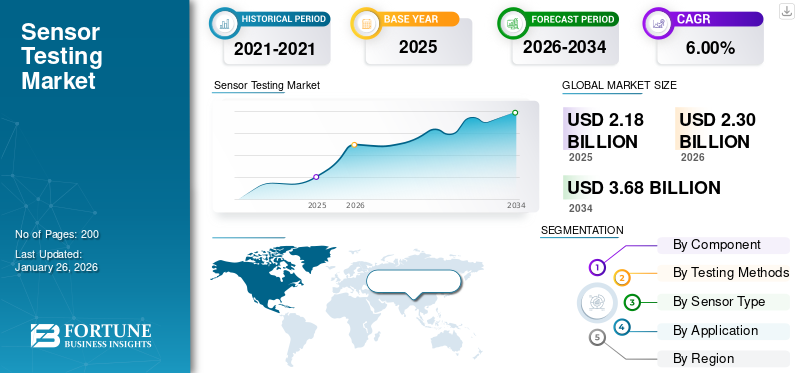
The global sensor testing market size was valued at USD 2.18 billion in 2025. The market is projected to grow from USD 2.30 billion in 2026 to USD 3.68 billion by 2034, exhibiting a CAGR of 6.00% during the forecast period. Asia Pacific dominated the sensor testing market with a market share of 39.60% in 2025.
Sensor testing refers to the validation and calibration processes that ensure sensors perform accurately, reliably, and consistently under varied operating conditions. These systems utilize precision instrumentation, automation software, and advanced analytics to measure parameters such as temperature, pressure, motion, light, and proximity.
Leading companies operating in this market include National Instruments Corporation, Keysight Technologies, Fluke Corporation, and Spectris plc. Their strong market position is reinforced by diversified product portfolios, continuous technological innovation, deep collaborations with OEMs, and extensive service networks.
Download Free sample to learn more about this report.
Sensor Testing Market Key Takeaways
 Market Size & Forecast
- 2025 Market Size: USD 2.18 Billion
- 2026 Market Size: USD 2.30 Billion
- 2034 Forecast Market Size: USD 3.68 Billion
- CAGR: 6.00% from 2026–2034
 Market Share
- Asia Pacific dominated the sensor testing market with a 39.60% share in 2025.
- The hardware segment is projected to dominate the market with an 81.24% share in 2026.
- The environmental testing segment is expected to hold a 43.63% share in 2026.
 Key Regional Highlights
Asia Pacific
Asia Pacific generated USD 0.86 billion in 2025 and is projected to reach USD 0.91 billion in 2026.
North America
North America generated USD 0.44 billion in 2025 and is projected to reach USD 0.45 billion in 2026.
Europe
Europe accounted for USD 0.67 billion in 2025 and is expected to reach USD 0.71 billion in 2026.
U.S.
Strong demand for advanced sensor testing solutions across aerospace, defense, and semiconductor manufacturing continues to support market growth.
Japan
Rising investments in semiconductor manufacturing and precision electronics are driving demand for sensor testing solutions.
Read More

IMPACT OF AI
Implementation of AI Capabilities to Fuel the Growth of the Market
AI is greatly affecting the sensor testing market by allowing smarter, faster, and more accurate testing processes. It helps automate complex data analysis, spot faults early, and improve test procedures, which cuts down on time and costs. For instance,
- In May 2025, researchers in Chicago developed an AI model inspired by the human brain to speed up the design of chemical sensors. The "spiking graph neural network" analyzes past research to predict effective sensor materials with ~90% accuracy.
AI-driven tools also improve predictive maintenance and increase the reliability of sensor systems across industries, speeding up innovation and product development.
MARKET DYNAMICS
MARKET DRIVERS:
Growing Automotive Industry and Advanced Driver Assistance Systems (ADAS) to Propel Market Growth
The automotive industry is quickly adopting new sensor technologies to improve vehicle safety and automation. Vehicles now use a variety of sensors, including LiDAR, radar, ultrasonic sensors, and cameras. These support Advanced Driver Assistance Systems and enable features such as collision avoidance, lane keeping, and adaptive cruise control. For instance,
- In September 2025, Valeo and Capgemini partnered to test and validate Valeo’s new Level 2+ Advanced Driver Assistance System (ADAS). The collaboration combines Valeo’s sensor and software expertise with Capgemini’s end-to-end development, data-driven testing, and AI-powered validation services.
This testing ensures the sensor’s accuracy and reliability under different conditions. Meeting worldwide safety regulations requires strict validation of automotive sensors, which is driving increased demand in the market.
MARKET CHALLENGE:
Complexity in Testing Different Sensor Types to Restrict Market Expansion
One of the main challenges in the ADAS market is the complexity of testing different sensor types. ADAS systems combine multiple sensors such as cameras, radar, LiDAR, and ultrasonic sensors, each with its own technology and testing needs.
Testing goes beyond checking individual sensor performance; it involves assessing how these sensors interact in real-world environments with different lighting, weather, and traffic conditions. Furthermore, confirming the integration of data from various sensors to guarantee accurate and reliable system responses adds another level of difficulty.
MARKET OPPORTUNITIES:
Growth in Industry 4.0 and Smart Manufacturing to Create Lucrative Growth Opportunities
The rise of Industry 4.0 and smart manufacturing is changing traditional factories into highly automated and interconnected systems. These systems rely heavily on sensors to monitor equipment, improve production processes, and ensure quality control. The sensors collect real-time data on machine health, environmental conditions, and product parameters. For instance,
- In November 2024, SensoPart’s new VISOR XE vision sensor boosts industrial automation with 4x faster speed, enhanced AI processing, and simpler installation. It integrates easily with existing systems, offering a powerful and efficient solution for advanced image-based tasks.
SENSOR TESTING MARKET TRENDS:
Rise in Simulation and Virtual Testing to be a Key Trend in the Market
Simulation and virtual testing have become important trends in the sensor testing market growth. These technologies let companies create detailed digital models and virtual environments that mimic real-world conditions. This enables thorough testing without depending only on physical prototypes. For instance,
- In November 2023, the VIVID project is a German-Japanese partnership to develop a virtual testing tool for validating autonomous vehicle sensors, ensuring safer automated driving. It combines software and hardware simulations to improve sensor performance and aims to standardize testing methods for levels 3 to 5 automation.
Additionally, simulation tools enable testing complex scenarios that are hard or risky to recreate in real life, such as extreme environmental conditions or rare events.
Download Free sample to learn more about this report.
Segmentation Analysis
By Application
Automotive Segment Holds the Largest Share, Driven by the Rising Integration of Advanced Sensor Systems in Vehicles
On the basis of application, the market is classified into automotive, consumer electronics, aerospace & defense, healthcare, and others.
To know how our report can help streamline your business, Speak to Analyst
The automotive sector holds the majority of the sensor testing market share as vehicles depend on various sensors for safety, navigation, and autonomous driving features. The strict safety standards and regulatory requirements in the automotive industry lead to thorough testing to ensure sensor accuracy and reliability.
The healthcare segment is expected to grow at a CAGR of 10.20% over the forecast period.
By Component
Hardware Components Lead the Market Owing to their Critical Role in Sensor Calibration and Performance Validation
In terms of components, the market is categorized into hardware and software.
The hardware segment captured the largest share of the market in 2025. In 2026, the segment is anticipated to dominate with an 81.24% share due to the spurring need for accurate measurement and evaluation of sensor performance, durability, and reliability. Physical testing equipment is necessary to validate sensors in real-world conditions and ensure they meet required standards. The growing complexity and variety of sensors also drive the demand for better hardware testing solutions.
The software segment is expected to grow at a CAGR of 8.30% over the forecast period.
By Testing Method
Environmental Testing Led the Market Due to Its Ability to Assess Sensor Durability and Real-World Performance
Based on testing method, the market is segmented into environmental testing, functional testing, calibration testing, performance testing, and others.
The environmental testing held the dominant position in 2025. The segment is expected to hold the share of 43.63% in 2026, as it confirms that sensors can handle different real-world conditions, including temperature, humidity, vibration, and dust. This testing is essential for verifying sensor durability and accuracy across various applications and tough environments. For instance,
- In July 2024, Draper, in partnership with DARPA, is developing microbe-based sensors for environmental monitoring. These engineered microbes will detect chemical and physical signals, translating them into measurable outputs to monitor toxins, pollutants, and hazardous agents.
The environmental segment is set to flourish with a growth rate of 7.30% growth across the forecast period.
By Sensor Type
Motion Sensors Segment Dominates the Market Due to Their Broad Adoption in Various Industries
Based on sensor type, the market includes temperature sensors, pressure sensors, motion sensors, proximity sensors, biometric sensors, and others.
In 2025, the motion sensors segment held the majority share in the market. The segment is expected to hold a share of 26.26% in 2026 as they are widely used in industries such as automotive, aerospace, consumer electronics, and industrial automation. They play a vital role in detecting movement and positioning. This requires thorough testing to ensure accuracy, reliability, and safety in different applications. For instance,
- In August 2025, Coimbatore started testing solar-powered streetlights with motion sensors to save energy and reduce pollution. They are trying out 122 lights that can dim automatically to see how well the sensors work and how much energy they can save.
In addition, biometric sensors are projected to grow at a CAGR of 9.40% during the study period.
Sensor Testing Market Regional Outlook
By geography, the market is categorized into Europe, North America, Asia Pacific, South America, and the Middle East & Africa.
Asia Pacific Sensor Testing Market Size, 2025 (USD Billion)
To get more information on the regional analysis of this market, Download Free sample
Asia Pacific
Asia Pacific accounted for USD 0.86 billion in 2025, representing 39.60% of the global market share, and is projected to reach USD 0.91 billion in 2026. The region’s dominance is driven by the increasing localization of semiconductor and sensor production, government-backed initiatives such as “Made in China 2025” and “Digital India,” and the rise of electronics test and measurement hubs, which have further strengthened regional growth. China accounts for the largest share within Asia Pacific, estimated to reach USD 0.29 billion in 2026, reflecting its strong presence in sensor R&D and manufacturing ecosystems.
Europe
Europe contributed 30.80% to the global market in 2025, with a valuation of USD 0.67 billion, and is projected to reach USD 0.71 billion in 2026. Growth is fueled by increasing investment in automotive safety systems, industrial automation, and environmental monitoring technologies that rely heavily on precise sensor calibration and validation. Countries such as the U.K. (USD 0.16 billion), Germany (USD 0.21 billion), and France (USD 0.11 billion) are among the frontrunners due to strong OEM presence, regulatory emphasis on product reliability, and advanced R&D infrastructure for sensor testing and validation systems.
North America
The North America market generated USD 0.44 billion in 2025, representing 20.00% of the global market landscape, and is expected to reach USD 0.45 billion in 2026. which is supported by steady demand for sensor testing platforms in aerospace, defense, and semiconductor manufacturing. Established test and measurement vendors, along with early technology adoption among Tier-1 suppliers and research labs, are sustaining the region’s market relevance.
Middle East & Africa and South America
In 2025, Middle East & Africa held 6.20% of the global market, reaching a valuation of USD 0.13 billion, and is projected to grow to USD 0.14 billion in 2026. Latin America contributed approximately USD 0.08 billion to the global market in 2025, accounting for 3.50% share, and is expected to reach USD 0.08 billion in 2026. Over the forecast period, South America is projected to reach USD 0.07 billion in 2025, driven by gradual industrial automation and automotive sensor integration in countries such as Brazil and Mexico. The Middle East & Africa region is anticipated to expand at a moderate pace, with the GCC region expected to reach USD 0.05 billion by 2025, supported by growing investments in smart infrastructure, process industries, and IoT-based monitoring systems.
COMPETITIVE LANDSCAPE
Key Industry Players:
Comprehensive Test Portfolios and Strategic Collaborations with OEMs Have Enabled Leading Vendors to Sustain Market Dominance
The market remains moderately consolidated, with a mix of established instrumentation leaders and specialized solution providers. Major companies have strengthened their market presence through broad product portfolios covering multiple sensor types, including temperature, pressure, motion, and optical sensors, along with deep collaborations with OEMs and system integrators.
National Instruments Corporation, Keysight Technologies, Fluke Corporation, and Spectris plc are among the leading players in this market. These companies stand out due to their advanced test architectures, integration with simulation and automation platforms, and continued investment in research and development.
LIST OF KEY SENSOR TESTING COMPANIES PROFILED:
- National Instruments Corp (U.S.)
- Keysight Technologies, Inc. (U.S.)
- Fluke Corporation (U.S.)
- Rohde & Schwarz Gmbh & Co (Germany)
- TE Connectivity (Switzerland)
- Spectris (U.K.)
- Advantest Corporation (Japan)
- Intertek Group (U.K.)
- Humanetics Group (U.S.)
- Giatec Scientific (Canada)
- Infeneon Technologies (Germany)
- Texas Instruments Inc (U.S.)
KEY INDUSTRY DEVELOPMENTS:
- September 2025: San Jose, California, and Lakewood, Colorado, are testing AI-powered vision sensors from Sony Semiconductor Solutions to improve pedestrian safety and traffic management. The solar-powered, privacy-friendly cameras detect vehicle direction, traffic volume, and pedestrian presence, especially at night.
- August 2025: Aemulus Holdings Bhd acquired the camera sensor testing business of China's Revotronix group, gaining intellectual property, technology, customer contracts, and assets. This acquisition strengthens Aemulus’s position in the CMOS image sensor market, boosting revenue and reducing reliance on third-party components.
- July 2025: L3Harris and Italy’s ELT Group partnered to build Italy’s first multi-sensor test facility for military ISR and electronic attack aircraft, boosting the country’s defense capabilities. The facility would support the Italian Air Force’s G550-based platforms and strengthen collaboration with allied nations.
- April 2024: Luminar launched its compact Halo lidar sensor and partnered with Applied Intuition to enable virtual testing of driver-assist systems. This integration helps automakers cut costs and speed up development. Luminar began shipping sensors to Volvo ahead of the EX90 SUV launch in late 2024.
- November 2022: Fujitsu and Wakayama Medical University in Japan tested a new millimeter-wave sensor and AI technology to detect falls in hospitals and nursing homes while protecting patient privacy. The trial aims to improve emergency response without using cameras, with plans to offer the sensor service by next year to enhance elderly care.
REPORT COVERAGE
The global market analysis provides an in-depth study of market size & forecast by all the market segments included in the report. It includes details on the market dynamics and market trends expected to drive the market in the forecast period. It offers information on the technological advancements, new product launches, key industry developments, and details on partnerships, mergers & acquisitions. The research report also encompasses a detailed competitive landscape with information on the market share and profiles of key operating players.
Request for Customization to gain extensive market insights.
Report Scope & Segmentation
| ATTRIBUTE | DETAILS |
| Study Period | 2021-2034 |
| Base Year | 2025 |
| Estimated Year | 2026 |
| Forecast Period | 2026-2034 |
| Historical Period | 2021-2024 |
| Growth Rate | CAGR of 6.00% from 2026-2034 |
| Unit | Value (USD Billion) |
| Segmentation |
By Component
By Testing Methods
By Sensor Type
By Application
By Geography
|


- 2021-2034
- 2025
- 2021-2024
- 200
Get 30-60 hrs Free Customization
Expand Regional and Country Coverage, Segments Analysis, Company Profiles, Competitive Benchmarking, and End-user Insights.




















Related Reports
-
US +1 833 909 2966 ( Toll Free )
-
Get In Touch With Us