Sequencing Reagents Market Size, Share & Industry Analysis, By Reagents (Sample & Nucleic Acid Preparation Reagents, Library Preparation Reagents, Library QC & Quantification Reagents, Target Enrichment Reagents, Sequencing Run Reagents & Consumables, and Others), By Origin (Synthetic, Biological, and Mixed), By Technology (Next-Generation Sequencing (NGS), Sanger Sequencing, Third Generation Sequencing, and Others), By Application (Drug Discovery & Development, Genetic & Rare Disease Research, Biomarker Discovery & Validation, and Others), By End User, and Regional Forecast, 2026-2034
 Download Free Sample
KEY MARKET INSIGHTS
 Listen to Audio Version
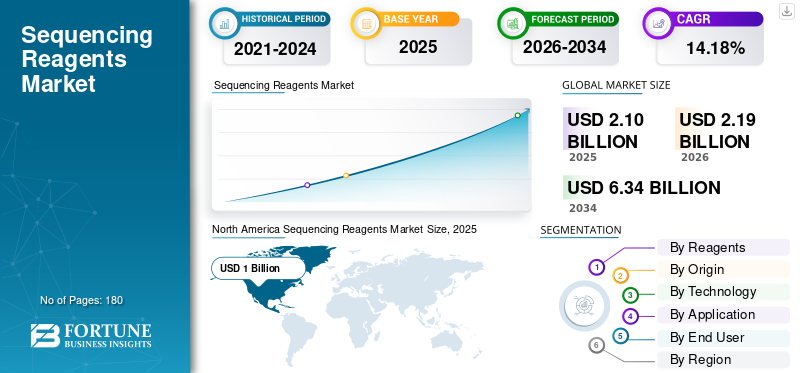
The global sequencing reagents market size was valued at USD 2.10 billion in 2025. The market is projected to grow from USD 2.19 billion in 2026 to USD 6.34 billion by 2034, exhibiting a CAGR of 14.18% during the forecast period. North America dominated the global sequencing reagents market with a market share of 47.62% in 2025.
The global market is experiencing steady and substantial growth. The market is expected to grow due to advances in DNA and RNA analysis. These reagents encompass chemicals, enzymes, and sequencing kits used in various sequencing technologies such as next-generation sequencing (NGS) and Sanger sequencing.
Furthermore, the growing demand for personalized medicines, human genome research, and clinical diagnostics, along with the increasing investment and presence of key players offering technologically advanced solutions, is expected to boost market growth.
- For instance, in July 2025, New England Biolabs announced the launch of the NEBNext Low-bias Small RNA Library Prep Kit, a new method for preparing small RNA that offers faster processing, reduced bias, and a wider input range compared to other commercially available options.
Furthermore, many key industry players including Thermo Fisher Scientific Inc. and Agilent, operating in the market, are focusing on offering innovative products for genomic and biotechnology research, thereby maintaining their positions in the market.
Download Free sample to learn more about this report.
Sequencing Reagents Market Key Takeaways
 Market Size & Forecast
- 2025 Market Size: USD 2.10 billion
- 2026 Market Size: USD 2.19 billion
- 2034 Forecast Market Size: USD 6.34 billion
- CAGR: 14.18% from 2026–2034
 Market Share
- North America dominated the global sequencing reagents market with a 47.62% share in 2025.
- The Next-Generation Sequencing (NGS) segment accounted for the largest market share of 77.3% in 2025.
- The Mixed segment accounted for a 64.2% market share in 2025.
 Key Regional Highlights
North America
North America held 47.62% share in 2025, valued at USD 1.00 billion.
Asia Pacific
Asia Pacific market valued at USD 0.53 billion in 2025.
Europe
Europe market valued at USD 0.28 billion in 2025.
U.S.
Market reached USD 0.95 billion in 2025.
Japan
Market reached USD 0.16 billion in 2025.
Read More

SEQUENCING REAGENTS MARKET TRENDS
Rapid Shift Towards Room Temperature Sequencing Reagents is a Key Market Trend
The shift toward room-temperature sequencing reagents is gaining momentum and is a prominent global trend in the market. These reagents eliminate the need for cold-chain logistics, reducing shipping costs and complexity, thus increasing accessibility in remote or resource-limited regions.
They also enhance shelf life and stability, enabling more flexible storage options for laboratories, supporting faster deployment and turnaround times for sequencing workflows. Thus, overall, such a product launch and adoption aimed to boost research and market growth.
- For instance, in September 2022, Illumina, Inc. launched NovaSeq X Series sequencers, including NovaSeq X and NovaSeq X Plus, designed for sustainable genomic sequencing. A key innovation is its ambient-temperature shipping capability for reagents, which eliminates the need for dry ice and saves approximately 500 tons of dry ice annually.
Download Free sample to learn more about this report.
MARKET DYNAMICS
MARKET DRIVERS
Rising Prevalence of Cancer and Drug Discovery to Drive the Market Growth
The rising prevalence of cancer globally is a significant factor driving the adoption of sequencing for oncology research and drug development. As the demand for precise diagnosis and personalized treatment options increases, the adoption of sequencing technologies to identify genetic mutations and molecular profiles associated with various cancers also increases. This surge in demand for accurate and rapid genetic insights is driving the utilization of sequencing reagents and contributing to the
- For instance, in August 2024, Illumina Inc. expanded oncology testing options for NovaSeq X Series by offering the high-throughput TruSight Oncology 500 (TSO 500 HT) and the latest TruSight Oncology 500 ctDNA v2 liquid biopsy These updates provide labs with improved economics, faster run times, and larger batch capacities for tissue and liquid biopsy research.
MARKET RESTRAINTS
High Cost of Reagents to Restrict the Market Growth
The high cost of sequencing reagents considerably limits market growth by increasing overall testing expenses. The cost of reagents is associated with the complex synthesis routes, stringent quality control measures, and advanced manufacturing techniques, which increase production costs. This restricts the adoption of reagents, especially for smaller laboratories and developing regions and the overall widespread implementation of sequencing technologies.
- For instance, according to various commercial websites, the cost of Illumina Reagent Kits for every Illumina sequencer in India is USD 110.95 per piece, which can be costly for small-scale laboratories.
MARKET OPPORTUNITIES
Expansion towards Third-Generation Sequencing Marks a Lucrative Market Growth Opportunity
The rapid expansion of third-generation sequencing workflows presents a significant growth opportunity in the market. These advanced workflows enable more accurate and comprehensive genome assemblies, structural variation detection, and epigenetic analysis, driving demand for specialized reagents.
Additionally, key companies are focused on offering advanced sequencing workflows, which increases demand for reagents and contributes to market growth.
- For instance, in February 2025, F. Hoffmann-La Roche launched proprietary breakthrough sequencing by expansion (SBX) technology, creating a new segment in next-generation sequencing. The SBX chemistry, integrated with an innovative sensor module, delivers ultra-fast, high-throughput sequencing that is adaptable and scalable for a wide variety of applications.
MARKET CHALLENGES
Supply Chain Stability and Challenges in Maintaining Consistency to Hamper the Market Growth
Maintaining supply-chain stability and consistency poses significant challenges to the growth of the market. The disruptions in raw material procurement, manufacturing delays, and logistical issues lead to shortages and delays in reagent availability deter the adoption of the product. Additionally, maintaining consistent reagent quality across different production batches is crucial for obtaining reliable sequencing results, therefore it can hinder the large-scale adoption and limit sequencing reagents market growth.
Segmentation Analysis
By Reagents
High Demand and Usage of Sequencing Run Reagents & Consumables to Propel Segment Growth
Based on the reagents, the market is categorized into sample & nucleic acid preparation reagents, library preparation reagents, library QC & quantification reagents, target enrichment reagents, sequencing run reagents & consumables, and others.
The library preparation reagents segment is expected to account for the largest share of the market. The segment held a 54.6% market share. The segment’s dominating position is driven by its critical role of library preparation in converting extracted DNA or RNA into sequencing-ready libraries. These reagents are utilized for fragmentation, end repair, adapter ligation, amplification, indexing and quality optimization across most sequencing workflows. Surge in application areas such as whole-genome sequencing, RNA sequencing, targeted sequencing, liquid biopsy and multiomic analysis is increasing recurring consumption of library preparation kits. Moreover, the development of integrated kits for low-input, degraded and complex samples is expected to support the segment’s growth.
- For instance, in February 2026, Twist Bioscience launched the Twist TrueAmp Library Preparation Kit and the Twist PCR-Free Whole Genome Sequencing Library Preparation Kit. The kits use proprietary enzymes to improve library yield, sequencing coverage and data quality across low-input, degraded and difficult sample types.
The sample & nucleic acid preparation reagents segment is expected to grow at a CAGR of 11.53% over the forecast period.
To know how our report can help streamline your business, Speak to Analyst
By Origin
Increasing Adoption Mixed Source due to Its Versatility and Compatibility Boosted Segment Growth
Based on the origin, the market is segmented into synthetic, biological, and mixed.
In 2025, the mixed segment dominated the global market. The mixed segment dominated the market, accounting for a 64.2% market share. The dominant share is bolstered by its versatility and compatibility across various sequencing platforms, providing researchers with flexible and reliable options for genetic analysis.
Also, the launch of new dynamic kits with mixed sources is expected to boost the segment’s growth.
- For instance, in May 2024, QIAGEN launched the QIAseq Multimodal DNA/RNA Library Kit. This kit supports applications such as Whole-Genome Sequencing (WGS), Whole-Transcriptome Sequencing (WTS), and subsequent target enrichment through hybrid capture, all from a single sample.
The synthetic segment is projected to grow at a CAGR of 16.17% over the forecast period.
By Technology
Increasing Installation and Routine Adoption Led to the NGS Segment’s Growth
Based on technology, the market is segmented into Next-Generation Sequencing (NGS), Sanger sequencing, third-generation sequencing, and others.
The next-generation sequencing (NGS) segment is anticipated to witness a dominant market share over the forecast period. The segment held a 77.3% market share. The dominant share of is due to the widespread routine adoption of the sequencing approach across research and translational workflows.
- For instance, in April 2024, Meridian Bioscience, Inc. announced the release of an extensive selection of glycerol-free NGS enzymes designed for all stages of Next-Generation Sequencing workflows.
The third-generation sequencing segment is projected to grow at a CAGR of 19.48% over the forecast period.
By Application
Rising Prevalence of Critical Diseases and Demand for Personalized Treatment to Boost Drug Discovery & Development Segment’s Growth
Based on application, the market is segmented into drug discovery & development, genetic & rare disease research, biomarker discovery & validation, and others.
The drug discovery & development segment held a dominant share of the market. The segment held a 57.1% market share. The growth of the segment is attributed to the rising prevalence of chronic diseases and the demand for personalized treatment, which is expected to boost genomic research and the adoption of these products.
- For instance, in April 2025, EpiCypher unveiled CUTANA meCUT&RUN and Multiomic CUT&RUN, two novel DNA methylation sequencing technologies advancing the frontiers of genomic research and drug discovery.
The genetic & rare disease research segment is projected to grow at a CAGR of 13.40% over the forecast period.
By End User
Research and Development Activities by Pharmaceutical & Biotechnology Companies Boosts the Segment’s Growth
Based on end user, the market is segmented into pharmaceutical & biotechnology companies, academic & research institutes, and others.
Pharmaceutical & biotechnology companies held the most significant portion of the market, accounting for a 43.0% share. Increasing research and development activities aimed at launching innovative drugs, as well as high investment in research and strategic initiatives to boost adoption, drive the segment growth.
- For instance, in January 2026, STORM Therapeutics collaborated with AlidaBio to accelerate the development of cancer therapies that target RNA modifications.
The academic & research institutes segment is projected to grow at a CAGR of 11.96% over the forecast period.
Sequencing Reagents Market Regional Outlook
By geography, the market is categorized into Europe, North America, Asia Pacific, Latin America, and the Middle East & Africa.
North America
North America Sequencing Reagents Market Size, 2025 (USD Billion)
To get more information on the regional analysis of this market, Download Free sample
North America held the dominant sequencing reagents market share in 2024, valued at USD 0.96 billion, and also maintained its leading position in 2025, with a value of USD 1.00 billion. The market in North America is expected to grow due to the presence of advanced research infrastructure and key players.
U.S. Sequencing Reagents Market
Based on North America’s strong contribution and the U.S. dominance within the region, the U.S. market can be analytically approximated at around USD 0.95 billion in 2025, accounting for roughly 45.5% of global market sales. The dominance of the country is due to strong investments activities in genomic research and presence of major biotech companies and research institutions.
Europe
Europe is projected to record a growth rate of 8.26% in the coming years, the third largest market among all regions, and reached the valuation of USD 0.28 billion by 2025. The region’s growth in the market is driven by robust research infrastructure and advancements in genomic research.
U.K. Sequencing Reagents Market
The U.K. market in 2025 reached around USD 0.06 billion, representing approximately 2.9% of global market revenues.
Germany Sequencing Reagents Market
Germany’s market is reached approximately USD 0.06 billion in 2025, equivalent to around 2.7% of global market sales.
Asia Pacific
Asia Pacific reached USD 0.53 billion in 2025 and secured the position of the second-largest region in the market. In the region, India and China are both recorded USD 0.09 billion and USD 0.10 billion as their valuation, respectively, in 2025.
Japan Sequencing Reagents Market
The Japan market in 2025 recorded around USD 0.16 billion, accounting for roughly 7.5% of the global market revenues.
China Sequencing Reagents Market
China’s market is projected to be one of the largest worldwide, with 2025 revenues reaching around USD 0.10 billion, representing roughly 4.6% of global market sales.
India Sequencing Reagents Market
The India market in 2025 recorded around USD 0.09 billion, accounting for roughly 4.5% of the global market revenues.
Latin America and the Middle East & Africa
The Latin America and Middle East & Africa regions are expected to witness moderate growth in this market space during the forecast period. The Latin America market recorded a valuation of USD 0.14 billion in 2025. The increasing focus on digitalization in the region, along with the adoption of telemedicine, is expected to drive the region’s growth. In the Middle East & Africa, the GCC recorded a value of USD 0.07 billion in 2025.
COMPETITIVE LANDSCAPE
Key Industry Players
Emphasis on Key Players to Offer Adequate Facility Management Services for Healthcare Systems
The global sequencing reagents market has a semi-consolidated structure, with several established players offering broad service portfolios and maintaining a strong presence across key geographies. Illumina and Thermo Fisher Scientific Inc. hold strong positions due to their robust geographic presence and large installed bases, along with a strong product portfolio and strategic activities.
Other notable players, such as Oxford Nanopore Technologies plc, QIAGEN, Agilent, and PacBio, are expanding their shares by improving their chemistry and workflow kits tied to their consumable ecosystems.
- For instance, in April 2025, QIAGEN announced plans to launch three new sample preparation instruments between 2025 and 2026, expanding and strengthening its portfolio for automated sample preparation.
LIST OF KEY SEQUENCING REAGENTS COMPANIES PROFILED
- Illumina, Inc.(S.)
- Thermo Fisher Scientific Inc. (U.S.)
- QIAGEN (Netherlands)
- Agilent (U.S.)
- Hoffmann-La Roche Ltd (Switzerland)
- Oxford Nanopore Technologies plc (U.K.)
- PacBio (U.S.)
- Twist Bioscience (U.S.)
- Integrated DNA Technologies, Inc. (U.S.)
- MGI Tech Co., Ltd. (China)
KEY INDUSTRY DEVELOPMENTS
- November 2025: QIAGEN acquired Parse Biosciences, a leading provider of scalable, instrument-free solutions for single-cell research.
- November 2025: Volta Labs and New England Biolabs announced a co-development partnership to expand the portfolio of NEBNext reagents on the Callisto Sample Preparation Platform.
- April 2025: Agilent Technologies Inc. participated in the American Association for Cancer Research (AACR) Annual Meeting to showcase innovative company products and partnerships playing a crucial role in transforming cancer research, diagnostics, and therapeutics.
- May 2024: Oxford Nanopore Technologies launched a new Pharmacogenomics (PGx) Beta Programme to advance personalised medicine, combining Twist Bioscience’s next generation sequencing (NGS) target enrichment technology with company’s sequencing platform.
- May 2023: Standard BioTools Inc. launched NGS library preparation functionality on the X9 High-Throughput Genomics System, for next-generation sequencing (NGS) library prep applications on a single benchtop system to support discovery through screening.
REPORT COVERAGE
Request for Customization to gain extensive market insights.
Report Scope & Segmentation
|
ATTRIBUTE |
DETAILS |
|
Study Period |
2021-2034 |
|
Base Year |
2025 |
|
Estimated Year |
2026 |
|
Forecast Period |
2026-2034 |
|
Historical Period |
2021-2034 |
|
Growth Rate |
CAGR of 14.18% from 2026-2034 |
|
Unit |
Value (USD Billion) |
|
Segmentation |
By Reagents, Origin, Technology, Application, End User and Region |
|
By Reagents |
|
|
By Origin |
|
|
By Technology |
|
|
By Application |
|
|
By End User |
|
|
By Region |
|
Frequently Asked Questions
According to Fortune Business Insights, the global market value stood at USD 9.96 billion in 2025 and is projected to reach USD 28.32 billion by 2034.
In 2024, the market value stood at USD 5.16 billion.
The market is expected to exhibit a CAGR of 12.11% during the forecast period.
By reagents, the sequencing run reagents & consumables segment is expected to lead the market.
The increasing demand for high-quality reagents for genomic and drug discovery research is driving market expansion.
Agilent and Illumina are the major players in the global market.
North America dominated the market in 2025.



- 2021-2034
- 2025
- 2021-2024
- 180
Get 30-60 hrs Free Customization
Expand Regional and Country Coverage, Segments Analysis, Company Profiles, Competitive Benchmarking, and End-user Insights.













.webp)






Related Reports
-
US +1 833 909 2966 ( Toll Free )
-
Get In Touch With Us