Signals Intelligence Market Size, Share & Industry Analysis, By Type (Communications Intelligence (COMINT), Electronic Intelligence (ELINT), Foreign Instrumentation Signals Intelligence), By Platform (Airborne, Naval, Marine, Ground, Space, Cyber), By Capability (Intercept & Collection, Direction Finding & Geolocation, Processing, Exploitation & Analytics, Fusion, Tasking & Dissemination, & Others), By End User (Defense ministries / armed forces, National intelligence agencies / SIGINT authorities, Homeland security / internal security agencies, & Others) and Regional Forecast, 2026-2034
 Download Free Sample
Signals Intelligence Market Size and Future Outlook
 Listen to Audio Version
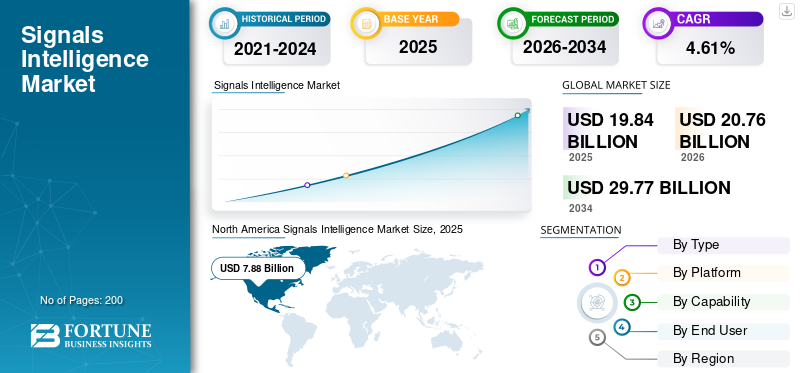
The global signals intelligence market size was valued at USD 19.84 billion in 2025 and is projected to grow from USD 20.76 billion in 2026 to USD 29.77 billion by 2034, exhibiting a CAGR of 4.61% during the forecast period. North America dominated the signals intelligence market, with a market share of 39.71% in 2025.
Signals intelligence (SIGINT) involves intercepting and analyzing communications (COMINT) and electronic emissions such as radar (ELINT) to derive actionable intelligence through decoding, geolocation, and pattern recognition across platforms such as aircraft, satellites, and ground stations. It is used primarily in military, defense, and national security for threat detection, adversary tracking, counterterrorism, cybersecurity, and disaster response operations. Driving factors include escalating geopolitical tensions, AI-driven real-time analytics advancements, and rising defense budgets fueling SIGINT modernization. Key players include BAE Systems, Lockheed Martin, Northrop Grumman, Raytheon, and so on. These players develop advanced SIGINT sensors for the USAF, next-gen prototypes such as GHOST for ISR, and supply ELINT and geolocation systems for militaries.
Download Free sample to learn more about this report.
SIGNALS INTELLIGENCE MARKET KEY TAKEAWAYS
 Market Size & Forecast
- 2025 Market Size: USD 19.84 billion
- 2026 Market Size: USD 20.76 billion
- 2034 Forecast Market Size: USD 29.77 billion
- CAGR: 0.0461% from 2026–2034
 Market Share
- North America dominated the signals intelligence market, with a market share of 39.71% in 2025.
- The Foreign Instrumentation Signals Intelligence (FISINT) segment is anticipated to rise with the highest CAGR of 5.74% over the forecast period.
- The space segment is projected to grow at a high CAGR of 5.19% over the forecast period.
 Key Regional Highlights
North America
North America held the dominant share in 2024, valuing at USD 7.54 billion, and also maintained the leading share in 2025, with USD 7.88 billion.
Europe
Europe is projected to record a steady growth rate during the forecast period of 4.34%, which is the second highest among all regions, and reach a valuation of USD 4.19 billion by 2026.
Asia Pacific
Asia Pacific market is estimated to reach USD 5.90 billion in 2026 and secure the position of the third-largest region in the market and fastest growing during the study period.
U.S.
U.S. market can be analytically approximated at around USD 4.98 Billion in 2026, accounting for roughly 5.06% CAGR.
Japan
The Japan market in 2026 is estimated at around USD 1.01 billion, accounting for roughly 5.20% of compound annual growth rate (CAGR) during the forecast period.
Read More

SIGNALS INTELLIGENCE MARKET TRENDS
Rising Big Data Analytics and RF Machine Learning (RFML) Fuels Market Trend
Big data analytics and RF machine learning (RFML) represent a pivotal trend in signals intelligence (SIGINT) market, enabling automated classification of complex radio frequency (RF) signals in congested electromagnetic environments using deep neural networks trained on synthetic and real spectrograms. RFML excels at detecting overlapping signals including frequency modulation (FM), on-off keying (OOK), multiple frequency-shift keying (MFSK), and LoRa through transfer learning that minimizes real-world data collection needs. Integrated with big data tools, it processes wideband spectra for real-time threat identification, emitter fingerprinting, and geolocation in SIGINT applications such as spaceborne intelligence, surveillance, and reconnaissance (ISR) and counter-unmanned aerial systems (UAS).
Impact of the U.S. Tariff War on the Market
U.S. tariffs significantly impact the signals intelligence (SIGINT) market by raising costs for imported electronic components essential to wideband receivers, gallium nitride amplifiers, and millimeter-wave circuits used in interception systems. Section 301 duties on Chinese semiconductors increase hardware prices, forcing DoD programs such as USAF GHOST and Army spectrum sensing initiatives to face budget pressures or deployment delays. Supply chain disruptions extend lead times for phased array antennas and software-defined radios, pushing primes such as Raytheon and Northrop Grumman toward domestic reshoring or alternative sourcing.
MARKET DYNAMICS
MARKET DRIVERS
Download Free sample to learn more about this report.
Proliferation of Advanced Communication Technologies is anticipated to Drive Market Growth
The proliferation of advanced communication technologies drives the signals intelligence market growth by creating denser, more complex electromagnetic environments that traditional SIGINT systems struggle to monitor effectively. Rapid deployment of 5G networks, low-earth orbit (LEO) satellite constellations, Internet of Things (IoT) devices, and software-defined radios generates exponentially more signals requiring interception, necessitating next-generation SIGINT platforms with wider bandwidth capture and adaptive processing.
MARKET RESTRAINTS
High Risk Of Data Overload Leads to Disruption in the Growth of the Market
The risk of data overload serves as a significant market restraint in signals intelligence (SIGINT), where exponentially growing volumes of intercepted signals from diverse sources such as satellite communications, radio transmissions, and multi-channel electronic emissions overwhelm existing processing infrastructure and analyst capacity. This complicates prioritization of actionable intelligence, leading to delayed threat detection and decision-making during high-real-time operations.
MARKET OPPORTUNITIES
Expanding Low-Earth Orbit (LEO) Satellite Constellations Creates New Market Opportunities
Expanding low-earth orbit (LEO) satellite constellations create significant market opportunities in signals intelligence (SIGINT) by enabling persistent global coverage and low-latency signal interception unattainable with traditional geostationary platforms. Proliferating commercial LEO networks such as Starlink generate dense signal environments ripe for SIGINT collection using opportunistic ambient emissions, while onboard AI enables edge analytics for tactical missions. This shift drives demand for space-qualified SIGINT payloads and hybrid ground-space architectures.
MARKET CHALLENGES
Regulatory Compliance Owing to Stringent National and International Laws Creates Market Challenge
Regulatory compliance presents a major market challenge in signals intelligence (SIGINT) due to stringent national and international laws governing surveillance, data retention, and cross-border intelligence sharing that restrict operational flexibility and increase legal risks. Varying privacy regulations such as GDPR in Europe and domestic wiretap statutes create jurisdictional conflicts, prohibiting SIGINT collection on allied territories or dual-use commercial satellites without complex diplomatic approvals.
Segmentation Analysis
By Type
High Usage in Electronic Warfare to Boost the Electronic Intelligence (ELINT) Platforms Segmental Growth
Based on the type, the market is segmented into Communications Intelligence (COMINT), Electronic Intelligence (ELINT), and Foreign Instrumentation Signals Intelligence (FISINT).
The Electronic Intelligence (ELINT) segment is anticipated to account for the largest market share. The segmental growth is owing to the fact that ELINT is essential for detecting, analyzing, and intercepting non-communication signals, including radar emissions from weapon systems, missile guidance, early warning, and enemy observation, which is essential in electronic warfare (EW).
The Foreign Instrumentation Signals Intelligence (FISINT) segment is anticipated to rise with the highest CAGR of 5.74% over the forecast period.
To know how our report can help streamline your business, Speak to Analyst
By Platform
Real-Time Data Collection to Boost Airborne Segmental Growth
Based on the platform, the market is segmented into airborne, naval, marine, ground, space, and cyber.
In 2025, the airborne segment dominated the global signals intelligence market share. The segmental growth is mainly because airborne platforms offer real-time, actionable intelligence and round-the-clock monitoring capabilities, which are essential for border surveillance, modern warfare, and thwarting emerging electronic threats.
The space segment is projected to grow at a high CAGR of 5.19% over the forecast period.
By Capability
Increasing Usage of AI and Machine Learning to Boosts Intercept & Collection Segmental Growth
Based on the capability, the market is segmented into intercept & collection, direction finding (DF) & geolocation, processing, exploitation & analytics, fusion, tasking & dissemination, and others.
The intercept & collection segment is anticipated to witness a dominating market share over the forecast period. In order to improve their efficiency and value for end users, modern interception & collection technologies are using AI and machine learning for automated decoding, bit level parsing, and real-time processing of large datasets.
The processing, exploitation & analytics segment is projected to grow at a high CAGR of 5.08% over the forecast period.
By End User
Rising International Threats and Territorial Tensions Leads to Defense Ministries/Armed Forces Segmental Growth
Based on end user, the market is segmented into defense ministries / armed forces, national intelligence agencies / SIGINT authorities, homeland security / internal security agencies, border security forces, and coast guard / maritime security agencies.
The defense ministries / armed forces segment dominated the segmental market share. Governments are compelled to make significant investments in SIGINT for border security and early warning systems because to growing international tensions and territorial conflicts in areas such as the Asia-Pacific.
In addition, national intelligence agencies / SIGINT authorities segment are projected to grow at a high CAGR of 5.13% during the study period.
Signals Intelligence Market Regional Outlook
By region, the Signals Intelligence market is categorized into Europe, North America, Asia Pacific, and Rest of the World.
North America
North America Signals Intelligence Market Size, 2025 (USD Billion)
To get more information on the regional analysis of this market, Download Free sample
North America held the dominant share in 2024, valuing at USD 7.54 billion, and also maintained the leading share in 2025, with USD 7.88 billion. North America dominates SIGINT due to massive U.S. Department of Defense (DoD) investments, including the FY2026 Army budget's USD 17.6 million for Spectrum Situational Awareness System (S2AS) procurement to enhance electromagnetic spectrum sensing.
U.S. Signals Intelligence Market
Based on North America’s strong contribution and the U.S. dominance within the region, the U.S. market can be analytically approximated at around USD 4.98 Billion in 2026, accounting for roughly 5.06% CAGR. The U.S. dominates with comprehensive SIGINT infrastructure spanning NSA's global interception network, NRO's satellite constellations, and DIA's tactical systems, supported by government investments.
Europe
Europe is projected to record a steady growth rate during the forecast period of 4.34%, which is the second highest among all regions, and reach a valuation of USD 4.19 billion by 2026. Europe strengthens SIGINT through NATO's 2025-2029 ISR framework emphasizing collective defense post-Ukraine.
U.K Signals Intelligence Market
The U.K. market in 2026 is estimated at around USD 1.59 billion, representing roughly 4.78% CAGR during the study period. U.K's GCHQ anchors Five Eyes SIGINT while RAF operates Rivet Joint aircraft for strategic collection.
Germany Signals Intelligence Market
Germany’s market is projected to reach approximately USD 1.03 billion in 2026. Germany significantly expanded PEGASUS airborne SIGINT fleet from two to planned six aircraft since 2022 Russian invasion, with Hensoldt supplying comprehensive sensor suites covering COMINT/ELINT from 20 MHz-40 GHz across Learjet platforms.
Asia Pacific
Asia Pacific market is estimated to reach USD 5.90 billion in 2026 and secure the position of the third-largest region in the market and fastest growing during the study period. Asia Pacific experiences rapid expansion fueled by escalating geopolitical tensions in the region, rising defense budget, and quick military capability upgrade.
Japan Signals Intelligence Market
The Japan market in 2026 is estimated at around USD 1.01 billion, accounting for roughly 5.20% of compound annual growth rate (CAGR) during the forecast period. Japan prioritizes SIGINT satellite constellation and ocean surveillance vessels defending exclusive economic zone against Chinese/North Korean incursions.
China Signals Intelligence Market
China’s market is projected to be one of the largest in Asia Pacific, with 2026 revenues estimated at around USD 2.30 billion. China fields comprehensive SIGINT architecture utilizing Yaogan satellite series, Type 815A surveillance ships, J-16D electronic warfare aircraft, and ground stations encircling Taiwan/South China Sea.
India Signals Intelligence Market
The India market in 2026 is estimated at around USD 1.51 billion. India invests USD 2 billion acquiring 12 extra-large unmanned underwater vehicles carrying SIGINT/ISR payloads for Andaman Sea/Indian Ocean surveillance against Chinese naval expansion.
Rest of the World
The rest of the world include Middle East and Africa and Latin America. Latin America employs SIGINT primarily for counternarcotic with Brazil's R-99 platforms and Chile's Condor systems monitoring pacific routes. Middle East features Israel's Unit 8200 global SIGINT dominance alongside Gulf Cooperation Council acquisitions of European maritime sensors. The Middle East & Africa and Latin America signals intelligence market is set to reach a valuation of USD 1.47 billion and USD 0.95 billion in 2026, respectively.
COMPETITIVE LANDSCAPE
Key Industry Players
Technological Advancements by Key Market Players Fuels the Market Expansion
The Signals Intelligence (SIGINT) market features established defense primes including Lockheed Martin, Northrop Grumman, BAE Systems, and Raytheon leading through specialized technological advancements in AI-driven signal processing and wideband interception systems.
Lockheed Martin advances RF machine learning integration for F-35 sensor fusion, enabling automated threat classification across contested electromagnetic spectra using deep neural networks trained on synthetic datasets. Furthermore, Raytheon specializes in ELINT geolocation suites leveraging gallium nitride amplifiers and millimeter-wave monolithic integrated circuits for precision emitter tracking in dense urban environments.
LIST OF KEY SIGNALS INTELLIGENCE COMPANIES PROFILED
- Lockheed Martin Corporation (U.S.)
- Northrop Grumman Inc. (U.S.)
- BAE Systems PLC. (U.K)
- Raytheon Technologies (U.S.)
- Thales Group (France)
- General Dynamics (U.S.)
- Boeing (U.S.)
- Hensoldt (Germany)
- L3Harris Technologies Inc. (U.S.)
- Rohde & Schwarz (Germany)
KEY INDUSTRY DEVELOPMENTS
- January 2026: At a ceremony in Gdańsk, Poland launched ORP Henryk Zygalski, its second signals intelligence (SIGINT) vessel. After ORP Jerzy Różycki, the first ship in the DELFIN program, was launched on July 1st, 2025.
- December 2025: With the successful arrival of the first aircraft in Germany, HENSOLDT, Lufthansa Technik Defense, and Bombardier Defense have achieved yet another significant milestone in the PEGASUS (Persistent German Airborne Surveillance System) program.
- August 2025: The U.S. Army has given Picogrid a contract to integrate third-party signals intelligence (SIGINT) systems. The project will make use of Picogrid's Legion software platform to combine analytics tools and radio frequency (RF) sensors from several suppliers into a single, unified operating perspective.
- April 2025: Leidos announced a new deal of USD 390 million to supply the National Security Agency (NSA) with signals intelligence (SIGINT) capabilities, engineering, analysis, and reporting tools.
- November 2023: – Lockheed Martin has entered a project to create signals intelligence systems for Finland's F-35 fighter aircraft. In order to head a consortium that would pool resources, skills, and experience over the following three years to provide new capabilities for the military industry, the company formed a framework agreement with VTT Technical Research Center of Finland.
REPORT COVERAGE
Request for Customization to gain extensive market insights.
Report Scope & Segmentation
| ATTRIBUTE | DETAILS |
| Study Period | 2021-2034 |
| Base Year | 2025 |
| Estimated Year | 2026 |
| Forecast Period | 2026-2034 |
| Historical Period | 2021-2024 |
| Growth Rate | CAGR of 4.61% from 2026-2034 |
| Unit | Value (USD Billion) |
| Segmentation | By Type, Platform, Capability, End User, and Region |
| By Type |
|
| By Platform |
|
| By Capability |
|
| By End User |
|
| By Region |
|
Frequently Asked Questions
According to Fortune Business Insights, the global market value stood at USD 19.84 billion in 2025 and is projected to reach USD 29.77 billion by 2034.
In 2025, the market value stood at USD 7.88 billion.
The market is expected to exhibit a CAGR of 4.61% during the forecast period.
By type, the Electronic Intelligence (ELINT) segment is expected to dominate the market.
Proliferation of advanced communication technologies is anticipated to drive market growth.
Lockheed Martin Corporation (U.S.), Northrop Grumman Inc. (U.S.), BAE Systems PLC. (U.K), Raytheon Technologies (U.S.), Thales Group (France), General Dynamics (U.S.) are few market players in the global market.
North America dominated the market in 2025



- 2021-2034
- 2025
- 2021-2024
- 200
Get 30-60 hrs Free Customization
Expand Regional and Country Coverage, Segments Analysis, Company Profiles, Competitive Benchmarking, and End-user Insights.




















Related Reports
-
US +1 833 909 2966 ( Toll Free )
-
Get In Touch With Us