Smart Aroma Diffusers Market Size, Share & Industry Analysis, By Type (Ultrasonic Smart Diffusers, Nebulizing Smart Diffusers, and Cartridge-Based Smart Diffusers), By Connectivity (WiFi Enabled, Bluetooth Enabled, and Hybrid Connectivity), By Distribution Channel (Specialty Stores, Online/E-Commerce, Hypermarkets/Supermarkets, and Others), and Regional Forecast, 2026-2034
 Download Free Sample
(Offer valid till 31st Oct 2026)

Smart Aroma Diffusers Market Size and Future Outlook
 Listen to Audio Version
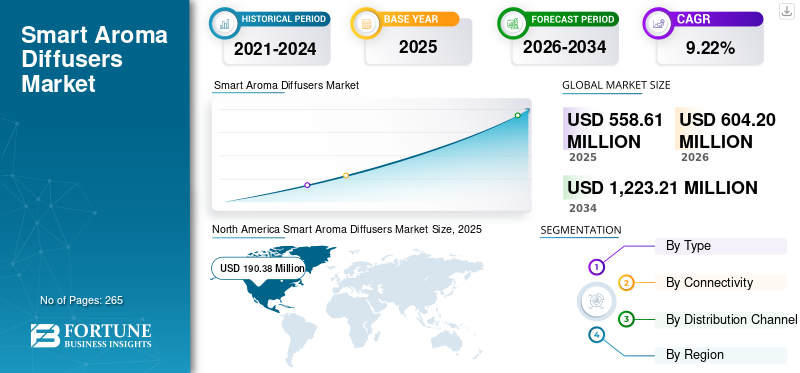
The global smart aroma diffusers market size was valued at USD 558.61 million in 2025. The market is projected to grow from USD 604.20 million in 2026 to USD 1,223.21 million by 2034, with a CAGR of 9.22% over the forecast period. North America dominated the smart aroma diffusers market with a market share of 34.08% in 2025.
The smart aroma diffuser market is growing steadily, driven by increased focus on consumers’ well-being, stress management, and smart home products. The growing demand for IoT-based home appliances has driven a rise in app- and voice-assistant-based smart diffusers compatible with Amazon Alexa and Google Home. For example, brands such as Pura and Vitruvi have launched Wi-Fi-based diffusers that enable users to set their preferred scent patterns, thereby providing ease of use for consumers. Moreover, the global market, valued at approximately USD 2 million, also drives demand for the product. Urbanization, rising disposable income, and increased awareness of the importance of air quality and mental well-being further drive market expansion.
Even though Gen Z cares about the environment, they do not always remain loyal to specific brands. Only about 29% of their clothing comes from a single brand, indicating a strong preference for experimentation and discovering new options that best suit their style. For this generation, purchasing decisions are closely tied to self-expression and individuality. A similar trend is visible in adjacent lifestyle categories such as smart aroma diffusers, where experience plays a key role in consumer choice.
Major players in the market, such as doTERRA and Young Living, focus on vertical integration and global distribution networks to maintain product quality and expand their global presence. On the other hand, Pura distinguishes itself through app-controlled technology and strategic brand partnerships to enhance user experience. Vitruvi, on the other hand, is more focused on premium positioning and design innovation through influencer marketing and eco-friendly products for urban consumers.
Download Free sample to learn more about this report.
Smart Aroma Diffusers Market Key Takeaways
 Global Market Size & Forecast
- 2025 Market Size: USD 558.61 million
- 2026 Market Size: USD 604.20 million
- 2034 Forecast Market Size: USD 1,223.21 million
- CAGR: 9.22% (2026–2034)
 Market Share
- North America dominated the market with a 34.08% share in 2025.
- The nebulizing smart diffusers segment is projected to register the fastest growth with a 10.24% CAGR during the forecast period.
- The hybrid connectivity segment is expected to witness the fastest growth with a 9.91% CAGR over the forecast period.
 Key Regional Highlights
Asia Pacific
Asia Pacific accounted for USD 158.70 million in 2025 and is the fastest-growing regional market.
North America
North America generated USD 190.38 million in 2025, maintaining its leading market position.
Europe
Europe held USD 48.44 million in 2025, accounting for 21.30% of the global market.
U.S.
U.S. market reached USD 127.89 million in 2025.
Japan
Japan market was valued at USD 22.54 million in 2025.
Read More

SMART AROMA DIFFUSERS MARKET TRENDS
Rising Adoption of Smart Home Technology to Amplify Product Demand
Increasing adoption of smart home technology is driving the integration of smart aroma diffusers with voice assistants such as Google Home and Amazon Alexa. Individuals demand seamless automation and convenience, prompting manufacturers to integrate app-based, WiFi-enabled controls into diffusers. This, in turn, results in an upgraded user experience through features such as voice commands, remote operation, and scheduling. Market players such as Pura lure consumer attention by providing highly customizable, connected products, which are fast-tracking product innovation and increasing consumer adoption across tech-savvy households.
MARKET DYNAMICS
MARKET DRIVERS
Growing Consumer Focus on Wellness and Stress Relief to Augment Market Growth
The growing consumer focus on stress relief and overall wellness practices is a key catalyst for the expansion of smart diffusers. With fast-paced urban lifestyles and professionals’ hectic work schedules, stress levels are increasing. In response, consumers are actively adopting aromatherapy as a relaxation solution to enhance mood and improve sleep. This transition has led to increased demand for essential oils from brands such as Young Living and doTERRA. This, in turn, drives demand for effective diffusion systems with smart features, such as timers and personalized scent settings, to enhance therapeutic benefits while improving user experience. Consequently, the increasing adoption of holistic wellness solutions is accelerating global market expansion.
Download Free sample to learn more about this report.
MARKET RESTRAINTS
High Product Costs and Price Sensitivity to Hamper Product Adoption
The high cost of smart aroma diffusers compared to traditional diffusers is a major factor hindering market growth. This is due to the high-tech features incorporated into the diffusers, such as app connectivity and compatibility with devices such as Amazon Alexa, which make them expensive. This may therefore limit the use of the devices by price-conscious consumers, especially in developing countries. This may therefore limit the market's growth even as the benefits of aromatherapy increase public awareness.
MARKET OPPORTUNITIES
Expansion in Emerging Markets and Urban Households to Create an Untapped Growth Opportunity
Increasing discretionary spending and rapidly expanding urbanization, combined with a growing consumer focus on wellness-related activities such as meditation and aromatherapy, especially in developing economies, create a favorable environment for the growth of smart aroma diffusers. The populace of high-growth economies in the Asia Pacific, such as China, Brazil, and India, is becoming increasingly health-conscious. This, in turn, generates demand for home-based wellness solutions in residential and commercial constructions, including essential oils, steamers, and diffusers, among others. This momentum is acting as a stimulus for companies to expand their footprint, especially through online retail platforms. Thus, increasing product accessibility for new consumer groups is expected to propel growth in this market in the coming years.
MARKET CHALLENGES
Discrepancy and Non-Uniformity Issues to Hinder Industry Expansion
The discrepancy and non-uniformity across the ecosystem of smart homes pose a challenge in the market, as many devices are designed to work with certain platforms, such as Amazon Alexa and Google Home. This, in turn, may create obstacles to integrating diffusers for users, as the device may not work with the existing smart home technology setup. This may cause dissatisfaction among users and may influence their decision to purchase the device. In this regard, manufacturers need to improve compatibility and integration, influencing the scalability and adoption rate of the devices.
Segmentation Analysis
By Type
Affordability and Versatility Boosted the Growth of Ultrasonic Diffusers Segment
By type, the market is segmented into ultrasonic smart diffusers, nebulizing smart diffusers, and cartridge-based smart diffusers.
The ultrasonic diffusers segment held the major market share due to its widespread availability and affordability. Their compatibility with existing prominent smart home devices, such as Google Home and Amazon Alexa, enhances accessibility and ease of use. Additionally, ultrasonic diffusers can function as both essential oils and humidifiers, making them more versatile than nebulizing and cartridge-based diffusers. Their versatility contributes to their higher sales volume. Therefore, their mass appeal and affordability position them as market leaders.
The nebulizing smart diffusers segment is anticipated to rise at the fastest CAGR of 10.24% over the forecast period.
To know how our report can help streamline your business, Speak to Analyst
By Connectivity
Advanced Connectivity and Remote Accessibility Boost Wi-Fi Enabled Segment Growth
Based on connectivity, the market is divided into WiFi enabled, Bluetooth enabled, and hybrid connectivity.
The WiFi enabled segment holds the largest share due to its powerful connectivity and remote accessibility. Their ability to integrate into pre-existing smart home ecosystems allows individuals to operate the devices from anywhere using voice control or an app. This provides greater convenience and an easier control mechanism, making these devices more attractive to consumers.
The hybrid connectivity segment is anticipated to rise at the fastest CAGR of 9.91% over the forecast period.
By Distribution Channel
Specialty Stores Segment Dominated the Market, Driven by its Ability to Provide More Personalized Shopping Experience
Based on distribution channel, the market is segmented into specialty stores, online/e-commerce, hypermarkets/supermarkets, and others.
The specialty stores segment accounted for the largest smart aroma diffusers market share, as these outlets provide a more personalized shopping experience. As smart aroma diffusers are also related to wellness and technology, consumers often prefer physically experience the product and receive detailed explanations before making a purchase. Retail stores carrying brands such as Vitruvi and doTERRA help build consumer trust by ensuring product authenticity. This, is turn, contributes significantly to overall segment growth.
The online/e-commerce segment is projected to grow at the second-fastest CAGR of 9.91% during the forecast period.
Smart Aroma Diffusers Market Regional Outlook
By geography, the market is categorized into Europe, North America, Asia Pacific, South America, and the Middle East & Africa.
North America
North America Smart Aroma Diffusers Market Size, 2025 (USD Million)
To get more information on the regional analysis of this market, Download Free sample
North America has emerged as a key region and is projected to grow at a CAGR of 9.63% in the coming years, with the highest market share among all regions, reaching a valuation of USD 190.38 million in 2025. The region’s growth is supplemented by early adoption of smart home devices and strong integration of home ecosystems. The consumer focus on wellness, aromatherapy, and stress-relieving activities also contributes to the growth of the market for smart aroma diffusers. The presence of strong brands such as Pura and Aera, along with the rising disposable income of the population, are some other factors driving the growth of the market.
U.S. Smart Aroma Diffusers Market
Given North America’s strong contribution and the U.S.' dominance in the region, the U.S. market reached USD 127.89 million in 2025, accounting for roughly 22.89% of global market sales.
Europe
Europe held the third-largest share in 2025, valued at USD 48.44 million and accounting for 21.30% of the global market. Increased demand for natural wellness solutions and aromatherapy for stress relief and improving sleep drives market growth. Moreover, premium products offered by brands such as Vitruvi, which specializes in design-oriented products, are contributing to the expansion of the market in the region.
U.K. Smart Aroma Diffusers Market
The U.K. market in 2025 reached USD 22.56 million, representing roughly 4.04% of global market revenues.
Germany Smart Aroma Diffusers Market
Germany’s market reached USD 20.33 million in 2025, equivalent to around 3.64% of global market sales.
Asia Pacific
The Asia Pacific region is the fastest-growing market, registering a CAGR of 10.11% and reaching a valuation of USD 158.70 million in 2025. Rising disposable income levels and growing awareness of aromatherapy and wellness practices, coupled with rising e-commerce penetration and the steady adoption of smart home ecosystems such as Google Home, are augmenting market growth.
Japan Smart Aroma Diffusers Market
The Japanese market in 2025 was valued at USD 22.54 million, accounting for roughly 10.03% of global market revenues. Home-based wellness routines and strong consumer inclination toward relaxation and mindfulness drive the market. Moreover, the country’s preference for design-oriented premium products and its integration with smart home systems aid sustained market expansion.
China Smart Aroma Diffusers Market
China’s market in 2025 was valued at USD 47.10 million in revenues, representing roughly 8.43% of global market sales.
India Smart Aroma Diffusers Market
The Indian market in 2025 was valued at USD 31.36 million, accounting for roughly 11.07% of global market revenues.
South America and the Middle East & Africa
The South America and Middle East & Africa regions are expected to witness moderate growth in this market during the forecast period. The South America market reached USD 51.50 million in 2025. Increasing urbanization, rising middle-class spending on home wellness products, and growing awareness of aromatherapy benefits further reinforce market growth. In the Middle East & Africa, the UAE reached USD 9.40 million in 2025.
South Africa Smart Aroma Diffusers Market
The South African market reached USD 22.11 million in 2025, representing roughly 3.96% of global market revenues.
COMPETITIVE LANDSCAPE
Key Players
Competitive Pricing and Product Innovation Increases Competition Amongst Players
The market for smart aroma diffusers is fragmented and highly competitive, with players emphasizing premiumization, product innovation, and strategic collaborations to strengthen their market positions. Players such as Vitruvi implement design-led differentiation and influencer branding to target premium consumers. Meanwhile, brands such as Aera and Pura focus on smart technology integration, including app-based controls and compatibility with ecosystems. Furthermore, players such as doTERRA emphasize product differentiation and vertical integration.
LIST OF KEY SMART AROMA DIFFUSERS COMPANIES PROFILED
- doTERRA (U.S.)
- Young Living (U.S.)
- Pura (U.S)
- Aera (U.S.)
- Vitruvi (Canada)
- Muji (Japan)
- Stadler Form (Switzerland)
- Saje Natural Wellness (Canada)
- InnoGear (China)
- URPOWER (China)
KEY INDUSTRY DEVELOPMENTS
- February 2026: Organic Aromas launched its revolutionary Smart Nebulizing Diffuser line, integrating the first-ever Bluetooth-enabled, app-controlled aromatherapy technology into premium nebulizing diffusers.
- January 2026: SCENTA, a leading Chinese fragrance technology company, launched its latest innovation, the A-T302 Dual-Atomizing Nozzle Smart Home Diffuser, at CES 2026. The device can instantly switch between distinct scents, such as citrus and tea, via smartphone
- November 2025: Transparent expanded its fragrance product offerings with the launch of a new home aroma diffuser. The new product aims to align with the brand’s design and fragrance ideology, emphasizing design that delivers ambient fragrances. The launch of the home aroma diffuser marked Transparent’s foray into a new product segment, moving beyond its traditional apparel offerings.
- August 2023: Escents introduced a new range of reed essential oils and natural fragrance diffusers to enhance the body aromatherapy experience. These diffusers use micro-mini straws as natural wicks, which draw the liquid up efficiently and then diffuse it into the air. This type of diffuser seems particularly appropriate for small, confined spaces, offering a new and exciting way to experience the benefits of aromatherapy.
- March 2023: Pura Scents Inc, a U.S.-based smart home fragrance company, partnered with The Metropolitan Museum of Art to launch an exclusive fragrance collection inspired by art, enhancing product differentiation through creative collaboration.
REPORT COVERAGE
The global smart aroma diffusers market analysis includes a comprehensive study of the market & forecast by all the market segments included in the report. This qualitative and quantitative report includes details on the market dynamics and trends expected to drive the market over the forecast period. It provides information on key aspects, including a technologically advanced product portfolio, the regulatory environment, and new launches. Additionally, it details partnerships, mergers & acquisitions, and key industry developments, and their prevalence by key regions. The global market research report also provides a detailed competitive landscape, including market share and profiles of key players.
Request for Customization to gain extensive market insights.
Report Scope & Segmentation
| ATTRIBUTE | DETAILS |
| Study Period | 2021-2034 |
| Base Year | 2025 |
| Estimated Year | 2026 |
| Forecast Period | 2026-2034 |
| Historical Period | 2021-2024 |
| Growth Rate | CAGR of 9.22% from 2026 to 2034 |
| Unit | Value (USD Million) |
| Segmentation | By Type, Connectivity, Distribution Channel, and Region |
| By Type |
|
| By Connectivity |
|
| By Distribution Channel |
|
| By Region |
|
Frequently Asked Questions
According to Fortune Business Insights, the global market value stood at USD 558.61 million in 2025 and is projected to reach USD 1,223.21 million by 2034.
In 2025, the market value stood at USD 190.38 million.
The market is expected to grow at a CAGR of 9.22% over the forecast period.
By type, the ultrasonic diffusers segment led the market.
Growing consumer focus on wellness and stress relief is the key factor driving the market.
doTERRA, Young Living, Pura, Vitruvi, Aera, and Pura are the major players in the global market.
North America dominates the market.



- 2021-2034
- 2025
- 2021-2024
- 265
-
(Offer valid till 31st Oct 2026)
Get 30-60 hrs Free Customization
Expand Regional and Country Coverage, Segments Analysis, Company Profiles, Competitive Benchmarking, and End-user Insights.



















-
US +1 833 909 2966 ( Toll Free )
-
Get In Touch With Us