Smart Diapers Market Size, Share & Industry Analysis, By Type (Disposable and Reusable), By Technology (RFID Tags, NFC, and Bluetooth /Wi-Fi Sensors), By End-user (Babies and Adults), By Distribution Channel (Specialty Stores, Departmental Stores, Online Stores, and Others), and Regional Forecast, 2026-2034
 Download Free Sample
(Offer valid till 15th Oct 2026)

Smart Diapers Market Overview
 Listen to Audio Version
The global smart diapers market size was valued at USD 0.82 billion in 2025 and is projected to grow from USD 0.89 billion in 2025 to USD 2.03 billion by 2034, exhibiting a CAGR of 10.82% during the forecast period. Europe dominated the smart diapers market with a market share of 34.94% in 2025.
Smart diapers are technologically enhanced diapers equipped with moisture, wetness, temperature, or even biochemical sensors that enable real-time monitoring of the condition of the diaper. Furthermore, the integration of sensor technology, such as moisture detection, Bluetooth connectivity, and real-time alerts, is also amplifying the consumption of smart and advanced diapers among consumers, boosting the global market growth.
Moreover, diaper firms such as Unicharm Corporation, Essity Aktiebolag publ, Ontex BV, and Daxin Bio, among others, are integrating mobile applications and machine learning algorithms to deliver personalized health insights and enhance user experience. In addition, parents and caregivers are increasingly aware of health risks, such as skin irritations and infections, which has further raised the demand for technologically advanced diapers. Hospitals, clinics, and nursing homes use these diapers for continuously monitoring the activities of patients through technology-enabled alerts, and is expected to drive the global market share.
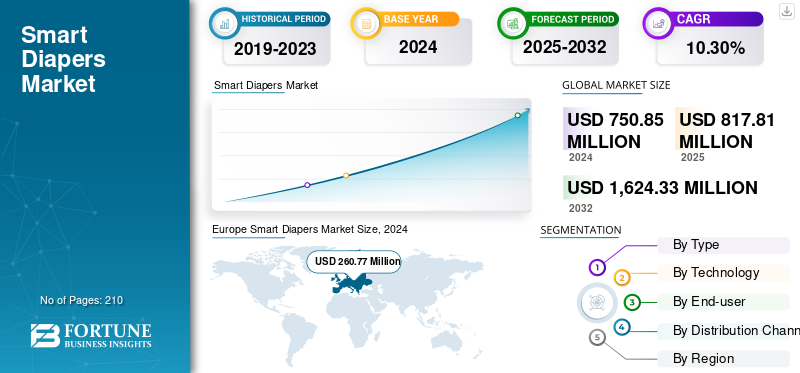
Download Free sample to learn more about this report.
Smart Diapers Market KEY TAKEAWAYS
 Market Size & Forecast
- 2025 Market Size: USD 0.82 billion
- 2026 Market Size: USD 0.89 billion
- 2034 Forecast Market Size: USD 2.03 billion
- CAGR: 10.82% from 2026–2034
 Market Share
- Europe dominated the smart diapers market with a 34.94% share in 2025.
- The disposable segment is projected to account for 70.79% of the global market in 2026.
- The Bluetooth/Wi-Fi sensors segment is anticipated to hold a 65.17% market share in 2026.
 Key Regional Highlights
Europe
Europe led the global smart diapers market in 2025, generating USD 0.28 billion and is projected to reach USD 0.31 billion in 2026.
Asia Pacific
Asia Pacific accounted for USD 0.21 billion in 2025, representing 25.76% of the global market, and is expected to reach USD 0.23 billion in 2026.
North America
North America generated USD 0.24 billion in 2025, capturing 29.86% of the market, and is projected to reach USD 0.27 billion in 2026.
U.S.
U.S. The smart diapers market is estimated to reach USD 201.97 million in 2026, supported by increasing adoption of connected healthcare and infant monitoring solutions.
Japan
Japan Rising awareness of elderly care technologies and smart health monitoring solutions is expected to support demand for smart diapers in the country.
Read More

Market Dynamics
Market Drivers
Increasing Elderly Population to Foster Market Growth
Elderly individuals often experience mobility challenges and incontinence, increasing the demand for diapers with features that monitor moisture, temperature, and overall hygiene. Furthermore, diapers market is expected to be also driven by rising elderly population. Therefore, advanced diapers enable caregivers to manage hygiene proactively for multiple patients simultaneously, reducing physical inspection times and workload in hospitals, further boosting the smart diapers market growth. For instance, according to the U.S. Census Bureau & World Health Organization, the population of Americans aged 65 and older is expected to grow from 58 million in 2022 to 82 million by 2050, representing a 47% increase.
Market Restraints
High Cost of Smart Diapers to Limit Market Growth
The integration of technological advancements (Bluetooth, RFID, real time monitoring, printed moisture sensors) and wireless features substantially raises production costs, resulting in higher product prices than traditional diapers. Furthermore, cost-sensitive consumers in developing countries often find these products unaffordable, which limits the market penetration of these diapers. These factors increase the cost of production and restrict the market growth.
Market Opportunities
Increasing Penetration of E-commerce Channels to Propel Market Growth
E-commerce enables a wider consumer reach globally, making it easier for parents and caregivers to purchase diapers from the comfort of their homes. Moreover, online channels allow for detailed product descriptions, customer reviews, and competitive pricing, which help in the increased adoption of smart diapers. This convenience reduces the reliance on physical stores, further boosting the market development. For instance, according to the IBEF, India’s e-retail sector is expected to experience robust long-term expansion, with the gross merchandise value (GMV) forecasted to grow at an annual rate exceeding 18%, reaching USD 170 billion by FY2030.
Smart Diapers Market Trends
Growing Demand for Sustainable Diapers to Support Market Expansion
The increasing environmental awareness and preference for biodegradable, organic, and chemical-free diaper materials align with smart and advanced diaper innovations, attracting eco-conscious consumers. Furthermore, stricter government regulations on disposable diaper waste and plastic use encourage diapers manufactured with sustainable materials, expanding the demand for smart diapers. For instance, in September 2024, Soft N Dry, a Canadian manufacturer of baby diapers, launched its advanced tree-free diaper technology called ecoLiite Core. The ecoLiite Core replaces traditional tree fiber with advanced synthetic materials, resulting in a diaper core that is 100% tree-free.
Download Free sample to learn more about this report.
Segmentation Analysis
By Type
Disposable Diapers Lead Market As They Allow Hassle-free Disposal
Based on type, the smart diapers market is divided into disposable and reusable.
The disposable segment is expected to lead the market, contributing 70.79% globally in 2026. Disposable diapers are preferred as they offer quick, hassle-free disposal, making them highly convenient for busy parents and caregivers. They eliminate the need for washing and reuse, which is essential in modern, fast-paced lifestyles, thus fostering segment growth.
The reusable segment is expected to grow at the fastest CAGR during the forecast period.
To know how our report can help streamline your business, Speak to Analyst
By Technology
Growing Demand for Real-time Remote Monitoring of Diaper Status Boostedc Bluetooth/Wi-Fi Sensors Segment Growth
Based on the technology, the market is divided into RFID (Radio Frequency Identification) Tags, NFC (Near Field Communication), and Bluetooth/Wi-Fi Sensors.
The Bluetooth/Wi-Fi Sensors segment is anticipated to hold a dominant market share of 65.17% in 2026. Bluetooth and Wi-Fi sensors enable real-time remote monitoring of diaper status, such as moisture level, temperature, and other health parameters. This feature allows caregivers and parents to receive instant alerts on smartphones or connected devices, enhancing timely diaper changes and health monitoring, thus supporting the growth of the segment.
The Bluetooth/Wi-Fi Sensors segment is expected to grow at the fastest CAGR of 10.67% during the forecast period.
By End-user
Requirement for Frequent Diaper Changes for Babies Propelled Segment Growth
Based on end-user, the market is divided into babies and adults.
The babiessegment is poised to account for 64.04% of the market share in 2026. Babies require frequent diaper changes due to sensitive skin and hygiene concerns, leading to consistent and high demand for smart and advanced diapers that offer monitoring features. Moreover, parents and caregivers invest heavily in baby care, favoring innovative, skin-friendly, and personalized diaper products, which augments the growth of the baby segment.
The adult segment is expected to grow at the fastest CAGR of 11.83% during the forecast period.
By Distribution Channel
Demand for Personalized Service and Expert Advice to Boost the Growth of the Specialty Stores Segment
Based on the distribution channel, the market is subdivided into specialty stores, departmental stores, online stores, and others.
The specialty stores segment is poised to account for 37.08% of the market share in 2026. Specialty stores offer a curated selection of baby care products, including premium and niche diapers such as smart, organic, and eco-friendly options. Moreover, these stores often build strong brand trust by providing personalized service, expert advice, and reliable product availability, thus fueling the segment growth.
The online segment is expected to grow at a CAGR of 13.56% during the forecast period.
Smart Diapers Market Regional Outlook
By region, the global smart diapers market analysis is segmented into North America, Europe, Asia Pacific, South America, and the Middle East & Africa.
Europe
Europe Smart Diapers Market Size, 2025 (USD Billion) To get more information on the regional analysis of this market, Download Free sample
Europe contributed 34.94% to the global market in 2025, with a valuation of USD 0.28 Billion, and is projected to reach USD 0.31 Billion in 2026. The region benefits from the presence of major market players and start-ups investing heavily in research and development, driving continuous innovation. Additionally, higher disposable income levels and willingness among consumers to spend on premium hygiene care products also contribute to the market growth across the region. Countries, including the U.K., are expected to record the valuation of USD 45.60 million, Germany to record USD 53.81 million, and France to record USD 44.22 million in 2025.
Asia Pacific
Asia Pacific accounted for USD 0.21 Billion in 2025, representing 25.76% of the global market share, and is projected to reach USD 0.23 Billion in 2026. In these regions, the expansion of retail infrastructure, including online channels, enhances product accessibility, thus supporting market growth across these countries.
North America
The North America market generated USD 0.24 Billion in 2025, representing 29.86% of the global market landscape, and is expected to reach USD 0.27 Billion in 2026. In the region, the U.S. and Canada are both estimated to reach USD 201.97 million and USD 32.66 million, respectively, in 2025. Smart diapers are also increasingly used in adult incontinence care, hospitals, and nursing homes in the U.S. Furthermore, the prevalence of nuclear families and working parents in the U.S. contributes to market growth, as smart diapers offer a practical tool for enhanced childcare monitoring.
South America
South America maintained a strong presence in the global market, reaching USD 0.05 Billion in 2025, accounting for 6.33% share, and is expected to reach USD 0.05 Billion in 2026. Rising urbanization, leading to lifestyle changes and increased demand for convenience products, has nurtured the demand for smart and advanced diapers across these regions.
Middle East & Africa
In 2025, Middle East & Africa held 3.72% of the global market, reaching a valuation of USD 0.03 Billion, and is projected to grow to USD 0.03 Billion in 2026.
Competitive Landscape
Key Market Players
Rising Investments by Key Players in Marketing Campaigns to Boost Market Growth
In recent times, marketing campaigns conducted by personal care companies have educated parents and caregivers about the benefits of smart and advanced diapers, such as real-time health monitoring and timely alerts, which have increased product demand. Furthermore, increasing campaigns highlight innovative features such as moisture sensors, smartphone integration, and eco-friendly materials, attracting tech-savvy and eco-conscious buyers, thus fostering the market growth. For instance, in January 2025, MamyPoko Pants introduced the #HarBabyKaPehlaDiaper campaign to encourage new mothers to choose their redesigned pant-style diapers for newborns. This campaign highlights the upgraded MamyPoko Pants Extra Absorb Newborn diapers, which feature an additional third absorption layer that provides up to 12 hours of dryness.
List of Key Smart Diaper Companies Profiled in the Report
- Procter & Gamble (Lumi by Pampers) (U.S.)
- Opro9 (Taiwan)
- Ontex BV (Belgium)
- SINOPULSAR (Taiwan)
- Essity Aktiebolag (Sweden)
- Unicharm Corporation (Japan)
- Smardii Inc. (U.S.)
- Monit Corp. (South Korea)
- Daxin Bio (China)
- Swastik Enterprises (India)
Key Industry Developments
- June 2025 – Swara Baby Products, a baby products company, unveiled India's first tree-free diaper technology under its Baby Hug Pro brand. The design maintains tested absorbency and dryness levels, allowing infants to crawl, walk, and play comfortably.
- May 2025 – GreenCore Solutions Corp., a provider of tree-free hygiene solutions, launched full-scale European production of its flagship TreeFree Diaper and entered its Retail Private Label Program (RPLP). The diaper is now 100% made in Europe, positioned to meet the growing demand from retailers across the EU.
- December 2024 – R for Rabbit, a premium baby care brand, launched its smart diaper product line called Feather Diapers, aimed at redefining modern parenting. This new offering is part of their "Next-Gen Parenting" campaign. It features advanced wetness detection technology, ultra-soft materials, and maximum comfort to address the evolving needs of parents and babies.
- January 2024 – Pampers, a baby care brand from Procter & Gamble, launched an all-new and improved range of Premium Care Diapers for babies. The diapers are equipped with a wetness indicator to notify parents when a change is needed, and have an all-around stretchy design for better fit and movement.
- June 2021 – Ontex, an international developer and producer of baby care, launched a smart diaper service called Orizon that enhances continence care efficiency and dignity, primarily targeting hospitals and elderly care facilities in Europe. The service includes a diaper embedded with a printed sensor, a transmitter clipped onto the diaper, and a mobile and web application that accurately monitors diaper saturation levels.
REPORT COVERAGE
The market research report provides a comprehensive analysis, focusing on key elements such as major companies, regional and market segmentation, regional analysis, competition landscape, supply chain analysis, competitive dynamics, type, technology, end-user, and distribution channel. Additionally, it offers insights into market trends and highlights significant developments within the industry. Beyond these aspects, it also examines various factors that have contributed to market growth in recent years.
Request for Customization to gain extensive market insights.
Report Scope & Segmentation
|
ATTRIBUTE |
DETAILS |
|
Study Period |
2021-2034 |
|
Base Year |
2025 |
|
Estimated Year |
2026 |
|
Forecast Period |
2026-2034 |
|
Historical Period |
2021-2024 |
|
Growth Rate |
CAGR of 10.82% from 2026 to 2034 |
|
Unit |
Value (USD Billion) |
|
Segmentation |
By Type
By Technology
By End-user
By Distribution Channel
By Region North America (By Type, Technology, End-user, Distribution Channel, and Country)
Europe (By Type, Technology, End-user, Distribution Channel, and Country)
Asia Pacific (By Type, Technology, End-user, Distribution Channel, and Country )
South America (By Type, Technology, End-user, Distribution Channel, and Country)
Middle East & Africa (By Type, Technology, End-user, Distribution Channel, and Country)
|
Frequently Asked Questions
Fortune Business Insights says that the global market size stood at USD 0.89 billion in 2026 and is anticipated to record a valuation of USD 2.03 billion by 2034.
Fortune Business Insights says that the global market value stood at USD 0.82 billion in 2025.
The global market will exhibit a CAGR of 10.82% during the forecast period of 2026-2034.
By type, the disposable segment dominates the market.
The increasing elderly population is a key factor driving the global market.
Unicharm Corporation, Essity Aktiebolag, Ontex BV, and Daxin Bio are some of the leading players globally.
Europe dominated the smart diapers market with a market share of 34.94% in 2025.



- 2021-2034
- 2025
- 2021-2024
- 210
-
(Offer valid till 15th Oct 2026)
Get 30-60 hrs Free Customization
Expand Regional and Country Coverage, Segments Analysis, Company Profiles, Competitive Benchmarking, and End-user Insights.

















Related Reports
-
US +1 833 909 2966 ( Toll Free )
-
Get In Touch With Us