Smart Factory Implementation Services Market Size, Share & Industry Analysis, By Service Type (System Integration Services, Consulting & Strategy Services, Deployment & Implementation Services, and Others), By Industry Vertical (Automotive, Electronics & Semiconductors, Pharmaceuticals & Life Sciences, Food & Beverages, Aerospace & Defense, and Others), By Technology (Industrial IoT (IIoT), Robotics & Industrial Automation, Artificial Intelligence & Advanced Analytics, Cloud Manufacturing Platforms, Digital Twin, and Others), and Regional Forecast, 2026-2034
 Download Free Sample
Smart Factory Implementation Services Market Size and Future Outlook
 Listen to Audio Version
The global smart factory implementation services market size was valued at USD 54.73 billion in 2025. The market is projected to grow from USD 63.08 billion in 2026 to USD 181.76 billion by 2034, exhibiting a CAGR of 14.1% during the forecast period. Asia Pacific dominated the smart factory implementation services market with a market share of 41.49% in 2025.
Smart factory implementation services refer to professional services that enable enterprises to design, integrate, deploy, and optimize Industry 4.0 technologies across manufacturing environments. These services support the integration of industrial IoT (IIoT), robotics, AI-driven analytics, digital twins, and cloud manufacturing platforms to enhance productivity, operational visibility, and real-time decision-making.
The market is experiencing strong momentum due to accelerating digital transformation across manufacturing industries, increasing automation adoption, and the need for resilient and flexible production systems. Manufacturers are prioritizing smart factory frameworks to improve operational efficiency, reduce downtime, and enhance supply chain transparency.
Key players such as Accenture plc, Capgemini SE, Siemens AG, IBM Corporation, Cognizant Technology Solutions, Schneider Electric SE, Rockwell Automation, Tata Consultancy Services (TCS), Honeywell International Inc., and Wipro Limited are expanding their smart manufacturing service portfolios.
- For instance, in April 2024, Siemens expanded its Xcelerator industrial digitalization portfolio to accelerate smart factory deployments across automotive and electronics sectors.
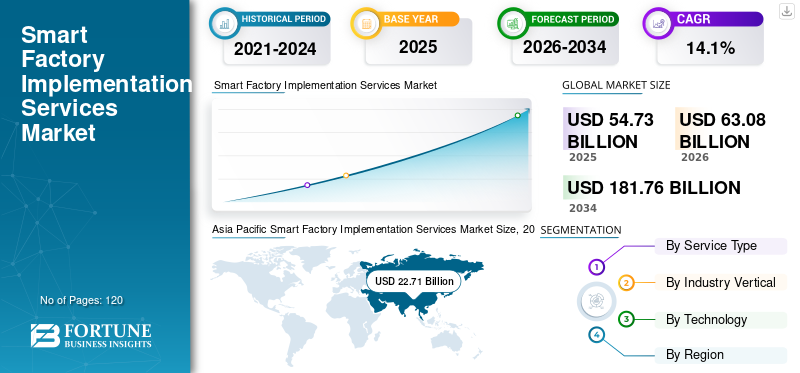
Download Free sample to learn more about this report.
Smart Factory Implementation Services Market Key Takeaways
 Global Market Size & Forecast
- 2025 Market Size: USD 54.73 billion
- 2026 Market Size: USD 63.08 billion
- 2034 Forecast Market Size: USD 181.76 billion
- CAGR: 14.1% from 2026–2034
 Market Share
- Asia Pacific dominated the smart factory implementation services market with a 41.49% share in 2025.
- System integration services held the leading share due to demand for connected manufacturing ecosystems.
- Automotive segment dominated due to high automation adoption and EV manufacturing expansion.
 Key Regional Highlights
Asia Pacific
Asia Pacific led the market with USD 22.71 billion revenue in 2025, supported by smart manufacturing investments.
North America
North America growth is driven by Industry 4.0 adoption and advanced automation solutions.
Europe
Europe benefits from strong industrial infrastructure and digital transformation initiatives.
U.S.
Market reached USD 14.24 billion in 2026, supported by AI and robotics integration.
Japan
Market reached USD 4.33 billion in 2026, driven by robotics expertise and advanced manufacturing.
Read More

SMART FACTORY IMPLEMENTATION SERVICES MARKET TRENDS
Convergence of IIoT, AI, and Digital Twin Technologies is a Market Trend
A major trend shaping the market is the convergence of IIoT platforms, AI-based analytics, and digital twin technologies to enable predictive maintenance, process optimization, and real-time production monitoring. Manufacturers are increasingly adopting integrated platforms that connect shop-floor data with enterprise systems. Furthermore, cloud-based manufacturing platforms are enabling scalable, modular smart factory rollouts, particularly in multi-plant global operations.
- For instance, in 2024, Schneider Electric partnered with NVIDIA to integrate AI-driven digital twin capabilities into industrial automation solutions.
Download Free sample to learn more about this report.
MARKET DYNAMICS
MARKET DRIVERS
Industry 4.0 Adoption and Automation Demand Accelerating Market Growth
The rapid adoption of Industry 4.0 frameworks across automotive, electronics, and aerospace industries is a key driver of smart factory implementation services market growth. Enterprises are investing in system integration services to modernize legacy production lines and enable data-driven manufacturing. Additionally, increasing labor shortages and the need for production scalability are pushing organizations toward robotics and intelligent automation systems, further strengthening market demand.
- For instance, in 2024, Rockwell Automation expanded its smart manufacturing partnerships to deploy digital production solutions across global industrial clients.
MARKET RESTRAINTS
High Implementation Costs and Integration Complexity Limiting Adoption
Smart factory transformation requires significant capital investment in digital infrastructure, cybersecurity, and workforce training. Small and mid-sized manufacturers may face financial and operational barriers during implementation. Moreover, integrating legacy equipment with modern IIoT and AI systems presents technical challenges, particularly in brownfield manufacturing facilities.
- For instance, in 2024, IBM highlighted integration complexity as a primary challenge in large-scale smart factory deployments within industrial sectors.
MARKET OPPORTUNITIES
AI-Driven Manufacturing Intelligence and Predictive Analytics Creating New Service Opportunities
The rapid advancement of AI and advanced analytics as well as smart factory technologies is creating new growth opportunities for consulting and deployment services. AI-enabled production optimization, defect detection, and supply chain forecasting are becoming core smart factory components. As enterprises prioritize data monetization and operational resilience, service providers are expected to benefit from long-term implementation and managed service contracts.
- For instance, in 2025, Accenture expanded its AI-powered manufacturing transformation services to support digital factory initiatives across Europe and North America.
Segmentation Analysis
By Service Type
System Integration Services Dominate Due to Core Infrastructure Modernization
Based on service type, the market is segmented into system integration services, consulting & strategy services, deployment & implementation services, and others.
The system integration services segment holds the largest market share, as manufacturers increasingly prioritize the seamless integration of diverse technologies such as robotics, Industrial IoT (IIoT) platforms, and advanced analytics tools into unified, interoperable digital ecosystems. This integration is critical for enabling real-time data flow, cross-system communication, and centralized control, which collectively enhance operational efficiency, reduce downtime, and support end-to-end smart factory transformation.
- For instance, Capgemini continues expanding its industrial system integration capabilities to support complex multi-plant digital transformation programs.
The deployment & implementation services segment is expected to register the highest CAGR of 15.2%, driven by rising large-scale smart factory rollouts.
To know how our report can help streamline your business, Speak to Analyst
By Industry Vertical
Automotive Sector Leads Owing to Advanced Manufacturing Modernization
Based on industry vertical, the market is segmented into automotive, electronics & semiconductors, pharmaceuticals & life sciences, food & beverages, aerospace & defense, and others.
The automotive segment holds the largest smart factory implementation services market share, supported by high automation intensity, EV production expansion, and robotics deployment.
- For instance, in 2024, BMW expanded digital manufacturing initiatives integrating AI and robotics across its global production plants.
The electronics & semiconductors segment is projected to grow at the highest CAGR of 15.9%, driven by advanced chip manufacturing digitization.
By Technology
Industrial IoT (IIoT) Leads Due to Real-Time Production Connectivity
Based on technology, the market is segmented into Industrial IoT (IIoT), robotics & industrial automation, artificial intelligence & advanced analytics, cloud manufacturing platforms, digital twin, and others.
The IIoT segment holds the largest market share, as it forms the backbone of smart factory connectivity and machine-to-machine communication, enabling real-time data exchange, predictive maintenance, and improved operational visibility across manufacturing processes.
- For instance, in 2024, Siemens enhanced its Industrial IoT capabilities through expanded MindSphere integrations for manufacturing clients.
The artificial intelligence & advanced analytics segment is expected to register the highest CAGR of 16.5% during the forecast period, driven by predictive maintenance and production optimization applications.
SMART FACTORY IMPLEMENTATION SERVICES MARKET REGIONAL OUTLOOK
By region, the market is categorized into North America, Europe, Asia Pacific, South America, and the Middle East & Africa.
Asia Pacific
Asia Pacific Smart Factory Implementation Services Market Size, 2025 (USD Billion)
To get more information on the regional analysis of this market, Download Free sample
Asia Pacific smart factory market holds the highest market share and is expected to register the highest CAGR globally. Rapid industrialization, electronics manufacturing expansion, and government-backed smart manufacturing programs drive service demand. China, Japan, and India are investing heavily in factory automation and AI-enabled manufacturing ecosystems.
Japan Smart Factory Implementation Services Market
Japan’s market in 2026 is estimated at around USD 4.33 billion, representing approximately 6.9% of global revenues. Strong robotics expertise and advanced manufacturing systems drive implementation services demand.
China Smart Factory Implementation Services Market
China’s market in 2026 is estimated at around USD 10.68 billion, representing approximately 16.9% of global revenues. Large-scale manufacturing digitization and government-backed smart factory solutions programs accelerate growth.
India Smart Factory Implementation Services Market
India’s market in 2026 is estimated at around USD 4.51 billion, representing approximately 7.1% of global revenues. Industrial modernization and digital transformation initiatives contribute to service adoption.
North America
North America represents a significant share of the global market, supported by strong Industry 4.0 adoption across automotive, aerospace, and electronics sectors. Enterprises are heavily investing in AI-driven analytics and robotics integration to enhance productivity and reduce downtime. The region benefits from strong technology vendor ecosystems and early adoption of cloud manufacturing platforms.
U.S. Smart Factory Implementation Services Market
The U.S. market in 2026 is estimated at around USD 14.24 billion, representing approximately 22.6% of global revenues. Advanced manufacturing initiatives and digital transformation investments support strong demand. High automation penetration and AI integration across industrial facilities further strengthen growth.
Europe
Europe holds a strong position due to advanced industrial infrastructure and strong regulatory emphasis on manufacturing efficiency and sustainability. Germany, the U.K., and France lead in industrial automation and digital twin adoption. Cross-border smart manufacturing collaborations within the EU support technology standardization.
U.K. Smart Factory Implementation Services Market
The U.K. market in 2026 is estimated at around USD 2.05 billion, representing approximately 3.2% of global revenues. Advanced manufacturing digitization initiatives support growth.
Germany Smart Factory Implementation Services Market
Germany’s market in 2026 is estimated at around USD 3.99 billion, representing approximately 6.3% of global revenues. Strong automotive and industrial machinery sectors drive automation services demand.
Middle East & Africa and South America
The Middle East & Africa and South America represent emerging markets. Industrial diversification programs and infrastructure modernization initiatives support gradual adoption. Investments in manufacturing digitalization and automation upgrades are expected to drive steady growth.
GCC Smart Factory Implementation Services Market
The GCC market in 2026 is estimated at around USD 2.02 billion, representing approximately 3.2% of global revenues. Industrial diversification and smart industry initiatives support digital factory investments.
COMPETITIVE LANDSCAPE
Key Industry Players
Integrated Digital Platforms and Industry Partnerships Strengthening Market Position
The smart factory implementation services market is competitive, with global consulting firms and industrial technology providers expanding service portfolios through acquisitions and strategic alliances. Companies are focusing on AI-driven automation, IIoT integration, and cloud manufacturing platforms to enhance differentiation. Long-term managed service contracts and cross-industry implementation expertise remain key competitive advantages.
LIST OF KEY SMART FACTORY IMPLEMENTATION SERVICES COMPANIES PROFILED
- Accenture plc (Ireland)
- Capgemini SE (France)
- Siemens AG (Germany)
- IBM Corporation (U.S.)
- Cognizant Technology Solutions (U.S.)
- Schneider Electric SE (France)
- Rockwell Automation (U.S.)
- Tata Consultancy Services (India)
- Honeywell International Inc. (U.S.)
- Wipro Limited (India)
KEY INDUSTRY DEVELOPMENTS
- February 2025: Rockwell Automation announced expansion of its digital transformation services portfolio targeting AI-driven manufacturing optimization.
- January 2025: Accenture strengthened its Industry X smart factory capabilities through expanded generative AI integration for manufacturing clients.
- October 2024: Schneider Electric partnered with NVIDIA to integrate AI-powered digital twin capabilities into industrial automation solutions.
- August 2024: Siemens enhanced its Xcelerator platform to support scalable smart manufacturing deployments.
- May 2024: Capgemini expanded its industrial automation consulting services to support large-scale digital manufacturing projects across Europe.
REPORT COVERAGE
The global report on smart factory implementation services market analysis includes a comprehensive study of market size & forecast across all key segments included in the report. It provides insights into market trends, drivers, restraints, opportunities, and challenges expected to influence global market growth over the forecast period The report also covers technological advancements in digital identity and verification platforms, compliance considerations, and key strategic developments including partnerships and M&A activity, alongside regional insights and competitive landscape analysis. Additionally, it includes regional insights and competitive landscape analysis, highlighting the market positioning and strategic initiatives of leading companies.
Request for Customization to gain extensive market insights.
Report Scope & Segmentation
| ATTRIBUTE | DETAILS |
| Study Period | 2021-2034 |
| Base Year | 2025 |
| Estimated Year | 2026 |
| Forecast Period | 2026-2034 |
| Historical Period | 2021-2024 |
| Growth Rate | CAGR of 14.1% from 2026-2034 |
| Unit | Value (USD Billion) |
| Segmentation | By Service Type, Industry Vertical, Technology, and Region |
| By Service Type |
|
| By Industry Vertical |
|
| By Technology |
|
| By Region |
|
Frequently Asked Questions
According to Fortune Business Insights, the global market value stood at USD 54.73 billion in 2025 and is projected to reach USD 181.76 billion by 2034.
In 2025, Asia Pacific’s market value stood at USD 22.71 billion.
The market is expected to exhibit a CAGR of 14.1% during the forecast period.
By industry vertical, the automotive segment is expected to lead the market.
Industry 4.0 adoption and automation demand are the key factor driving the market growth.
Accenture plc, Capgemini SE, Siemens AG, IBM Corporation, and Cognizant Technology Solutions are among the major players in the global market.
Asia Pacific dominated the market in 2025 by holding the largest share.



- 2021-2034
- 2025
- 2021-2024
- 120
Get 30-60 hrs Free Customization
Expand Regional and Country Coverage, Segments Analysis, Company Profiles, Competitive Benchmarking, and End-user Insights.











Related Reports
-
US +1 833 909 2966 ( Toll Free )
-
Get In Touch With Us