Wire and Cable Market Size, Share & Industry Analysis, By Material (Metal and Polymer [PVC, PE, and LSFOH]), By Product Type (Power Cables, Hybrid Cables, and Communication Cables), By Connection (Overhead, Underground, and Submarine), By Voltage (Low, Medium, High, and Extra-High Voltage), By End-User (Aerospace and Defense, Construction [Commercial and Residential], IT and Telecommunication, Power Transmission and Distribution, Oil and Gas, Consumer Electronics [Household Appliances and White Goods], Manufacturing, and Automotive [Passenger Vehicles]), and Regional Forecast, 2026-2034
 Download Free Sample
 Wire and Cable Market Size and Future Outlook
 Listen to Audio Version
The global wire and cable market size was valued at USD 233.00 billion in 2025. The market is projected to grow from USD 246.48 billion in 2026 to USD 410.70 billion by 2034, exhibiting a CAGR of 6.59% during the forecast period.
The market comprises the manufacturing, distribution, and sale of insulated and non-insulated electrical conductors used for the transmission and distribution of electrical power, signals, and data across residential, commercial, industrial, utility, telecommunications, transportation, and renewable energy applications.
The market is experiencing significant growth due to increasing investments in power transmission and distribution infrastructure, rapid urbanization, and rising electricity demand worldwide. Governments and utilities are upgrading aging grid networks and expanding electrification projects to improve energy access and grid reliability, driving demand for power cables and conductors. The growing deployment of renewable energy projects, such as solar and wind farms, is further boosting the need for specialized cables for power generation and grid interconnection. Additionally, the expansion of telecommunications networks, data centers, electric vehicle charging infrastructure, and smart city initiatives is increasing demand for communication and fiber-optic cables. These factors, coupled with ongoing industrialization and construction activities in emerging economies, continue to support the sustained growth of the global market and drive the demand of the market. Smart grids modernization is a major growth trend in the wire and cables market, driving demand for advanced power and communication cables that enable real-time monitoring, automation, and bidirectional electricity flow.
Prysmian Group, Nexans, and NKT A/S are among the leading vendors in the global market due to their extensive product portfolios, strong technological capabilities, and significant presence in large-scale power infrastructure projects worldwide. These companies have established leadership positions in High-Voltage (HV) and High-Voltage Direct Current (HVDC) cable systems, submarine cables, and renewable energy connectivity solutions, which are critical for modernizing electricity grids and supporting the global energy transition. Their continuous investments in research and development, manufacturing capacity expansion, and strategic participation in offshore wind, interconnector, and grid expansion projects enable them to secure major contracts from utilities and governments globally. Additionally, their broad geographic reach, strong customer relationships, and expertise in delivering complex transmission and distribution solutions reinforce their competitive advantage and make them key contributors to the global market growth.
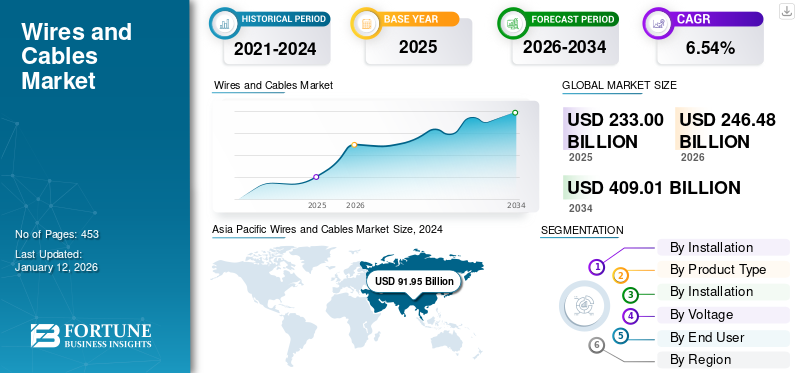
Download Free sample to learn more about this report.
Wire and Cables Market Trends
Expansion of Power Transmission and Distribution Networks to Drive Market Growth
The expansion of power transmission and distribution (T&D) networks is a major factor driving the growth of the global market. Rapid urbanization, industrialization, and rising electricity consumption are prompting governments and utilities to invest heavily in upgrading aging grid infrastructure and expanding electricity networks to meet growing energy demand. The development of new transmission lines, substations, and cross-border interconnections requires extensive deployment of high-, medium-, and low-voltage cables, thereby increasing demand for wire and cable products.
- In November 2024, RTE entered into contracts with five vendors, including Prysmian, Nexans, NKT-SolidAl, and Hellenic Cables, to ensure that it has access to underground power wires for all of its projects through 2028. The commitment totals around 1,000 USD million and includes the supply and installation of approximately 5,200 kilometers of underground cables for voltages between 90,000 and 400,000 volts.
MARKET DYNAMICS
MARKET DRIVERS
Download Free sample to learn more about this report.
Rising Deployment of Renewable Energy Projects to Drive Market Growth
The increasing deployment of renewable energy projects is a key factor driving the global wire and cable market growth. Governments and private investors worldwide are accelerating investments in solar, wind, hydropower, and other renewable energy sources to reduce carbon emissions and enhance energy security. Renewable energy facilities require extensive networks of power cables for connecting generation assets to substations, transmission grids, and end users. Offshore and onshore wind farms, in particular, rely on high-voltage submarine and underground cables for efficient power transmission over long distances. Similarly, large-scale solar installations require significant volumes of low- and medium-voltage cables for power collection and grid integration. As countries continue to expand renewable energy capacity and modernize grid infrastructure to accommodate clean energy sources, demand for advanced wire and cable solutions is expected to rise substantially, supporting the long-term growth of the market.
- In June 2026, DICABS obtained a contract to deliver over 1,300 kilometers of 33kV high-tension (HT) and 3.3kV low-tension (LT) wires for Adani Green Energy's solar and wind power projects as part of the Khavda Power Project in Gujarat. As a result of these major renewable energy projects, there is an increased need for power cables and other transmission infrastructure. Market growth is anticipated to be bolstered by a significant rise in demand for wire and cable solutions as nations persist in expanding their renewable energy infrastructure and enhancing their grid integration.
MARKET RESTRAINTS
Supply Chain Disruptions are Hindering Market Growth
Supply chain disruptions are restraining the growth of the market by causing shortages of critical raw materials, increasing transportation costs, and delaying project execution. The industry relies heavily on the timely availability of copper, aluminum, steel, polymers, and other components sourced from global supply networks. Geopolitical tensions, trade restrictions, logistical bottlenecks, and fluctuations in shipping costs can disrupt the supply of these materials, leading to production delays and increased manufacturing expenses. Furthermore, prolonged lead times for raw materials and specialized cable components can postpone infrastructure, utility, renewable energy, and construction projects. These challenges create uncertainty for manufacturers and end users, affecting profitability and limiting the pace of market expansion.
MARKET OPPORTUNITIES
Growing Adoption of Electric Vehicles to drive market Opportunities
The growing adoption of Electric Vehicles (EVs) is creating significant opportunities for the market. EVs require extensive wiring systems for battery management, power distribution, charging systems, and electronic components, resulting in higher cable consumption compared to conventional internal combustion engine vehicles. Additionally, the rapid expansion of EV charging infrastructure, including residential, commercial, and public fast-charging stations, is driving demand for high-performance power and charging cables.
- In June 2026, Bolt.Earth and ChargeZone partnered to create an interoperable EV charging network with more than 1,500 fast-charging locations across India. Further, supporting the country's growing EV ecosystem and increasing demand for charging cables and power infrastructure.
MARKET CHALLENGES
High Installation and Infrastructure Costs to Restrain Market Growth
High installation and infrastructure costs are expected to restrain the growth of the market. While advanced cable systems improve power transmission efficiency and network reliability, their deployment often requires substantial capital investment. The installation of underground, submarine, and high-voltage cables involves significant expenses related to trenching, excavation, specialized equipment, labor, testing, and maintenance. In addition, large-scale transmission and distribution projects require supporting infrastructure such as substations, transformers, and grid interconnection facilities, further increasing overall project costs. These high upfront investments can pose challenges for utilities, industrial users, and governments operating under budget constraints, particularly in developing economies. As a result, project delays, reduced infrastructure spending, and slower adoption of advanced cable systems may limit the growth of the market during the forecast period.
Segmentation Analysis
By Material
Metal Segment Dominated Due to Widespread Use of Copper and Aluminum Conductors
Based on material, the global market is segmented into metal and polymer. Polymer is further divided into PVC, PE, LSFOH/HFFR, and others.
The metal segment dominated the wire and cable market share in 2025. The dominance is owing to the widespread use of copper and aluminum conductors in power transmission, distribution, construction, telecommunications, automotive, and industrial applications. Metals offer excellent electrical conductivity, mechanical strength, durability, and heat resistance, making them the preferred choice for manufacturing wires and cables. Copper is extensively used in building wiring, industrial equipment, and communication cables due to its high conductivity and reliability. At the same time, aluminum is widely adopted in power transmission and distribution networks due to its lightweight nature and cost-effectiveness.
The polyethylene (PE) segment is emerging as the fastest-growing category and is projected to expand at a CAGR of 8.70% during the forecast period. The polyethylene (PE) segment is emerging as the fastest-growing segment in the market owing to its excellent electrical insulation performance, moisture resistance, durability, and cost-effectiveness. Polyethylene-based materials, particularly High-Density Polyethylene (HDPE) and Cross-Linked Polyethylene (XLPE), are increasingly being used in power transmission and distribution cables, telecommunications cables, fiber-optic networks, and renewable energy applications.
By Product Type
Power Cables Segment Dominated Due to Extensive Use in Power Transmission and Distribution Networks
Based on product type, the market is segmented into power cables, hybrid cables, and communications cables.
The power cables segment dominated the market, accounting for approximately 82.45% share in 2025. The growth is owing to the increasing demand for electricity and rising investments in power transmission and distribution infrastructure worldwide. Power cables are extensively used in utility networks, renewable energy projects, industrial facilities, and commercial buildings to ensure efficient electricity transmission and distribution.
The communication cables segment is projected to witness the fastest growth, expanding at a CAGR of 9.47% during the forecast period. The growth is owing to the rapid expansion of telecommunications networks, broadband connectivity, data centers, and fiber-optic infrastructure worldwide. The increasing deployment of 5G networks, rising internet penetration, and growing demand for high-speed data transmission have significantly boosted the adoption of communication cables.
By Connection
Overhead Segment Dominated Due to Cost-effectiveness and Ease of Installation
Based on connection, the global market is segmented into overhead, underground, and submarine.
The overhead segment dominated the market, accounting for approximately 78.46% share in 2025. The growth is owing to its widespread adoption in power transmission and distribution networks. Overhead cables are more cost-effective to install and maintain than underground cable systems, making them the preferred choice for long-distance electricity transmission.
The underground segment is anticipated to register the fastest-growth and is projected to expand at a CAGR of 8.14% during the forecast period. The growth is owing to the increasing demand for reliable, safe, and aesthetically appealing power transmission and distribution systems. Underground cables are less vulnerable to weather-related disruptions, natural disasters, and physical damage compared to overhead lines, resulting in improved grid reliability and lower maintenance requirements. Increasing urbanization, smart city developments, and investments in modern power infrastructure have accelerated the adoption of underground cable networks, particularly in densely populated urban areas where space constraints and safety considerations are critical.
By Voltage
Low-Voltage Segment Dominated Due to Extensive Use in Residential, Commercial, and Industrial Electrical Infrastructure
Based on voltage, the global market is segmented into low voltage, medium voltage, high voltage, and extra-high voltage.
The low voltage segment dominated the market, accounting for approximately 54.76% share in 2025. Such dominance is owing to its widespread use in residential, commercial, and industrial applications. Low-voltage cables are extensively utilized for building wiring, power distribution, lighting systems, telecommunications, and industrial equipment, making them essential for everyday electrical infrastructure.
The extra-high voltage segment is anticipated to register the fastest-growth rate of 9.15% during the forecast period. The growth is owing to the rising need for efficient long-distance electricity transmission and large-scale grid interconnections. EHV cables are widely used in transmission networks, renewable energy integration projects, and cross-border power connections due to their ability to transmit large volumes of electricity with minimal power losses.
By End-User
To know how our report can help streamline your business, Speak to Analyst
Growing Demand for Reliable Electricity Transmission Worldwide Drives the Power Transmission and Distribution Segment Growth
Based on end-user, the global market is segmented into aerospace and defense, construction {commercial and residential}, IT and telecommunication, power transmission & distribution, oil and gas, consumer electronics {high tech products, small appliances, household appliances, white goods, HVAC, and others}, manufacturing {Industrial machinery, and others}, automotive {passenger vehicles, utility vehicles}, and others.
The construction segment dominated in 2025 with a market share of 26.76%. The growth is due to rapid urbanization, increasing residential and commercial construction, and large-scale infrastructure investments worldwide. Rising demand for smart buildings, energy-efficient electrical systems, fire safety installations, and building automation is driving the need for power, control, and communication cables.
The consumer electronics segment is anticipated to register the fastest growth of 8.24% during the forecast period. The growth is owing to the widespread adoption of smartphones, laptops, televisions, gaming consoles, home appliances, and other connected devices. These products require a variety of power, charging, data transmission, and communication cables for efficient operation and connectivity.
Wire and Cable Market Regional Outlook
By region, the market is categorized into Europe, North America, Asia Pacific, Latin America, and the Middle East & Africa.
Asia Pacific
Asia Pacific Wire and Cable Market Size, 2025 (USD Billion)
To get more information on the regional analysis of this market, Download Free sample
Asia Pacific dominated the global market, accounting for approximately USD 98.11 billion in 2025. The region’s growth is due to rapid urbanization, industrialization, and increasing investments in power transmission and distribution infrastructure across countries such as China, India, Japan, and Southeast Asia nations. Rising electricity demand, expanding renewable energy projects, and large-scale construction activities are driving the need for power, communication, and industrial cables. Additionally, the deployment of 5G networks, expansion of data centers, growth in electric vehicle manufacturing, and government initiatives supporting rural electrification and smart city development are further fueling demand for such products.
China Wire and Cable Market
The China market in 2025 was valued at approximately USD 49.10 billion. The China market is growing rapidly due to the country's strong manufacturing base, continuous expansion of energy infrastructure, and increasing investments in advanced industrial sectors. As the world's largest producer and consumer of electricity, China is investing heavily in Ultra-High-Voltage (UHV) transmission networks, renewable energy integration, and smart grid development, driving substantial demand for power cables. Additionally, the country's leadership in electric vehicle production, industrial automation, telecommunications, and data center construction is fueling the need for high-performance wires and cables. Government initiatives supporting technological modernization, energy transition, and infrastructure development further contribute to the sustained growth of the market in China.
India Wire and Cable Market
The India market was estimated at approximately USD 9.95 billion in 2025. India is emerging as a high-growth market due to the rapid expansion of the construction, infrastructure, and industrial sectors. The increasing development of residential housing, commercial complexes, metro rail projects, airports, and industrial parks is driving substantial demand for electrical wiring and cable systems. Furthermore, rising investments in power distribution upgrades, renewable energy installations, and telecommunications infrastructure are creating additional growth opportunities for cable manufacturers.
Europe
Europe accounted for approximately USD 56.65 billion in 2025. The Europe market is growing steadily due to the region's strong focus on energy transition, decarbonization, and grid modernization. European countries are investing heavily in upgrading aging electricity networks, expanding cross-border interconnections, and integrating renewable energy sources such as offshore wind and solar power into national grids.
Germany Wire and Cable Market
The Germany market in 2025 was estimated at approximately USD 11.36 billion. The Germany market is growing due to the country's well-established industrial manufacturing sector and its position as a leading automotive production hub in Europe. The increasing adoption of industrial automation, Industry 4.0 technologies, and advanced manufacturing systems is driving demand for high-performance industrial and control cables.
U.K. Wire and Cable Market
The U.K. market in 2025 was estimated at approximately USD 6.98 billion. The U.K market is growing steadily due to the country's significant investments in offshore wind energy and national infrastructure modernization. As one of the world's largest offshore wind markets, the U.K. requires extensive submarine, export, and grid connection cables to transmit renewable electricity from offshore projects to onshore networks.
North America
North America accounted for approximately USD 43.00 billion in 2025. The North America market is growing due to increasing investments in data center infrastructure, grid resilience projects, and advanced manufacturing facilities across the U.S. and Canada. The rapid adoption of cloud computing, artificial intelligence, and digital services has accelerated the construction of hyperscale data centers, driving demand for power and communication cables.
U.S. Wire and Cable Market
The U.S. market in 2025 was estimated at approximately USD 33.49 billion. There is considerable growth in the market owing to the fast proliferation of data center projects and cloud computing solutions, as well as digital connectivity initiatives. The high investments being made by tech companies in AI-enabled hyperscale data centers are leading to high demand for power, optical, and communication cables. Also, the increasing requirements for high-speed internet connectivity, broadband penetration, and telecommunications in the U.S. are leading to increased deployment of cable installations in the industrial and commercial segments.
Middle East & Africa
The Middle East & Africa market accounted for approximately USD 24.31 billion in 2025. There is high growth in the market owing to the increasing investment in construction and development of facilities related to the oil & gas industry, mining sector, and water infrastructure projects. Nations such as Saudi Arabia, UAE, Qatar, and South Africa have been expanding their industrial infrastructure, including pipelines, refineries, desalination plants, and mining projects.
GCC Wire and Cable Market
The GCC market in 2025 was estimated at approximately USD 11.66 billion. The GCC region is witnessing growth in the sector owing to the economic diversification plans and massive urbanization initiatives by various countries of the region, especially Saudi Arabia, the UAE, and Qatar. Various large-scale projects being undertaken in these countries, such as NEOM, The Line, and Red Sea Project, are creating high demand for wires and cables.
Latin America
Latin America accounted for approximately USD 10.93 billion in 2025. Growth in the Latin America market can be attributed to growing investments made by the mining industry, energy connectivity projects, and industrialization of economies such as Brazil, Chile, Peru, and Mexico. The active mining industry in Latin America, especially copper and lithium mining, needs large cables for their smooth functioning.
Brazil Wire and Cable Market
The Brazil market size in 2025 was estimated at approximately USD 3.99 billion. The Brazil industry is set to experience growth due to Brazil’s large-scale investments in hydropower plants, agriculture-related infrastructures, and rural electrification schemes. Being one of the biggest producers of hydropower energy in the world, Brazil is actively constructing and upgrading its power grid system that will link the energy producers and the consumers, thus making more demands for power cables. Modernization of agriculture and agro industries requires an increase in the demand for electrical and telecommunication cables.
COMPETITIVE LANDSCAPE
KEY INDUSTRY PLAYERS
Key Players Expanding Production Capacity and Developing Advanced Cable Technologies to Strengthen Market Presence
Prysmian Group, Nexans, NKT A/S, Sumitomo Electric Industries, Furukawa Electric, Southwire Company, LS Cable & System, Belden Inc., Leoni AG, and Fujikura Ltd. are some of the top manufacturers of wire and cables. These players are working toward increasing their production facilities, developing high and extra high voltage cables, fiber optic cables, and sustainable cables to cater to the rising demand for the product from the power transmission industry, renewable energy, telecommunication, data centers, and industrial segments.
- In March 2026, Prysmian bagged a major contract for the Eastern Green Link 4 (EGL4) in the U.K. Prysmian received a contract worth about USD 2.3 billion for the delivery of about 640 kilometers of high-voltage cables, out of which 530 kilometers of cables will be submarine ones. The project is aimed at increasing grid reliability, integrating renewable energy sources, and also serving the energy transition objectives of the U.K. The contract further cements the position of Prysmian as a market leader in the high voltage and submarine cable business.
LIST OF KEY WIRE AND CABLE COMPANIES PROFILED
- Prysmian Group (Italy)
- Nexans S.A. (France)
- NKT A/S (Denmark)
- Sumitomo Electric Industries, Ltd. (Japan)
- Furukawa Electric Co., Ltd. (Japan)
- LS Cable & System Ltd. (South Korea)
- Southwire Company, LLC (U.S.)
- Fujikura Ltd. (Japan)
- Belden Inc. (U.S.)
- Leoni AG (Germany)
KEY INDUSTRY DEVELOPMENTS
- June 2026: LS Cable & System bagged an ultra-high voltage power grid order in Singapore valued at around KRW 140 billion (~USD 93 million). With the investments in data centers increasing owing to growing artificial intelligence and cloud computing, the demand for upgrades of the transmission network within the country has gained momentum, and LS Cable & System seems set to cash in on the trend ahead of its rivals.
- January 2026: NKT Transmission and SSEN Transmission agreed to work together on the development of two HVDC transmission lines in Scotland, namely Western Isles and Spittal to Peterhead. SSEN Transmission, which is the transmission system operator in northern Scotland, has finally issued the contracts to NKT for the HVDC power cable systems operating at 525 kV.
- January 2025: The development of wire and cables by Sumitomo Electric Industries relates to its investments worth USD 350 million into building a factory in Nigg, Scotland, which will manufacture high-voltage submarine cables. This facility will be engaged in the production of High-Voltage Direct Current (HVDC) cables that will be used for the transmission of electricity from offshore wind farms and for the construction of grid connections. Besides, Sumitomo received a contract regarding a 260 km long subsea power cable between Scotland's islands and the mainland.
- April 2023: The company reinforced its presence in the international wire and cable business by converting its Business Group AM into the ACS (Automotive Cable Solutions) Division, underscoring the increasing significance of automotive wires and cables in its product line. The division serves as an internationally known supplier to the automotive industry and has ten production sites spread over seven countries with around 3,300 employees. It provides a variety of wire and cable solutions for automotive cables, special cables, and EV charging cables, and is regarded as one of the leading companies in this field. As an independent division, the ACS division enjoys synergies in the entire group and yet maintains its operational freedom to enter the wire and cable business.
- March 2023: Belden, a global leading provider of network infrastructure and digitization, is pleased to offer its Fault-Managed Power System (FMPS) Hybrid Cables, which have been engineered and certified to be used on Class 4 circuits. The launch of the 2023 NEC (National Electrical Code) enables the industry to provide power distribution safely at the same level as that of Class 2 circuits, but with the ability to transmit more power over longer distances.
REPORT COVERAGE
The global wire and cable market analysis provides an in-depth study of the market size and forecast by all the market segments included in the report. It contains details on the market dynamics and market trends expected to drive the market in the forecast period. It offers information on technological advancements, new product launches, key industry developments, and partnerships, mergers & acquisitions. The market research report also includes a detailed competitive landscape, providing market share and profiles of key players.
Request for Customization to gain extensive market insights.
Report Scope & Segmentation
| ATTRIBUTE | DETAILS |
| Study Period | 2021-2034 |
| Base Year | 2025 |
| Estimated Year | 2026 |
| Forecast Period | 2026-2034 |
| Historical Period | 2021-2024 |
| Growth Rate | CAGR of 6.59% from 2026-2034 |
| Unit | Value (USD Billion) |
| Segmentation | By Material, By Product Type, By Connection, By Voltage, By End-User, and By Region |
| By Material |
|
| By Product Type |
|
| By Connection |
|
| By Voltage |
|
| By End-User |
|
| By Region |
|
Frequently Asked Questions
Fortune Business Insights says that the global market value stood at USD 233.00 billion in 2025 and is projected to reach USD 410.70 billion by 2034.
The market is expected to exhibit a CAGR of 6.59% during the forecast period.
The power transmission and distribution segment led the market in terms of end-user.
Rising deployment of renewable energy projects to drive the market growth.
Prysmian, Nexans, and NKT A/S are among the prominent players in the market.
Asia Pacific dominated the market, with the highest share in 2025.



- 2021-2034
- 2025
- 2021-2024
- 280
Get 30-60 hrs Free Customization
Expand Regional and Country Coverage, Segments Analysis, Company Profiles, Competitive Benchmarking, and End-user Insights.



















Related Reports
-
US +1 833 909 2966 ( Toll Free )
-
Get In Touch With Us