Smart HVAC System Market Size, Share & Industry Analysis, By System Type (Heating Systems, Ventilation Systems, and Air Conditioning & Cooling Systems), By Component (Smart Thermostats, Sensors, Controllers, Smart Vents & Dampers, Actuators & Valves, Gateways & Communication Modules, and Others (HVAC Relays, HVAC Zone Panels)), By Sales Channel (Direct Sales, Distributors & Dealers, and Online Retail), By End User (Residential, Commercial, and Industrial), and Regional Forecast, 2026 – 2034
 Download Free Sample
Smart HVAC System Market Size and Future Outlook
 Listen to Audio Version
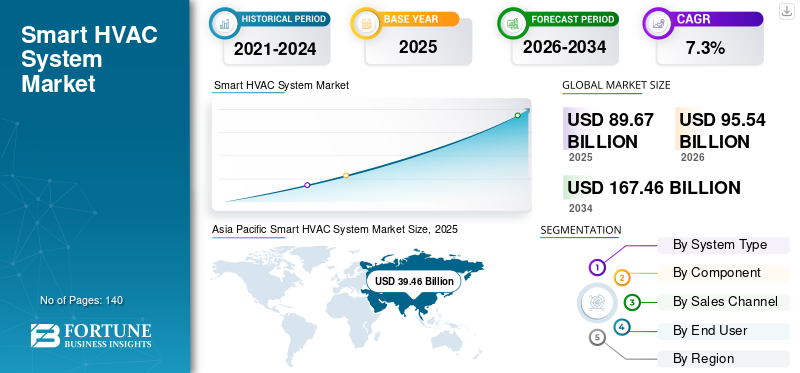
The global smart HVAC system market size was valued at USD 89.67 billion in 2025 and is projected to grow from USD 95.54 billion in 2026 to USD 167.46 billion by 2034, exhibiting a CAGR of 7.3% during the forecast period. Asia Pacific dominated the smart HVAC system market with a market share of 44.01% in 2025.
Smart HVAC system comprises connected heating, ventilation, and air conditioning systems integrated with smart thermostats, sensors, controllers, actuators, dampers, valves, gateways, and communication modules to optimize indoor climate control, energy efficiency, air quality, and equipment performance across residential, commercial, and industrial buildings. These systems include smart heating systems, smart ventilation systems, and smart air conditioning & cooling systems, designed to enable automated temperature regulation, humidity control, airflow optimization, remote monitoring, predictive diagnostics, and intelligent energy management. They help building owners, facility managers, and households to reduce energy consumption, improve occupant comfort, enhance indoor air quality, and support sustainable building operations across residential buildings and commercial applications.
Growing demand for energy-efficient HVAC systems, rising adoption of smart buildings, increasing deployment of connected HVAC equipment, government incentives, and stricter building energy performance regulations are accelerating market growth. Integration of IoT, AI, cloud connectivity, smart sensors, and building automation technologies is further improving system responsiveness, operational visibility, maintenance efficiency, and lifecycle performance. Key players continue to invest in energy efficient solutions, advanced smart HVAC controls, connected air conditioners, smart heat pumps, intelligent ventilation solutions, and energy optimization technologies to address evolving building automation and climate-control requirements worldwide.
- For instance, in March 2025, Carrier Global Corporation and Google Cloud announced a collaboration to strengthen grid resilience through AI-powered home energy management systems by integrating Carrier’s battery-enabled HVAC technology with Google Cloud’s AI analytics and WeatherNext AI models, supporting smarter energy management and connected residential HVAC operations.
Carrier Global Corporation, Johnson Controls International plc, Daikin Industries, Ltd., Trane Technologies plc, Honeywell International Inc., Siemens AG, Schneider Electric SE, Mitsubishi Electric Corporation, and LG Electronics Inc. are among the major companies operating in the market.
Download Free sample to learn more about this report.
Smart HVAC System Market KEY TAKEAWAYS
 Global Market Size & Forecast
- 2025 Market Size: USD 89.67 billion
- 2026 Market Size: USD 95.54 billion
- 2034 Forecast Market Size: USD 167.46 billion
- CAGR: 7.3% during 2026–2034
 Market Share
- Asia Pacific dominated the global market with a 44.01% share in 2025.
- Air Conditioning & Cooling Systems held the largest system-type share in 2025.
- Controllers held the largest component share in 2025, supported by their role in temperature regulation.
 Key Regional Highlights
Asia Pacific
Dominated the market with USD 39.46 billion in 2025 and is expected to remain the leading region.
North America
Accounted for more than USD 21.26 billion in 2025, supported by mature HVAC infrastructure.
Europe
It expected to witness substantial growth, driven by building energy-efficiency regulations, heat pump adoption.
U.S.
The market is estimated at approximately USD 18.38 billion in 2026.
Japan
The market is estimated at approximately USD 5.03 billion in 2026, accounting for roughly 5.3% of global sales.
Read More

SMART HVAC SYSTEM MARKET TRENDS
Growing Adoption of Connected HVAC Systems and AI-Based Energy Optimization is Accelerating Market Expansion
Demand for smart HVAC systems is increasingly being driven by the rapid adoption of connected HVAC systems, smart thermostats, intelligent sensors, automated controllers, and cloud-enabled energy management technologies across residential, commercial, and industrial buildings. As building owners, facility managers, and households focus on reducing energy consumption and improving indoor comfort, HVAC manufacturers are integrating Internet of Things (IoT), AI, machine learning, occupancy sensing, predictive diagnostics, and remote monitoring capabilities into heating, ventilation, and air conditioning systems.
The market is witnessing growing deployment of smart HVAC solutions to support temperature control, humidity regulation, indoor air quality monitoring, airflow optimization, equipment health tracking, and demand-response participation. Smart controllers, connected heat pumps, intelligent air conditioners, smart dampers, actuators, valves, gateways, and communication modules are improving operational visibility, reducing maintenance downtime, and enabling more efficient building performance. Across North America, Europe, Asia Pacific, South America, and the Middle East & Africa, rising smart building adoption, energy-efficiency regulations, electrification of heating systems, and growing demand for automated climate-control solutions are strengthening market growth.
- For instance, in September 2025, Trane Technologies announced AI Control and ARIA, two AI-driven building solutions designed to help customers improve building optimization and energy management by using advanced technology for smart building operations.
MARKET DYNAMICS
MARKET DRIVERS
Download Free sample to learn more about this report.
Rising Maintenance Complexity and Need for HVAC Asset Uptime Driving Market Growth
The market is gaining momentum as building owners and facility operators increasingly face challenges related to HVAC maintenance complexity, technician shortages, equipment downtime, and rising lifecycle operating costs. Large commercial buildings, hospitals, data centers, hotels, industrial facilities, and multi-site retail chains depend on continuous heating, ventilation, and air conditioning performance to maintain occupant comfort, business continuity, process reliability, and indoor air quality. Smart HVAC solutions help address these requirements by enabling real-time equipment monitoring, fault detection, automated alerts, usage-based performance tracking, and predictive maintenance planning. Instead of relying only on scheduled inspections or reactive repairs, facility teams can identify abnormal temperature patterns, airflow issues, component wear, filter conditions, refrigerant performance concerns, and system inefficiencies before they lead to costly failures. This is particularly important for buildings operating multiple HVAC zones, rooftop units, chillers, heat pumps, air handling units, and ventilation systems. Growing demand for reduced downtime, lower repair costs, longer equipment life, and centralized monitoring across distributed building portfolios is encouraging adoption of smart thermostats, sensors, controllers, gateways, actuators, dampers, and connected HVAC equipment globally.
- For instance, in March 2025, Daikin Applied announced that Daikin had invested in Poppy to accelerate the transition to smart and adaptive HVAC systems and buildings that improve energy efficiency, occupant health, and decarbonization.
MARKET RESTRAINTS
High Initial Cost and Integration Complexity Limiting Market Expansion
The smart HVAC system market growth is constrained by high upfront costs, integration complexity, and limited adoption readiness across price-sensitive residential and small commercial buildings. Smart HVAC systems require connected devices, sensors, controllers, gateways, communication modules, smart thermostats, actuators, and compatible building automation infrastructure, which can increase total system cost compared with conventional HVAC equipment. Many existing buildings operate with legacy HVAC systems that lack digital interfaces, creating challenges in retrofitting smart controls, ensuring interoperability, and integrating equipment across different communication protocols. In addition, cybersecurity concerns, data privacy risks, limited technical expertise, and maintenance complexity can slow adoption among facility owners and small businesses. In developing markets, low awareness, limited digital infrastructure, and higher sensitivity to installation costs may further restrict the deployment of smart HVAC solutions. These factors can delay replacement decisions, increase implementation timelines, and limit market expansion despite rising demand for energy-efficient and connected climate-control systems.
MARKET OPPORTUNITIES
Retrofitting Aging Building Infrastructure Creates Significant Market Opportunities
A major opportunity emerging within the market is the growing modernization of aging HVAC infrastructure across existing residential, commercial, institutional, and industrial buildings. A large share of global building stock continues to operate with conventional thermostats, manually controlled ventilation systems, outdated rooftop units, legacy chillers, older air handling units, and limited digital monitoring capabilities. This creates strong opportunities for smart HVAC manufacturers to offer retrofit-friendly solutions such as smart thermostats, wireless sensors, connected controllers, smart dampers, actuator upgrades, communication modules, and gateway devices that can improve system performance without requiring complete HVAC replacement. The opportunity is particularly strong in offices, schools, hospitals, hotels, retail chains, warehouses, and government buildings where operators are seeking better energy visibility, lower operating costs, improved indoor air quality, and extended equipment life. Growing renovation activity, sustainability-focused building upgrades, utility rebate programs, and demand for grid-interactive buildings are further encouraging the adoption of smart HVAC retrofits. These solutions allow building owners to convert existing HVAC assets into connected, data-enabled systems capable of supporting remote monitoring, automated control, demand response, and long-term energy optimization.
- For instance, in May 2026, Siemens launched Asset Performance Advanced, an AI-powered managed service designed to continuously monitor heating, ventilation, and air conditioning systems and building automation devices, enabling early issue detection and improved autonomous building operations.
MARKET CHALLENGES
Interoperability Issues and Legacy Building Infrastructure Challenging Market Growth
One of the major challenges affecting the market is the limited compatibility between legacy HVAC equipment, smart controls, communication protocols, and building automation systems across a significant portion of the global building stock. Many existing residential, commercial, and industrial buildings operate with older heating, ventilation, and air conditioning systems that lack digital interfaces, sensor connectivity, or standardized communication capabilities, making smart HVAC integration more complex and costly. At the same time, fragmented protocols, cybersecurity concerns, data privacy requirements, and varying technical standards continue to increase implementation complexity for manufacturers, installers, and facility managers. High upfront investment, limited skilled technicians, and uncertainty regarding return on investment may further slow adoption, especially in small commercial buildings and price-sensitive emerging markets. These factors create ongoing challenges for HVAC manufacturers, building automation providers, and end users seeking to balance energy efficiency, system compatibility, operational reliability, and long-term cost savings while deploying smart HVAC solutions across diverse building environments.
Segmentation Analysis
By System Type
Air Conditioning & Cooling Systems Lead Owing to Rising Demand for Connected Cooling and Energy-Efficient Climate Control
By system type, the market is segmented into heating systems, ventilation systems, and air conditioning & cooling systems.
Air conditioning & cooling systems held the largest smart HVAC system market share in 2025, driven by the growing adoption of connected air conditioners, smart cooling systems, inverter-based HVAC units, VRF/VRV systems, smart chillers, rooftop units, and cooling equipment integrated with sensors, controllers, and communication modules. Rising cooling demand across residential, commercial, industrial, and institutional buildings continues to support strong deployment of smart air conditioning and cooling systems globally. Compared to other system types, air conditioning and cooling systems have broader usage across warm-climate regions, commercial buildings, data centers, hospitality facilities, retail spaces, offices, and smart homes. Their ability to support automated temperature control, energy optimization, remote monitoring, predictive diagnostics, and demand-response functionality makes them the most widely adopted system. Growing urbanization, rising electricity costs, increasing smart building adoption, and demand for efficient indoor climate management continue to reinforce adoption of connected cooling systems worldwide.
- For instance, in September 2025, Daikin Industries announced that it would begin demonstrations of a new HVAC system at Toyota Woven City to generate indoor air quality and air environments for greater comfort, including social implementation of an air conditioning and ventilation system that provides pollen-free spaces.
Ventilation systems are expected to witness the highest growth rate of 7.2%, driven by rising demand for indoor air quality monitoring, smart airflow control, energy-efficient ventilation, and healthier building environments. Growing adoption of connected ventilation systems, occupancy-based airflow management, smart dampers, air quality sensors, and building automation-integrated ventilation controls is accelerating adoption across offices, healthcare facilities, educational institutions, hospitality buildings, transportation hubs, and commercial complexes.
To know how our report can help streamline your business, Speak to Analyst
By Component
Controllers Dominate Owing to Their Critical Role in Smart HVAC System Automation and Building-Level Climate Management
By component, the market is segmented into smart thermostats, sensors, controllers, smart vents & dampers, actuators & valves, gateways & communication modules, and others.
Controllers held the largest market share in 2025 due to their role as the central operating layer for smart heating, ventilation, and air conditioning systems across residential, commercial, and industrial buildings. These components enable HVAC equipment to process sensor inputs, regulate temperature, manage airflow, control humidity, coordinate zoning, support demand-based operation, and integrate with building automation systems. Compared with other components, controllers have broader deployment across smart air conditioners, heat pumps, VRF systems, rooftop units, chillers, air handling units, ventilation systems, smart dampers, and connected commercial HVAC infrastructure. Their ability to support automated system control, energy optimization, remote diagnostics, equipment sequencing, and interoperability with communication protocols makes them the most widely adopted component.
Gateways & communication modules are expected to witness the highest CAGR of 8.8%, driven by increasing adoption of connected HVAC equipment, cloud-enabled monitoring, building automation integration, and multi-protocol communication across smart buildings.
By Sales Channel
Strong HVAC Product Reach and Established Regional Networks Makes Distributors & Dealers the Preferred Sales Channel
By sales channel, the market is segmented into direct sales, distributors & dealers, and online retail.
Distributors & dealers held the largest market share in 2025, as they remain the primary sales route for smart HVAC equipment, connected heating and cooling systems, smart thermostats, sensors, controllers, actuators, valves, dampers, gateways, and communication modules across residential, commercial, and light industrial applications. HVAC distributors and authorized dealers provide broad product availability, regional inventory support, technical assistance, after-sales coordination, and access to trained contractor networks, making them critical for product adoption and replacement demand.
Online retail is expected to witness the highest CAGR of 8.9%, driven by increasing consumer adoption of smart thermostats, connected HVAC accessories, smart sensors, and residential climate-control devices through e-commerce platforms and brand-owned digital stores.
By End User
Commercial is the Leading End User with Strong Adoption of Smart Building Automation and Energy-Efficient HVAC Controls
By end user, the market is segmented into residential, commercial, and industrial.
Commercial held the largest market share in 2025, as offices, retail spaces, hospitality facilities, healthcare buildings, educational institutions, airports, data centers, and commercial complexes increasingly deploy smart HVAC systems to improve energy efficiency, indoor air quality, occupant comfort, and building performance. Commercial buildings require advanced climate-control solutions such as smart thermostats, sensors, controllers, actuators, dampers, valves, gateways, connected chillers, rooftop units, VRF systems, and building automation-integrated HVAC equipment to manage large-scale heating, ventilation, and cooling operations. In comparison to residential and industrial users, commercial facilities have higher demand for centralized monitoring, occupancy-based control, predictive diagnostics, energy optimization, and regulatory compliance.
The residential segment is expected to witness a significant growth rate of 7.1%, driven by increasing adoption of smart thermostats, connected air conditioners, smart heat pumps, room-level sensors, and app-enabled climate-control devices.
Smart HVAC System Market Regional Outlook
By geography, the market is categorized into Europe, North America, Asia Pacific, South America, and the Middle East & Africa.
North America
Asia Pacific Smart HVAC System Market Size, 2025 (USD Billion)
To get more information on the regional analysis of this market, Download Free sample
North America’s market accounted for over USD 21.26 billion in 2025, supported by mature HVAC infrastructure, strong smart thermostat adoption, extensive commercial building automation, and increasing demand for connected climate-control systems across the U.S., Canada, and Mexico. Regional demand is strongly influenced by rising investments in energy-efficient buildings, smart homes, data centers, healthcare facilities, offices, retail spaces, and institutional infrastructure. The region benefits from well-established HVAC distribution networks, advanced building management systems, high consumer awareness, and growing deployment of Internet of Things (IoT)-enabled sensors, controllers, smart thermostats, connected heat pumps, and automated airflow management solutions. Growing focus on indoor air quality, utility demand-response programs, predictive maintenance, and AI-based energy optimization is further strengthening demand for Smart HVAC System solutions capable of improving comfort, reducing energy consumption, and enhancing building performance.
U.S. Smart HVAC System Market
The U.S. is expected to dominate with an estimated revenue of USD 18.38 billion in 2026, driven by the country’s large residential and commercial HVAC installed base, strong adoption of smart thermostats, advanced building automation infrastructure, and rising demand for connected heating, ventilation, and cooling systems. Demand for smart HVAC systems remains particularly strong across offices, retail buildings, healthcare facilities, data centers, educational institutions, hospitality spaces, industrial facilities, and smart homes requiring automated climate control, indoor air quality monitoring, remote diagnostics, and energy optimization. The country continues to witness substantial investments from HVAC manufacturers, building automation providers, utilities, and smart home technology companies seeking to improve system intelligence, grid responsiveness, and operational efficiency.
Europe
Europe is expected to witness substantial growth during the forecast period, driven by stringent building energy-efficiency regulations, rising heat pump adoption, expanding smart building initiatives, and increasing demand for intelligent HVAC controls across Germany, the U.K., France, Italy, Spain, BENELUX, Nordics, Russia, and the rest of Europe. Regional demand is closely associated with building renovation programs, heating electrification, indoor air quality improvement, smart readiness initiatives, and growing deployment of connected HVAC systems in residential, commercial, and institutional buildings. Europe remains one of the most important markets as building owners and facility managers increasingly prioritize automated temperature control, smart ventilation, energy monitoring, occupancy-based operation, and integration with building automation systems.
U.K. Smart HVAC System Market
The U.K. market for 2026 is estimated at USD 2.91 billion, representing roughly 3.0% of global sales.
Germany Smart HVAC System Market
Germany’s market is projected to reach approximately USD 3.86 billion for 2026, equivalent to around 4.0% of global sales.
Asia Pacific
Asia Pacific will remain the dominating market during the forecast period and generated a revenue of USD 39.46 billion in 2025. In 2026, China and Japan are projected to reach approximately USD 18.60 billion and USD 5.03 billion, respectively. Regional growth is strongly supported by the large HVAC manufacturing base, rapid urbanization, rising connected air conditioner adoption, increasing smart building development, and expanding demand for energy-efficient cooling systems across China, India, Japan, South Korea, ASEAN, Oceania, and the rest of Asia Pacific. The region continues to witness rising investments in smart inverter air conditioners, connected heat pumps, VRF systems, smart thermostats, intelligent sensors, controllers, gateways, and building automation-integrated HVAC solutions that improve energy efficiency, indoor comfort, remote monitoring, and operational performance across residential, commercial, and industrial buildings.
China Smart HVAC System Market
China’s market is projected to remain the dominant in Asia Pacific, with 2026 revenues estimated at around USD 18.60 billion, representing roughly 19.5% of global sales.
Japan Smart HVAC System Market
The Japanese market is estimated at around USD 5.03 billion for 2026, accounting for roughly 5.3% of the global sales.
India Smart HVAC System Market
In 2026, India will capture USD 6.48 billion, accounting for roughly 6.8% of global sales.
Middle East & Africa
The Middle East & Africa is driven by increasing adoption of energy-efficient cooling systems, expanding smart building projects, and rising demand for connected HVAC solutions across GCC countries, South Africa, North Africa, Israel, and other regional markets. Demand is closely linked to hot climatic conditions, commercial construction, hospitality development, airports, healthcare facilities, data centers, and growing deployment of building automation systems that improve cooling efficiency and indoor comfort. GCC countries lead regional adoption due to large-scale smart city projects, premium commercial infrastructure, district cooling integration, and strong demand for intelligent air conditioning and ventilation systems, while Israel benefits from advanced smart building readiness and technology-driven HVAC control adoption.
GCC Smart HVAC System Market
The GCC market is projected to reach around USD 2.59 billion in 2026, representing roughly 2.7% of the global sales.
South America
South America’s growth is supported by rising demand for energy-efficient cooling systems, growing adoption of connected HVAC equipment, and increasing building modernization across Brazil, Argentina, Chile, Colombia, Peru, and other regional economies. The demand for smart HVAC systems is primarily associated with warm-climate cooling requirements, commercial real estate growth, hospitality expansion, retail modernization, and increasing deployment of smart air conditioners, sensors, controllers, and connected ventilation systems. Growing penetration of smart homes, building automation systems, and energy-efficient climate-control technologies is further supporting demand for intelligent HVAC solutions that improve comfort, energy efficiency, equipment reliability, and building performance across the region.
Brazil Smart HVAC System Market
The Brazilian market’s 2026 valuation is anticipated at USD 2.51 billion in 2026, representing roughly 2.6% of the global sales.
COMPETITIVE LANDSCAPE
Key Industry Players
Competitive Advantage Driven by Connected HVAC Portfolios, Building Automation Capabilities, and Energy Optimization Technologies
The smart HVAC system market is moderately fragmented, with competitive positioning shaped by connected HVAC product portfolios, building automation capabilities, smart control technologies, energy-efficiency performance, and regional distribution strength across developed and emerging economies. Leading companies including Carrier Global Corporation, Daikin Industries, Ltd., Johnson Controls International plc, Trane Technologies plc, Honeywell International Inc., Siemens AG, Schneider Electric SE, Mitsubishi Electric Corporation, and LG Electronics Inc., maintain strong market positions through advanced HVAC systems, smart thermostats, controllers, sensors, actuators, valves, gateways, and intelligent building solutions supporting residential, commercial, and industrial applications worldwide.
Competitive differentiation is increasingly influenced by the ability to provide connected air conditioners, smart heat pumps, AI-enabled controls, predictive maintenance tools, building automation platforms, indoor air quality monitoring, and remote energy management capabilities. Companies are continuously investing in cloud-connected HVAC systems, smart building ecosystems, low-GWP and energy-efficient equipment, data-driven diagnostics, and strategic partnerships to improve comfort, reduce energy consumption, support decarbonization, and address growing demand for intelligent heating, ventilation, and cooling solutions across global markets.
- November 2025: Johnson Controls launched Metasys 15.0, an open building automation system designed to improve operational efficiency and enable deeper integration with advanced HVAC, fire, security, and OpenBlue smart building technologies.
LIST OF KEY SMART HVAC COMPANIES PROFILED
- Carrier Global Corporation (U.S.)
- Daikin Industries, Ltd. (Japan)
- Johnson Controls International plc (Ireland)
- Trane Technologies plc (Ireland)
- Honeywell International Inc. (U.S.)
- Siemens AG (Germany)
- Schneider Electric SE (France)
- Mitsubishi Electric Corporation (Japan)
- LG Electronics Inc. (South Korea)
- Samsung Electronics Co., Ltd. (South Korea)
KEY INDUSTRY DEVELOPMENTS
- February 2026: Samsung Electronics launched SmartThings Pro HVAC offerings at AHR 2026, providing an AI-powered IoT platform that enables HVAC professionals to remotely manage, monitor, and optimize residential and commercial HVAC systems.
- October 2025: Samsung launched Made-in-India WindFree Cassette air conditioners with built-in Wi-Fi, SmartThings integration, WindFree cooling, R32 refrigerant, and energy-saving capabilities for smarter commercial cooling applications.
- September 2025: Carrier Global Corporation initiated field trials of next-generation battery-enabled HVAC systems designed to store and shift energy when the grid needs it most, supporting grid resilience and intelligent residential HVAC energy management.
- September 2025: Carrier Global Corporation completed the U.S. Department of Energy’s Commercial Building HVAC Technology Challenge laboratory validation in the 10–14-ton rooftop heat pump category, strengthening high-efficiency commercial HVAC innovation.
- March 2025: Trane Technologies completed the acquisition of BrainBox AI, expanding its autonomous HVAC controls and generative AI building technology capabilities for sustainable and intelligent building operations.
REPORT COVERAGE
The global smart HVAC system market analysis includes a comprehensive study of the market size & forecast by all the segments included in the report. It includes details on the market dynamics and trends expected to drive the market over the forecast period. The report provides information on key aspects, including an overview of technological advancements, regulatory environment, and product launches. Additionally, it details partnerships, mergers & acquisitions, and key industry developments. The global market research report also provides an in-depth competitive landscape with information on the market share and profiles of key operating players.
Request for Customization to gain extensive market insights.
Report Scope & Segmentation
| ATTRIBUTE | DETAILS |
| Study Period | 2021-2034 |
| Base Year | 2025 |
| Estimated Year | 2026 |
| Forecast Period | 2026-2034 |
| Historical Period | 2021-2024 |
| Growth Rate | CAGR of 7.3% from 2026-2034 |
| Unit | Value (USD Billion) |
| Segmentation | By System Type, Component, Sales Channel, End User, and Region |
| By System Type |
|
| By Component |
|
| By Sales Channel |
|
| By End User |
|
| By Region |
|
Frequently Asked Questions
According to Fortune Business Insights, the global market value will stand at USD 95.54 billion in 2026 and is projected to reach USD 167.46 billion by 2034.
In 2025, Asia Pacifics market value stood at USD 39.46 billion.
The market is expected to exhibit a CAGR of 7.3% during the forecast period.
By end user, the commercial segment leads the market.
Rising energy-efficiency regulations, smart building adoption, connected HVAC systems, AI optimization, IAQ monitoring, electrification, remote diagnostics, and predictive maintenance demand are some of the key factors driving market growth.
Carrier Global Corporation, Daikin Industries, Ltd., Johnson Controls International plc, Trane Technologies plc, Honeywell International Inc., and Siemens AG are the top players in the market.
Asia Pacific held the largest market share in 2025.



- 2021-2034
- 2025
- 2021-2024
- 140
Get 30-60 hrs Free Customization
Expand Regional and Country Coverage, Segments Analysis, Company Profiles, Competitive Benchmarking, and End-user Insights.















Related Reports
-
US +1 833 909 2966 ( Toll Free )
-
Get In Touch With Us