Sodium Perborate Market Size, Share & Industry Analysis, By Type (Tetrahydrate and Monohydrate), By End-Use (Household Care, Industrial Cleaning, Textile Industry, Pulp and Paper Industry, and Others), and Regional Forecast, 2026-2034
 Download Free Sample
Sodium Perborate Market Size and Future Outlook
 Listen to Audio Version
The global sodium perborate market size was valued at USD 20.6 million in 2025. The market is projected to grow from USD 21.2 million in 2026 to USD 28.06 million by 2034, exhibiting a CAGR of 2.2% during the forecast period. North America dominated the sodium perborate market with a market share of 46.6% in 2025.
Sodium perborate is an oxygen-releasing inorganic bleaching agent supplied primarily in monohydrate and tetrahydrate forms. It is used in household cleaning, industrial cleaning, textile processing, pulp and paper applications, and selected specialty formulations where controlled oxidative bleaching, stain removal, and formulation stability are important.
Growth in the market is driven by continued demand from laundry and cleaning formulations, residual use in textile and industrial bleaching systems, and steady niche demand in regions where traditional oxygen bleach chemistries remain commercially relevant. Growth is further supported by application-specific performance, storage stability, and compatibility in powdered formulations. At the same time, substitution by sodium percarbonate, regulatory scrutiny surrounding boron-containing substances, and shifting formulation preferences continue to influence market positioning and regional demand patterns.
The market comprises a limited group of specialty inorganic and bleaching chemical suppliers, including Evonik Treibacher GmbH, Evonik Industries AG, Fengchen Group Co., Ltd, Merck KGaA, and Tokyo Chemical Industry (India) Pvt. Ltd., led by established persalt producers and regional formulators. Product consistency, supply reliability, regulatory compliance, and cost competitiveness remain central to the competitive positioning of participants in the global market.
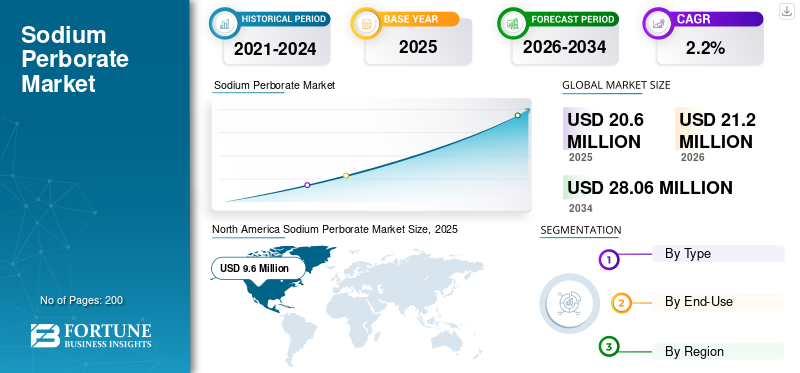
Download Free sample to learn more about this report.
SODIUM PERBORATE MARKET Key Takeaways
 Global Market Size & Forecast
- 2025 Market Size: USD 20.6 million
- 2026 Market Size: USD 21.2 million
- 2034 Forecast Market Size: USD 28.06 million
- CAGR: 2.2% from 2026–2034
 Market Share
- North America dominated the sodium perborate market with a market share of 46.6% in 2025.
- The monohydrate segment is expected to grow at a CAGR of 2.1% during the forecast period.
- The industrial cleaning segment is expected to grow at a CAGR of 2.2% over the forecast period.
 Key Regional Highlights
North America
The region led the global market with a value of USD 9.6 million in 2025 and is expected to reach USD 9.9 million in 2026, supported by strong household, institutional, and industrial cleaning demand.
Asia Pacific
The market is projected to reach USD 5.1 million by 2026, driven by large-scale manufacturing, industrial cleaning demand, and continued use in textile-related applications.
Europe
The regional market is forecast to reach USD 3.1 million in 2026, expanding at a 1.8% CAGR due to steady demand from household cleaning, industrial applications, and specialty chemical formulations.
U.S.
The U.S. market was valued at USD 8.8 million in 2025 and remains the largest market in North America, supported by its extensive cleaning products industry and consistent use in household and institutional formulations.
Japan
Japan continues to contribute to Asia Pacific market growth through its advanced industrial base, stable demand for specialty cleaning formulations, and ongoing use of sodium perborate in performance-oriented applications.
Read More

SODIUM PERBORATE MARKET TRENDS
Rising Manufacturers Focus on Shelf Stability to Boost Market Development
Demand patterns are increasingly shaped by the balance between mature household-care usage and more specialized yet commercially relevant industrial and textile applications. In powder detergents and cleaning systems, sodium perborate remains valued for its bleaching efficiency, storage stability, and compatibility with activators and other formulation components. This supports continued use in legacy and cost-sensitive formulations, particularly where powdered cleaning products remain well established.
Alongside this, manufacturers and buyers are paying greater attention to optimal dosing, product shelf stability, and application suitability in industrial cleaning and textile processes. Market participants are increasingly prioritizing strategies focused on maintaining established demand niches, strengthening distribution reach, and ensuring consistent product grades rather than broad-scale capacity expansion. As a result, the market is moving toward a stable, niche-oriented structure rather than high-volume commodity growth.
MARKET DYNAMICS
MARKET DRIVERS
Download Free sample to learn more about this report.
Household and Institutional Cleaning Demands to Propel Market Growth
Household care remains the largest demand center for sodium perborate, supported by its continued use in powdered laundry additives, cleaning products, and oxygen-bleach formulations. The compound also remains relevant in industrial and institutional cleaning systems that require dependable oxidative cleaning performance and dry-formulation stability. These uses create a stable and resilient demand base, even as the market transitions away from being a high-growth bleach category.
Beyond household care, textile processing and limited pulp-and-paper applications continue to support consumption volumes in selected regions. Suppliers benefit from familiarity with applications, broad handling experience, and the ability to serve customers who still prefer sodium perborate over substitute chemistries in specific formulations.
- For instance, industrial and institutional users continue to use oxygen-bleach systems in powdered and specialty formulations where shelf stability and controlled bleaching action remain important.
MARKET RESTRAINTS
Boron-Related Regulatory Pressure Can Restrict Market Expansion
While sodium perborate remains commercially relevant in several end-use segments, the market continues to face sustained substitution pressure from sodium percarbonate and other alternatives to bleaching chemistries in mainstream detergent systems. Many formulators have increasingly shifted toward alternative oxygen-bleach ingredients to align with evolving regulatory, labeling expectations, and consumer preference trends.
In addition, the sodium perborate market growth is constrained by its mature end-use profile. Growth in legacy detergent and bleaching systems is comparatively limited, and regional regulatory pressure on boron-containing substances can increase compliance burdens and reduce flexibility in adopting new formulations.
MARKET OPPORTUNITIES
Cost-Sensitive Powdered Systems to Create Lucrative Growth Opportunities
Opportunities in the market continue to exist across cost-sensitive powdered cleaning systems, institutional formulations, and regional markets where conventional oxygen-bleach products remain commercially viable. Suppliers that can offer reliable quality, competitive pricing, and tailored product grades are well-positioned to preserve and expand demand within established niches.
Additional opportunities are emerging in textile processing and specialty cleaning formulations, where customers value oxidation efficiency and dry-storage stability. Application guidance, distribution capability, and selective market penetration in developing regions can help suppliers sustain moderate long-term growth.
MARKET CHALLENGES
Growing Popularity of Alternative Bleach Systems Can Hamper Market Growth
A key challenge in the market is maintaining demand for sodium perborate amid the growing popularity of alternative bleach systems in mainstream consumer formulations. This places pressure on producers to defend existing demand niches through cost, consistency, and established customer relationships rather than through strong product differentiation.
In addition, the market remains relatively small and concentrated, which can limit investment appetite and expand the impact of compliance costs, logistics disruptions, and shifting customer specifications. Suppliers, therefore, need disciplined portfolio management and stable customer servicing to maintain long-term market participation.
Segmentation Analysis
By Type
Tetrahydrate Segment Held the Largest Share due to its Established Role in Conventional Bleaching Powders
Based on type, the market is segmented into tetrahydrate and monohydrate.
The tetrahydrate segment accounted for the largest sodium perborate market share in 2025. The segment’s growth is driven by its established role in conventional bleaching powders and cleaning formulations, where cost efficiency, formulation familiarity, and broad usability support larger-scale consumption.
The monohydrate segment is expected to grow at a CAGR of 2.1% during the forecast period, driven by its higher active oxygen content, suitability for compact formulations, and relevance in selected specialty and performance-oriented applications.
By End-Use
To know how our report can help streamline your business, Speak to Analyst
Household Care Segment Dominated the Market Due to the Rising Demand For Powdered Detergents
By end-use, the market is categorized into household care, industrial cleaning, textile industry, pulp and paper industry, and others.
The household care segment dominated the market in 2025. The segment’s growth is driven by demand for powdered detergents, laundry bleach formulations, and stain-removal products that continue to use oxygen-bleach chemistry in dry systems.
The industrial cleaning segment is expected to grow at a CAGR of 2.2% over the forecast period. The segment’s demand is driven by institutional and commercial cleaning requirements, stable demand for oxidative cleaning products, and the product’s utility in selected maintenance and sanitation formulations.
Sodium Perborate Market Regional Outlook
By geography, the market is categorized into North America, Europe, Asia Pacific, Latin America, and the Middle East & Africa.
North America
North America Sodium Perborate Market Size, 2025 (USD Million)
To get more information on the regional analysis of this market, Download Free sample
North America held the dominant share in 2025, valued at USD 9.6 million. The market is expected to maintain its leading share, reaching USD 9.9 million by 2026. The region benefits from established household cleaning demand, mature usage of powdered bleach, and continued institutional and industrial consumption for cleaning applications. The U.S. remains the largest market, while Canada contributes additional demand supported by stable cleaning-product consumption patterns.
U.S. Sodium Perborate Market
In 2025, the U.S. market reached USD 8.8 million. The U.S. dominates regional consumption due to its sizable base of cleaning products, a visible import footprint, and the continued use of the product in selected household and institutional formulations.
To know how our report can help streamline your business, Speak to Analyst
Asia Pacific
Asia Pacific is estimated to reach USD 5.1 million by 2026. The region’s growth is driven by its manufacturing scale, broad demand for cleaning products, and continued use of sodium perborate in industrial cleaning and textile-related applications. China remains the largest market, while India, Japan, South Korea, and the rest of the Asia Pacific continue to support demand through industrial activity and formulation diversity.
China Sodium Perborate Market
In 2025, the Chinese market reached USD 1.7 million. China’s market demand is supported by its role as a major producer and exporter of the product family and by domestic use across industrial and cleaning-related value chains.
Europe
The European region is projected to grow at a 1.8% rate during the forecast period, reaching a valuation of USD 3.1 million in 2026. The market’s growth is supported by demand from household and industrial cleaning, selected specialty formulations, and established persalt handling experience. The region also benefits from technical formulation know-how and relatively mature specialty chemical distribution structures.
U.K. Sodium Perborate Market
The U.K.’s market in 2025 stood at around USD 0.5 million, representing approximately 1.1% of global market revenue.
Germany Sodium Perborate Market
Germany’s market reached approximately USD 0.6 million in 2025, accounting for about 2.7% of global sales.
Latin America
Latin America is experiencing steady growth and is expected to reach a valuation of USD 1.0 million by 2026. The demand is concentrated in household care, industrial cleaning, and selected textile-related applications, with variability across countries depending on formulation patterns, industrial activity, and access to imports.
Brazil Sodium Perborate Market
Brazil’s market reached approximately USD 0.5 million in 2025, equivalent to around 1.6% of global sales.
Middle East & Africa
The Middle East & Africa region is gradually expanding, driven by demand for industrial cleaning, institutional sanitation products, and conventional bleaching systems used in selected commercial applications. Industrial cleaning remains the region’s most important growth area, while household care and textile-related demand continue to contribute to market expansion.
GCC Sodium Perborate Market
GCC reached USD 1.1 million by 2025, accounting for approximately 1.8% of global revenues. GCC demand is supported by institutional cleaning, commercial product demand, and the continued use of oxidative cleaning systems in climate- and infrastructure-intensive operating environments.
COMPETITIVE LANDSCAPE
Key Industry Players
Key Players Are Maintaining Product Availability, Distribution Reach, and Grade Consistency to Sustain Their Positions in the Market
The market includes a mix of specialty persalt suppliers, inorganic chemical manufacturers, and regional bleaching-chemical distributors that serve household care, industrial cleaning, textile, and limited pulp and paper applications. Competition is shaped by product consistency, oxygen-bleach performance, pricing, supply reliability, and the ability to provide appropriate grades for dry-formulation systems. Leading companies differentiate through product availability, technical familiarity, logistics support, and distribution reach rather than through broad innovation-led differentiation. Some key market players include Evonik Treibacher GmbH, Evonik Industries AG, Fengchen Group Co., Ltd, Merck KGaA, and Tokyo Chemical Industry (India) Pvt. Ltd.
LIST OF KEY SODIUM PERBORATE COMPANIES PROFILED
- Evonik Treibacher GmbH (Austria)
- Evonik Industries AG (Germany)
- Zhejiang Jiehua New Materials Co., Ltd. (China)
- Fengchen Group Co., Ltd (China)
- Henan BON Chemical Co., Ltd (China)
- Merck KGaA (Germany)
- Tokyo Chemical Industry (India) Pvt. Ltd. (India)
- Loba Chemie Pvt. Ltd. (India)
- Jayvir Dye Chem (India)
- Perry Impex (India)
- ACURO ORGANICS LIMITED (India)
REPORT COVERAGE
The global sodium perborate market analysis provides an in-depth study of market size & forecast by all the market segments included in the report. It includes details on market dynamics and trends expected to drive the market during the forecast period. It offers information on technological advancements, new product launches, key industry developments, and partnerships, mergers & acquisitions. The market research report also includes a detailed competitive landscape, providing market share and profiles of key players.
Request for Customization to gain extensive market insights.
Report Scope & Segmentation
| ATTRIBUTE | DETAILS |
| Study Period | 2021-2034 |
| Base Year | 2025 |
| Estimated Year | 2026 |
| Forecast Period | 2026-2034 |
| Historical Period | 2021-2024 |
| Growth Rate | CAGR of 2.2% from 2026 to 2034 |
| Unit | Value (USD Million) and Volume (Tons) |
| Segmentation | By Type, End-Use, and Region |
| By Type |
|
| By End-Use |
|
| By Geography |
|
Frequently Asked Questions
Fortune Business Insights estimates that the global market size was valued at USD 20.6 million in 2025 and is projected to reach USD 28.06 million by 2034.
Recording a CAGR of 2.2%, the market is slated to exhibit steady growth during the forecast period.
By end-use, the household care segment led the market in 2025.
North America held the highest market share in 2025.
Evonik Treibacher GmbH, Evonik Industries AG, Fengchen Group Co., Ltd., Merck KGaA, and Tokyo Chemical Industry (India) Pvt. Ltd. are the top players in the market.
The key factor driving market growth is the rising household and institutional cleaning demands.



- 2021-2034
- 2025
- 2021-2024
- 200
Get 30-60 hrs Free Customization
Expand Regional and Country Coverage, Segments Analysis, Company Profiles, Competitive Benchmarking, and End-user Insights.


















-
US +1 833 909 2966 ( Toll Free )
-
Get In Touch With Us