Sodium Percarbonate Market Size, Share & Industry Analysis, By Type (Coated, Uncoated, Tablet, and Others), By Application (Laundry, Household Cleaning, Industrial Cleaning, Textile Industry, and Others), and Regional Forecast, 2026-2034
 Download Free Sample
Sodium Percarbonate Market Size and Future Outlook
 Listen to Audio Version
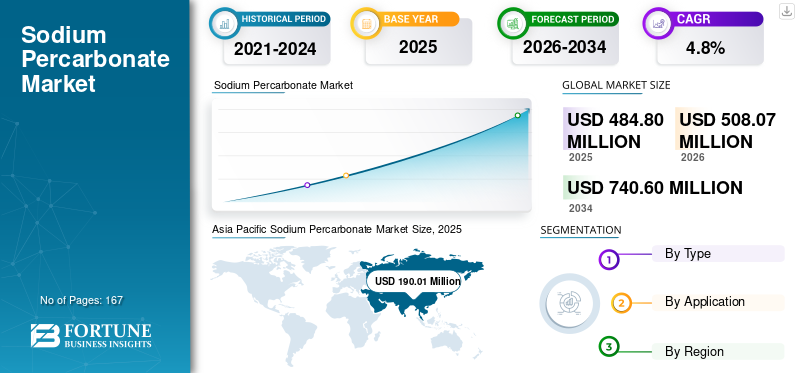
The global sodium percarbonate market size was valued at USD 484.80 million in 2025 and is projected to grow from USD 508.07 million in 2026 to USD 740.60 million by 2034, exhibiting a CAGR of 4.8% during the forecast period. Asia Pacific dominated the sodium percarbonate market with a market share of 39.19% in 2025.
Sodium percarbonate is a solid adduct of sodium carbonate and hydrogen peroxide (commonly referred to as sodium carbonate peroxyhydrate) that functions as an active-oxygen bleaching agent and oxidizing detergent agent. It is widely used in laundry detergents, bleach additives, automatic dishwashing products, and hard-surface cleaning formulations, and is also used in selected textile, paper, and specialty oxidation applications. Producers including Solvay describe it as a free-flowing white granular material designed for applications ranging from hard-surface cleaners to all-fabric bleaches and laundry detergents, while Evonik highlights percarbonate as a core persalt used in modern laundry and dishwashing detergents. The market is therefore supported by its role as a chlorine-free solid bleach source across both household cleaning and selected industrial end uses.
Furthermore, the market is characterized by several significant participants, including Solvay, Evonik Treibacher GmbH, Jiangxi Boholy Chemical Co., Ltd., Akkim Kimya, Zhejiang Jiehua New Materials Co., Ltd.
Download Free sample to learn more about this report.
SODIUM PERCARBONATE MARKET KEY TAKEAWAYS
 Global Market Size & Forecast
- 2025 Market Size: USD 484.80 million
- 2026 Market Size: USD 508.07 million
- 2034 Forecast Market Size: USD 740.60 million
- CAGR: 4.8% from 2026–2034
 Market Share
- Asia Pacific dominated the sodium percarbonate market with a market share of 39.19% in 2025.
- The coated segment is projected to grow at a 4.8% CAGR over the study period.
- The uncoated segment held the second-largest share in 2025 and is projected to grow at a 4.4% CAGR over the forecast period.
 Key Regional Highlights
North America
North America constitutes a significant market, bolstered by laundry additives, household cleaning products, and the region’s robust soda ash industry.
Europe
The region is projected to grow at an annual rate of 3.6%, reaching a market valuation of USD 148.95 million by 2026.
Asia Pacific
In 2024, the Asia Pacific region accounted for the largest share, valued at USD 182.22 million, and continued to lead in 2025, valued at USD 190.01 million.
U.S.
The U.S. market is estimated at around USD 92.42 million in 2026, accounting for roughly 18.2% of global sales.
Japan
The Japanese market is estimated to be around USD 25.15 million in 2026, accounting for roughly 4.9% of the global revenues.
Read More

SODIUM PERCARBONATE MARKET TRENDS
Shift toward Stabilized, Coated, and Compact-Detergent-Compatible Types to be a New Market Trend
A significant market trend is the transition from generic sodium percarbonate supplies to higher-stability coated types. These are specifically designed for compact detergents, bleach additive products, and automatic dishwashing formats. Solvay’s Oxyper types clearly differentiate between stabilized laundry-oriented types and high-coated types intended for detergent powders, tablets, and machine dishwash products. Similarly, Evonik emphasizes that ongoing development of its coating process has enhanced storage stability, shelf life, pourability, and bulk density, attributes that are becoming increasingly critical as detergent systems grow more concentrated and performance-sensitive.
This trend is significant since the success of formulation is now influenced by factors beyond mere oxygen availability. Producers are now competing based on flowability, compatibility with enzymes and builders, shelf stability under humid conditions, and dissolution behavior in tablets and compact powders. This shift directs demand toward coated and higher-performance types rather than solely toward standard commodity percarbonate, particularly in developed detergent markets and premium export-oriented applications.
MARKET DYNAMICS
MARKET DRIVERS
Download Free sample to learn more about this report.
Expansion of Laundry, Dishwashing, and Home-Care Formulations is Sustaining Core Market Demand
The demand for sodium percarbonate is primarily driven by the scale and robustness of detergent and cleaning product manufacturing. Solvay markets sodium percarbonate directly to the hard-surface cleaner, laundry detergent, and fabric bleach sectors, whereas Evonik observes that percarbonate is a key component in numerous commercial stain salts and is employed in laundry and dishwashing detergents. These applications are not peripheral; they are integral to the mainstream household and professional cleaning market.
The downstream demand environment remains structurally supportive. A.I.S.E. reported that Europe’s detergents and maintenance products industry reached USD 55.7 billion in 2024, with significant value pools in laundry, dishwashing, and household cleaning. As sodium percarbonate is a fundamental oxygen-bleach component used in powders, tablets, and additive systems, growth in the cleaning products category directly underpins the expansion of baseline consumption.
A subsequent aspect of the driver involves formulation enhancement. Producers are progressively marketing stabilized and coated types that exhibit superior performance in compact detergents and dishwashing systems. As formulators strive for enhanced efficacy at reduced dosages and under more challenging storage conditions, the product advantages not only from increased volume but also from a higher-value product mix within its category.
MARKET RESTRAINTS
Sensitivity to Feedstock Economics and Storage-Stability Requirements Can Limit Margin Expansion
Sodium percarbonate is an active-oxygen chemical whose costs are closely linked to upstream hydrogen peroxide and soda ash. USGS notes that soda ash remains an important chemical feedstock, including use in soap and detergents, while major producers continue to invest in soda ash and peroxide efficiency, emissions, and logistics. That indicates input availability is solid, but also that market economics remain tied to broader chemical and energy cost conditions.
Another limitation is that sodium percarbonate's performance is highly dependent on its stability, coating quality, and moisture management. Manufacturers consistently emphasize storage stability, shelf life, and proper product handling. Lower-cost, less-stable grade types may face limitations when used in compact detergents, tablets, humid climates, and export storage chains. This can hinder substitution efforts and may result in some customers remaining loyal to validated, coated, or branded types.
MARKET OPPORTUNITIES
Industrial and Specialty Oxidation Uses Provide White-Space Beyond Core Detergent Demand
Although detergents remain the primary application, producer disclosures reveal a wider array of opportunities. Boholy explicitly lists sodium percarbonate for applications in textiles, paper manufacturing, dishware disinfection, metal surface treatment, medical oxygen-related uses, and aquaculture oxygenation. Solvay’s broader peroxygen platform also encompasses pulp and paper, water treatment, aquaculture, and resource and environmental uses, demonstrating that active-oxygen chemistry continues to advance into technical and environmental sectors.
The opportunity herein does not lie in every specialty use transforming into a high-volume segment overnight. Instead, these applications serve to diversify the market and underpin premium niches where consumers prioritize oxidizing performance, ease of handling compared to liquid peroxide, or an environmentally favorable chlorine-lean process route. This consideration is especially pertinent in areas such as textile processing, specialty industrial cleaning, paper treatment, and specific water-related applications, where solid peroxide chemistry can provide logistical or formulation benefits.
MARKET CHALLENGES
Competition from Alternative Bleaching Systems and Need for Application-Specific Validation Remain Ongoing Challenges
Sodium Percarbonate operates within a broader oxidizing and bleaching ecosystem that encompasses liquid hydrogen peroxide, peracetic acid systems, and various other bleaching and disinfection chemistries. Both Solvay and Evonik market extensive peroxide portfolios across diverse end applications, demonstrating that customers frequently select among several active-oxygen options depending on process design, handling considerations, cost, and efficacy requirements. This factor can limit market penetration in certain applications, even when sodium percarbonate remains technically feasible.
Application engineering also faces the challenge of ensuring customers get the right balance of coating level, bulk density, dissolution profile, and formulation compatibility. In detergents, dishwashing tablets, and specialty bleach products, performance issues can appear as caking, reduced shelf life, poor dissolution, or loss of active oxygen. Therefore, market growth isn't just about increasing volume; it often depends on the supplier's ability to optimize types and provide formulation support.
Segmentation Analysis
By Type
Improved Stability and Superior Compatibility with Compact Detergent Powders and Tablets Contributed to Coated Segmental Dominance
Based on type, the market is segmented into coated, uncoated, tablet, and others.
The coated segment maintained market dominance in 2025 owing to its improved stability, prolonged shelf life, and superior compatibility with compact detergent powders and tablets. Boholy’s product portfolio includes coated types, and Solvay’s high-coated Oxyper type is expressly formulated for use in bleach additive products, detergent powders and tablets, as well as automatic machine dishwashing powders and tablets. This observation clearly signifies that coated type are the preferred format in applications where moisture resistance and storage stability are paramount. Additionally, this segment is projected to grow at a 4.8% CAGR over the study period.
The uncoated segment held the second-largest share in 2025 and is projected to grow at a 4.4% CAGR over the forecast period. The growth is driven by its cost sensitivity and straightforward formulation. Boholy categorizes uncoated sodium percarbonate alongside coated types, thereby affirming the ongoing market demand for less-processed variants. The segment is more susceptible to storage and humidity constraints, thereby exhibiting a higher demand profile in applications requiring rapid turnover, simplified packaging, or reduced formulation complexity, thereby diminishing the need for advanced stabilization.
By Application
To know how our report can help streamline your business, Speak to Analyst
Importance of Stain Removal, Whitening, and Active-Oxygen Bleaching in Both Powder and Additive Forms Lead to Dominance of Laundry Segment
In terms of application, the market is categorized into laundry, household cleaning, industrial cleaning, textile industry, and others.
The laundry segment represents the largest sodium percarbonate market share. This segment highlights the importance of stain removal, whitening, and active-oxygen bleaching in both powder and additive forms. Laundry remains the primary application, as it involves high volume, frequent use, and compatibility with coated or stabilized types, which suppliers can identify using technical means.
The household cleaning segment experienced the most rapid market expansion in 2025. This growth was primarily driven by consumer preference for visibly effective cleaning results and, increasingly, by formulations marketed as free from active oxygen and chlorine. Although product formats differ considerably, sodium percarbonate continues to attract formulators who require a stable solid oxidizer that can be incorporated into powders, tablets, and dry mixes. Furthermore, this segment is projected to grow at a 5.6% CAGR from 2026 to 2034.
The textile segment is expected to grow moderately. Demand in this sector is primarily driven by bleaching and finishing requirements, especially when processors prioritize oxidizing efficiency and ease of handling. This segment generally exhibits more cyclical fluctuations than household cleaning products, as it is linked to industrial textile manufacturing; nonetheless, it remains a substantial market in Asia, where textile manufacturing ecosystems are highly concentrated.
Sodium Percarbonate Market Regional Outlook
By geography, the market is categorized into North America, Europe, Asia Pacific, Latin America, and the Middle East & Africa.
Asia Pacific
Asia Pacific Sodium Percarbonate Market Size, 2025 (USD Million)
To get more information on the regional analysis of this market, Download Free sample
In 2024, the Asia Pacific region accounted for the largest share, valued at USD 182.22 million, and continued to lead in 2025, valued at USD 190.01 million. The regional growth is supported by its extensive detergent manufacturing infrastructure, comprehensive textile processing capabilities, and a dense network of producers, as well as associated chemical supply chains. Furthermore, the region benefits from robust downstream demand across sectors, including laundry detergents, textiles, and paper industries.
China Sodium Percarbonate Market
By 2026, the Chinese market is projected to attain a valuation of USD 76.28 million. Prominent China-based manufacturers such as Boholy and Zhejiang Jinke exemplify the region’s manufacturing prominence. China also benefits structurally from its proximity to both feedstocks and end-use manufacturing, positioning it as the most logical hub for large-scale supply, particularly for standard and mid-value types serving detergent and industrial export markets.
To know how our report can help streamline your business, Speak to Analyst
Japan Sodium Percarbonate Market
The Japanese market is estimated to be around USD 25.15 million in 2026, accounting for roughly 4.9% of the global revenues.
India Sodium Percarbonate Market
The Indian market is estimated at around USD 30.15 million in 2026, accounting for roughly 5.9% of global revenues.
Europe
Europe is expected to experience substantial sodium percarbonate market growth in the coming years. Over the forecast period, the region is projected to grow at an annual rate of 3.6%, reaching a market valuation of USD 148.95 million by 2026. Europe remains a significant market due to its extensive, mature detergent and maintenance product industry, coupled with a heightened focus on product stewardship, formulation efficacy, and sustainability. Data from A.I.S.E. for 2025 highlight the substantial demand for laundry, dishwashing, and home-care products across Europe, while both Solvay and Evonik maintain their robust positioning in peroxide and active-oxygen technologies in the region.
U.K. Sodium Percarbonate Market
The U.K. market is estimated at around USD 25.14 million in 2026, accounting for roughly 4.9% of global revenues.
Germany Sodium Percarbonate Market
Germany’s market is estimated at around USD 28.72 million in 2026, accounting for roughly 5.7% of global revenues.
North America
North America constitutes a significant market, bolstered by laundry additives, household cleaning products, and the region’s robust soda ash industry. Solvay’s Green River operations and the broader U.S. soda ash infrastructure are of strategic importance, given that soda ash is a fundamental component in the production of sodium percarbonate.
U.S. Sodium Percarbonate Market
Given North America’s significant contribution and the U.S. dominance in the region, the U.S. market is estimated at around USD 92.42 million in 2026, accounting for roughly 18.2% of global sales.
Latin America and Middle East & Africa
Latin America and Middle East & Africa are emerging markets characterized by their smaller scale yet expanding growth. This development is driven by increasing detergent consumption, the rise of local manufacturing of cleaning products, and specific industrial applications such as textiles, paper production, and water treatment. The Latin America market is projected to reach USD 27.05 million by 2026.
GCC Sodium Percarbonate Market
The GCC market is estimated at USD 9.16 million in 2026, accounting for approximately 1.8% of global revenues.
COMPETITIVE LANDSCAPE
Key Industry Players
Competitive Intensity Remains Moderate as Process Control and Logistics Efficiency Strengthen Supplier Positioning
The market exhibits a moderate level of concentration around well-established suppliers of peroxide and active oxygen. It also encompasses Chinese manufacturers offering a broader range of commodities and application-grade products. Solvay serves as a prominent global reference point, featuring branded sodium percarbonate grades and an extensive portfolio of peroxygen compounds. Evonik highlights the performance of coated percarbonate used in compact detergents. Boholy presents a comprehensive selection of both commodity and specialty products, including coated, uncoated, low-oxygen, high-bulk-density, and tablet formulations.
Suppliers who demonstrate superior process control and logistical efficiency are better positioned to succeed in the premium detergent, dishwashing, and export markets, where storage stability and consistency are paramount.
LIST OF KEY SODIUM PERCARBONATE COMPANIES PROFILED IN REPORT
- Solvay (Belgium)
- Evonik Treibacher GmbH (Austria)
- Jiangxi Boholy Chemical Co., Ltd. (China)
- Akkim Kimya (Turkey)
- Zhejiang Jiehua New Materials Co., Ltd. (China)
- Hongye Holding Group (China)
- OCI ALABAMA (U.S.)
- PJSC Khimprom (Russia)
- Hodogaya Chemical Co., Ltd. (Japan)
- Central Drug House (India)
REPORT COVERAGE
The global sodium percarbonate market analysis provides an in-depth study of market size & forecast by all the market segments included in the report. It includes details on the market dynamics and market trends expected to drive the market during the forecast period. It offers information on technological advancements, new product launches, key industry developments, and partnerships, mergers & acquisitions. The market research report also encompasses detailed competitive landscape with information on the market shares and profiles of key players.
Request for Customization to gain extensive market insights.
Report Scope & Segmentation
| ATTRIBUTE | DETAILS |
| Study Period | 2021-2034 |
| Base Year | 2025 |
| Estimated Year | 2026 |
| Forecast Period | 2026-2034 |
| Historical Period | 2021-2024 |
| Growth Rate | CAGR of 4.8% from 2026-2034 |
| Unit | Value (USD Million) and Volume (Kiloton) |
| Segmentation | By Type, Application, and Region |
| By Type |
|
| By Application |
|
| By Region |
|
Frequently Asked Questions
Fortune Business Insights says that the global market size was valued at USD 484.80 million in 2025 and is projected to reach USD 740.60 million by 2034.
Recording a CAGR of 4.8%, the market is slated to exhibit steady growth during the forecast period of 2026-2034.
The laundry application segment is leading in the market.
Asia Pacific held the highest market share in 2025.
Expansion of laundry, dishwashing, and home-care formulations is accelerating the adoption of Sodium Percarbonate.



- 2021-2034
- 2025
- 2021-2024
- 167
Get 30-60 hrs Free Customization
Expand Regional and Country Coverage, Segments Analysis, Company Profiles, Competitive Benchmarking, and End-user Insights.


















-
US +1 833 909 2966 ( Toll Free )
-
Get In Touch With Us