Solar Power Green Airport Market Size, Share & Industry Analysis By Installation Type (Rooftop, Ground-Mounted, and Carport), By Infrastructure (Greenfield and Brownfield), By Airport Operations (Airside Operations (Runway & Taxiway, Lighting and Navigation, and Others), Terminal Operation (Baggage Handling Systems, Airport Retail, and Others), Landside Operation (Car Parking, Car Rental, and Others)), By Application (Civil & Commercial, and Military), By Airport Class (Class A, Class B, and Class C), By Airport Type (International and Domestic), and Regional Forecast, 2026-2034
 Download Free Sample
KEY MARKET INSIGHTS
 Listen to Audio Version
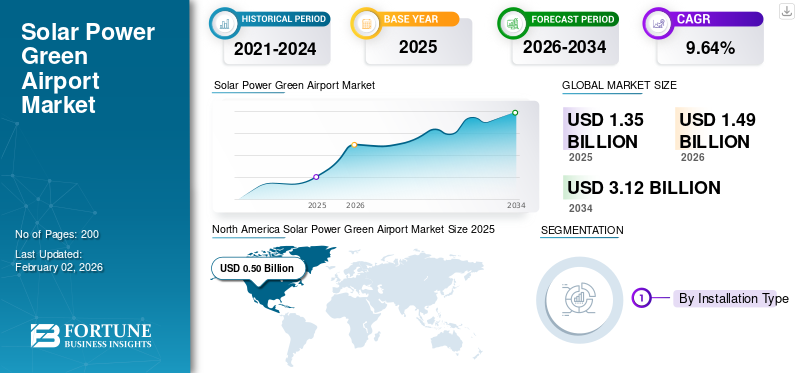
The global green airport solar power market size was USD 1.35 billion in 2025. The market is projected to grow from USD 1.49 billion in 2026 to USD 3.12 billion by 2034, growing at a CAGR of 9.64% during the forecast period. North America dominated the solar power green airport market with a market share of 37.13% in 2025.
A solar power green airport deploys solar energy to power its operations to reduce reliance on fossil fuel and decrease environment impact. This initiative includes the installation of solar panels to generate electricity which is used to power various operations at the airport. With the use of clean energy, airports aim to implement a sustainable solution as it reduces carbon emissions and reliance on fossil fuels. There is an increase in the installation of solar panels at airports as the aviation carbon emission regulations and standards are becoming stringent.
Key players in the market such as First Solar, Canadian Solar, Trina Solar, JinkoSolar, are designing and installing solar farms and infrastructure at various airports. Companies such as Envision Solar (U.S.) are developing solar EV charging stations to reduce environmental impact and increase energy independence. Moreover, government agencies and aviation ministries support and regulate green infrastructure projects at airports to accelerate renewable power adoption. For instance, Airports Authority of India (AAI), Federal Aviation Administration (FAA) installs solar power plants at various airports for the generation and self-consumption of green and renewable energy to encourage green energy usage at airports.
Download Free sample to learn more about this report.
Solar Power Green Airport Market Key Takeaways
 Global Market Size & Forecast
- 2025 Market Size: USD 1.35 billion
- 2026 Market Size: USD 1.49 billion
- 2034 Forecast Market Size: USD 3.12 billion
- CAGR: 9.64% from 2026-2034
 Market Share
- North America dominated the green airport solar power market with a 37.13% share in 2025.
- The brownfield segment is projected to account for a 66.79% share in 2026.
- The terminal operations segment is expected to hold a 59.80% share in 2026.
 Key Regional Highlights
North America
North America accounted for USD 0.50 billion in 2025 and is projected to reach USD 0.56 billion in 2026.
Europe
Europe generated USD 0.29 billion in 2025 and is expected to reach USD 0.32 billion in 2026.
Asia Pacific
Asia Pacific was valued at USD 0.44 billion in 2025 and is projected to reach USD 0.49 billion in 2026.
U.S.
The market is projected to reach USD 0.47 billion by 2026.
Japan
The market is projected to reach USD 0.07 billion by 2026.
Read More

Government Incentives and Subsidies Accelerating Solar Power Green Airport Industry Growth
Governments across the globe are actively supporting the transition of airports into green solar powered hubs with the help of financial and regulatory incentives. Governments are launching such initiatives to reduce the carbon footprint of the aviation sector to improve energy efficiency and support emission goals. For example, Cochin International Airport received financial support from the Kerala government and central incentives for renewable projects under the Ministry of New and Renewable Energy (MNRE). Moreover, European countries such as France are actively promoting rooftop solar, including at airports, with incentives and mandates. The government has increased its solar target to 60 GW by 2030, with mandatory solar for certain commercial and industrial buildings and covered car parks.
In addition, governments across the globe offer direct subsidies and grants to airports to install solar power systems to reduce initial investment costs. For instance, in August 2023, El Paso International Airport (ELP) received a USD 3 million grant from the Federal Aviation Administration (FAA) for the installation of solar panels and a USD 360,000 grant to develop an Airport Sustainability Master Plan. Therefore, such incentives and subsidies for solar installations to promote sustainability and contribute to cleaner environment is expected to accelerate the adoption of solar power at airports on a large scale.
Solar Power Green Airport Market Trends
Rise of Hybrid Solar and Battery Storage Solutions in Green Airport
As airports increasingly adopt green energy such as solar power to reduce carbon emissions and operating costs, the integration of battery energy storage systems (BESS) with their solar power setups has increased. Hybrid solar and battery storage solutions are becoming increasingly popular in green airports, offering a sustainable and reliable way to power operations. These power systems combine solar photovoltaic (PV) panels with battery energy storage systems (BESS) to maximize renewable energy usage and reduce carbon footprints. For instance, in March 2024, Copenhagen Airport installed a huge battery for green energy storage generated from solar and wind energy. Airports require a consistent power supply for all their critical operations. Hybrid solar systems with battery storage can seamlessly switch to stored energy during grid failures or power fluctuations, ensuring uninterrupted services. Therefore, such approach is gaining traction as it ensures continuous power supply along with reduction on fossil fuel reliance.
Download Free sample to learn more about this report.
Market Dynamics
Market Drivers
Surge in Pressure to Reduce Carbon Emissions in the Aviation Sector to Propel Market Growth
Aviation holds around 2.5% of the global CO2 emissions, which is increasing rapidly as compared to other industries such as rail, road, or maritime industry. Thus, the aviation sector is under constant pressure to reduce its environmental impact and fulfil the targets for achieving net zero emission. Clean energy such as solar energy can help the aviation sector to help achieve these targets by reducing the reliance on traditional fossil fuels that contribute on a large extent to the overall carbon emission generation. Solar power systems offer a clean and renewable energy source.
This is expected to help the airports meet international sustainability goals set by International Civil Aviation Organization (ICAO). The International Civil Aviation Organization (ICAO) has set a long-term global aspirational goal (LTAG) of net zero carbon emissions by 2050 for international aviation. Such targets encourage various airports across the globe to invest in solar power infrastructure to reduce carbon footprint and achieve carbon emissions goals. For instance, in January 2025, Rome Fiumicino Airport launched the largest self-consumption solar farm of Europe which is expected to generate 30 million kWh per year. This initiative aims to advance its commitment to sustainability and carbon neutrality by 2030.
Market Restraints
High Initial Capital Investment and Long Payback Period to Hinder Market Growth
One of the factors restraining the market is high upfront cost associated with the installation of solar power systems at airports. The airports require solar infrastructure installed on a larger scale to power their operations. This involves costs related to solar panels, inverters, structural modifications, grid integration, and energy storage systems. Such adoption is carried out by solar farm installation projects that need hefty initial funding which can be challenging for airports operating on limited budgets. For instance, in November 2020, the 10 MW solar power project planned at Gautam Buddha International Airport, India, is expected to cost around USD 10 million.
Moreover, the return on investment (ROI) for solar installations at airports is relatively long It often takes 10 to 20 years for ROI which depends on multiple factors such as airport size, energy consumption, and incentives released by governments. However, solar panel installations at airports are generally showing a positive return on investment (ROI), with costs often recovered within a few years. Large airports with USD 15-25 million investments in solar infrastructure typically get complete payback within a period of 5-8 years. Although, the overall high investment cost is expected to hinder the solar power green airport market during the forecast period.
Market Challenges
Land and Space Constraints for Solar Installation Pose a Significant Challenge for Market Expansion
Numerous airports in urban and land scarce regions are facing the challenge of limited land and space required to build and set up solar arrays. Major urban international hubs are often surrounded by dense infrastructure and lack of availability of open land or rooftops for the installation of either ground mounted or rooftop solar panels. Airports require a huge amount of energy for various operations including airside, landside, and terminal. Without sufficient space, it becomes difficult to complete a solar farm project and provide solar power to meet the energy needs of the airport, creating a significant challenge for the growth of the solar power green airport industry.
Market Opportunities
Integration of Solar Power with Smart Airport Infrastructure to Drive Growth Opportunities
As more airports adopt the use of solar energy to power various airport operations, there is a rise in the utilization of solar power to support smart airport technologies. The rising popularity of smart airport technologies such as energy management systems, automated lighting, and IoT-based monitoring presents major opportunities for solar power integration. Airports are increasingly moving toward energy self-sufficiency and sustainable operations. Combining solar power with smart grids and advanced storage can significantly optimize the power usage and reduce the reliance on conventional energy sources.
Segmentation Analysis
By Installation Type
Ground-Mounted Segment Held the Largest Market Share Due to Cost Effectiveness and Higher Efficiency
On the basis of installation type, the market is classified into rooftop, ground-mounted, and carport.
The ground-mounted segment holds the largest share contributing 76.67% globally in 2026 and is expected to grow at the fastest rate during the forecast period. The driving factor for the growth of the segment is scalability, cost effectiveness, and ease of installation across airports. Airports have large spaces and unused non-operational spaces that can be used for construction and installation of solar farms. Moreover, ground-mounted systems have lower installation and maintenance costs which makes them a suitable choice for most airports. For instance, in 2024, Denver International Airport 7&8 Solar PV Park, a ground-mounted solar project, was completed over 140 acres.
By Infrastructure
Brownfield Segment to Hold the Largest Share Due to Increase in Retrofitting of Existing Airports
On the basis of infrastructure, the market is classified into greenfield and brownfield.
The brownfield segment is projected to remain the dominant airport infrastructure type in the global market contributing 66.79% globally in 2026. The segment holds the highest share as there is an increase in the retrofitting of existing airports with solar power to meet sustainability goals. Airports such as Cochin (India), Denver (U.S.), and Gatwich (U.K.) are examples of implementation of large solar projects. Such developments are driving the dominance of the brownfield segment.
The greenfield segment is estimated to grow at the fastest CAGR over the forecast period. The growth is associated with a rise in programs and policies developed by governments to support construction of green airports. For instance, in January 2025, the Ministry of Civil Aviation (MoCA) shared plans to approve the development of three new greenfield airports in Puri (Odisha), Kota (Rajasthan), and Parandur (Tamil Nadu). Greenfield airports constructed on undeveloped land, offer a unique opportunity to integrate sustainable technologies and design principles from the outset, making them ideal for incorporating solar power and other green initiatives.
By Airport Operations
Terminal Operation Segment Holds the Largest Market Share Due to High Terminal Power Demand
On the basis of airport operations, the solar power green airport market is classified into airside operations, terminal operations, and landside operations. Airside operations include runway & taxiway, lighting and navigation, refueling and drainage, and electric vehicle charging stations. Terminal operations include baggage handling systems, security equipment and infrastructure, airport retail, and others. Landside operations comprises car parking, car rental, and others.
The terminal operations segment holds the largest share contributing 59.80% globally in 2026 in the market as there is huge terminal power demand in airplane operations. The terminal operations are the most energy intensive part of the airport. Terminals require continuous power for HVAC systems, lightings, escalators, baggage handling, and other applications. Moreover, the airports are focusing on using green energy to prioritize powering the passenger facing zone which is expected to drive the growth of the segment.
The airside operations segment is estimated to be the fastest-growing segment as airports are heavily investing in solar power to shift from fossil fuel ground equipment to electric powered systems. These include electric tugs, equipment, GPU units which require clean and reliable power source, increasing the adoption of solar energy at airports. For instance, in June 2025, Karnataka established and inaugurated a solar-integrated EV charging station near Kempegowda International Airport.
By Application
Civil & Commercial Segment Holds the Largest Market Share Due to Strict Regulatory Requirements
On the basis of application, the market is classified into civil & commercial and military.
The civil & commercial segment holds the largest share contributing 89.85% globally in 2026 in the market as there is an increase in focus in commercial aviation sector to meet regulatory requirements and emissions goals. Moreover, with the rise in passenger traffic, there is a surge in energy demand and the need to reduce carbon emissions. Moreover, in countries such as India, China, governments are actively promoting solar adoption at civil airports with the help of public-private partnerships and national green airport programs.
The military segment is estimated to be the fastest-growing segment due to a rise in focus on energy resilience and independence at military airports and bases. Military operations require uninterrupted power for radar systems, communication units, runway operations, and security infrastructure. Moreover, an increase in modernization efforts in the military sector is expected to push solar implementation in military airfields.
By Airport Class
Class A Segment Holds the Largest Market Share Due to Sustainability Mandates and Climate Control Frameworks
On the basis of airport class, the market is classified into class A, class B, and class C.
The class A airports segment holds the largest market share due to the early adoption of large scale solar projects driven by international regulations and sustainability mandates. Frameworks such as ICAO’s CORSIA, Airport Carbon Accreditation Programs, and others prioritize net zero airport operations which is expected to push the adoption of solar power energy at airports.
The class B segment is estimated to be the fastest-growing segment owing to a rise in regional connectivity initiatives and government-backed modernization schemes. Such initiatives target mid-tier airports in developing economies to promote the use of green energy within airport operations. Moreover, programs such as UDAN scheme in India and the Green Airport Initiative by Thailand are encouraging investments in the expansion of airports along with the use of sustainable energy.
To know how our report can help streamline your business, Speak to Analyst
By Airport Type
International Segment Holds the Largest Market Share Due to Rise in Air Traffic and Increased Energy Demands
On the basis of airport class, the market is classified into international and domestic.
The international airports segment currently holds the largest share in the market due to a rise in passenger traffic, extensive infrastructure, and higher energy demands to meet the increased air traffic. These international airports are investing in sustainable technologies including solar farms at a large scale to lower costs and enhance sustainability. For instance, in March 2025, Fiji Airports announced its adoption of various sustainable initiatives including solar farm installation to reduce carbon footprint.
The domestic segment is estimated to be the fastest-growing segment. The segment is growing driven by regional airport expansion plans and solar viability in remote areas. As a part of national green infrastructure initiatives, numerous countries are focusing on tier-2 and tier-3 cities. These smaller airports are increasingly integrating solar solutions to reduce cost and environmental impact.
Solar Power Green Airport Market Regional Outlook
On the basis of region, the market has been studied across North America, Europe, Asia Pacific, and the rest of the world.
North America
North America Solar Power Green Airport Market Size 2025 (USD Billion)
To get more information on the regional analysis of this market, Download Free sample
In 2025, North America represented USD 0.5 billion, accounting for 37.13% of the worldwide market, and is projected to grow to USD 0.56 billion in 2026. North America currently holds the largest market share. The countries in the region such as U.S. and Canada have shown a significant shift toward sustainability in airport infrastructure. For instance, according to a 2020 study by the University of Colorado, 20% of public airports in the U.S. had adopted on-site solar power generation as part of their sustainability initiatives. Moreover, federal and state initiatives and active funding is expected to promote the research and development of solar infrastructure at airports. For instance, in July 2023, Federal Aviation Administration (FAA) invested USD 22.58 million to Indianapolis International Airport in Indiana to construct energy efficient infrastructure and install solar panels. Airports such as Indianapolis International and Denver International are leveraging on-site solar farms to reduce the reliance on conventional energy grids and switch to sustainable energy alternatives. In addition, net zero airport targets by 2040 to 2050 fuel the demand for solar integrated operations such as lighting and runway systems.The U.S. market is projected to reach USD 0.47 billion by 2026.
Europe
The Europe market generated USD 0.29 billion in 2025, representing 21.82% of the global market landscape, and is expected to reach USD 0.32 billion in 2026. The Europe market is witnessing rapid growth, driven by zero emission mandates and Environmental, Social Governance (ESG) pressures. The European Union makes strict regulations and enforces aggressive carbon reduction targets for the aviation sector. Therefore, the airports are under regulatory pressure to decarbonize operations especially in countries such as Germany, France, and Netherlands. For instance, in April 2024, Toulon Hyeres airport, France, reached net zero Scope 1 and 2 emissions and inaugurated rooftop solar power system with capacity of generating 690 MWh per year. Therefore, increase in airports transformation across the region into low-emission zones with the help of solar energy is expected to propel the growth of the solar power green airport industry in the region.The UK market is projected to reach USD 0.07 billion by 2026, while the Germany market is projected to reach USD 0.11 billion by 2026.
Asia Pacific
Asia Pacific contributed 32.82% to the global market in 2025, with a valuation of USD 0.44 billion, and is projected to reach USD 0.49 billion in 2026. The Asia Pacific region is rapidly emerging as a significant region in the market. As the passenger and cargo traffic in the region is increasing, countries such as China, India, Indonesia, and others are under pressure to expand airport infrastructure, which is expected to promote the adoption of solar power. India’s National Solar Mission and solar technology advancements in China are encouraging large scale adoption of solar power at airports. Rapid urbanization and pollution concerns have made the governments of these countries prioritize cleaner energy for airport use. According to India Brand Equity Foundation, 86 airports across the country use green energy, with 55 of those using 100% of their overall energy usage from green sources.The Japan market is projected to reach USD 0.07 billion by 2026, the China market is projected to reach USD 0.19 billion by 2026, and the India market is projected to reach USD 0.14 billion by 2026.
Rest of the World
Rest of the World contributed approximately USD 0.11 billion to the global market in 2025, accounting for 8.23% share, and is expected to reach USD 0.12 billion in 2026. Several airports in Latin America are embracing solar energy and sustainable practices to become more environmentally friendly, with the Galapagos Ecological Airport in Ecuador. Various incentives and recognition programs promote green energy adoption at airports. For instance, airports operated by VINCI Airports in Brazil, Chile, Costa Rica, Dominican Republic, and Mexico have been awarded the 'Green Airport Recognition 2023' by the Airports Council International Latin America and the Caribbean (ACI-LAC). Such awareness and recognition programs encourage the adoption of solar power at airports driving the growth of the market in Latin America. Several airports in the Middle East and Africa are actively transitioning toward solar and green initiatives. For instance, in 2024, Dubai Airports and Etihad Clean Energy launched the world’s largest solar project and installed 62,904 panels across DWC and DXB airports.
Competitive Landscape
Key Market Players
Key Players Focus on Investment in Research & Development and Strategic Partnerships to Enhance their Market Presence
The market is highly competitive, driven by a rise in pressure to reduce carbon emission and meet sustainability goals in the aviation sector. It is primarily dominated by key solar power green airport companies such as SunPower Corporation, JinkoSolar Holding Co., Ltd, and Canadian Solar Inc. These companies play a key role in the solar green airport sector by installing solar systems at various types of airports. The companies are developing solar infrastructure at regional and international airports and helping aviation industry in their broader sustainability projects. Major players form strategic partnerships and agreements with airports to provide high efficiency photovoltaic modules for solar farm projects.
LIST OF KEY SOLAR POWER GREEN AIRPORT COMPANIES PROFILED
- SunPower Corporation (U.S.)
- JinkoSolar Holding Co., Ltd (China)
- Canadian Solar Inc (Canada)
- Yingli Solar (China)
- LONGi Solar Technology (China)
- Trina Solar Limited (China)
- Vikram Solar Ltd. (India)
- Tata Power Solar (India)
- Waaree Energies (India)
- Enel X (Italy)
KEY INDUSTRY DEVELOPMENTS
- In November 2024, Tata and Noida airport signed an agreement for wind and solar power supply required to run the airport. TPREL was expected to develop, operate, and maintain a 13MW onsite solar power capacity
- In September 2024, The Port Authority of New York and New Jersey along with the New Terminal One consortium announced during Climate Week NYC that construction commenced on a massive solar array of 13,000 panels at John F. Kennedy International Airport (JFK).
- In June 2024, the Airports Company of Zimbabwe (ACZ) announced modernization of international airports by installing solar plants at three major locations. These plants will supply renewable energy to airports and the national grid.
- In February 2024, BIAL signed an agreement with CleanMax for 45.9 MW solar-wind power supply for Bengaluru airport.
- In April 2023, Gautam Solar provided 10BB Mono Half-Cut Solar panels for a solar power plant at Raja Bhoj International Airport. This initiative is aimed at promoting clean energy and reducing carbon footprint.
REPORT COVERAGE
The report provides a detailed analysis of the industry and focuses on important aspects such as key players, technology, application, depending on various regions. Moreover, the research report offers deep insights into the market trends, competitive landscape, market competition, and solar power green airport market share and market status and highlights key industry developments. Additionally, it encompasses several direct and indirect factors that have contributed to the growth of the market in recent years.
Request for Customization to gain extensive market insights.
Report Scope & Segmentation
|
ATTRIBUTE |
DETAILS |
|
Study Period |
2021-2034 |
|
Base Year |
2025 |
|
Estimated Year |
2026 |
|
Forecast Period |
2026-2034 |
|
Historical Period |
2021-2024 |
|
Unit |
Value (USD Billion) |
|
Growth Rate |
CAGR of 9.64% from 2026 to 2034 |
|
Segmentation
|
By Installation Type
|
|
By Infrastructure
|
|
|
By Airport Operations
|
|
|
By Application
|
|
|
By Airport Class
|
|
|
By Airport Type
|
|
|
By Region
|
Frequently Asked Questions
The global green airport solar power market size was USD 1.35 billion in 2025. The market is projected to grow from USD 1.49 billion in 2026 to USD 3.12 billion by 2034.
Registering a CAGR of 9.64%, the market will exhibit significant growth during the forecast period.
By airport class, the class A segment is the leading segment in the market.
SunPower Corporation (U.S.), JinkoSolar Holding Co., Ltd (China), Canadian Solar Inc (Canada), and Yingli Solar (China) are some of the leading players in the market.
North America dominates the market in terms of share.
In 2025, the market value stood at USD 0.50 billion.
A rise in pressure to reduce carbon emissions in the aviation sector is a key factor pushing industry expansion.



- 2021-2034
- 2025
- 2021-2024
- 200
Get 30-60 hrs Free Customization
Expand Regional and Country Coverage, Segments Analysis, Company Profiles, Competitive Benchmarking, and End-user Insights.




















Related Reports
-
US +1 833 909 2966 ( Toll Free )
-
Get In Touch With Us